
A rewritten headline gets more signups, and the team calls it a winner. But the new version also received a newsletter slot, while the old one did not. The result says something about that combined experience; it cannot isolate the headline. Recording content experiment confounders as the test runs makes that distinction visible before anyone rolls out a change.
This applies to A/B tests of article pages, landing pages, and calls to action, as well as before-and-after content updates. Random assignment protects a well-run A/B test from many differences between visitors, but it cannot repair broken exposure or measurement. A before-and-after comparison has no such protection against changes in demand or promotion. The eight checks below cover those competing explanations, including several that are technically measurement or implementation problems rather than confounders in the strict statistical sense.
Set the Experiment Record Before Launch
Give the test an ID and write down the specific change, the page or page group, the comparison method, the assignment unit (such as a visitor), the planned dates, and one primary outcome with its denominator. For example, “completed newsletter signups per eligible visitor” answers a different question from “CTA clicks per pageview.” Keep a saved copy of each version and decide in advance how you will handle incomplete data, unusually small groups, and a test interrupted by a campaign.
If the problem is deciding what to change, start with the reader’s actual point of friction. These A/B test ideas for underperforming landing pages show how to connect a proposed change to a completed outcome. Once the hypothesis is set, add the following fields to the log.
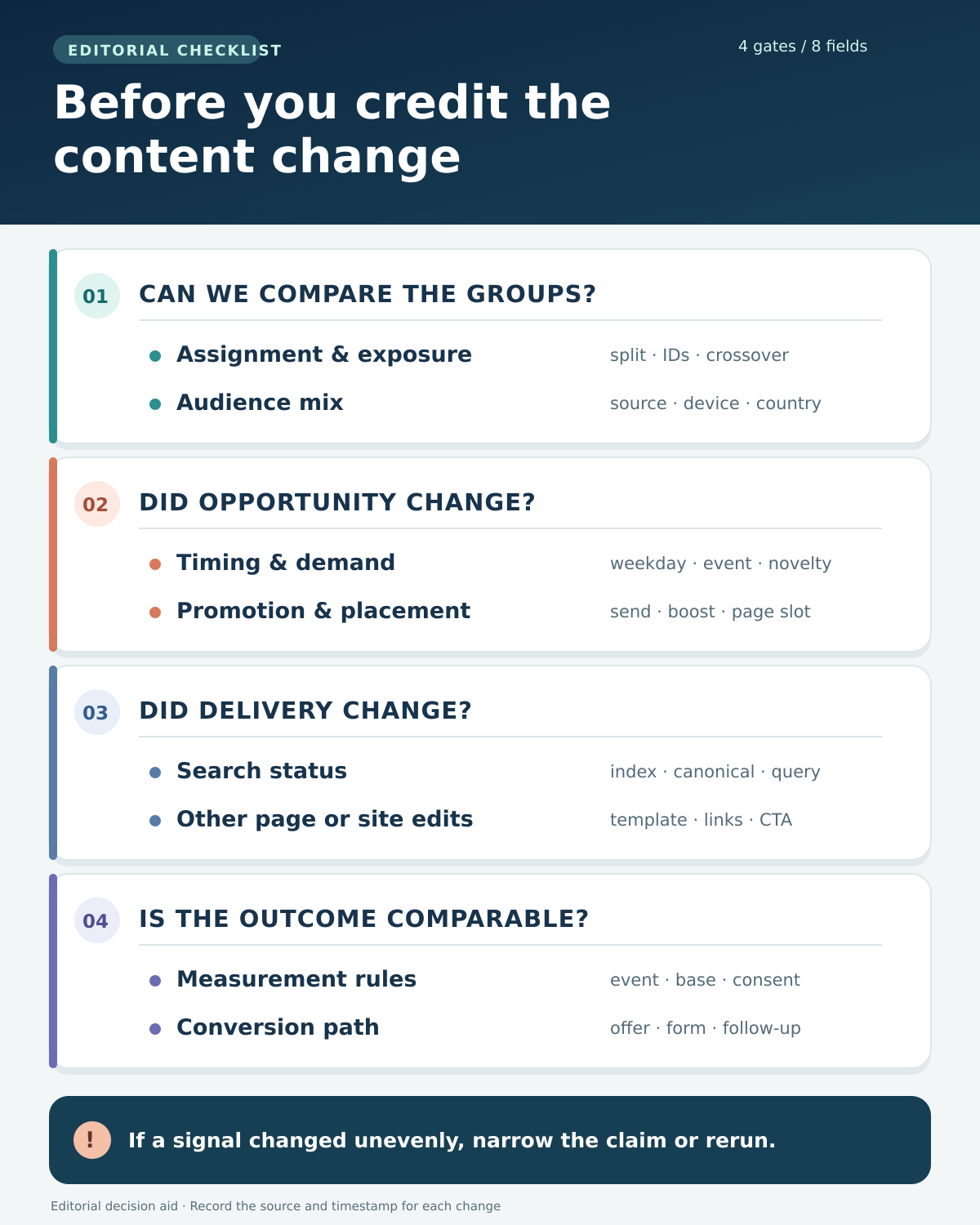
1. Assignment and Actual Exposure
Record the intended traffic split, the identifier used to assign a person or session, when the variant was first shown, and the actual number of eligible exposures in each group. Note anyone who saw both versions. A browser cache, inconsistent user ID, delayed experiment script, or a redirect that fails on one device can make the delivered experience differ from the plan.
A 50/50 plan does not mean the observed counts must be exactly equal. It does mean an unexpected, persistent imbalance needs investigation. Check the platform’s sample-ratio-mismatch diagnostic where available, along with crossover and missing exposure logs. Do this before treating a conversion-rate difference as a content effect. For a simple before-and-after update, mark assignment as “none” and keep the causal claim correspondingly modest.
2. Audience and Channel Mix
Record each version’s traffic by source, device, country, and new versus returning visitors, using the same definitions across the test. A how-to article sent to existing subscribers may attract readers with a different level of interest from those arriving through a broad social post. If one version gets many more of the former, its stronger signup rate may reflect who arrived.
In a properly randomized simultaneous test, small differences between groups can occur by chance; avoid declaring a winner from whichever post-hoc segment looks best. Use these cuts first to diagnose delivery and to check whether the result applies to the audience you intend to serve. In a sequential test, record the audience mix for each period because it may have changed substantially even when total visits look similar.
3. Timing, Demand, and First-Exposure Effects
Log the start and end times, weekdays covered, holidays, product launches, relevant news, and unusual demand spikes. A guide to annual filing may get a surge near a deadline regardless of its new introduction. A headline may also draw extra attention the first time returning readers encounter it, then settle down.
Compare daily patterns and, where possible, let both variants run through the same normal traffic cycle. Microsoft Research’s discussion of experiment monitoring describes how a one-day spike or a fading effect can change the interpretation of an overall average. A holiday does not automatically invalidate a simultaneous randomized test, but record whether the versions were exposed evenly during it and whether the result can reasonably generalize beyond that week.
4. Promotion and Page Placement
Log the date, audience, destination URL, and variant exposure for every newsletter send, paid boost, social post, homepage feature, or prominent internal link. A content update often receives a new distribution push at the same time. An increase in visits after that update is not evidence that the revised wording brought in the visits.
Promotion can also change outcomes after arrival. A narrowly targeted email may produce more qualified readers than a broad homepage slot. If only one version receives a placement, report the result as a combined content-and-distribution change or repeat the content comparison with equivalent promotion. Keep UTM conventions consistent and record the actual send or placement time, not just the campaign name in a dashboard.
5. Search Visibility and Indexing State
For pages that depend on organic discovery, record the indexed URL, selected canonical, major query mix, impressions, clicks, country, device, and any relevant search-system change. A new article may need time to be discovered; an updated article may be shown for different queries. A change in aggregate click-through rate can therefore reflect a different set of impressions rather than a better title.
If an A/B test uses separate URLs, check the implementation as well as the results. Google’s website-testing guidance covers canonical signals for alternate URLs and temporary redirects for test variations. Do not treat Search Console clicks as interchangeable with on-page sessions. For a before-and-after SEO claim, compare the same page and relevant query, country, and device cuts; note search updates, indexing problems, and changes in demand as possible competing explanations. The content audit workflow is useful when a weak result may call for a technical check rather than another rewrite.
6. Other Editorial and Site Changes
Record every change to the tested page and its surrounding experience: article body, imagery, template, navigation, internal links, load behavior, CTA, form destination, and relevant sitewide releases. Keep a dated change record and, when useful, a real saved page capture or version diff. A “headline test” that also changes the hero image and button label measures the package, not the headline alone.
Concurrent experiments matter most when they touch the same visitor journey. A separate footer color test is unlikely to explain a lead-form result; a simultaneous form redesign might. Note the affected pages and groups, then decide whether the interaction requires a clean rerun, a narrower conclusion, or an explicitly bundled recommendation. Avoid adding a generic warning about every unrelated release.
7. Measurement and Attribution Rules
Record the analytics property, event name and firing condition, eligible denominator, filters, consent setup, reporting time zone, and attribution or lookback settings relevant to the outcome. Verify the event on both variants before launch and again after any tag or form deployment. “Signups” cannot be compared across periods if the old event counted completed forms and the new one counts button clicks.
Different systems also answer different questions: Search Console records search impressions and clicks, while analytics tools measure what they can collect after a visit. Keep the measures separately labeled. An attribution-model or consent change can alter reported outcomes without an equivalent reader-behavior change. For a compact set of page-level measures, see these analytics metrics for SEO content. If the event definition changed mid-test, repair the series from trustworthy raw data when possible; otherwise mark the affected comparison unusable.
8. Offer and Conversion-Path Availability
Record what happens after the content’s CTA: the destination, form status, offer terms, price or availability where relevant, and the team’s follow-up capacity. A new article layout might send more people to a demo form while a form outage reduces completed requests. The click increase can be real, but the full-funnel conclusion needs the outage beside it.
Choose a primary outcome that matches the decision and watch a few guardrails. If the goal is qualified leads, CTA clicks are an intermediate measure; completed forms and lead quality help show whether the change helped. If the offer or form was unavailable to one group, diagnose the failure before comparing downstream conversion. If it affected both groups, record the time and evaluate whether the result still answers the intended question.
Use One Log to Make the Readout Auditable
The log should preserve the test plan and the changes that occurred during it. One event row per meaningful change is often easier to use than a long narrative written after the results are known.
| Field | Record |
|---|---|
| Experiment identity | ID, owner, hypothesis, version snapshots, assignment unit, and primary metric with denominator |
| Exposure and audience | Planned/actual split, crossover check, traffic source, device, country, and eligibility rules |
| Event entry | Timestamp and time zone; affected page, variant, or segment; what changed; supporting report or deployment record |
| Outcome check | Daily result by variant, quality or downstream guardrail, data-through date, and any measurement exception |
| Decision | What can be concluded, what remains uncertain, and whether to roll out, repair, or rerun |
Illustrative log entry: “Nov. 12, 10:00 a.m. ET — version B received a newsletter feature; version A did not. Exposure report saved. Do not attribute the resulting traffic difference to the headline. Compare on-page outcomes for balanced segments or rerun with equivalent placement.” The entry records a real type of problem, but the date and event here are examples, not results from an actual test.
When reading the result, address the most consequential exception first. A persistent assignment imbalance or broken outcome event calls for diagnosis before a winner is named. Unequal promotion calls for a narrower claim or a balanced rerun. If the groups, exposure, and measurement hold up, compare the preselected outcome and its uncertainty, then check the downstream guardrails. A before-and-after rise can justify a follow-up test; by itself, it rarely isolates the content edit from everything else that changed.
Content Experiment Confounders: Record the Conditions, Then Decide
A useful experiment log does not need a paragraph for every small fluctuation. It needs the facts that could change the decision: who saw each version, when and where they saw it, what else changed, and whether the outcome was measured the same way. Keep those facts beside the result so the next editor can tell a content improvement from a change in audience, exposure, or tracking.