Ever feel like you do the hard part, publish something useful, and then almost nobody sees it? That is exactly why 11 Content Distribution Channels Ranked matters.
Most teams do not have a content problem. They have a distribution problem.
This guide shows you which channels deserve your time first, which ones can drive faster traffic generation, and which ones are better as controlled tests. Stick with me, and I will walk you through the clearest picks, the best next steps, and the mistakes that waste effort.
Exploring 11 Content Distribution Channels Ranked
Content distribution channels are the paths that move your content from your dashboard to real people. Some channels build long-term traffic, some create quick bursts of visibility, and some help you borrow trust from bigger digital platforms, media outlets, or creators.
For most businesses in the US, I rank these 11 channels by a mix of control, compounding value, speed, and how easy they are to measure inside a practical content strategy.
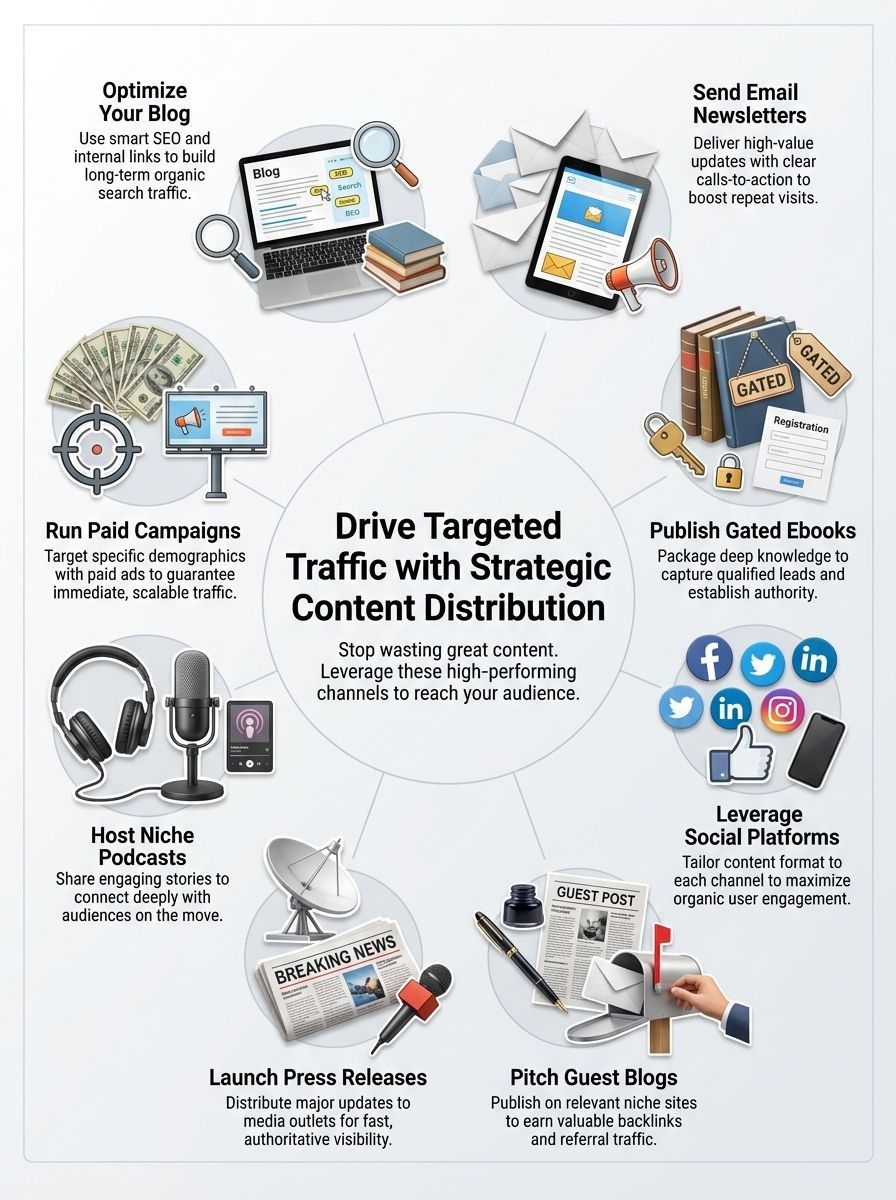
| Rank | Channel | Channel type | Best reason to use it |
|---|---|---|---|
| 1 | Website and blog | Owned | Builds searchable traffic and gives you full control over SEO optimization, calls to action, and conversion paths. |
| 2 | Email newsletters | Owned | Brings readers back without depending on platform algorithms. |
| 3 | Social media platforms | Owned and shared | Expands audience engagement quickly when your format matches the platform. |
| 4 | Pay-Per-Click advertising | Paid | Captures intent fast and gives you clean testing data for headlines, offers, and landing pages. |
| 5 | Paid social ads | Paid | Scales reach and retargeting faster than organic posting alone. |
| 6 | Guest blogging | Earned | Wins referral traffic, authority, and brand discovery from audiences you do not own yet. |
| 7 | Podcasts | Earned | Builds trust with busy listeners who prefer audio or video conversation. |
| 8 | Ebooks | Owned | Turns deep content into a lead magnet, nurture asset, or sales enablement piece. |
| 9 | Q&A platforms | Earned | Lets you meet people at the exact moment they are searching for answers. |
| 10 | Sponsored content | Paid | Places your message inside trusted distribution platforms with a built-in audience. |
| 11 | Press releases | Earned and paid | Useful for true news, but weak for everyday content promotion. |
- Start with owned channels, because you control the message, the data, and the next click.
- Add earned channels, because they widen reach and build credibility.
- Use paid channels, because they speed up testing and help you scale what already works.
Exploring Owned Content Distribution Channels
Owned channels should carry the heaviest load in your content marketing plan. They give you the best shot at steady traffic generation, clean ROI measurement, and repeat audience engagement over time.
If you only have the bandwidth to do a few things well, build here first.
Maximize Your Website and Blog
Your website and blog are still the center of your content strategy because every other marketing channel should point back to them. This is where you control the headline, the offer, the form, the layout, and the conversion path.
Google recommends hitting a Largest Contentful Paint within 2.5 seconds and an Interaction to Next Paint under 200 milliseconds. In plain English, your pages should load fast and feel responsive, so make site speed a distribution job, not just a developer chore.
- Check your Core Web Vitals in Search Console before you publish a new pillar page.
- Compress large images and keep the first screen simple, so the main message appears fast.
- Add one clear call to action per page, because too many choices cut conversions.
- Link every new article to one service page and one related blog post, so traffic has somewhere useful to go next.
A simple rule works well here: publish pieces that solve one real problem, then update your best pages before you create five more average ones. In my experience, one strong page that loads quickly and answers search intent beats a stack of thin posts every time.
Enhance Engagement through Email Newsletters
Email campaigns are one of the few distribution strategies that do not depend on an algorithm deciding whether your audience gets to see you. That control is why email stays near the top of almost every smart content promotion plan.
Mailchimp’s current benchmark across all users shows an average open rate of 35.63% and an average click rate of 2.62%. If your numbers sit well below that, fix relevance first, not volume.
- Segment by recent signup, past buyer, active reader, and inactive reader.
- Write one promise in the subject line, then cash it in with one main CTA.
- Send readers back to a strong landing page, not your homepage.
- Review click maps and unsubscribes after every send, because those two signals usually tell you what your audience actually wants.
Mailchimp also reports that segmented campaigns drive 23% higher open rates and 49% higher click-through rates. That is why a small, relevant email list often outperforms a bigger list that gets the same generic blast.
Distribute Knowledge with Ebooks
Ebooks work best when you treat them like a high-value repackaging of content you already know your audience wants. A good ebook can support email campaigns, sales conversations, webinar follow-up, and lead generation from a single asset.
For BB Marketing teams, this channel gets especially useful when the topic needs depth. Buyers rarely make a serious decision from one short post, but they will trade an email for a practical guide, checklist, or industry playbook.
- Turn three to five related blog posts into one focused ebook with a clear point of view.
- Create a dedicated landing page with one headline, three bullets, and one form.
- Use the ebook as a nurture asset, not just a top-of-funnel freebie.
- Track downloads, assisted conversions, and sales calls influenced by the asset.
LinkedIn Document Ads are useful here because readers can preview and download a document directly in the feed, and you can gate the full asset with a Lead Gen Form. One easy-to-miss detail, single-page documents cannot use that form, so build the asset with a preview in mind before you upload it.
Leverage Your Social Media Platforms
Social media should support your website, email campaigns, and content promotion plan, not replace them. The key is format fit: short video, carousels, documents, clips, or opinion posts should match how people already use each platform.
Edison Research’s 2026 US data shows that Facebook reaches 54% of Americans age 12 and up, Instagram 42%, TikTok 38%, Reddit 35%, and LinkedIn 31%. That is a good reminder that the best platform is the one your audience already opens, not the one getting the loudest buzz.
| Platform | Best format | Good for | Watch out for |
|---|---|---|---|
| Expert posts, documents, short native video | B2B audience engagement, lead quality, influencer partnerships | Dry corporate copy that says a lot and teaches nothing | |
| Carousels, reels, visual explainers | Brand awareness and shareable education | Sending people off-platform too early | |
| TikTok | Short vertical video | Reach, discovery, message testing | Polished ads that do not feel native |
| Community posts, links, video | Broad reach, retargeting, local business visibility | Posting without community management | |
| Problem solving posts and comments | Research, trust building, niche online platforms | Dropping promotional links before earning trust |
A simple way to keep this manageable is to turn one blog post into three social assets: a short clip, a carousel, and a text post with a sharp takeaway. That gives you distribution strategies with less production strain.
Leveraging Earned Content Distribution Channels
Earned channels help other people carry your message. They often take more effort up front, but they can add authority, widen traffic sources, and expose your brand on digital channels you do not control.
Expand Reach via Guest Blogging
Guest blogging still works when you use it for audience fit, not link tricks. A well-placed post on a respected niche site can send referral traffic, create brand familiarity, and strengthen your reputation with the right readers.
Google’s spam policies make the line clear, large-scale guest posting with keyword-heavy links is treated as link spam. So pitch thoughtful articles to sites your buyers already read, and keep the bio link natural and useful.
- Choose sites with an audience that matches your offer, not just sites with a high reputation.
- Pitch a topic backed by your own data, process, or customer lesson.
- Link readers to one relevant page that expands the point you just made.
- Measure referral traffic, assisted conversions, and backlinks from each placement.
If one guest post sends qualified readers who stay, subscribe, or book, you have found a repeatable earned distribution channel. If it sends empty clicks, move on fast.
Announce Updates with Press Releases
Press releases help when you have real news, a launch, funding event, product milestone, executive hire, report, or community partnership worth sharing. They are weak when you try to force everyday blog content into a news format.
As of July 2026, PRWeb lists public pricing from $120 for a basic release to $480 for premium distribution. That is useful because it puts a real floor under the cost, which means minor updates usually belong in email campaigns or direct outreach, not on a wire.
- Use a press release when the update affects customers, partners, investors, or industry media outlets.
- Lead with the news in the first sentence, not brand background.
- Include one image, chart, or demo asset, because PR Newswire says multimedia releases can generate up to six times greater engagement.
- Pitch a short custom note to a small list of relevant editors after the release goes live.
The strongest releases do two jobs at once: they give reporters a usable story angle and give readers a clean landing page for the next step.
Engage Audiences with Podcasts
Podcasts build trust in a way short posts rarely can. People hear tone, confidence, nuance, and real examples, which makes audio and video podcasting a strong fit for expert brands, founders, consultants, and educators.
Edison Research’s 2026 Infinite Dial reports that 58% of Americans age 12 and up consumed a podcast in the last month, and 45% did so in the last week. That means podcasting is no longer a niche bet, it is a mainstream distribution channel.
- Start with guest appearances if launching your own show feels too heavy.
- Clip each episode into short social video, quote graphics, and an article recap.
- Publish show notes that answer one search-driven question, so the episode supports SEO techniques too.
- Track meaningful actions such as email signups, booked calls, and page visits from episode pages.
Spotify updated creator analytics in June 2026 so a play reflects at least 30 seconds of listening or watching. That is a helpful benchmark because it pushes you to judge audience engagement on meaningful consumption, not inflated starts.
Connect on Q&A Platforms
Q&A platforms are valuable because they reveal the exact words people use when they are stuck, confused, or ready to compare options. That makes them useful for research, SEO optimization, and trust building all at once.
Quora says it reaches more than 400 million monthly unique visitors, and Reddit reported 126.8 million daily active uniques in its first quarter of 2026. Those are huge pools of intent, but they punish lazy self-promotion fast.
| Platform | Best move | What to avoid |
|---|---|---|
| Answer a narrow question with a clear example or process | Dropping a sales link in the first sentence | |
| Quora | Write a structured answer that teaches before it sells | Turning every answer into a brand pitch |
| Industry forums | Use your real expertise and stay active in one or two threads | Posting keyword-stuffed links or copied replies |
Google also lists forum comments with optimized links as a spam signal, so keep the link secondary. Answer first, earn the click second.
Paid Content Distribution Channels
Paid advertising buys speed, which is why it earns a place in strong distribution strategies. It can validate headlines, offers, audiences, and landing pages much faster than organic testing alone.
IAB expects US social media ad spend to grow 14.6% in 2026, while paid search is projected to grow 7.4%. That tells you two things quickly: social is getting more budget, and search still matters because buyers keep showing intent there.
Increase Visibility with Pay-Per-Click (PPC) Advertising
PPC works best when the offer is clear and the landing page is built to convert. It is one of the fastest marketing channels for testing message match, because the user already told you what they want through the search query.
Google Ads lets campaigns spend up to two times your average daily budget on a given day, though the monthly limit still applies. That catches new advertisers off guard, so set budgets with real breathing room and check search terms early.
- Group keywords by intent, not by giant topic buckets.
- Send each ad group to a page that answers the same promise as the ad copy.
- Use negative keywords to cut wasted spend.
- Review cost per lead and conversion rate together, because cheap clicks can still be expensive traffic.
If PPC brings qualified visits but weak conversions, your problem is probably the page, not the keyword. That is why PPC is so useful for traffic generation and landing-page testing at the same time.
Boost Engagement with Paid Social Ads
Paid social ads are great for getting content in front of defined audience segments fast. They also work well for retargeting people who read a blog post, watched a clip, downloaded an ebook, or visited a service page.
Use them to test one variable at a time, the opening hook, the thumbnail, the first line of copy, or the CTA. That gives you cleaner learning and better ROI measurement than changing everything at once.
- Start with a small budget and two to three creative variations.
- Retarget warm visitors before you try broad cold audiences.
- Use native-looking creative that matches the feel of the platform.
- Keep one control ad running, so you always know whether the new idea actually won.
Meta’s Advantage+ budget tools let you put minimums or maximums on ad sets, which helps if you want automation without losing spending control. TikTok’s Creative Center is also useful for quick creative research before you make a new video ad.
Amplify Reach with Sponsored Content
Sponsored content is useful when you want your message to live inside a trusted publication, creator feed, newsletter, or niche content hub. It usually feels more natural than a display ad because it sits inside content people already chose to consume.
This channel works best when the publisher audience already overlaps with your buyer. It works badly when you buy placement just to collect links or chase vanity impressions.
| Tactic | Best use | Main strength | Main risk |
|---|---|---|---|
| Sponsored article | Explain a product category or point of view | Borrows publisher trust | Weak results if the audience fit is off |
| Influencer partnership | Show real use, social proof, or expert commentary | Feels human and shareable | Poor fit if the creator audience is broad but unqualified |
| Paid amplification of creator content | Scale the best-performing creator asset | Combines authenticity with media control | Easy to overspend on weak creative |
IAB projects US creator economy ad spend to reach $44 billion in 2026, so influencer partnerships are now a serious media line, not a side experiment. Buy them for trust and audience fit, then measure assisted conversions, not just reach.
One more guardrail matters here: Google treats paid articles, guest posts, or press releases that pass ranking credit as spam if the real goal is link manipulation. So if you sponsor content, do it for audience engagement and brand lift, not for shortcut SEO techniques.
Choosing the Right Distribution Channel
The right channel depends on your goal, your audience, your budget, and how fast you need feedback. A small team usually gets better results from a simple stack of core marketing channels than from trying to be everywhere at once.
| Criterion | Question to ask | Best channel match | What to track |
|---|---|---|---|
| Goal | Do you need awareness, leads, or direct sales? | Awareness fits social media and podcasts, leads fit email campaigns and ebooks, sales fit PPC and retargeting. | Reach, leads, revenue |
| Audience | Where does your audience already spend time? | LinkedIn for B2B, Instagram or TikTok for visual discovery, Reddit and Quora for question-led research. | Engaged sessions, saves, replies |
| Content type | Is your message better as a post, guide, video, or conversation? | Blogs for search, ebooks for depth, podcasts for trust, short video for discovery. | Time on page, downloads, plays |
| Budget | Can you wait for compounding returns, or do you need traffic now? | Owned channels for long-term value, paid advertising for faster testing. | Cost per click, cost per lead |
| Timing | Is this evergreen content or a time-sensitive launch? | Evergreen fits blog and email, launches fit paid social, PPC, and press outreach. | Launch-week traffic, assisted conversions |
| Resources | What can your team produce consistently? | Text-heavy teams often win with blogs, email, and guest posts. On-camera teams often win with podcasts and short video. | Output per month, production time |
| Measurement | Can you clearly tell whether the channel worked? | Email, PPC, and paid social are usually easiest to measure. Podcasts and guest posts need clearer tracking setup. | CTR, conversion rate, assisted revenue |
| Risk | How much downside can you handle if the test fails? | Low-risk tests fit email, blog updates, and community answers. Higher-risk tests fit sponsored content and larger ad buys. | Spend lost, negative feedback, unsubscribe rate |
| Scale | Can this channel grow with your business? | Website, email, paid search, and paid social usually scale best when the offer is proven. | Volume, efficiency, repeatability |
| Fit | Does the channel support your broader content marketing system? | The strongest picks reinforce each other, blog to email, email to social, social to retargeting, guest posts to homepage or lead magnet. | Channel overlap and assisted conversions |
- Pick two core channels, usually one owned and one discovery channel.
- Add one experiment, so your content strategy keeps learning.
- Set one main metric per channel, because too many KPIs blur decisions.
- Review weekly, then shift effort to the marketing channels that keep sending qualified traffic.
If a channel looks busy but does not move traffic generation, leads, or sales, treat that as an answer. Cut it, simplify, and put the effort where your readers already respond.
Final Thoughts
You now have a practical view of 11 Content Distribution Channels Ranked by control, speed, and long-term value.
Start with your website, email campaigns, and one social media channel that fits your audience. Then layer in earned options like guest blogging or podcasts, and use paid advertising where you can track results clearly.
Keep the plan simple, measure audience engagement and ROI measurement every week, and double down on the channels that keep bringing the right people back. That is how content promotion turns into steady growth.
FAQs about Content Distribution Channels Ranked
1. What are the top content distribution channels, ranked?
Top content distribution channels, ranked by reach and impact, include social platforms, email, search engines, video platforms, paid ads, influencer partnerships, online communities, syndication partners, podcasts, content hubs, and direct site traffic.
2. How do I pick the best channels for my content?
Match channel strengths to your audience and format, test a few, and watch the results, tweak as you go. Think like a detective, follow the data.
3. How do I rank channels for my business?
Look at reach, engagement, cost, and conversion, then score each channel. Pick the ones that hit your main goals first.
4. How often should I post on each channel?
Post often enough to stay visible, but not so often you wear out your audience; quality beats quantity. Start small, measure, then scale what works.