
Teams and users often hit roadblocks with Bavayllo. The platform might slow down their work. Errors pop up and stop projects cold. This wastes time, creates stress, and leads to poor results. A constraint on Bavayllo is any rule or limit that controls how the platform works.
Think of it like speed limits on a road. You might face storage limits that cap how much data you can save. There could be rules about what users can do. Memory limits might slow things down, just like in the IBM Integrated Analytics System.
This guide explains what constraint on Bavayllo means. You’ll learn why these limits matter for your work. We’ll show you different types of limits and how they affect your tasks. Clear steps will help you handle these limits better. Your team can avoid slowdowns and work faster.
Understanding constraint on Bavayllo helps you work smarter with the platform!
What Does “Constraint on Bavayllo” Mean?
A constraint on Bavayllo is a rule or limit that shapes how the platform works. These limits control what users and teams can do. They affect choices, actions, and features. The system might cap performance based on how much it can produce. Budget limits also create constraints.
These limits exist for good reasons. They keep the platform stable and secure. Constraints help keep the system safe during data tasks. They stop errors by blocking actions that could break things. Teams need to understand these limits to use the platform well. Good understanding helps with data integrity and smart choices.
Common Types of Constraints on Bavayllo
Different constraints affect how teams handle tasks and data in Bavayllo. These limits shape user experience and control resources. They also affect how the system adapts to changes.
What are Structural Constraint on Bavayllo?
Structural constraints set clear rules for the system. They create direct limits on variables. For example, A1 might need to stay under 100. B7 might need to be at least 5. These upper and lower bounds guide optimizers to make safe choices.
Some constraints are physical. Inventory must stay balanced when planning shipments across days. Integer constraints keep task counts whole. You can’t have half a product or half an assignment. Binary rules mean you pick yes or no only. This works like an on-off switch for features.
These boundaries keep things stable and protect data. Performance stays steady as users work with the platform each day. Structural limits help with growth and efficiency. Your team uses resources wisely within set limits.
How do resource-based constraints affect Bavayllo?
Resource constraints limit what teams can do based on budgets. A team might have $50,000 for advertising. TV ads cost $3,000 each. Newspaper ads cost $500 each. The tool tracks spending with formulas like E3 = 3000 * C3 + 500 * D3. The rule E3 <= 50,000 keeps costs within budget.
Rules also stop negative values. You can’t buy negative ads or assign negative tasks. The formula A1 >= 0 prevents this. These limits avoid overspending and keep plans realistic. Teams must watch these constraints to protect data. Following limits helps meet company goals and improve usability. Ignoring resource constraints causes project management problems. It can hurt performance in Bavayllo.
What are the Behavioral and External Constraint on Bavayllo?
Behavioral constraints shape how users act in Bavayllo. Company policies create these rules. An admin might stop team members from deleting key project cards. This prevents errors and keeps data safe. Cultural norms also guide teamwork. Teams clarify roles and share updates with the right people.
External constraints come from outside Bavayllo. Laws about data storage create limits. Teams must follow rules about where client files can live. Technology limits affect speed when too many projects run together. Audits and software guidelines shape these restrictions. Users work within clear boundaries while keeping communication secure.
How Do Constraints on Bavayllo Impact Users and Teams?
Limits on Bavayllo guide users away from costly mistakes. Clear constraints shape how people use the platform. Input field labels help users enter the right data. This cuts down on errors for everyone.
Teams working on software find that built-in limits reduce guesswork. People know what they can and can’t do. Tasks get done faster. Users often try unexpected things. Constraints stop problems before they happen.
Structure limits reduce slowdowns by setting clear rules. Resource constraints manage workload and speed issues. This matters when using artificial intelligence tools or security settings. These controls keep projects able to grow. They support new ideas from team members.
Following boundaries keeps performance reliable. Ignoring them risks data security and workflow. Every stakeholder feels the impact. This includes teams tracking education or medical adherence projects.
What are the Best Practices for Managing Constraints on Bavayllo?

Understanding constraint on Bavayllo helps with better performance. These practices help users and teams manage limits well:
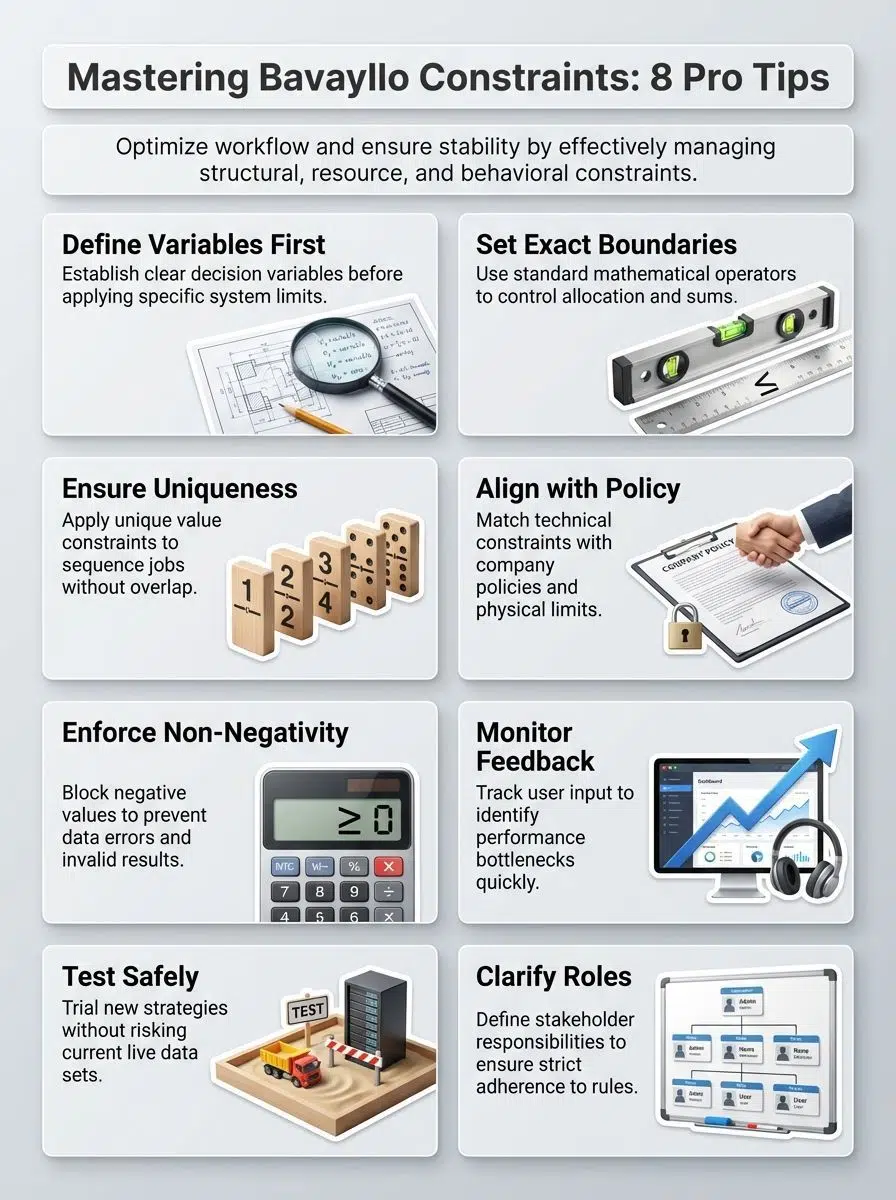
- Calculate the value you need using clear decision variables first. Then apply limits in Bavayllo.
- Use operators like <=, =, or >= to set exact boundaries. For stock distribution, make sure cells add up to 100 percent. Use B1 = SUM(A1:A5) and set B1 = 1.
- Apply ALLDIFFERENT constraints when each task needs a unique value. This helps sequence jobs without overlap.
- Match constraints with company policies and physical limits. This keeps solutions practical.
- Set non-negativity constraints like A1 >= 0. No variable should fall below zero. This prevents errors.
- Check user feedback often. Find slowdowns or user experience problems. Look for scalability issues.
- Get support through live chat or phone. Call USA (888-831-0333) or International (01+775-831-0300). They help with production slowdowns.
- Try a free trial of Analytic Solver features. Test new strategies without risking current data.
- Study product documentation and tutorials. Product mix models help you understand each constraint better.
- Make roles and responsibilities clear. Everyone should know which rules to follow. This helps with prioritization on the platform.
What Are Future Trends in Bavayllo Constraints and Adaptation?
Bavayllo will face new scalability limits as more users join. People want to customize features more. User interface options like dark mode will become standard. Better feedback signals will help users work faster.
Organizations change policies and shift resources often. These changes affect how Bavayllo works within its limits. Stakeholders must improve performance while following boundaries. New behavioral rules might change how tasks get done. Privacy laws add constraints that users must follow.
UX principles will shape Bavayllo’s future. The principle of mapping helps users understand connections. The Principle of Visibility shows what’s happening. The principle of feedback tells users their actions worked. Teams turn challenges into chances to build better solutions. The system stays clear and effective for everyone.
Constraints shape workflows and spark new ideas. Ignoring limits might slow growth or hurt user experience. More focus on accessibility helps every user work well within their abilities. This makes following rules even more important as needs change each year.
Takeaways
Understanding constraint on Bavayllo matters for users and teams. These limits keep projects clear and safe. Constraints help teams follow rules and set goals. They prevent errors in tools like the IBM Integrated Analytics System.
Knowing how constraints affect your work helps you adapt quickly. You can stay productive within boundaries. Smart awareness leads to better choices. Users stay motivated. Stakeholders trust the process more.
Following best practices to overcome slowdowns helps your team. You can use the platform well while meeting all requirements. The key is understanding these limits and working with them, not against them.