
Figuring out the right marketing budget for small business growth is one of the hardest balancing acts in management. Spend too little, and your brand remains hidden from potential customers; spend aimlessly without a clear structure, and you burn through working capital on channels you can’t measure.
A sustainable budget anchors your marketing spend directly to revenue, protects baseline operating tools, and gives acquisition channels enough runway to generate measurable returns.
How Much Should You Spend? (The Percentage-of-Revenue Baseline)
The cleanest way to establish a baseline number is linking your marketing budget to gross revenue. This ensures your expenses scale naturally as sales fluctuate.
| Business Stage | Revenue Percentage | Primary Goal |
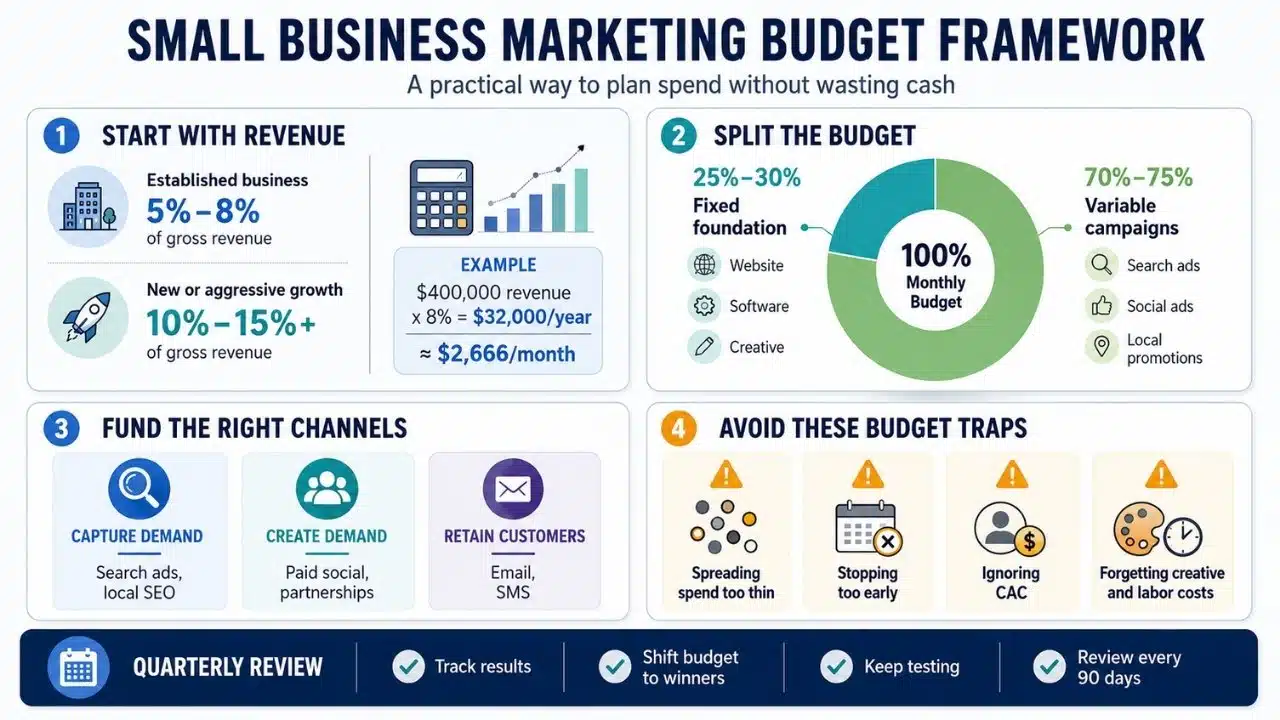
| Established (1–3+ years) | 5% – 8% of Gross Revenue | Protecting market position, driving retention, steady acquisition |
| New or Aggressive Growth | 10% – 15%+ of Gross Revenue | Capturing market share, building brand awareness, rapid scaling |
A Quick Math Example
For example, if your business generates $400,000 in gross annual revenue and you settle on an 8% growth baseline, your calculation is straightforward: $400,000 × 0.08 = $32,000 per year (or roughly $2,666 per month).
If you are running a brand-new business with zero historical revenue, avoid guessing at percentages. Calculate your startup runway instead, and lock in a fixed monthly dollar amount you can sustain for at least six months without relying on immediate break-even returns.
Separating Fixed Overhead from Campaign Dollars
Before launching new ad campaigns, split your total monthly allowance into two distinct operational buckets: Fixed Infrastructure and Variable Campaign Spend.
Fixed Overhead (Your Marketing Foundation)
These are the non-negotiable recurring costs required to maintain an active digital presence, regardless of active promotion:
-
Website maintenance and hosting: Domain renewals, security certificates, site plugins, and platform fees (Shopify, WordPress, Webflow).
-
Software subscriptions: Email marketing tools (Klaviyo, Mailchimp), CRM platforms, and scheduling tools.
-
Core creative assets: Professional brand photography, graphic design software, and copywriting updates.
Variable Campaign Spend (Your Growth Levers)
These are performance-driven dollars that you can dial up or down based on seasonality and performance:
-
Paid search and social advertising (Google Ads, Meta, LinkedIn).
-
Sponsorships for local community events or trade shows.
-
Promotional print materials, direct mail, or regional signage.
A practical rule of thumb is reserving 25% to 30% of your budget for fixed tools and platform infrastructure, leaving the remaining 70% to 75% for active customer acquisition.
Allocating Capital Across Marketing Channels
How you divide your campaign budget depends on how your customers buy. Some buyers are actively looking for a provider right now, while others need to be introduced to your brand over time.
Capturing Existing Demand (High-Intent Search)
When someone searches for a specific service in your area like “commercial HVAC repair” or “local accounting firm”—they have clear buying intent. Channels that capture this demand deserve a primary slice of your ad budget:
-
Google Search Ads: Bidding on high-intent keywords within your specific service radius.
-
Local SEO & Google Business Profile: Optimizing your local listing to capture map-pack results.
Generating New Demand (Brand Awareness)
If prospects don’t know your product category exists, you have to build awareness by putting engaging content in front of your target audience:
-
Paid Social Media: Targeted video or image campaigns on Meta, Instagram, or LinkedIn.
-
Community Partnerships: Sponsoring neighborhood events, local sports teams, or industry associations.
Driving Repeat Sales (Customer Retention)
Acquiring a new customer costs far more than re-engaging a past buyer. Email marketing and SMS sequences consistently deliver high returns because you own the subscriber list outright without paying ongoing ad network fees.
Four Budgeting Mistakes That Waste Cash
-
Spreading ad spend too thin across five platforms: Splitting $200 a month across Facebook, TikTok, Google Ads, Yelp, and local print ads yields zero useful data. Focus on one primary channel, prove its return, and only then expand.
-
Stopping ad campaigns prematurely: Paid campaigns require an initial testing period. Expecting massive positive returns within the first ten days usually leads to quitting right before ad algorithms optimize.
-
Ignoring Customer Acquisition Cost (CAC): If acquiring a customer costs $150 in ad spend but that customer only generates $40 in gross profit, your campaign strategy is broken regardless of traffic volume.
-
Forgetting about labor and creative production: Great ad campaigns require strong visuals and copy. If you hire freelancers or agencies, those costs must come directly out of your marketing allowance rather than general operating expenses.
Final Thoughts
Building a practical marketing budget for small business operations requires linking your spending to actual revenue rather than guesswork.
Start by taking your gross annual revenue from last year, applying a 7% to 10% baseline, and converting that into a predictable monthly figure. Secure your core website and email tools first, allocate your remaining capital toward one proven acquisition channel, and evaluate performance quarterly as sales scale.
Frequently Asked Questions(FAQs) on Marketing Budget for Small Business
What is the minimum effective budget for online ads?
For local service providers or small e-commerce shops, $500 to $1,000 per month per platform is generally the floor. Anything less fails to generate enough click volume to gather reliable conversion data or win ad auctions against local competitors.
Should graphic design and content creation come out of the marketing budget?
Yes. Freelance copywriters, graphic designers, video editors, and agency retainers fall under marketing costs. If you produce everything in-house, track employee hours dedicated to marketing activities so you understand your true operational investment.
How often should I adjust my marketing budget?
Review channel metrics monthly to shift dollars toward top-performing ad sets, but keep your overall budget allocations stable for at least 90 days. Channels like SEO, content marketing, and brand building need a full quarter to demonstrate real traction.