


Starting early Monday morning, a wave of frustration swept through the user base of Claude Code, Anthropic’s developer-focused platform. Many users—particularly those subscribed to the $200/month Max plan—were surprised to find themselves locked out of the service due to new and unexpected usage restrictions. This shift appeared with no prior communication, no updated policy announcements, and no technical explanation on the company’s documentation or dashboard.
Instead of detailed notifications, users were greeted by a vague message: “Claude usage limit reached”. Alongside that message, users received a reset timer indicating when they could resume their tasks, typically within a few hours. However, for many who rely on Claude Code for professional or mission-critical work, this unexplained restriction caused a complete standstill in development pipelines.
Heavy Users Experience the Harshest Restrictions
The most affected users seem to be those on the Max plan, a premium subscription tier that costs $200 per month. According to Anthropic’s own advertising, this plan is designed for power users and supposedly offers 20 times the usage capacity of the Pro plan. The Pro plan itself is already marketed as having five times the capacity of the free tier. However, these are relative estimates only, not fixed numerical quotas.
Without published limits in messages, tokens, or API credits, users were left in the dark about what their actual usage entailed. Some claimed they had only performed minimal actions before hitting the wall. The lack of detailed usage breakdowns made it nearly impossible to verify if they had exceeded their entitlements or if there had been a technical glitch in usage tracking.
This ambiguity led to widespread speculation that Anthropic may have quietly reduced usage limits behind the scenes, especially for Max users who have historically consumed a large number of API calls—sometimes generating usage equivalent to over $1,000 per day in API pricing.
Developers Report Broken Workflows and Lost Productivity
For many, the sudden enforcement of these limits was more than a minor inconvenience. Developers relying on Claude Code for software generation, debugging, and AI pair programming found themselves unable to progress. Projects came to a halt, particularly for those in time-sensitive phases of development.
Some attempted to switch to other tools, such as Google’s Gemini or Moonshot AI’s Kimi, but quickly realized these alternatives did not match Claude Code’s integrated capabilities, particularly in understanding code structure, refactoring logic, or offering context-aware code suggestions.
In professional and enterprise contexts, such as AI-powered coding for startups or automation projects in DevOps pipelines, even a few hours of unplanned downtime can result in missed milestones, delayed deliveries, and significant financial losses.
Lack of Transparency Sparks Frustration in the Developer Community
The broader frustration stemmed not only from the limits themselves but from Anthropic’s lack of transparency. Many developers had no idea they were approaching a cap, much less that they were about to be temporarily blocked. Without real-time usage dashboards, cap warnings, or threshold alerts, users were left with no means to adjust behavior or allocate requests efficiently.
Furthermore, there was no email, blog post, or platform notification to indicate that usage policies had changed. With no official communication, users were forced to rely on community forums like GitHub and Reddit, where others were reporting similar experiences, to piece together what might be happening. This made the situation more chaotic and added to a growing sense of distrust among even the most loyal customers.
Broader Technical Issues Add to the Problem
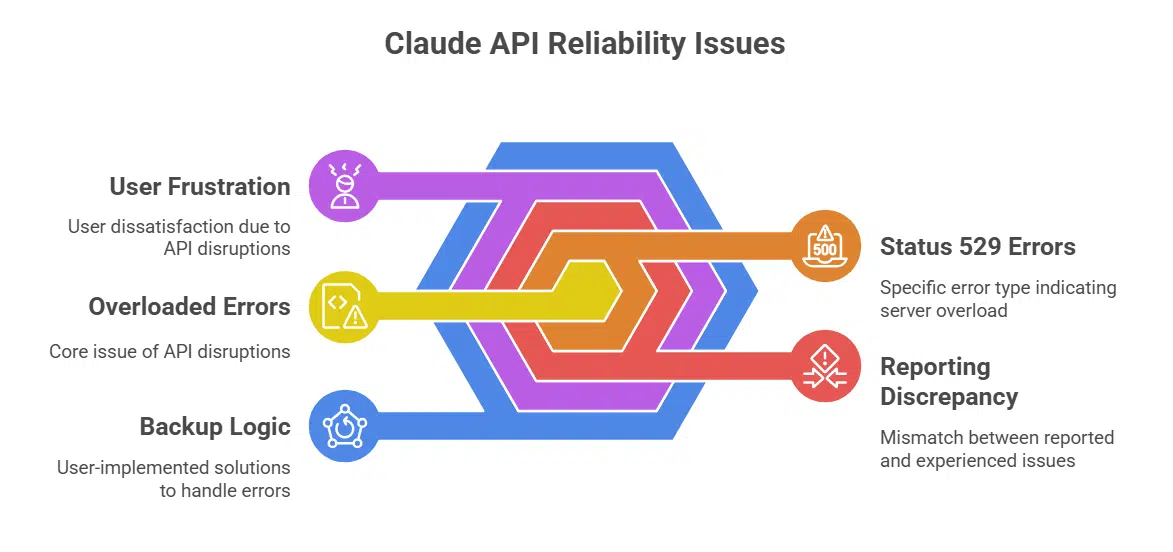
Compounding the frustration, Claude API users began experiencing frequent overloaded errors during the same period. These included 529 status errors, indicating that servers were overwhelmed or unable to process requests. Oddly, Anthropic’s official status page listed six separate incidents in just four days, yet the weekly uptime remained listed as 100%, creating further confusion.
This discrepancy between public-facing performance metrics and user-experienced disruptions gave rise to questions about whether Anthropic’s monitoring and reporting tools accurately reflect system-wide issues. Developers relying on Claude Code for automated workflows had to implement backup logic to handle these unexpected errors or temporarily migrate parts of their architecture to alternative providers.
Anthropic Confirms Issues but Offers Little Clarity
In response to media inquiries, Anthropic acknowledged that some users were facing performance slowdowns and limits. However, the company did not provide a detailed explanation of whether this change in usage policy was temporary, experimental, or permanent. There was also no comment on whether users would be compensated or informed of usage changes in advance in the future.
For users who depend on predictability, particularly those who build and budget around paid subscription tiers, this lack of clarity has proven particularly damaging. It has raised serious concerns about Anthropic’s communication practices and its ability to manage expectations for professional users.
Subscription Tiers Offer Flexibility—But Not Predictability
Anthropic’s business model for Claude Code is built around tiered access levels:
-
Free Tier: Offers limited access that fluctuates based on server demand
-
Pro Tier (~$20/month): Grants roughly five times the free tier’s usage
-
Max Tier ($200/month): Advertised as offering 20 times more usage than Pro
However, none of these tiers define exact usage in terms of message count, token limits, or computational units. The free tier is explicitly noted as “subject to demand”, and even Max users have no guarantee of absolute availability. This flexibility may work in Anthropic’s favor from a network management perspective, but for developers and businesses, it creates uncertainty that can hinder planning and execution.
What This Means for Developers and the Future of Claude Code
This episode is a cautionary moment for both developers and Anthropic. For developers, it highlights the importance of having redundancy plans and being aware of the risks of vendor lock-in, especially with fast-moving AI platforms. For Anthropic, it’s a clear signal that communication and transparency must improve if they want to retain the trust of their most loyal—and highest-paying—customers.
Without immediate steps to clarify usage policies, communicate changes before they are implemented, and improve user control over their own usage tracking, Anthropic risks driving its premium customers to rival platforms, even if those alternatives offer slightly weaker performance.
In a time when developers and businesses are increasingly relying on AI-powered tools to drive innovation and efficiency, sudden and unexplained limitations—especially for paying users—can cause real disruption. Claude Code’s recent shift in usage policy, implemented without notice or clarity, has shaken user confidence and raised broader concerns about Anthropic’s transparency and reliability as a service provider.
Unless the company takes clear steps to rebuild trust through communication, transparency, and user control, it risks alienating its core developer base—ironically, the same group that has been most vocal in praising Claude Code’s technical capabilities until now.
























