Civil rights and constitutional law are foundational pillars in shaping modern societies. They govern the principles of fairness, justice, and liberty while defining the legal frameworks that protect individuals and groups.
Understanding the interplay of Civil Rights vs Constitutional Law reveals their critical roles in fostering equality and democracy. This article explores Civil Rights vs Constitutional Law: 10 Ways They Impact Society, offering insights into their principles and societal effects.
What Are Civil Rights and Constitutional Law?
Civil rights are the guarantees of equal social opportunities and protections under the law, regardless of race, religion, gender, or other characteristics. These rights aim to eliminate discrimination and ensure equal treatment for all individuals.
Civil rights address fundamental issues like access to education, voting rights, and equal treatment in employment and public services.
Examples of Civil Rights:
- Right to vote.
- Freedom from discrimination.
- Equal access to public facilities.
- Fair treatment in the workplace.
Core Principles of Civil Rights
| Principle | Description |
| Equality | Ensures equal opportunities for all people. |
| Non-Discrimination | Protects individuals from bias or prejudice. |
| Inclusion | Encourages participation in public life. |
| Accessibility | Removes barriers to essential services. |
Constitutional Law Explained
Constitutional law governs the interpretation and implementation of a country’s constitution. It outlines the fundamental rights of individuals and the limitations of governmental power, forming the legal backbone of a nation. Constitutional law also ensures checks and balances between the branches of government, safeguarding democracy and the rule of law.
Core Elements of Constitutional Law:
- Establishment of government structure.
- Protection of individual freedoms (e.g., freedom of speech, religion).
- Division of powers among branches of government.
Key Features of Constitutional Law
| Feature | Explanation |
| Fundamental Rights | Guarantees personal liberties. |
| Separation of Powers | Divides authority among branches. |
| Judicial Review | Allows courts to evaluate laws’ constitutionality. |
| Rule of Law | Ensures government accountability. |
The Interplay Between Civil Rights and Constitutional Law
Civil Rights Rooted in Constitutional Frameworks
Constitutional law often lays the groundwork for civil rights. For instance, the U.S. Constitution’s amendments, such as the 13th, 14th, and 15th, provide the foundation for civil rights legislation. These amendments abolished slavery, guaranteed equal protection, and secured voting rights regardless of race or color. This synergy underscores how Civil Rights vs Constitutional Law are intertwined in creating a just society.
Key Distinctions
While civil rights focus on protecting individuals from discrimination, constitutional law emphasizes structuring government and safeguarding broader liberties. The two intersect in areas like judicial rulings and landmark legislation. For example, constitutional principles guided the enforcement of civil rights through cases like Brown v. Board of Education, which declared racial segregation unconstitutional.
Civil Rights vs Constitutional Law
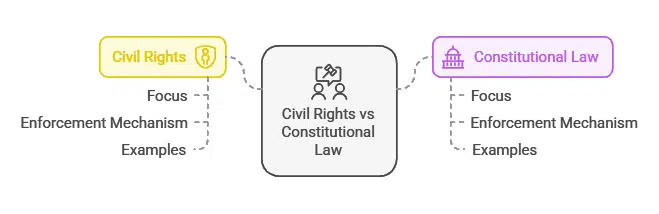
| Aspect | Civil Rights | Constitutional Law |
| Focus | Individual protections against discrimination. | Structure of government and broad liberties. |
| Enforcement Mechanism | Civil rights acts and policies. | Judicial review and constitutional amendments. |
| Examples | Civil Rights Act, Voting Rights Act. | First Amendment, Equal Protection Clause. |
10 Ways Civil Rights and Constitutional Law Impact Society
1. Promoting Equality
Civil rights laws strive to eliminate discrimination and foster inclusivity in education, employment, and public life. Constitutional protections ensure these rights are upheld, creating a legal basis for equality.
Example: The Civil Rights Act of 1964 prohibited segregation in public spaces, enforcing the equal protection clause of the 14th Amendment. This law transformed the social fabric of the United States, reducing systemic inequalities and promoting equitable access to opportunities.
Equality Metrics by Law
| Metric | Pre-Law Era | Post-Law Era |
| School Integration | < 20% | > 70% |
| Workplace Diversity | Minimal Representation | Significant Inclusion |
2. Safeguarding Individual Freedoms
Constitutional law ensures basic freedoms such as speech, religion, and assembly. Civil rights build on these principles by protecting individuals from infringement based on identity, ensuring equal access to these freedoms regardless of background.
Real-Life Insight: Organizations like the American Civil Liberties Union (ACLU) work to defend individual freedoms, citing constitutional protections and civil rights laws in their advocacy efforts.
3. Shaping Judicial Precedents
Landmark cases like Brown v. Board of Education demonstrate how constitutional interpretations drive civil rights advancements. These cases often serve as the basis for new legislation and influence legal standards globally.
Key Cases and Their Impact
| Case | Year | Outcome |
| Brown v. Board of Education | 1954 | Ended school segregation |
| Roe v. Wade | 1973 | Protected reproductive rights |
| Obergefell v. Hodges | 2015 | Legalized same-sex marriage |
| Shelby County v. Holder | 2013 | Modified Voting Rights Act |
4. Influencing Policy Development
Civil rights and constitutional mandates guide policymakers in addressing systemic issues such as voting access, healthcare equity, and criminal justice reform. For example, laws like the Voting Rights Act have shaped voting policies to ensure fair access for historically disenfranchised groups.
Actionable Tip: Advocates and citizens can influence policy by participating in public comment sessions and supporting advocacy organizations focused on equity and justice.
5. Strengthening Democracy
Both frameworks empower citizens by ensuring fair participation in democratic processes, like voting and running for office. The Voting Rights Act of 1965 is a prominent example of civil rights legislation bolstering democracy by removing barriers to voter participation.
Example: The record voter turnout in the 2020 U.S. elections highlighted the importance of safeguarding voting rights and eliminating discriminatory practices.
6. Reducing Inequality
Civil rights advocacy combats disparities, while constitutional protections ensure legal backing for marginalized groups. Together, they provide a robust framework to address societal inequities in areas like education, healthcare, and housing.
Inequality Reduction Metrics
| Sector | Pre-Advocacy Disparities | Post-Advocacy Improvements |
| Education | High Dropout Rates | Increased Graduation Rates |
| Employment | Wage Gaps | Improved Pay Equity |
| Healthcare Access | Limited Coverage | Expanded Services |
7. Protecting Minority Rights
Constitutional law often upholds minority protections, while civil rights laws ensure enforcement against discrimination. This dual approach safeguards vulnerable groups against systemic biases.
Example: The Voting Rights Act of 1965 targeted racial discrimination in voting practices, ensuring minorities could participate fully in democratic processes.
8. Enhancing Education Access
Civil rights initiatives, backed by constitutional principles, promote equal opportunities in education, regardless of race or socioeconomic status. Programs like affirmative action have been pivotal in diversifying educational institutions.
Practical Example: Title IX ensures gender equality in federally funded education programs, creating opportunities for women in academics and sports.
9. Balancing Government Power
Constitutional law limits government overreach, while civil rights legislation provides remedies against abuse of power. For example, laws prohibiting discriminatory policing practices are often supported by constitutional guarantees of equal protection.
10. Inspiring Global Standards
Civil rights advancements influence international human rights norms, showcasing the universal value of equality and justice. Countries around the world have modeled their human rights frameworks after landmark U.S. civil rights and constitutional developments.
Global Influence Examples
| Country | Modeled Framework | Inspiration |
| South Africa | Anti-Apartheid Laws | U.S. Civil Rights Movement |
| India | Right to Equality | U.S. Constitution’s Equal Protection Clause |
| Canada | Charter of Rights and Freedoms | U.S. Bill of Rights |
Challenges in Upholding Civil Rights and Constitutional Law
Legal Interpretation
Judicial interpretations of constitutional provisions can vary, impacting the enforcement of civil rights. Differing opinions among courts often lead to inconsistencies in legal outcomes.
Example: The debate over affirmative action showcases varying interpretations of the Equal Protection Clause, creating legal uncertainties.
Social and Political Resistance
Progress often encounters pushback, requiring persistent advocacy and legal challenges. For example, debates over affirmative action continue to polarize public opinion despite its intent to promote equity.
Ensuring Accountability
Governments and institutions must remain accountable to uphold these principles consistently. Mechanisms like independent oversight committees and public advocacy are essential to ensure compliance.
Final Thoughts
Civil rights and constitutional law are crucial in shaping societies that value justice, equality, and democracy. By understanding their interplay, individuals can better appreciate their rights and responsibilities.
The impact of these legal frameworks continues to evolve, addressing new challenges while laying the groundwork for a more equitable future. Through the lens of Civil Rights vs Constitutional Law, we see the profound influence of legal protections on societal progress.