

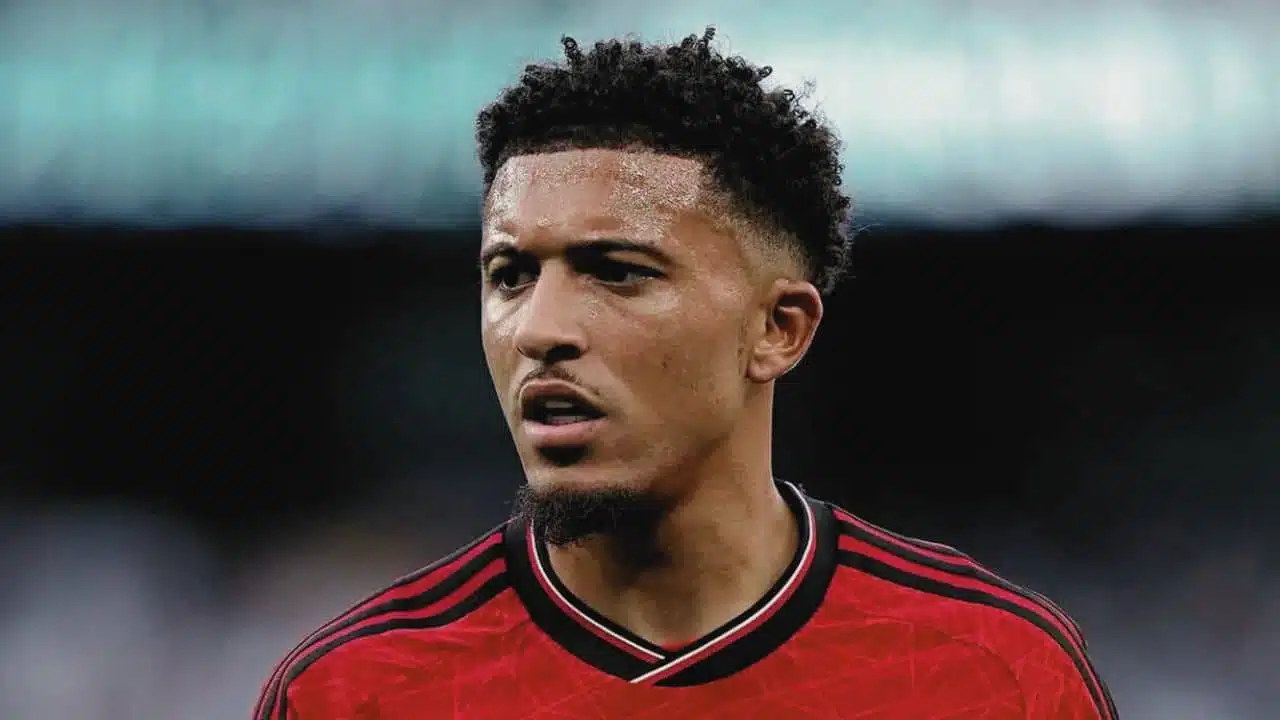
In a significant move during the transfer window, Chelsea has secured Manchester United winger Jadon Sancho on a loan deal that will see him at Stamford Bridge until the end of the season. This transfer agreement also includes a crucial clause: an obligation for Chelsea to sign the England international, who is currently 24 years old, for a fee ranging between £20-25 million next summer.
This transfer is not just another routine transaction in the football world but rather a complex deal with layers of strategic decision-making and context that are worth exploring in detail.
Sancho’s Journey at Manchester United: High Hopes and Unexpected Challenges
Sancho’s arrival at Manchester United in July 2021 was met with enormous expectations. United had signed the talented winger from Borussia Dortmund for a hefty £73 million, a transfer that had been highly anticipated and widely celebrated. Sancho was seen as a critical addition to the squad, expected to bring creativity, pace, and flair to United’s attack. His previous performances in the Bundesliga, where he was one of the standout players, had convinced many that he would replicate his success in the Premier League.
However, Sancho’s journey at Old Trafford has been far from smooth. Over the span of three full seasons, he made a total of 83 appearances, a number that suggests regular involvement. But the reality was more complicated. Despite his clear talent and potential, Sancho struggled to find consistent form. The adaptation to the Premier League, with its unique physical and tactical demands, proved to be more challenging than anticipated.
The situation took a significant turn for the worse when Sancho had a very public and high-profile disagreement with Manchester United manager Erik ten Hag. This fallout was not just a minor spat but a serious conflict that had substantial repercussions. The disagreement led to Sancho being sidelined from the first-team training sessions, effectively isolating him from the rest of the squad. This was a drastic measure, highlighting the severity of the situation and the strained relationship between the player and the manager.
In an attempt to revive his career, Sancho was loaned back to Borussia Dortmund in January 2024. This move was seen as a way for him to regain his confidence and form in a familiar environment. However, despite returning to Manchester United in the summer of 2024, Sancho has not featured in any of their Premier League games so far this season. This absence from the squad raised further questions about his future at the club and whether he could reintegrate into the team.
Sancho’s struggles have not been limited to club football. On the international stage, he has also faced setbacks. The last of his 23 England caps came in 2021, marking a three-year absence from the national team. Despite being one of England’s brightest young talents, Sancho was overlooked for major tournaments such as Euro 2024 and the 2022 World Cup in Qatar. This decline in his international career has been as dramatic as it has been concerning, especially for a player who was once considered a key part of England’s future.
The Strategic Perspective: Why Manchester United Had to Let Sancho Go
For Manchester United, the decision to loan out Sancho is seen as a pragmatic solution to a complicated and somewhat unfortunate situation. The club’s leadership, including sporting director Dan Ashworth, technical director Jason Wilcox, and chief executive Omar Berrada, had to navigate a scenario that was not of their making but required careful handling.
Sancho’s fallout with Erik ten Hag was already underway when this trio of senior figures took their positions at the club. Their challenge was to manage the delicate situation while protecting the club’s interests. The uneasy truce that was negotiated to bring Sancho back into pre-season training and include him in the club’s tour of the United States was a temporary measure. This allowed Sancho to maintain his fitness levels, which in turn made it easier for the club to find an alternative destination for him where he could continue his career.
From a strategic standpoint, Manchester United’s decision to loan out Sancho, with a future sale clause included, represents an effort to turn a difficult situation into a more manageable one. Before his conflict with Erik ten Hag became public, Sancho was already underperforming relative to the high expectations that accompanied his transfer. Despite showing flashes of brilliance, he struggled to deliver the consistency and impact that Manchester United had hoped for when they signed him.
In addition, Manchester United has seen the emergence of several young talents who have started to make their mark in the wide positions that Sancho typically occupies. Alejandro Garnacho, for example, had a breakthrough season, demonstrating his potential as a future star. Similarly, Amad Diallo has impressed at the start of this season, further complicating Sancho’s prospects of regaining a regular spot in the team. These young players, combined with established stars like Marcus Rashford and Antony, have given Erik ten Hag more options in the wide attacking roles, making Sancho’s departure less impactful on the squad’s overall depth.
The decision to let Sancho go is undoubtedly tinged with a sense of disappointment, as his transfer to Manchester United was initially seen as a major coup. However, given all that has transpired, the loan move to Chelsea, with a potential permanent transfer, is viewed as the best possible outcome for all parties involved.
Chelsea’s Calculated Gamble: Why Signing Sancho Makes Sense
The decision to bring Jadon Sancho to Stamford Bridge has raised some eyebrows, particularly given Chelsea’s already crowded roster of attacking talents. The club boasts a formidable array of forwards, including Christopher Nkunku, Nicolas Jackson, Pedro Neto, Mykhailo Mudryk, Noni Madueke, Cole Palmer, Joao Felix, and Marc Guiu. With such a wealth of options, one might wonder why Chelsea would add another player like Sancho to the mix.
However, there are several reasons why Chelsea sees value in this deal. First and foremost is the price. At £20-25 million, Sancho is being acquired at a significantly lower cost than his original transfer fee of £73 million. For a player of his caliber and potential, this is considered a bargain in today’s inflated transfer market. Chelsea’s management believes that if Sancho can rediscover his form, he could become a valuable asset to the team, providing additional depth and creativity in their attacking options.
Another factor is the presence of key figures at Chelsea who have a history with Sancho. Manager Enzo Maresca, for example, previously worked with Sancho during his time at Manchester City, where Sancho spent his formative years. Maresca has publicly stated that he knows Sancho well and believes that the winger could be a good fit for Chelsea’s tactical setup. In addition to Maresca, Chelsea’s recruitment specialist Joe Shields also has ties to Sancho, having been involved in his early development at Manchester City. This familiarity gives Chelsea confidence that they can help Sancho get back to his best.
Moreover, Chelsea has a tradition of signing players who have a personal connection to the club, often those who supported Chelsea as children. Jadon Sancho, born and raised in South London, fits this profile perfectly. His ties to the area and his boyhood support for Chelsea add an emotional dimension to the signing, which the club’s fans are likely to appreciate.
A Fresh Start for Sancho: Can He Reignite His Career at Chelsea?
For Jadon Sancho, this move to Chelsea represents a crucial opportunity to reignite a career that has stalled in recent years. At just 24 years old, Sancho still has plenty of time to fulfill the potential that made him one of the most exciting young talents in European football.
Chelsea offers him a fresh start, away from the challenges and controversies that marked his time at Manchester United. If he can adapt to the new environment and regain his confidence, Sancho has the ability to become a key player for Chelsea. The club’s supportive management, coupled with the tactical setup under Enzo Maresca, could provide the ideal conditions for Sancho to thrive.
The road ahead will not be easy, and Sancho will need to work hard to earn his place in a highly competitive Chelsea squad. However, with the right mindset and support, this move could be the turning point in his career, allowing him to once again showcase the talent that made him a star at Borussia Dortmund.
In conclusion, the loan deal between Chelsea and Manchester United for Jadon Sancho is more than just a simple transfer. It is a strategic move with potential long-term implications for both clubs and the player himself. For Manchester United, it represents a way to move forward from a difficult situation. For Chelsea, it is a calculated gamble on a player who could still have a bright future. And for Jadon Sancho, it is a chance to start anew and reclaim his place among Europe’s elite footballers.
The Information is Collected from ESPN and Yahoo.





















