

Artificial intelligence (AI) is quickly evolving, offering diverse models with capabilities ranging from conversational agents to deep learning-based systems. Among the popular AI models currently making waves are ChatGPT, DeepSeek, and Qwen 2.5.
Each of these models offers a unique set of features that cater to different user needs, making it important to evaluate their performance, efficiency, and cost to determine the best choice for specific tasks.
In this article, we’ll explore how ChatGPT vs DeepSeek vs Qwen 2.5 stack up against each other in key areas like speed, accuracy, resource consumption, scalability, and pricing. By the end of this comparison, you’ll have a clearer understanding of which AI model is the best fit for your personal or business needs.
Overview of ChatGPT
ChatGPT, developed by OpenAI, is an AI-powered language model that excels in conversational AI. It is based on the GPT (Generative Pre-trained Transformer) architecture, which uses large-scale data to generate human-like text.
With impressive capabilities in natural language processing (NLP), ChatGPT can hold conversations, answer questions, create content, and even assist with complex problem-solving tasks.
Key Features of ChatGPT:
- Natural Language Understanding: ChatGPT can understand and generate human-like responses, making it highly suitable for tasks like customer support, content creation, and virtual assistance.
- Large Knowledge Base: Trained on diverse datasets, it has a broad knowledge base spanning a wide range of topics.
- Scalability: Easily scalable for businesses, making it suitable for both small startups and large enterprises.
| Feature | ChatGPT |
| Training Data | Extensive NLP datasets |
| Use Cases | Customer support, content creation, coding assistance |
| Speed | Fast response times |
| Adaptability | High adaptability to various tasks |
| Popularity | Widely used across industries |
Exploring DeepSeek
DeepSeek is a powerful AI model designed for deep learning tasks, especially those requiring high-level pattern recognition and predictive analytics. While ChatGPT focuses primarily on natural language tasks, DeepSeek specializes in processing large datasets to identify patterns and make predictions.
Key Features of DeepSeek:
- Deep Learning Optimization: DeepSeek utilizes advanced deep learning algorithms for data-heavy tasks, such as fraud detection, sentiment analysis, and recommendation systems.
- High Accuracy in Predictive Analytics: It is particularly useful for tasks that require the AI to predict outcomes based on past data.
- Efficiency in Data Handling: Known for its efficiency in handling large datasets without compromising on speed.
| Feature | DeepSeek |
| Focus Area | Deep learning, data analysis |
| Use Cases | Fraud detection, data mining, predictive analytics |
| Speed | Moderate response times |
| Accuracy | High accuracy in pattern recognition |
| Popularity | Niche, specialized use cases |
Understanding Qwen 2.5
Qwen 2.5 is a versatile AI model, specifically tailored for use in specialized industries like healthcare, finance, and manufacturing. It’s known for its precision and ability to handle complex industry-specific tasks with ease.
While ChatGPT and DeepSeek offer broad capabilities, Qwen 2.5 stands out by focusing on optimization for specific use cases, including robotics and AI-driven automation.
Key Features of Qwen 2.5:
- Precision and Accuracy: Qwen 2.5 excels in highly specialized tasks, offering pinpoint precision in industries such as healthcare diagnostics, automated manufacturing, and financial analysis.
- Industry-Specific Solutions: Built with custom features to cater to specific sectors, offering out-of-the-box solutions for complex problems.
- Scalability for Large Enterprises: Well-suited for large companies that need an AI solution integrated into their existing workflows.
| Feature | Qwen 2.5 |
| Specialization | Healthcare, finance, manufacturing |
| Use Cases | Robotics, diagnostics, financial analysis |
| Speed | Fast in specialized applications |
| Precision | Very high accuracy for complex tasks |
| Popularity | Gaining popularity in niche industries |
ChatGPT vs DeepSeek vs Qwen 2.5: Performance Comparison
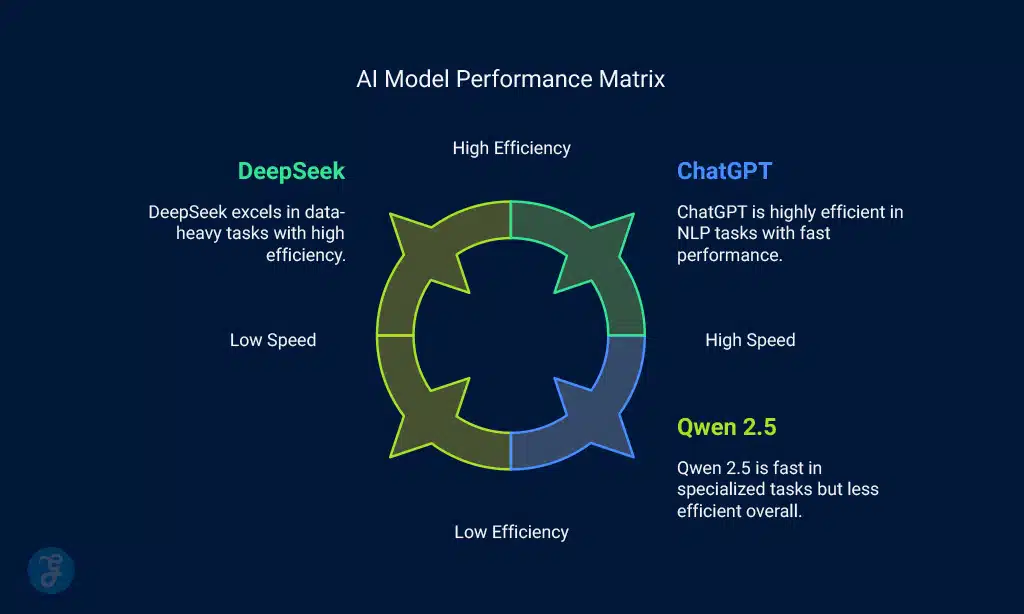
When comparing ChatGPT, DeepSeek, and Qwen 2.5 based on performance, it’s important to focus on metrics like speed, accuracy, and adaptability. Each model excels in different areas, so it’s crucial to assess which attributes are more important for your use case.
Speed & Efficiency
- ChatGPT: Known for its fast response times, ChatGPT is optimized for real-time conversations and content generation. Its ability to quickly process requests makes it ideal for interactive applications.
- DeepSeek: Though not as fast as ChatGPT, DeepSeek is optimized for tasks that require heavy data processing. It may take more time to produce results but excels in deep learning tasks like fraud detection and predictive modeling.
- Qwen 2.5: While Qwen 2.5 is fast in specialized tasks, its efficiency can vary based on the complexity of the industry-specific problems it addresses.
| Model | Speed | Efficiency |
| ChatGPT | Fast | Highly efficient in NLP tasks |
| DeepSeek | Moderate | Highly efficient in data-heavy tasks |
| Qwen 2.5 | Fast (in specialized tasks) | Efficient in industry-specific solutions |
Accuracy
- ChatGPT: ChatGPT is highly accurate in natural language tasks, offering impressive text generation capabilities.
- DeepSeek: Accuracy is one of DeepSeek’s strongest attributes, especially in tasks like fraud detection and sentiment analysis, where precision is critical.
- Qwen 2.5: Known for its high precision in complex fields like medical diagnostics and financial analysis, Qwen 2.5 outperforms other models in industry-specific accuracy.
| Model | Accuracy |
| ChatGPT | High in conversational tasks |
| DeepSeek | Extremely high in pattern recognition |
| Qwen 2.5 | Very high in specialized industries |
ChatGPT vs DeepSeek vs Qwen 2.5: Efficiency Breakdown
Efficiency in AI refers to how well a model performs while managing computational resources. This includes energy consumption, system requirements and scalability.
Power Consumption & Resource Management
- ChatGPT: ChatGPT requires substantial computational resources for large-scale use. However, its efficient design helps balance performance with energy usage, especially in cloud environments.
- DeepSeek: As a deep learning model, DeepSeek can be resource-intensive, especially for tasks involving huge datasets. The complexity of its algorithms demands powerful systems for optimal performance.
- Qwen 2.5: While Qwen 2.5 is efficient for industry-specific applications, its resource demands vary depending on the complexity of the problem. However, it is highly efficient when tailored for specific use cases.
| Model | Resource Management | Power Consumption |
| ChatGPT | Efficient in cloud setups | Moderate |
| DeepSeek | Resource-heavy for large datasets | High |
| Qwen 2.5 | Efficient in specialized tasks | Varies by industry |
ChatGPT vs DeepSeek vs Qwen 2.5: Cost Comparison
The cost of implementing AI is a crucial consideration for businesses. Pricing models differ across AI tools based on usage, features and scalability.
Pricing Models
- ChatGPT: Offers flexible subscription plans for both developers and enterprises. While affordable for small businesses, the cost can increase with higher usage demands.
- DeepSeek: As a deep learning-focused AI, DeepSeek’s cost can be high due to the need for extensive computational resources and specialized features.
- Qwen 2.5: Pricing for Qwen 2.5 is typically tailored to enterprise needs. While it offers premium features for specialized industries, the cost is often justified by the ROI in sectors like healthcare and manufacturing.
| Model | Cost Structure | Pricing Model |
| ChatGPT | Subscription-based | Affordable for startups |
| DeepSeek | High due to data-heavy tasks | Premium pricing |
| Qwen 2.5 | Enterprise pricing | Customized pricing based on industry |
Pros and Cons of Each AI Model
ChatGPT Pros and Cons
Pros:
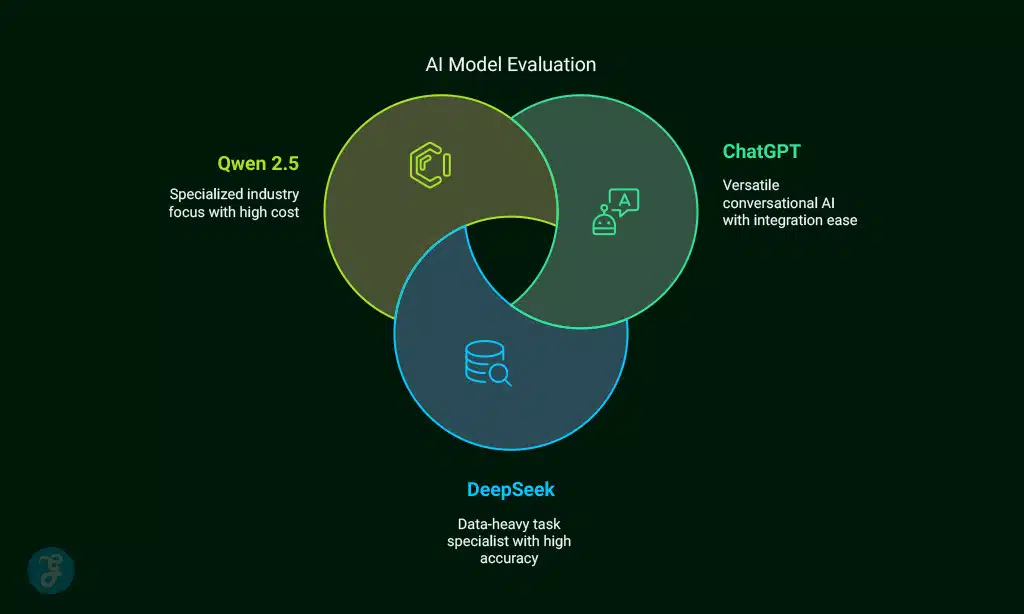
- Highly versatile for conversational tasks.
- Scalable for different industries.
- Easy to integrate into existing systems.
Cons:
- Not specialized for complex tasks outside of natural language processing.
DeepSeek Pros and Cons
Pros:
- Excellent for data-heavy tasks like predictive analytics.
- High accuracy and reliability in specialized tasks.
Cons:
- Requires more computational resources.
- Slower than ChatGPT in general use cases.
Qwen 2.5 Pros and Cons
Pros:
- Highly accurate in specialized applications.
- Tailored for industries like healthcare and finance.
Cons:
- Not as versatile in general-purpose AI tasks.
- Higher cost, making it better suited for large enterprises.
Which AI Model is Best for Your Needs?
Choosing the right AI model depends on your business needs and use case. Here’s a quick guide:
- ChatGPT: Best for conversational agents, customer support, and content creation.
- DeepSeek: Ideal for businesses requiring deep learning, data analysis, and predictive modeling.
- Qwen 2.5: Perfect for specialized tasks in industries like healthcare, finance, and manufacturing.
Wrap Up
The battle between ChatGPT, DeepSeek, and Qwen 2.5 highlights the diverse applications of AI. While ChatGPT excels in conversational tasks and general applications, DeepSeek shines in data-heavy analytics, and Qwen 2.5 dominates in specialized industries. Each model offers distinct advantages depending on your business or personal needs.
ChatGPT is perfect for most conversational applications, while DeepSeek is the go-to for those needing predictive analytics. Qwen 2.5, on the other hand, is ideal for those in niche industries looking for highly precise AI solutions.
Ultimately, the right choice depends on your use case, budget, and scaleability needs.





















