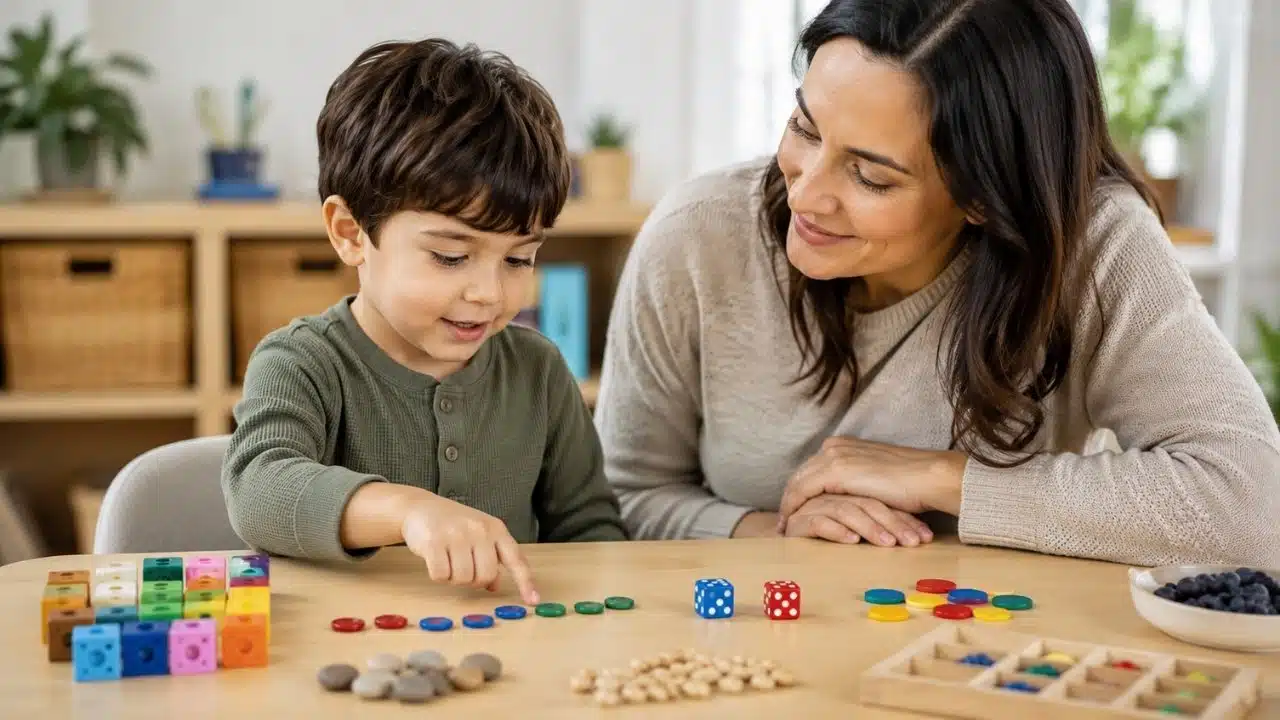
Many parents celebrate when their three-year-old proudly recites the numbers from 1 to 20 without missing a beat. While memorizing the order of number words is a fantastic memory milestone, reciting the alphabet of numbers is not the same thing as understanding what those numbers actually represent.
Understanding how children understand numbers begins with distinguishing between rote memorization and true math comprehension. A child who can count to 10 out loud might still struggle if you hand them a pile of five blocks and ask them to show you five. Real numerical comprehension, often called number sense, involves connecting an abstract spoken word or written symbol to a concrete quantity.
If you are curious whether your toddler or preschooler is developing genuine mathematical reasoning, look for these seven foundational indicators in their daily play.
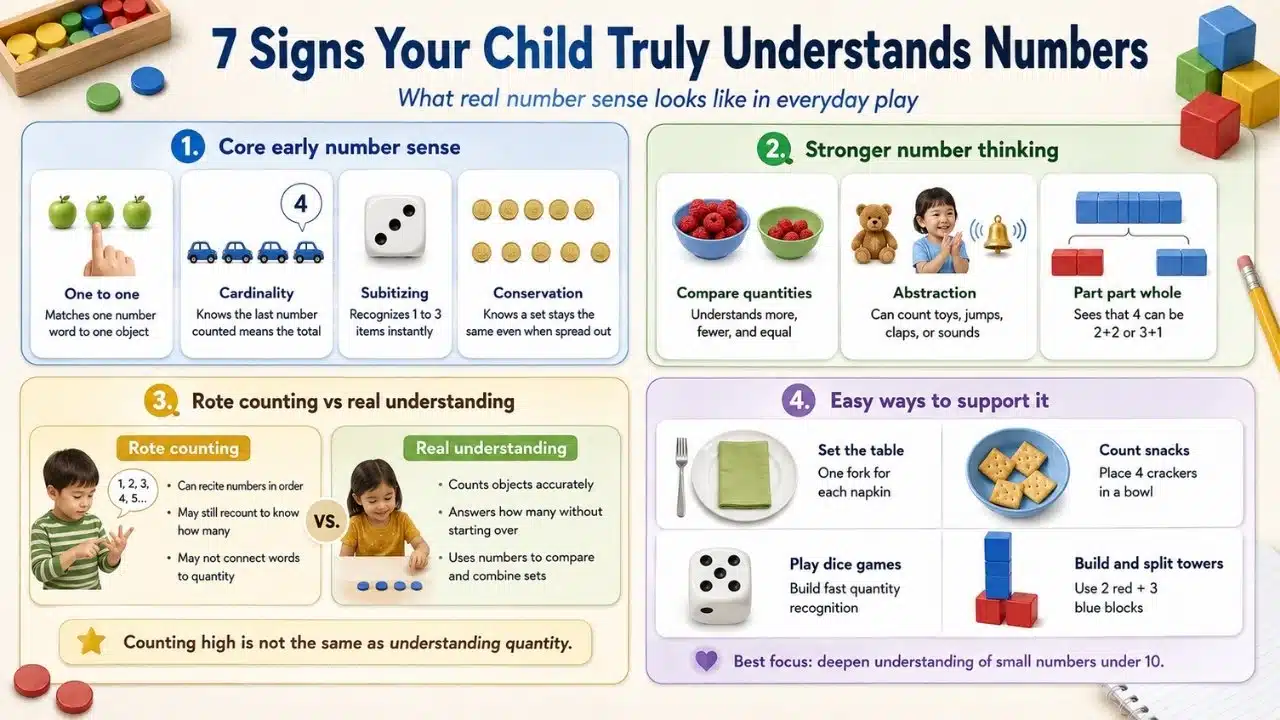
7 Key Indicators of How Children Understand Numbers
1. They Demonstrate One-to-One Correspondence
One-to-one correspondence is the ability to pair exactly one number word with exactly one physical object as you count a set.
When young toddlers first start counting objects, they often count faster than their fingers can move. They might point to a single toy car and say three numbers rapidly, or touch three different blocks while only saying one word. A child who has mastered one-to-one correspondence slows down. They touch the first block and say “one,” touch the second block and say “two,” and touch the third block and say “three.”
This deliberate pairing shows that the child understands number words are not just a catchy song. They realize each individual word attaches to a single physical item in front of them.
2. They Grasp the Concept of Cardinality
Cardinality is a distinct cognitive leap that usually happens after a child masters one-to-one correspondence.
To test for cardinality, watch what happens after your child counts a row of four buttons: “One, two, three, four.” If you immediately ask how many buttons there are altogether, a younger child might start over and count them again from one. They view counting as a procedural action rather than a way to measure total quantity.
A child who understands cardinality will look at you without recounting and confidently answer, “Four!” They realize that the final number stated during the counting process represents the total size of the group.
3. They Can Subitize Small Quantities Instantly
Subitizing is the ability to look at a small cluster of items and instantly know how many there are without counting them one by one.
When an adult looks at the side of a standard die showing three dots, they do not point and count each dot. The brain recognizes the visual pattern of three instantly. Children develop this same visual skill for small groups of one, two, or three items around age three or four.
If your child looks at a plate with two crackers and immediately says “two” without using a finger to point and count, they are using subitizing. This skill provides crucial insight into how children understand numbers, showing that their minds are forming direct mental representations of quantities.
4. They Understand the Conservation of Number
The principle of conservation of number means that the total quantity of a set remains unchanged, regardless of how the items are arranged physically.
Imagine placing five small coins in a tight line right next to each other. Your child counts them and agrees there are five coins. Now, right in front of their eyes, spread those same five coins far apart so they form a long line.
Younger children who rely strictly on visual appearances will often claim there are now more coins because the line looks longer. A child who grasps number conservation will state that there are still five coins. They understand that changing physical spacing or visual layout does not add or subtract items from a group.
5. They Compare Quantities Using Magnitude
True math readiness involves understanding relative relationships between numbers. It is not enough to know that 4 comes after 3; a child needs to realize that 4 represents a larger quantity than 3.
Observe how your child handles choices involving items they want. If you offer a choice between a pile of two blueberries and a pile of six blueberries, do they instantly recognize which pile holds more? When children can evaluate sets and use words like more, fewer, bigger, or equal, it shows progress in how children understand numbers as relative magnitudes rather than isolated words.
6. They Apply the Abstraction Principle
The abstraction principle means that a child understands counting rules apply to absolutely anything, not just physical, identical objects like red plastic blocks.
In the early stages of counting, children practice on concrete toys that look identical. As their mathematical understanding matures, they realize they can count:
-
Mis-matched physical items, such as two cars, a doll, and a crayon on a table.
-
Intangible events, such as three jumps in the air or four claps of their hands.
-
Environmental sounds, such as two dog barks in the distance.
Realizing that abstract ideas and actions can be quantified demonstrates a mature grasp of numerical reasoning.
7. They Begin Composing and Decomposing Numbers
Before children ever solve written addition or subtraction equations on a worksheet, they explore early operations through spatial play.
Decomposing a number means understanding that a larger set can be split into smaller parts. For instance, if you hand a child four apples, they might notice that two apples are green and two are red. They realize that 4 is not just a solid block; it is made up of 2 and 2, or 3 and 1.
Recognizing that numbers can be broken down and put back together reveals a deep structural view of how children understand numbers, laying the perfect foundation for future arithmetic.
The Rote Counting Trap: What Parents Get Wrong
It is easy to fall into the trap of measuring math success by how high a child can count out loud. Reciting numbers up to 50 or 100 is an impressive memory trick, but it is fundamentally an auditory language exercise. It relies on the same brain mechanics a toddler uses to memorize the lyrics to a favorite cartoon theme song.
Focusing strictly on rote counting can create a false sense of progress. A child who can chant up to 30 may still get confused when asked to pass you three spoons at the dinner table.
Instead of pushing your child to count to higher numbers, focus on deepening their comprehension of small numbers under 10. A child who deeply understands the concept of four (how it looks, how it breaks into two pairs, how it feels as a physical weight, and how it compares to three) has a far stronger foundation for school than a child who blindly recites high numbers without meaning.
Early Math Support Strategy Matrix
Use this matrix to match everyday play activities with specific number sense milestones:
| Mathematical Concept | Everyday Play Activity | Simple Material Needed |
| One-to-One Correspondence | Setting the table by placing one fork on each napkin. | Standard utensils and napkins |
| Cardinality | Counting a small pile of snacks and placing them in a bowl. | Crackers, raisins, or grapes |
| Subitizing | Playing basic board games that use a standard dot die. | Board game with dot dice |
| Composition & Decomposition | Building a tower using two red blocks and three blue blocks. | Interlocking building blocks |
Building Early Math Skills Alongside Letter Sounds with 123 Magic Number Fun: Math Kid
Just as understanding how to teach letter sounds in order prepares children for decoding and reading fluency, building early numeracy requires a similarly structured, multi-sensory approach. Practicing letter sounds and number recognition side by side helps young learners develop fine motor coordination, visual discrimination, and cognitive retention across all core early childhood subjects.
Integrating Literacy and Numeracy Through Interactive Play
Combining structured phonics with gamified math activities keeps toddlers, preschoolers, and kindergartners motivated while reinforcing foundational concepts. Built by Edutorial, interactive learning tools bridge the gap between abstract symbols and real-world understanding through guided feedback, vibrant visuals, and playful game modes.
-
Guided Finger Tracing (1 to 50): Similar to letter tracing, practicing step-by-step number formation helps children develop proper stroke paths, handwriting confidence, and fine motor control.
-
Multi-Sensory Number Recognition: Activities like popping numbered balloons, matching memory tiles, and steering underwater submarines allow kids to see, hear, and connect written numerals with physical object quantities.
-
Progressive Math Skill Building: Moving from basic object counting to dot-to-dot number art, crossword math puzzles, and math car races creates a smooth transition into addition, subtraction, and missing-number logic.
-
Cross-Platform Access: Parents and educators can install 123 Magic Number Fun: Math Kid on Google Play or download 123 Magic Number Fun on the Apple App Store.
As highlighted in Editorialge’s review of Alphabet Magic Trace & Phonics, pairing gamified tracing movements with real-time audio prompts speeds up symbol recall far more effectively than static flashcards alone. Aligning your systematic approach on how to teach letter sounds in order with interactive math practice gives early learners a complete, balanced foundation for school readiness.
Final Thoughts on How Children Understand Numbers
Developing early math skills is a gradual process that thrives on informal, playful interactions. Observing how children understand numbers in daily life allows you to meet your child at their exact stage of cognitive development. By focusing on physical grouping, spatial relationships, and practical counting during regular routines, you build a resilient foundation for lifelong mathematical reasoning without ever needing a single flashcard or worksheet.
Frequently Asked Questions (FAQs) About How Children Understand Numbers
At what age should a child understand cardinality?
Most children begin developing cardinality between ages 3.5 and 4.5. Before this age, children can often count items in order using one-to-one correspondence, but they may still need to recount the items if asked how many there are in total.
Is subitizing something that can be practiced at home?
Yes. You can practice subitizing through quick, low-pressure visual games. Briefly show your child a plate with two or three small items, cover it up after two seconds, and ask them how many they saw. Playing board games with dot dice is also an excellent way to strengthen visual subitizing skills naturally.
Why does my child keep skipping numbers when counting objects?
Skipping numbers (such as counting “one, two, four, seven”) is completely normal for toddlers and young preschoolers. It indicates that their physical hand movement is moving faster than their brain can retrieve spoken number words. Encourage them to slow down and physically move each item from one side of the table to the other as they speak.