The best productivity podcasts do more than fill an otherwise quiet journey. They help you solve a specific problem: an overloaded schedule, a scattered task system, constant distraction, inconsistent planning, or the pressure to produce good work without burning out.
The category has become unusually loose. Many lists include famous business and self-help shows that discuss productivity only occasionally. Others recommend podcasts that stopped publishing years ago.
I chose the ten shows below after checking their publishing activity in August 2026, recent catalogues, formats, and commute fit. I did not rank them by chart position, celebrity, or download claims. One show cannot be “best” for everyone. The right choice depends on your problem and the time you genuinely have.
10 Best Productivity Podcasts for Different Goals and Commutes
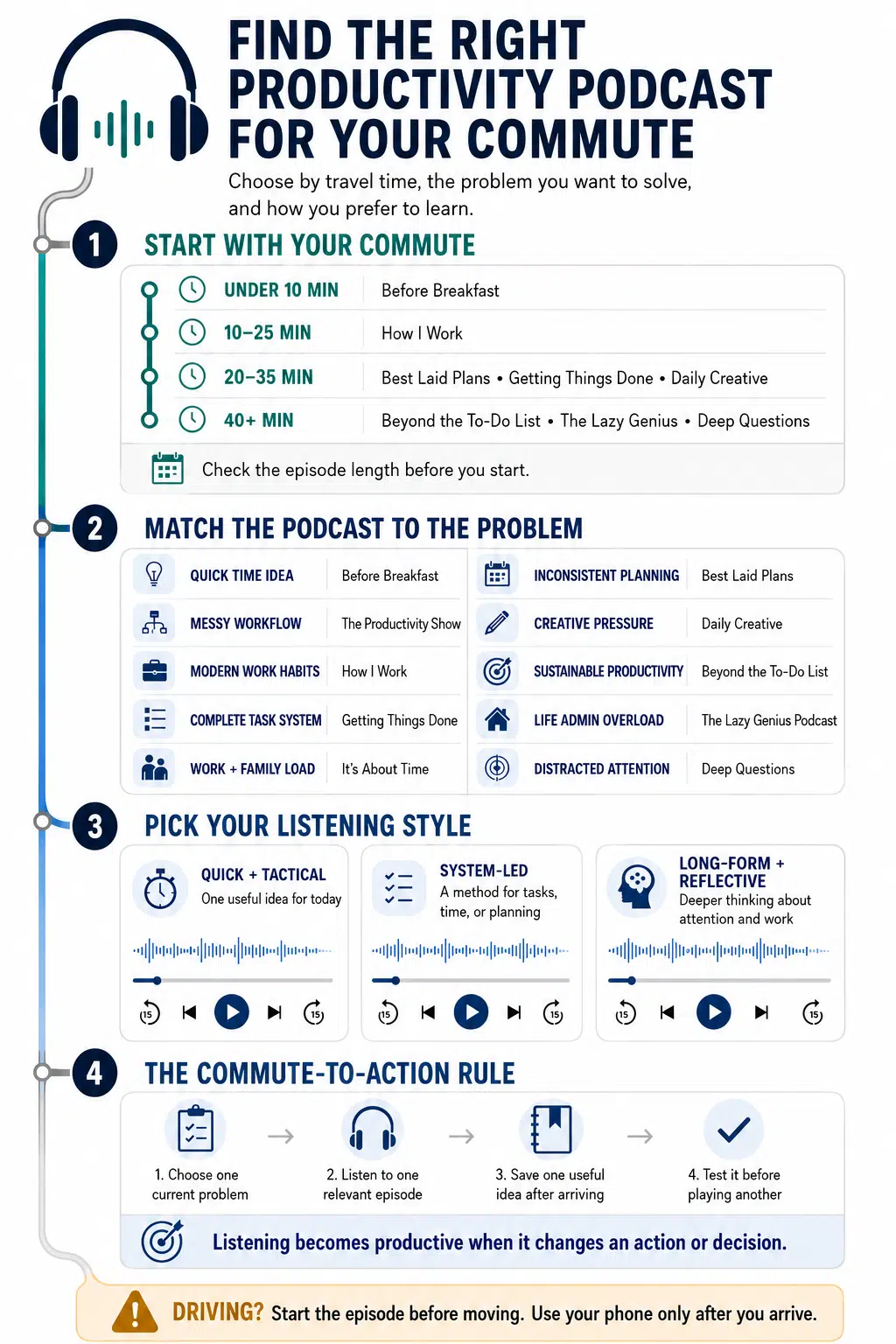
The 10 best productivity podcasts below are not ranked from strongest to weakest. Each serves a different need, from organizing an overloaded task system to protecting focus or managing work alongside family responsibilities.
I have included the ideal listener, commute fit, starting episode, and main limitation for every show. You do not need to follow all ten. Begin with the podcast that addresses the problem creating the most friction in your work or daily life.
1. Before Breakfast: Best for a Commute Under 10 Minutes
Laura Vanderkam’s Before Breakfast is the clearest choice for a very short commute. Most regular episodes take one scheduling or time-management idea and explain it in roughly four to seven minutes. That is enough time to make a useful point without turning the morning journey into a seminar.
The compact format means you are less likely to arrive with ten tips competing for attention. Start with “Make a List of Annoying Tasks,” a six-minute example of its single-idea approach.
The feed contains advertising, and occasional guest interviews run closer to 25 minutes. The usual episodes may feel too slight if you want a detailed system. For one practical prompt before work, however, it is hard to beat.
2. The Productivity Show: Best for Systems and Workflows
Produced by Asian Efficiency and hosted by Thanh Pham and Brooks Duncan, The Productivity Show deals directly with the mechanics of work: email, attention, decision fatigue, automation, meetings, and workflow design. It is especially useful when your problem is not motivation but friction inside the way you work.
Begin with “The Subtraction Strategy: Why Removing Friction Beats Adding Goals Every Time.” Its premise corrects the productivity industry’s habit of prescribing another tool, routine, or target for every difficulty.
The feed mixes brief tactical episodes with discussions lasting 45 minutes or more. Some subjects are tied to particular tools or AI products and may age faster than the broader workflow advice.
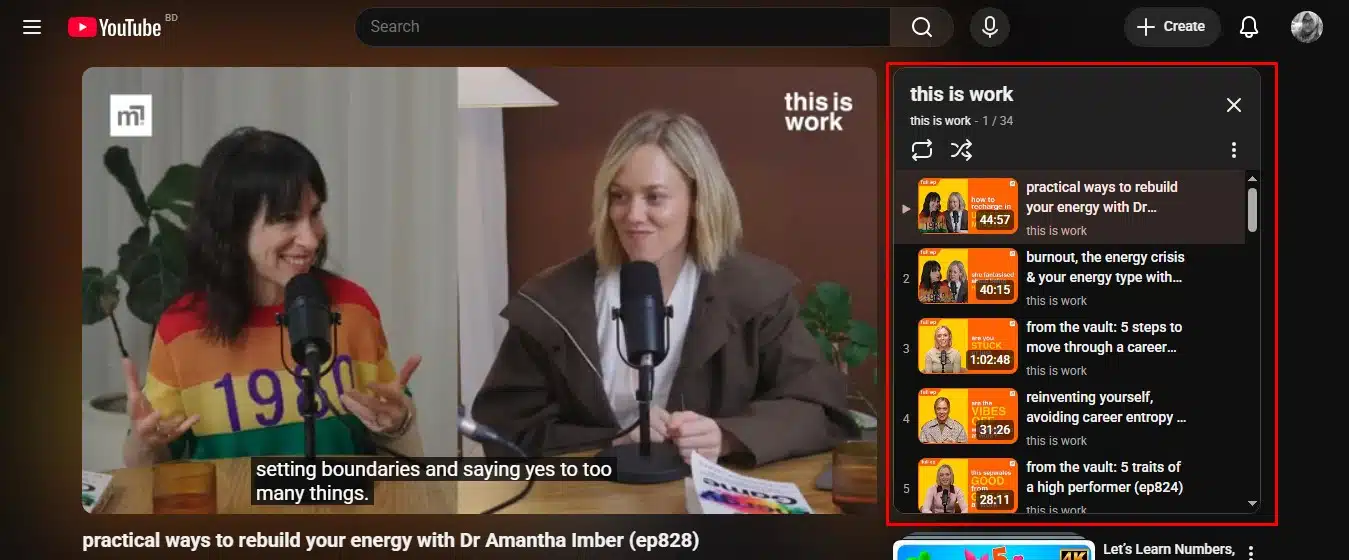
3. This is Work: Best for Work Habits and Applied AI
Organizational psychologist Dr. Amantha Imber hosts interviews and shorter practical episodes about focus, leadership, overwhelm, career habits, and workplace AI. The range suits listeners who want to learn how other people operate without adopting one productivity system.
A useful first episode is “How I AI: How to Use AI to Prioritise When Everything Feels Urgent.” At about 13 minutes, it suits a short journey and deals with a recognizable workplace problem rather than discussing AI in the abstract.
The breadth is also the limitation. Some episodes are more about careers, leadership, or technology than personal productivity. Choose by topic instead of expecting every release to match the same need.
4. Getting Things Done: Best for the GTD Method
The official Getting Things Done podcast goes further than the familiar advice to write everything down. Its catalogue covers capture, clarification, reviews, priorities, lists, paper systems, apps, and the choices that turn an open loop into a next action.
This is the strongest selection for someone learning GTD or trying to repair a system that has become cluttered. “How Do You Choose What to Do?” is a sensible starting episode because the problem makes sense even if you do not know the full method.
Some discussions assume GTD vocabulary. The feed also uses webinar material and promotes the paid GTD Connect service, while production quality can vary. It is a method-specific recommendation.
5. It’s About Time: Best for Time Management Around a Full Life
Anna Dearmon Kornick treats time management as something that has to survive family responsibilities, mental load, self-care, business demands, and days that refuse to follow the plan. That makes It’s About Time more realistic than advice designed around an uninterrupted office schedule.
Start with “7 Quick Time Management Tips to Boost Your Productivity on Your Busiest Days.” Despite the list-style title, the episode does not pretend that isolated hacks will solve chronic overload.
The examples often speak most directly to entrepreneurs, working parents, and people carrying several responsibilities. Other listeners may see themselves less often. For anyone whose calendar cannot be separated from the rest of life, that perspective is the value.
6. Best Laid Plans: Best for Planning and Weekly Reviews
Sarah Hart-Unger’s Best Laid Plans is for people who enjoy the act of planning but want it to produce more than a tidy notebook. Episodes cover weekly and annual reviews, routines, time tracking, goal adjustments, paper planners, and the practical problem of planning around changing responsibilities.
“5 Lessons From Time Tracking That Aren’t What You’d Think” is a good entry point. It addresses a broadly useful practice without requiring an interest in a particular planner product.
The show is specialized. If notebooks, planning tools, and review routines hold little interest, choose a broader podcast. If your plans fail because you never revisit them, its detail is an advantage.
7. Daily Creative: Best for Creative Professionals
Some older recommendation pages still call this show The Accidental Creative. Its current name is Daily Creative with Todd Henry, and its subject is the difficult work of producing ideas consistently under pressure.
Writers, designers, creative leaders, and others paid to make original work will find discussions of motivation, distraction, collaboration, leadership, and sustainable output. “The Price of Becoming” is a strong starting point, built around small, repeatable creative practice rather than a dramatic reinvention.
Its advice is shaped around creative work, not household organization or general office efficiency. That narrower focus is why it belongs here.
8. Beyond the To-Do List: Best for Thoughtful Interviews
Erik Fisher has hosted Beyond the To-Do List since 2012, interviewing authors and practitioners about attention, habits, burnout, meaningful work, and intentional living. It works well for listeners who prefer to hear several perspectives rather than adopt one host’s system.
Try “Productivity Without Burnout: Executing With Agency Instead of Illusion of Control.” It captures the show’s more humane view of performance and avoids treating tighter control as the answer to every problem.
As with any guest-led programme, relevance varies. Some episodes deliver a clear idea; others are broader conversations, and the feed includes sponsor or product promotion. Choose by the problem in the title.
9. The Lazy Genius Podcast: Best for Sustainable Life Administration
Kendra Adachi’s central idea is simple: decide what matters, then use kinder and smaller systems for everything else. The Lazy Genius Podcast belongs on this list because many productivity problems begin outside the office, in meals, family logistics, projects, routines, and the exhausting attempt to optimize all of them.
“How to Get Better at Projects” is one of the most direct starting points for a general productivity listener. It shows how the podcast approaches progress without demanding that every part of life become an efficiency contest.
Episodes often last 45 minutes or more, and the feed ranges across parenting, food, home, and family life. It may be too broad for listeners seeking only knowledge-work tactics, but highly relevant to people managing a full life.
10. Deep Questions With Cal Newport: Best for Focus and Long Commutes
Cal Newport’s Deep Questions examines deep work, digital distraction, meaningful productivity, and the effect of technology on attention. Longer advice episodes suit an extended commute, while shorter commentary formats sometimes fit a 20- to 30-minute journey.
“Can I Be a Digital Minimalist in 2026?” is an appropriate starting point for anyone whose main productivity problem is fractured attention. It can also be divided across two journeys without losing the argument.
The current feed devotes substantial time to AI and work. Not every release is a direct lesson in planning or focus. It remains a strong choice for thoughtful knowledge-work questions if you choose episodes selectively.
Do Not Turn Listening Into Productive Procrastination
Productivity media can create the feeling of improvement before anything has changed. The easiest safeguard is to follow one or two feeds, choose episodes by present need, and carry one useful idea into the next workday.
If you are driving, do not take notes or interact with your phone. Save one thought after you arrive, then test it before collecting more techniques. Listening becomes productive only when it affects a decision, habit, or piece of work.
Final Thought
The best productivity podcasts make a commute useful without turning it into another performance target. Choose the show that fits your journey and your current problem. One idea applied on Monday is worth more than a hundred episodes saved for later.
Frequently Asked Questions on the Best Productivity Podcast
1. What Is the Best Productivity Podcast for Beginners?
Before Breakfast is the easiest starting point because ordinary episodes are brief and usually focus on one clear action. Listeners who want a complete system may prefer Getting Things Done, although it requires more context and commitment.
2. Which Productivity Podcast Is Best for a 10-Minute Commute?
Before Breakfast is designed for this time window. Shorter episodes of The Productivity Show and How I Work can also fit, but their lengths vary more from one release to another.
3. Which Podcast Is Best for Focus and Deep Work?
Deep Questions with Cal Newport is the strongest fit for attention, distraction, digital habits, and focused knowledge work. Its main advice episodes can be long, so it is better for an extended commute or listening across several journeys.
4. Are Productivity Podcasts Actually Useful?
They can be, provided listening leads to action. A podcast is less useful when it becomes background noise or a substitute for doing the work. Choose episodes around a current problem and apply one idea before seeking another.
5. How Many Productivity Podcasts Should I Follow?
For most people, one or two are enough. A short practical feed can cover quick ideas, while a longer show can provide depth. Following more only helps if you can choose deliberately rather than building an unmanageable listening backlog.