

Finding the Best Pet Friendly Flooring in Australia is often a balancing act between style and survival. We Aussies love our indoor-outdoor lifestyle, but that open door policy often invites mud, grit, and the enthusiastic scramble of paws. You want a home that looks like a magazine spread, but you also need one that can survive a Golden Retriever doing “zoomies” or a cat that thinks the floor is a scratching post.
The good news is that flooring technology has evolved rapidly. Gone are the days when you had to sacrifice aesthetics for durability. Today’s market offers sophisticated options that mimic the warmth of native Australian timbers—like Spotted Gum and Blackbutt—while providing an armoured shield against claws and accidents.
This comprehensive guide will walk you through the top contenders, the technical specs you need to know, and the crucial mistakes to avoid, ensuring your renovation investment lasts for years to come.
Key Takeaways
-
Hybrid Flooring is the current market leader for a reason: it combines waterproof peace of mind with excellent durability.
-
Slip Ratings Matter: Always insist on an R10 or P3 rating to prevent vet bills for torn ligaments.
-
Texture is Functional: “Embossed in Register” finishes provide necessary traction for paws.
-
Colour Strategy: Match your floor colour to your pet’s fur and choose matte finishes to hide scratches.
-
Maintenance: Keep claws trimmed and avoid steam mops to prolong the life of your investment.
The “Pet-Proof” Criteria: What to Look For
Before we rank the specific brands and materials, it is crucial to understand that “pet-friendly” isn’t just a marketing sticker—it comes down to three non-negotiable technical specifications. When you are standing in a showroom looking at samples, these are the three factors that will determine if your floor survives the next 10 years.
1. The Wear Layer (The Claw Shield)
For Vinyl and Hybrid floors, durability is all about the Wear Layer. This is the clear, protective coating on top of the design.
-
The Rule: Ignore anything with a 0.3mm wear layer (often sold as “residential grade”). For homes with pets, you need a minimum of 0.5mm (Commercial Grade). This thickness is the difference between a floor that shrugs off a dog’s claws and one that gets gouged.
-
For Laminate: Look for an AC Rating of AC4 or AC5.
2. Slip Resistance (The Safety Factor)
A floor that is too slippery isn’t just annoying; it’s dangerous. Dogs rely on friction to stand and turn. On glass-smooth surfaces, they can suffer from hip dysplasia or torn ligaments (ACL) due to constant slipping.
-
The Rule: Ask for the “Slip Rating.” You are looking for an R10 or P3 rating. This offers the perfect “Goldilocks” grip—enough traction for paws to hold on during a game of fetch, but smooth enough to mop easily.
3. Waterproof vs. Water-Resistant
There is a massive difference between these two terms.
-
Water-Resistant (e.g., Standard Laminate/Timber): Buys you 15 minutes to wipe up a spill before damage occurs.
-
Waterproof (e.g., Hybrid/Vinyl): This means a puddle can sit there all day while you’re at work, and the floor will be perfectly fine.
-
The Rule: If you have a puppy, an older dog with incontinence, or a messy drinker, 100% Waterproof is the only safe option.
The “Big Three” Contenders: A Snapshot
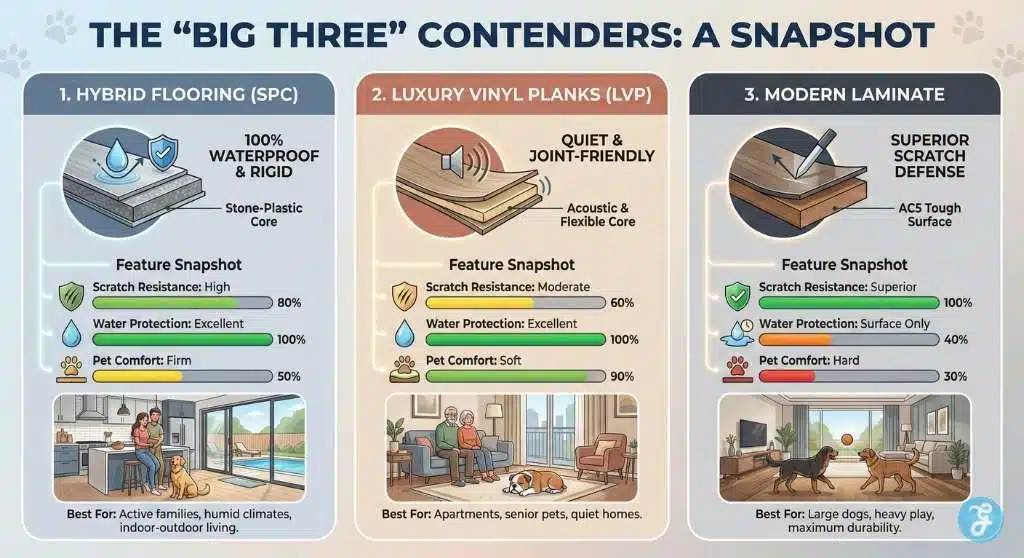
Before we dive deep into the technicalities, it is essential to understand the three main categories dominating the Australian market for pet owners. Each has distinct advantages depending on your specific pet (big drooly dog vs. nimble cat) and your home’s climate.
1. Hybrid Flooring (SPC)
-
The All-Rounder: A rigid combination of vinyl and laminate technologies.
-
Best Feature: 100% Waterproof and temperature stable.
-
Ideal For: Families with pools, puppies in training, or humid climates (QLD/NT).
2. Luxury Vinyl Planks (LVP)
-
The Comfort Choice: Flexible, synthetic planks that are soft underfoot.
-
Best Feature: Acoustic silence and joint support for older pets.
-
Ideal For: Apartments, multi-story homes, and senior dogs with arthritis.
3. Modern Laminate
-
The Scratch Defender: Wood-based boards with an incredibly hard top layer.
-
Best Feature: Superior scratch resistance (often harder than timber).
-
Ideal For: Large, active dogs with sharp claws.
Why Hybrid Flooring is Winning the Race
When industry experts discuss the Best Pet Friendly Flooring currently available, Hybrid flooring (specifically Stone Plastic Composite or SPC) is frequently the top recommendation. It addresses the two biggest nightmares for pet owners: moisture and temperature.
Waterproof vs. Water Resistant
This is a critical distinction. Traditional timber and older laminates are merely water-resistant, meaning they can handle a spill if you wipe it up quickly. Hybrid flooring is 100% waterproof. If your dog knocks over a water bowl while you are at work, or if a new puppy has an accident that sits for hours, the boards will not swell, buckle, or peel. This peace of mind is invaluable for Aussie families.
Durability and Stability
Australia’s harsh sun can wreak havoc on floors near sliding doors. Hybrid flooring’s limestone core (SPC) makes it incredibly stable in changing temperatures, unlike solid timber, which expands and contracts. For pets, this rigid core also means the floor feels solid underfoot, providing a stable platform for running and playing.
Key Spec to Watch: Look for a wear layer of at least 0.5mm (commercial grade). This top clear layer is what stands between your dog’s claws and the beautiful timber print underneath.
Luxury Vinyl Planks: The Quiet Achiever
If you have ever lived in a house with laminate flooring and a dog, you know the sound: click-click-click. It can be relentless. Luxury Vinyl Planks (LVP) solve this problem entirely.
Acoustics and Anxiety
LVP is made of softer, synthetic materials that absorb sound. For anxious pets who get startled by loud noises, or for owners who value peace and quiet, this is a game-changer. The acoustic dampening properties also make it a neighbour-friendly choice for those living in apartments or townhouses.
Joint Health for Senior Pets
Just like runners prefer a track with a bit of “give” over concrete, older pets benefit from softer flooring. The slight cushioning effect of vinyl is much kinder to the hips and joints of ageing dogs compared to the unforgiving hardness of tiles or polished concrete.
The Trade-Off: While vinyl is tough, it is softer than laminate. Heavy furniture can leave indentations over time, and extremely sharp claws on a heavy dog can potentially gouge the surface if the wear layer isn’t thick enough.
Laminate: The Heavyweight Champion of Scratch Resistance
Don’t let the memories of cheap 90s laminate fool you. Modern, high-quality laminate is a beast when it comes to abrasion. It is often constructed with a melamine wear layer containing aluminium oxide, the second hardest substance after diamond.
The AC Rating System
When shopping for laminate, you will see an “AC Rating” (Abrasion Class). For a pet-friendly home, you should ignore anything below AC3.
-
AC3: Good for residential use, small pets.
-
AC4: Excellent for active families and medium dogs.
-
AC5: Commercial grade. This is the gold standard for giant breeds or multi-pet households.
The “Ice Rink” Factor
The downside of laminate’s hardness is that it can be slippery. To mitigate this, avoid high-gloss “piano” finishes. Instead, opt for “Embossed in Register” (EIR) finishes. This technology stamps a texture onto the board that perfectly matches the wood grain image, providing essential traction for paws to grip.
Comparison Table: At a Glance
| Feature | Hybrid Flooring (SPC) | Luxury Vinyl (LVP) | Modern Laminate |
| Scratch Resistance | High (Resists most claws) | Moderate (Good, but soft) | Superior (Hardest surface) |
| Water Protection | 100% Waterproof | 100% Waterproof | Water Resistant (Surface only) |
| Pet Comfort | Firm (Stable but hard) | Soft (Best for joints) | Hard (Can be cold/stiff) |
| Noise Levels | Quiet (With acoustic backing) | Silent (Absorbs paw clicks) | Noisy (Click-clack sound) |
| Urine Resistance | Excellent (Won’t stain) | Excellent (Won’t stain) | Good (Must clean quickly) |
| Traction (Grip) | Good (If textured finish) | Excellent (Natural grip) | Low (Slippery if gloss) |
Flooring to Avoid (The “Do Not Buy” List)
In your search for the Best Pet Friendly Flooring, you will encounter salespeople trying to push products that look great in the showroom but fail miserably in a pet-filled home.
1. Bamboo Flooring
Often marketed as “eco-friendly” and “harder than oak,” bamboo has a fatal flaw: moisture sensitivity. In the humid parts of Australia, or with just one unnoticed pet accident, bamboo boards can swell dramatically. Once swollen, they rarely shrink back to their original shape, leaving you with unsightly cupping.
2. Solid Softwood Timber
Pine and other softwoods are beautiful but impractical. A 30kg Labrador simply walking across a Pine floor can leave indentations. If you must have real timber, stick to high Janka-rated Australian hardwoods like Spotted Gum or Ironbark, but be prepared for maintenance.
3. Polished Porcelain Tiles
While they are impervious to scratches, high-gloss tiles are a safety hazard. They offer zero traction for paws. This can lead to hip dysplasia or ligament tears in active dogs who slip while cornering. If you want tiles, choose a matte, textured finish.
4. Loop Pile Carpet
If you want carpet in the bedrooms, avoid “loop pile.” Cat claws can easily get snagged in the loops, unravelling the carpet and potentially injuring the cat’s toe. Always choose “cut pile” (plush or twist) where the fibres stand straight up.
The Technical Buying Guide: What to Ask
To ensure you are truly getting the Best Pet Friendly Flooring, you need to speak the language of the experts. When you visit a showroom, ask these three critical questions:
1. “What is the Slip Rating?”
In Australia, slip resistance is measured in ‘R’ ratings (Ramp test) or ‘P’ ratings (Pendulum test).
-
Goal: You want a rating of R10 or P3.
-
Why: This provides enough grip for a dog to trot without sliding, but isn’t so rough that it becomes impossible to mop. Anything lower (R9) is too slippery; anything higher (R11/R12) will trap dirt and be a nightmare to clean.
2. “What is the Wear Layer thickness?”
For Vinyl and Hybrid floors, the wear layer is your shield.
-
Entry Level: 0.3mm (Avoid for pets).
-
Family/Pet Standard: 0.5mm (Highly Recommended).
-
Commercial: 0.7mm (Indestructible, but often more expensive).
3. “Is it Low VOC?”
Pets spend their lives with their noses inches from the floor. Volatile Organic Compounds (VOCs) are chemicals that off-gas from cheap plastics and glues. Ensure your flooring is certified FloorScore® or meets Australian low-VOC standards to protect your pet’s respiratory health.
Design Hacks for Hiding the Mess
Even the most durable floor will eventually show signs of wear. However, smart aesthetic choices can make wear and tear virtually invisible.
-
Colour Matching: It sounds simple, but it works. If you have a Golden Retriever, a blonde “Tasmanian Oak” or “Blackbutt” colour will hide the shedding fur significantly better than a dark “Jarrah” floor. Conversely, if you have a black dog, avoid white-washed Scandi floors.
-
Matte over Gloss: High-gloss finishes act like mirrors, highlighting every smudge, nose print, and micro-scratch. A matte or satin finish absorbs light and hides imperfections.
-
Variation is Key: Choose a floor design with high “colour variation” (knots, grains, and changing tones). A uniform, solid-colour floor shows dirt instantly. A floor with a busy, natural grain pattern camouflages muddy paw prints until you have time to clean them.
Installation and Maintenance for Pet Owners
Choosing the floor is only half the battle. How you install and maintain it dictates its longevity.
The Importance of Underlay
Never skimp on underlay. For Hybrid and Laminate, a high-quality acoustic underlay does more than dampen sound; it levels out minor subfloor imperfections. If a heavy dog jumps on a board that has a hollow gap underneath due to a poor subfloor, the click-lock mechanism can snap.
Cleaning Protocols
-
Avoid Steam Mops: Despite what TV commercials say, forcing superheated steam into the joints of any floating floor (even a waterproof hybrid) is risky. It can degrade the adhesives and seals over time.
-
pH Neutral Cleaners: Harsh chemicals can strip the protective wear layer. Use a pH-neutral cleaner specifically designed for your floor type.
-
The “Welcome Mat” Strategy: Place high-quality, absorbent mats at every entrance. Stopping the grit and sand at the door is the single most effective way to prevent scratching.
Cost Breakdown: What Should You Pay?
Prices vary wildly across Australia, but here is a realistic guide for quality, pet-friendly materials (supply only, per square metre):
-
Budget Laminate (AC3): $25 – $40 (Not recommended for big dogs).
-
Quality Laminate (AC4/5): $45 – $75 (Sweet spot).
-
Luxury Vinyl Plank: $40 – $70.
-
High-Spec Hybrid (SPC): $50 – $90.
-
Engineered Timber: $100 – $200+ (Requires high maintenance).
Note: Installation usually adds another $30-$50 per square metre, depending on your location and the complexity of the job.
Frequently Asked Questions (FAQs)
1. Can I install Hybrid flooring over my existing tiles?
Yes, in most cases! This is one of the biggest advantages of Hybrid flooring. Because it has a rigid core and often comes with a built-in underlay, it can bridge the grout lines of existing ceramic tiles without them “telegraphing” (showing through) the surface. This saves you the massive cost and mess of ripping up old tiles.
2. Is “scratch-resistant” the same as “scratch-proof”?
No. No flooring material on earth is truly scratch-proof (even concrete can chip). “Scratch-resistant” means the material has a hardened wear layer designed to deflect daily abuse. However, if a 40kg dog digs frantically at a spot, they will eventually leave a mark. Keeping nails trimmed is just as important as the floor you choose.
3. My dog has accidents often. Is Laminate really a bad choice?
If accidents are frequent (e.g., an incontinence issue or a puppy), standard laminate is risky because liquids can seep into the joints and swell the fibreboard core. However, “Hydro” ranges of laminate now exist with water-repellent coatings on the joins. If you love the look of laminate, ensure you buy a range explicitly marked as “waterproof surface” or “wet area approved.”
4. Will pet urine stain vinyl or hybrid floors?
Generally, no. The synthetic top layer of Hybrid and Vinyl floors is non-porous and highly resistant to chemical staining, including the acidity of urine. However, urine should still be cleaned up promptly to prevent odours from getting trapped in the microscopic gaps between planks.
5. What is the best flooring for a large, heavy dog?
For giant breeds (Great Danes, Mastiffs), High-Quality Laminate (AC5 rated) or Hard Hybrid is best. Large dogs exert immense pressure through their claws. Soft vinyl might dent under their weight when they stand up, and real timber will gouge. A hard, textured laminate offers the best resistance to that heavy downward pressure.
The Final Thought: Style Meets Survival
Finding the best pet-friendly flooring isn’t about finding the indestructible—it’s about balancing aesthetics with your pet’s habits. The golden rule? Prioritize technical specs over colour. You can find a nice oak shade in any range, but you can’t fix a floor that swells from a puppy accident.
-
For Peace of Mind: Choose Hybrid (SPC). It is 100% waterproof and the best “set and forget” option for active families.
-
For Comfort & Quiet: Choose Luxury Vinyl (LVP). It is silent and kind to the joints of ageing dogs.
-
For Toughness: Choose AC5 Laminate. It offers superior scratch resistance for large, active dogs.
Before buying, take a sample home. Scratch it with keys and let your dog walk on it. The best floor is the one that passes your “real life” test.





















