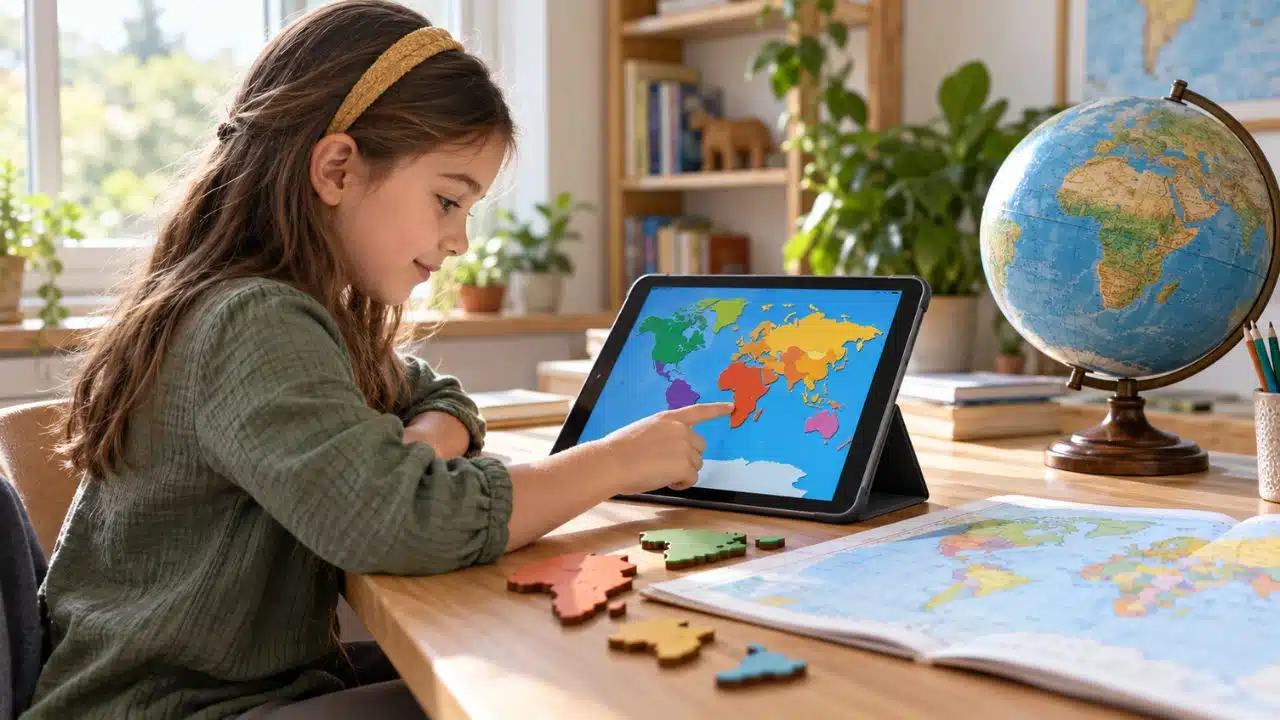
When I began looking for the best geography and map games for kids, I did not want nine versions of the same flag quiz. Place names matter, but geography should also build a sense of location, distance, landforms, borders, and how places connect.
For this guide, I compared features, platforms, pricing, privacy information, and age fit across quizzes, puzzles, globe-based play, and real-world deduction. These are editorial recommendations; the right choice depends on the child.
Geography and Map Games for Kids at a Glance
| Game | Best for | Suggested age | Platforms | Cost model |
| Seterra Geography | Broad map practice | 8+ | Web, iOS, Android | Free |
| Stack the States 2 | US states and capitals | 7–11 | iOS, Android | One-time purchase |
| Stack the Countries | Playful world geography | 7–12 | iOS, Android | One-time purchase |
| World Geography Games | Free browser activities | 8–13 | Web | Free with advertising |
| Maps of Our World | Political and physical maps | 8–13 | iPhone, iPad | Free to try; paid map packs |
| JigsawGeo | Globe-based map puzzles | 9–13 | iPhone, iPad, Mac | Two maps free; paid expansions |
| WorldHop: Kids Geography | Younger learners | 6–9 | iOS, Android | Free trial; one-time unlock |
| Worldle | A daily family puzzle | 9+ | Web | Free daily game; paid archive |
| GeoGuessr | Real-world visual deduction | 13+ | Web, iOS, Android | Limited free play; subscription |
The ages are my learning-fit suggestions, not app-store ratings. Prices and availability can change. This is not a strict best-to-worst ranking; each game meets a different need.
1. Seterra Geography
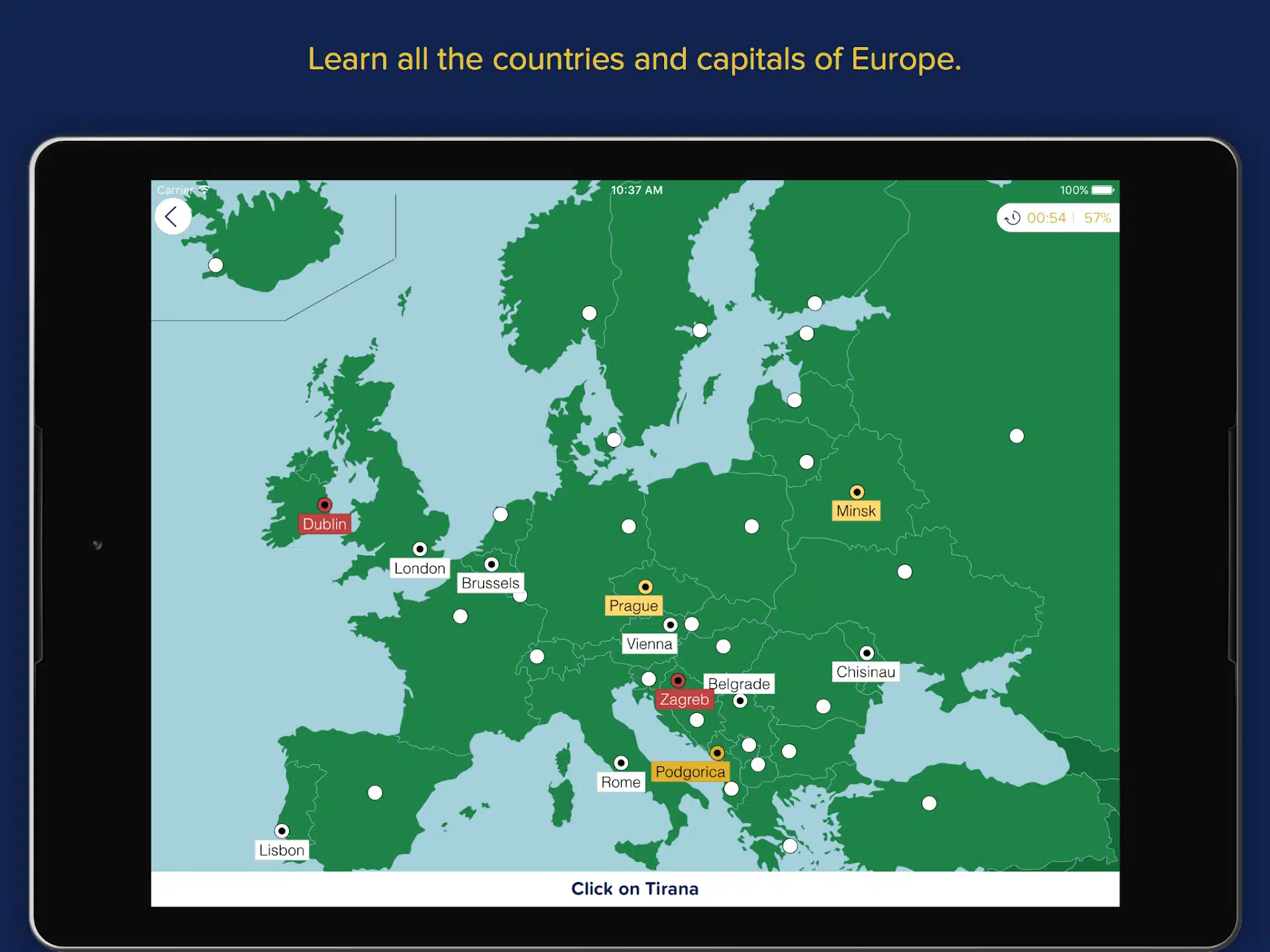
Seterra is my strongest all-around starting point. Its large quiz library goes well beyond countries and flags to include capitals, provinces, cities, oceans, rivers, mountains, volcanoes, and islands. Parents can narrow practice to one continent or topic, while Learn Mode and custom quizzes help keep the challenge manageable.
It feels more like focused practice than an adventure, and recognition questions do not prove independent recall. After a round, I would ask the child to label three places on a blank map. A few recent Android reviews mention zoom and performance issues, so the browser version may be the better starting point.
2. Stack the States 2
Stack the States 2 gives every correct answer a physical purpose. Children move and drop animated state shapes, trying to build a stack high enough to complete the level. That simple mechanic makes repeated questions feel less like a worksheet.
The app covers state locations, capitals, cities, flags, shapes, and landmarks. Bonus activities, multiple profiles, and voice mode add value. It is a modest one-time purchase with no third-party advertising or extra purchases listed.
Its boundary is obvious: this is a US-only game. After playing, ask the child to plan an imaginary journey through three neighboring states.
3. Stack the Countries
Stack the Countries takes the same stacking idea around the world. Children answer questions, collect countries, and unlock more map games. Beginners can focus on one continent at a time.
Topics include capitals, cities, landmarks, neighbors, languages, flags, and country shapes. It is a one-time purchase with no third-party advertising or extra purchases listed.
The tradeoff is depth: it favors political geography over climate, landforms, or human-environment relationships. Afterward, choose one collected country and find its main language, a landmark, and a neighbor in a current atlas.
4. World Geography Games
World Geography Games earns its place through sheer range. Alongside countries, capitals, and flags, its browser activities cover rivers, mountains, deserts, volcanoes, oceans, latitude and longitude, biomes, and the water cycle.
Nothing needs downloading, no registration is required, and the publisher says scores are not stored on its servers. The tradeoff is advertising and analytics cookies; the site may also have problems in Brave. Families wanting an ad-free space may prefer another option.
It is easy to connect the quizzes to a wider lesson. Ask why towns often develop near certain rivers or mountains, turning recall into geographic thinking.
5. Maps of Our World
Many geography games stop at borders and capitals. Maps of Our World also includes physical maps featuring rivers, lakes, mountains, and deserts. That makes it one of the more balanced options for children ready to see that a country is more than its outline.
Children can study before a quiz and progress to harder levels. The app is free to try, but deeper collections cost extra; the complete collection was $19.99 when I checked. It is Apple-only and feels more like polished map study than a story.
Its best use is comparison: open political and physical maps of one region, then discuss how rivers or mountains may influence cities and borders.
6. JigsawGeo
JigsawGeo turns countries and regions into puzzle pieces that children place on an interactive 3D globe. Its six levels progress from guided placement to country names, capitals, flags, and pinpointing capital cities.
The globe matters because flat maps can distort the apparent size of countries. Moving pieces around a sphere builds a more realistic mental picture. JigsawGeo includes two free maps, with others sold separately, and lists no advertising, accounts, subscriptions, or data collection.
Compatibility is its biggest drawback: the current mobile release requires iOS or iPadOS 26. Optional Game Center leaderboards are another setting for families to consider. As a follow-up, compare Greenland and Africa on the globe and a flat map.
7. WorldHop: Kids Geography
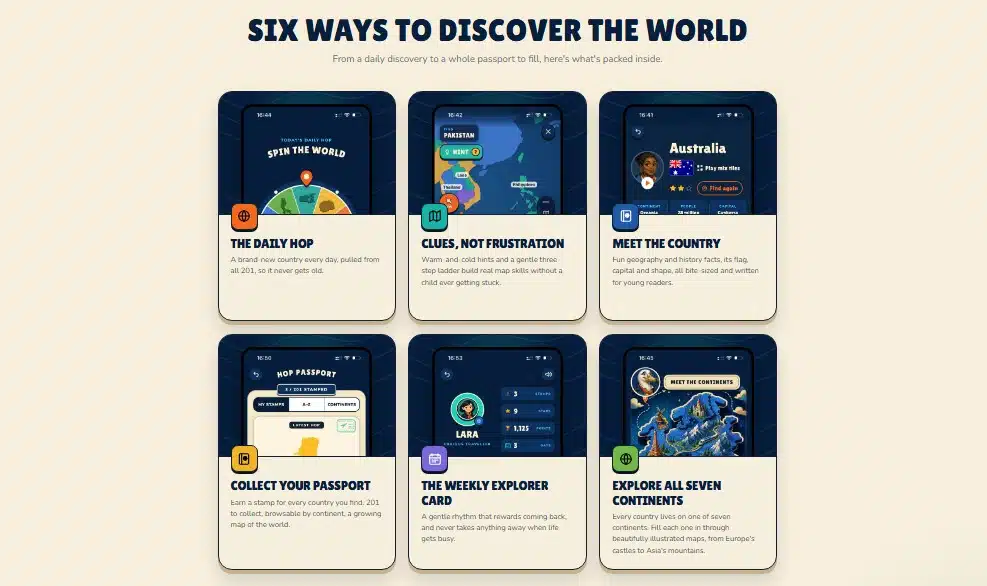
WorldHop is the gentlest entry here. Each day, children find a country on a movable world map and add it to a personal passport. Recorded narration reduces the reading demand.
Guided journeys introduce continents, oceans, Earth, and climate. The app works offline, supports multiple profiles, and lists no advertising, accounts, or data collection. A 14-day trial precedes the one-time unlock.
I would still call WorldHop promising rather than proven. It launched in September 2026 and has limited review history, so its long-term reliability remains unknown.
8. Worldle
The original Worldle asks players to identify a country or territory from its silhouette in six guesses. Wrong answers provide distance, direction, and proximity clues, making children think about relative location.
The daily puzzle is free in desktop and mobile browsers. Bonus rounds add neighbors, capitals, flags, and facts. The site contains advertising, while earlier puzzles require a paid account.
Spelling, unscaled silhouettes, and distance clues may frustrate younger children. I see Worldle primarily as a family game: make a guess together, locate the country on a globe, and trace the direction shown by the next clue.
9. GeoGuessr
GeoGuessr is the least conventional recommendation here. Instead of asking for a capital or flag, it places the player in real-world street imagery. The challenge is to study road markings, signs, languages, vegetation, terrain, architecture, and other details before placing a guess on the map.
Some play is available for free, while broader map access, multiplayer modes, and competitive features require a subscription. I would not recommend it for unsupervised elementary use. Its current Apple listing carries a 13+ rating and notes contests, chat, and user-generated content.
For teenagers or parent-led family play, however, it can be excellent. Before guessing, ask the player to name three clues and explain what each suggests.
What Geography Games Teach, and What They Miss
The messy reality is that most geography games teach map recall, not the whole subject. Recognizing Brazil or locating the Nile is valuable, but geography also asks why cities develop where they do, how climate shapes daily life, and how people change their environments.
I treat these games as starting points. Map practice becomes more meaningful when it leads to a genuine question: Why is that city beside a river? Why do those countries share a language? Why does that border follow a mountain range?
No badge proves deep understanding. Progress appears when a child uses map knowledge in a book, news story, journey, or conversation.
A Map Is the Beginning, Not the Lesson
The best geography and map games for kids do more than reward memorization. They help children build a mental map of the world. Seterra is the broadest starting point, the Stack games make recall playful, WorldHop welcomes younger learners, and Worldle and GeoGuessr ask older children to reason from clues.
My rule is simple: choose one game that matches the child’s age and current goal, then carry one question beyond the screen. A globe, atlas, family route, or news story can turn a correct answer into knowledge the child can actually use.
Frequently Asked Questions on Geography and Map Games for Kids
1. What is the best free geography game for kids?
Seterra is my best free choice because it covers many topics, and its mobile listings state that it has no advertising or in-app purchases. World Geography Games is also broad and free but uses advertising and analytics cookies.
2. Which geography game is best for younger children?
WorldHop is the clearest early-elementary choice because it combines narration, short activities, and a simple passport system. Stack the States 2 can also work with voice mode and some initial help.
3. Are app-store age ratings reliable learning guides?
Not by themselves. An age rating usually describes permitted content, not educational difficulty. A child may still need to read names, understand directions, or tap small regions accurately.
4. Can a map game replace geography lessons?
No. Games are useful for practice, repetition, and curiosity, but they rarely cover human geography, environmental relationships, map bias, or why places change. They work best alongside books, atlases, discussion, and real maps.
5. Is GeoGuessr appropriate for children?
It is better suited to teenagers or parent-led play. Its mobile listing includes a 13+ rating, social features, contests, and user-generated content. Parents should review account and communication settings before a child uses it.