
Writing good content is already hard. Writing good content that also satisfies search intent, covers the right subtopics, avoids thin explanations, and gives editors something useful to improve is a different job entirely.
That is where content optimization tools come in. They do not replace editorial judgment, original insight, or expertise. But they can help writers see what top-ranking pages commonly cover, where a draft is weak, which related terms may be missing, and whether the structure is strong enough for search-driven publishing.
The mistake is treating these tools like magic ranking machines. The smarter use is treating them like editorial x-rays: they show gaps, patterns, and missed opportunities, but a human still has to decide what deserves to be added.
Our Selection Criteria
We selected these tools based on practical usefulness for SEO writers, content teams, agencies, and publishers.
| Criteria | What We Looked For |
|---|---|
| SERP analysis | Does the tool analyze top-ranking pages and search intent? |
| Content scoring | Does it give useful optimization feedback without encouraging keyword stuffing? |
| Brief creation | Can it help build briefs, outlines, or topic structures? |
| Draft optimization | Does it support writers while editing or refreshing content? |
| Ease of use | Can writers and editors actually use it without needing a technical SEO background? |
| Team fit | Is it useful for freelancers, agencies, in-house content teams, or enterprise SEO teams? |
8 Best Content Optimization Tools for SEO Writers and Content Teams
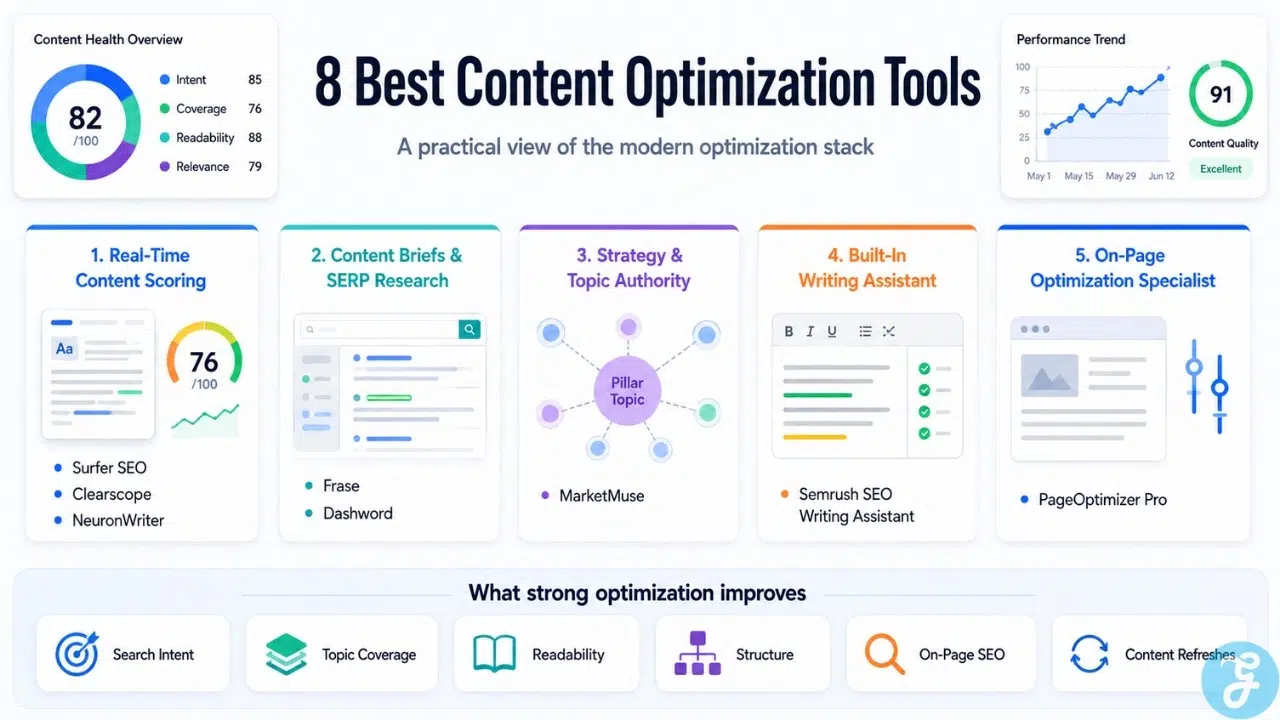
These content optimization tools are not all built for the same kind of user. Some are better for writers, some for agencies, some for enterprise strategy, and some for strict on-page optimization.
1. Surfer SEO
Surfer SEO is one of the most popular content optimization tools for writers who want real-time SEO feedback while drafting. Its Content Editor helps users write and optimize content with real-time metrics for structure, word count, NLP-ready keywords, and images, while Surfer’s documentation says the editor uses top-ranking pages and competitor analysis to provide article guidelines.
It is especially useful when you want a clear content score, recommended terms, outline support, and a workflow that feels friendly for writers. Surfer works well for new articles and content refreshes, but the best results still come when writers use the suggestions selectively instead of chasing the score blindly.
Best Feature/For:
- Best for real-time SEO writing and content scoring
- Great for bloggers, agencies, affiliate sites, and SEO content teams
Why We Chose It:
- Easy-to-understand content editor
- Strong SERP-based recommendations
- Useful for both new drafts and content updates
- Good balance between SEO guidance and writer-friendly workflow
Things to consider:
- Can encourage over-optimization if used mechanically
- Writers still need to add originality, examples, and expert insight
2. Clearscope
Clearscope is a premium content optimization platform built for teams that care about quality, topic coverage, and search visibility. Its product page describes data-backed recommendations for creating comprehensive, high-ranking content, and its homepage now positions Clearscope around discoverability across Google, ChatGPT, and other search environments.
The tool is known for its clean interface, content grading, topic suggestions, and editorial-friendly workflow. It is a strong choice for serious content teams that want better optimization without overwhelming writers with too many technical controls.
Best Feature/For:
- Best for premium editorial SEO optimization
- Great for content teams, SaaS companies, agencies, and publishers
Why We Chose It:
- Very clean writing and grading experience
- Strong topic coverage recommendations
- Helpful for maintaining content quality across a team
- Better suited to editorial workflows than many cheaper tools
Things to consider:
- Pricing may be high for freelancers or small blogs
- It is mainly a content optimization tool, not a complete SEO suite
3. Frase
Frase has evolved from an SEO content briefing and optimization tool into a broader platform for SEO and AI-search visibility. Its official site says Frase researches markets, creates optimized content, and tracks visibility across Google, ChatGPT, and Perplexity.
Frase is especially useful for creating briefs quickly. Writers can research SERPs, understand common questions, build outlines, and optimize drafts from one place. It is a practical option for teams that produce content regularly and need to reduce research time without skipping search intent analysis.
Best Feature/For:
- Best for content briefs and SERP research
- Great for agencies, freelancers, and content operations teams
Why We Chose It:
- Speeds up content research and outlining
- Useful question and topic discovery features
- Helps connect search intent with draft structure
- Good fit for teams producing many SEO articles
Things to consider:
- AI-generated drafts still need strong human editing
- Best used as a research and optimization assistant, not a final writer
4. MarketMuse
MarketMuse is more strategic than many basic content optimization tools. Its Optimize page says the software provides personalized insights to improve even strong-performing articles, while its main site describes AI-powered software that helps teams decide what content to write and how much to write based on competitive weakness and content opportunity.
This makes MarketMuse especially useful for larger content programs. It is not only about fixing one article; it helps teams think about topical authority, content gaps, content planning, and optimization priorities.
Best Feature/For:
- Best for content strategy and topic authority planning
- Great for enterprise teams, publishers, and serious content marketers
Why We Chose It:
- Strong for content inventory and gap analysis
- Helps prioritize what to update or create
- Useful for building topical authority, not just optimizing one page
- Better suited for strategic SEO teams than casual users
Things to consider:
- Can feel complex for beginners
- Smaller teams may not need the full strategy layer
5. Semrush SEO Writing Assistant
Semrush SEO Writing Assistant is a good choice for teams already using Semrush. Its official page describes it as a smart writing editor for optimizing copy for engagement and SEO, and Semrush’s knowledge base says it analyzes content in real time for SEO performance, readability, originality, and tone of voice.
Its biggest advantage is ecosystem fit. If your team already uses Semrush for keyword research, competitor analysis, site audits, and reporting, SEO Writing Assistant keeps content optimization inside the same platform.
Best Feature/For:
- Best for Semrush users who want built-in writing optimization
- Great for marketing teams and agencies already using Semrush
Why We Chose It:
- Checks readability, SEO, tone, and originality
- Works well inside a broader SEO workflow
- Useful for writers who need simple real-time guidance
- Good option when content optimization is only one part of your SEO process
Things to consider:
- Not as specialized as tools like Clearscope or Surfer
- Best value comes when you already use Semrush regularly
6. NeuronWriter
NeuronWriter is a budget-friendly content optimization tool with AI writing and NLP-style recommendations. Its official site presents it as a content optimization tool, while its feature page says it uses AI to help create optimized content quickly and efficiently.
It is popular with freelancers, niche site owners, and smaller teams that want SERP-based optimization without paying premium enterprise prices. NeuronWriter can help with competitor analysis, content structure, suggested terms, and draft improvement.
Best Feature/For:
- Best value-focused content optimization tool
- Great for freelancers, bloggers, niche sites, and small agencies
Why We Chose It:
- More affordable than many premium tools
- Useful for content scoring and optimization guidance
- Includes AI-assisted writing features
- Good fit for smaller SEO workflows
Things to consider:
- Interface and workflow may feel less polished than premium tools
- Serious editorial teams may want stronger reporting and collaboration features
7. Dashword
Dashword is a simple, writer-friendly content optimization tool for creating briefs and improving drafts. Its official site says it helps users create content briefs quickly and optimize content for SEO, while its content optimization checker compares a page against top-ranking results for a target keyword.
Dashword is a good choice when you want practical guidance without a heavy platform. It works especially well for small teams that need briefs, topic coverage, and optimization feedback but do not want complicated dashboards.
Best Feature/For:
- Best for simple SEO briefs and lightweight optimization
- Great for small content teams, bloggers, and agencies
Why We Chose It:
- Easy to understand and use
- Helps writers create more complete content briefs
- Good for comparing drafts against SERP expectations
- Less intimidating than larger SEO platforms
Things to consider:
- Not as feature-heavy as Semrush, MarketMuse, or Surfer
- May not satisfy teams that need advanced content strategy tools
8. PageOptimizer Pro
PageOptimizer Pro, often called POP, is more focused on strict on-page SEO than broad editorial content strategy. Its comparison page lists features such as keyword insights, keyword strategy, POP NLP, content briefs, content editor, schema support, and EEAT-related checks, while its pricing page describes the POP Content Brief as a way to create or improve optimized pages using word count, keywords, and variations.
POP is useful when you want detailed on-page recommendations and a repeatable optimization checklist. It may appeal more to SEO specialists and agencies than casual writers because it leans into technical on-page execution.
Best Feature/For:
- Best for detailed on-page SEO optimization
- Great for SEO consultants, agencies, and content refresh workflows
Why We Chose It:
- Strong on-page optimization focus
- Useful for schema, entity, keyword, and page-level checks
- Good for improving existing pages methodically
- Helps agencies create repeatable optimization processes
Things to consider:
- Less editorially elegant than Clearscope or Dashword
- Better for SEOs than writers who only want light guidance
A Quick Overview
Here’s an overview of our top 8 selections:
| Tool | Best For | Main Strength | Best Fit |
|---|---|---|---|
| Surfer SEO | Real-time SEO writing | Content score and SERP-based terms | Bloggers, agencies, SEO teams |
| Clearscope | Premium editorial optimization | Topic coverage and content grading | SaaS, publishers, content teams |
| Frase | Briefs and SERP research | Fast outline and question research | Agencies, freelancers |
| MarketMuse | Content strategy | Topic authority and content gaps | Enterprise teams, publishers |
| Semrush SEO Writing Assistant | Semrush users | SEO, readability, tone, originality checks | Marketing teams |
| NeuronWriter | Budget optimization | Affordable SERP-based content guidance | Freelancers, niche sites |
| Dashword | Simple briefs | Lightweight content optimization | Small teams, bloggers |
| PageOptimizer Pro | On-page SEO | Detailed page-level recommendations | SEO consultants, agencies |
How to Choose the Right Content Optimization Tool
The best content optimization tool depends on your workflow, not just your budget. A solo blogger does not need the same platform as an enterprise content team managing thousands of URLs.
For most SEO writers, Surfer SEO, Frase, or Dashword will feel the most practical. For editorial teams with higher quality standards, Clearscope is one of the strongest choices. For content strategy and topic authority, MarketMuse is better suited. If your team already uses Semrush, SEO Writing Assistant is convenient. For budget-conscious SEO workflows, NeuronWriter is worth considering. For strict on-page optimization and refreshes, PageOptimizer Pro is a strong specialist option.
A simple selection framework:
- Pick Surfer SEO if you want a strong all-around writing optimizer.
- Pick Clearscope if editorial quality and topic coverage matter most.
- Pick Frase if your main need is faster briefs and SERP research.
- Pick MarketMuse if you need strategy, planning, and content gap analysis.
- Pick Semrush SEO Writing Assistant if you already use Semrush.
- Pick NeuronWriter if you want an affordable optimization workflow.
- Pick Dashword if you want simple briefs and easy optimization.
- Pick PageOptimizer Pro if you want detailed on-page SEO recommendations.
Final Checklist Before You Choose
Before subscribing to a content optimization tool, ask:
- Does it help with both new content and content refreshes?
- Does it analyze search intent and top-ranking pages clearly?
- Does it support writers without forcing keyword stuffing?
- Can your team use it inside its current writing workflow?
- Does the price make sense for your publishing volume?
Better Content Still Needs Better Judgment
Content optimization tools can make a draft stronger, clearer, and more complete. They can reveal missing subtopics, weak structure, thin explanations, and search-intent gaps.
But they cannot replace expertise. They cannot invent a useful opinion, interview a subject-matter expert, test a product, or understand your audience better than a good editor can.
The best workflow is simple: use these tools for research, structure, and optimization. Then use human judgment to make the content original, useful, accurate, and worth reading.
Frequently Asked Questions (FAQs) on Content Optimization Tools
What are content optimization tools?
Content optimization tools help writers and SEO teams improve content for search performance. They usually analyze top-ranking pages, suggest related topics, score drafts, and highlight gaps in structure, readability, or keyword coverage.
Which content optimization tool is best overall?
Surfer SEO is one of the best all-around choices for real-time content optimization. Clearscope is stronger for premium editorial workflows, while MarketMuse is better for strategic content planning.
Are content optimization tools good for beginners?
Yes, but beginners should avoid treating the score as the only goal. Tools like Surfer, Dashword, Frase, and NeuronWriter are easier to start with than more strategic platforms like MarketMuse.
Can content optimization tools guarantee rankings?
No. They can improve your chances by helping you cover search intent and strengthen content quality, but rankings also depend on authority, backlinks, technical SEO, competition, freshness, user satisfaction, and brand trust.
Which tool is best for agencies?
Surfer SEO, Frase, Semrush SEO Writing Assistant, NeuronWriter, and PageOptimizer Pro are all useful for agencies. The best choice depends on whether the agency needs briefs, writing optimization, reporting, or detailed on-page SEO recommendations.