
Adding greenery to your indoor spaces does more than just brighten up a room. The best air purifying plants can enhance your mood, sharpen your focus in the office, and create a tranquil sanctuary for sleep. While no plant replaces a high-end HEPA filter, these 15 varieties are the gold standard for durability, aesthetic appeal, and natural air filtration.
Quick Picks: Best Plants at a Glance
If you’re looking for the perfect match for your space, here is a quick breakdown of the top contenders based on light, care, and safety.
Quick Answer: The best air-purifying plants for bedrooms and offices are those that thrive in indirect light and require minimal maintenance. Top choices include the Snake Plant for its oxygen production at night, the ZZ Plant for low-light offices, and the Spider Plant for a pet-friendly, resilient option.
| Plant Name | Best Room | Light Level | Watering | Pet Safe? | Why We Love It |
| Snake Plant | Bedroom | Low to Bright | Every 2–3 weeks | No | Produces oxygen at night. |
| Spider Plant | Office | Medium | Weekly | Yes | Removes formaldehyde & safe for cats. |
| ZZ Plant | Office | Low | Monthly | No | Virtually indestructible; thrives in cubicles. |
| Peace Lily | Bedroom | Low to Medium | Weekly | No | Excellent for humidity and toxins. |
| Boston Fern | Office | Bright Indirect | Frequent | Yes | Natural humidifier; great for dry offices. |
| Aloe Vera | Bedroom | Bright | Every 3 weeks | No | Soothes skin and monitors air quality. |
Do Air Purifying Plants Really Work? (A Reality Check)
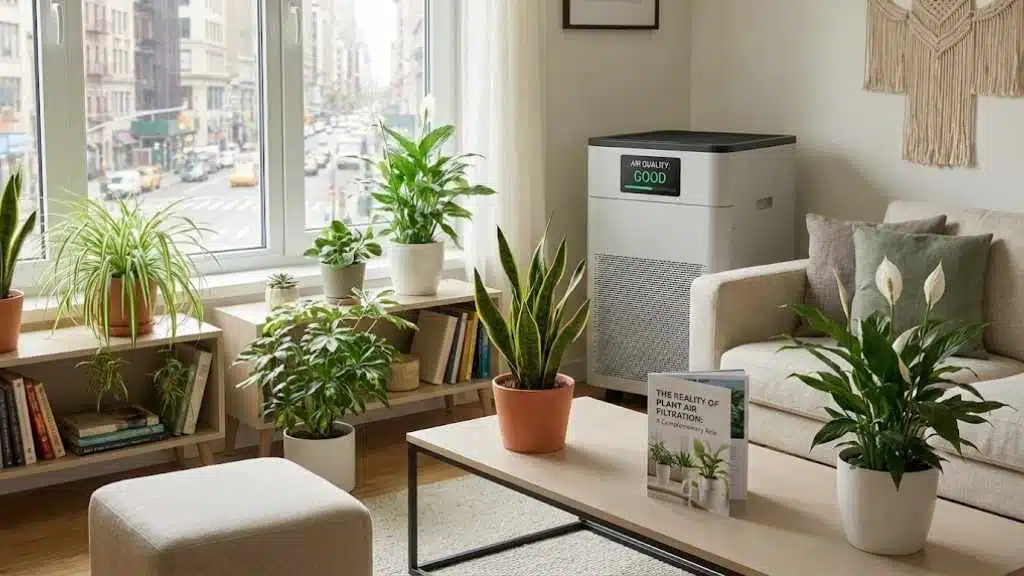
You’ve likely heard the claim that a few houseplants can turn your home into a pristine forest. This idea stems from the famous 1989 NASA Clean Air Study, which proved that certain plants could remove Volatile Organic Compounds (VOCs) like benzene and formaldehyde from the air.
The Lab vs. The Living Room
While the NASA results are scientifically accurate, there is a catch: those experiments were conducted in hermetically sealed space stations and lab chambers.
In a modern home or office, air exchange happens constantly through open doors, windows, and HVAC systems. Recent studies by environmental engineers suggest that to achieve the same filtration rate as a standard mechanical air purifier, you would need between 10 and 100 plants per square meter.
The Verdict: A Complementary Role
Does this mean plants are useless? Absolutely not. While they aren’t a replacement for a HEPA filter or proper ventilation, they offer “soft” benefits that machines can’t replicate:
- Micro-climate Control: Plants increase humidity, which can prevent dry skin and respiratory irritation in air-conditioned offices.
- Psychological Boost: Studies show that “Biophilia” (our innate connection to nature) reduces cortisol levels and improves productivity.
- Minor Toxin Reduction: They do absorb small amounts of pollutants over time, acting as a secondary support system for your indoor environment.
How to Choose the Right Plant for Bedroom vs Office
Selecting a plant isn’t just about looks; it’s about matching the plant’s “lifestyle” to your room’s environment.
Bedroom Factors
The bedroom should be a place of rest. When choosing greenery for this space, consider:
- Oxygen Cycles: Most plants take in CO2 during the day, but Snake Plants and Aloe Vera flip the script by releasing oxygen at night, potentially improving sleep quality.
- Low Fragrance: Avoid heavy-scented blooms (like some lilies or jasmine) if you are sensitive to smells while sleeping.
- Dust Management: Choose plants with smooth leaves that are easy to wipe down to prevent allergen buildup near your bed.
Office Factors
Office plants need to be “office-tough.”
- Light Variety: Many offices rely on fluorescent lights. Choose “low-light” champions like the ZZ Plant or Pothos.
- Neglect Tolerance: If you leave for a long weekend, you need a plant that won’t wilt by Monday morning.
- Desk Footprint: Opt for vertical growers or “trailing” plants that can sit on a high shelf without taking up valuable desk space for your monitors.
“Match Your Room” Decision Guide
- If you have low light: Go with a Snake Plant, ZZ Plant, or Chinese Evergreen.
- If you have a busy schedule: Choose Pothos or Rubber Plants—they handle missed waterings gracefully.
- If you have pets: Stick to Spider Plants, Areca Palms, or Boston Ferns. Always check the ASPCA Toxic and Non-Toxic Plants List before buying.
15 Best Air Purifying Plants
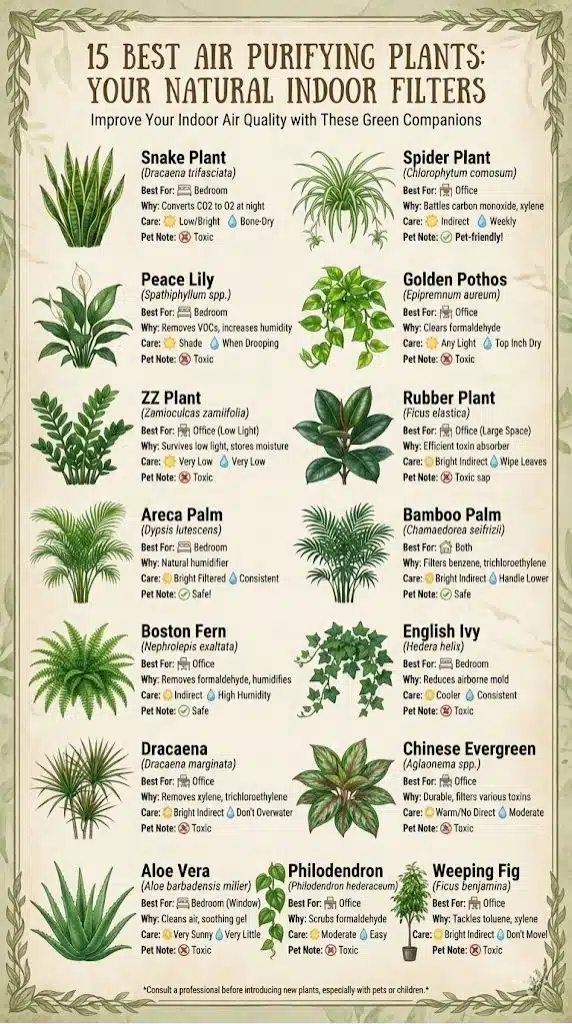
1. Snake Plant (Dracaena trifasciata)
Best for: Bedroom
Why it’s on the list: Known as “Mother-in-Law’s Tongue,” this is one of the few plants that converts $CO_2$ into $O_2$ at night.
Care basics: Thrives on neglect. Low to bright light; water only when the soil is bone-dry.
Placement tip: Place a tall variety in a corner to add height without taking up floor space.
Pet note: Toxic if ingested; keep away from curious chewers.
2. Spider Plant (Chlorophytum comosum)
Best for: Office
Why it’s on the list: Effectively battles carbon monoxide and xylene. It also produces “pups” (babies) that you can share with coworkers.
Care basics: Prefers indirect light and weekly watering.
Placement tip: Looks fantastic in a hanging basket or on top of a filing cabinet.
Pet note: Pet-friendly! One of the safest choices for cat owners.
3. Peace Lily (Spathiphyllum spp.)
Best for: Bedroom
Why it’s on the list: A powerhouse at removing VOCs like benzene and trichloroethylene. It also increases room humidity by up to 5%.
Care basics: Loves shade. It will “droop” when it’s thirsty, making it a great communicator.
Placement tip: Keep on a nightstand, but away from drafty windows.
Pet note: Toxic to both cats and dogs.
4. Golden Pothos (Epipremnum aureum)
Best for: Office
Why it’s on the list: Often called “Devil’s Ivy” because it’s nearly impossible to kill. It’s excellent at clearing formaldehyde.
Care basics: Thrives in almost any light. Water when the top inch of soil is dry.
Placement tip: Let it trail down from a bookshelf for a “jungle” vibe.
Pet note: Toxic if eaten.
5. ZZ Plant (Zamioculcas zamiifolia)
Best for: Office (Low Light)
Why it’s on the list: It can survive in windowless offices with only overhead fluorescent lighting.
Care basics: Very low water needs; its waxy leaves store moisture.
Placement tip: Perfect for a desk or a dim hallway.
Pet note: Keep out of reach of pets.
6. Rubber Plant (Ficus elastica)
Best for: Office (Large Space)
Why it’s on the list: The large surface area of its thick, dark leaves makes it an efficient absorber of airborne toxins.
Care basics: Bright, indirect light. Wipe leaves with a damp cloth to keep them shiny and functional.
Placement tip: A sturdy floor pot near a window.
Pet note: The sap can be irritating; keep away from pets.
7. Areca Palm (Dypsis lutescens)
Best for: Bedroom
Why it’s on the list: It acts as a natural humidifier, releasing moisture into the air—great for those with sinus issues.
Care basics: Needs bright, filtered light and consistent moisture.
Placement tip: Use it to fill an empty corner to create a tropical sanctuary.
Pet note: Safe and non-toxic!
8. Bamboo Palm (Chamaedorea seifrizii)
Best for: Both
Why it’s on the list: Exceptional at filtering out benzene and trichloroethylene. It brings a zen, calming aesthetic to any room.
Care basics: Prefers bright, indirect light but can handle lower light levels.
Placement tip: Near a piece of furniture to soften sharp lines.
Pet note: Safe for pets.
9. Boston Fern (Nephrolepis exaltata)
Best for: Office
Why it’s on the list: One of the best plants for removing formaldehyde and acting as a humidifier.
Care basics: Loves humidity. Mist it regularly or place it on a pebble tray.
Placement tip: Hanging in a bright corner or on a pedestal.
Pet note: Safe for pets.
10. English Ivy (Hedera helix)
Best for: Bedroom
Why it’s on the list: Studies suggest it can reduce airborne mold particles, which is a major win for allergy sufferers.
Care basics: Prefers cooler temperatures and consistent moisture.
Placement tip: On a high shelf where the vines can drape down beautifully.
Pet note: Toxic to pets; ensure it is hung high.
11. Dracaena (Dracaena marginata)
Best for: Office
Why it’s on the list: Its architectural, sword-like leaves remove xylene and trichloroethylene common in office paints and markers.
Care basics: Needs bright, indirect light. Don’t overwater.
Placement tip: A narrow corner where you need a “pop” of height.
Pet note: Toxic to cats and dogs.
12. Chinese Evergreen (Aglaonema spp.)
Best for: Office
Why it’s on the list: A durable plant that filters out a variety of toxins while tolerating low light and dry air.
Care basics: Keep it warm and out of direct sun.
Placement tip: Excellent for a desk or a medium-sized floor pot.
Pet note: Toxic if ingested.
13. Aloe Vera (Aloe barbadensis miller)
Best for: Bedroom (Window)
Why it’s on the list: It’s a “2-for-1” plant: it cleans the air and provides a soothing gel for minor burns or dry skin.
Care basics: Needs a very sunny spot and very little water.
Placement tip: A sunny windowsill.
Pet note: Toxic to pets.
14. Philodendron (Philodendron hederaceum)
Best for: Office
Why it’s on the list: Famous for its heart-shaped leaves and its ability to scrub formaldehyde from the air.
Care basics: Very easy to grow; prefers moderate light.
Placement tip: Train it to grow up a small moss pole or let it trail.
Pet note: Toxic if eaten.
15. Weeping Fig (Ficus benjamina)
Best for: Office
Why it’s on the list: A classic indoor tree that tackles pollutants like toluene and xylene.
Care basics: Sensitive to changes. Once you find a spot it likes, don’t move it!
Placement tip: Near a large window where it can grow into a centerpiece.
Pet note: Toxic to pets.
Placement and Care Tips That Improve Results
Where To Put Plants for Real-World Benefit
To maximize the “feel-good” factor and the minor air-cleaning benefits, placement is key:
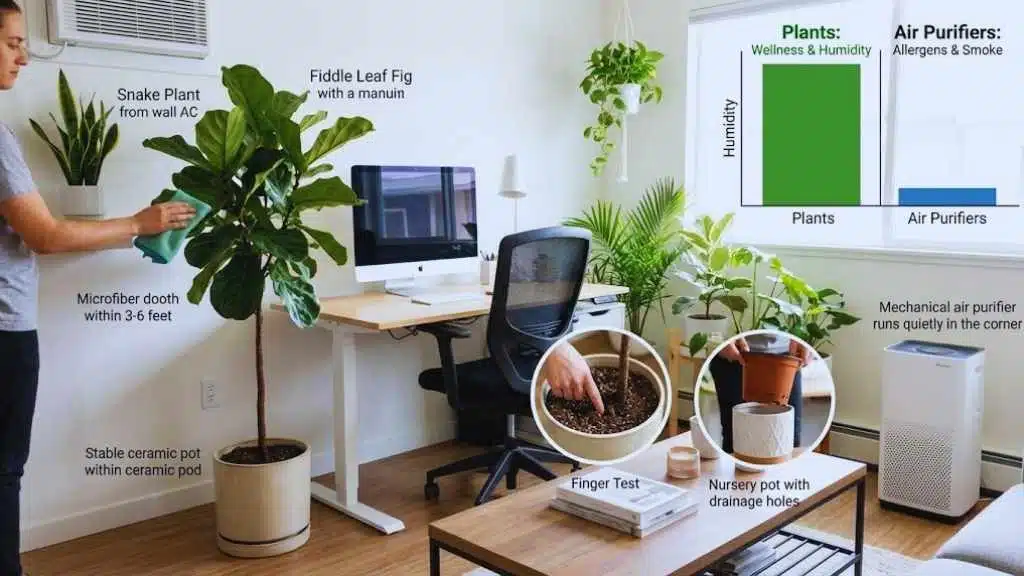
- The “Breathing Zone”: In your office, place plants within 3 to 6 feet of your desk. This ensures you benefit from the increased humidity and psychological calm.
- Stable Environments: Avoid placing plants directly in front of AC vents or heaters. Rapid temperature changes can shock the plant and cause leaf drop.
- Stable Foundations: Use heavy, stable pots for floor plants to prevent accidental tipping during a busy workday.
Maintenance That Matters
- Dust the Leaves: This is the most underrated tip. Dust blocks the plant’s “pores” (stomata), making it harder for them to breathe and filter air. A quick wipe with a microfiber cloth once a month makes a huge difference.
- Drainage is Non-Negotiable: Most indoor plants die from “wet feet” (root rot). Ensure your pots have drainage holes or use a “nursery pot” inside a decorative planter.
- The Finger Test: Before watering, stick your finger an inch into the soil. If it’s damp, wait. Overwatering is the #1 killer of office greenery.
Plants vs. Air Purifiers: The Bottom Line
Think of plants as wellness boosters, not industrial filters.
- Use Plants for: Stress reduction, humidity, beauty, and minor toxin removal.
- Use Air Purifiers for: Removing wildfire smoke, heavy allergens, pet dander, and viruses.
Final Thoughts
Integrating greenery into your workspace or sleeping quarters is more than a trend; it’s a commitment to a healthier, more mindful lifestyle. While science clarifies that a few potted plants won’t replace a high-tech air filtration system, their contribution to indoor wellness is undeniable. By naturally increasing humidity, sharpening cognitive focus, and providing a much-needed visual break from digital screens, these fifteen plants act as living anchors for your well-being.
The secret to success lies in the selection. Whether you choose the indestructible ZZ Plant for a dim office corner or the night-blooming Snake Plant for your bedside, matching the plant to your specific light levels and schedule ensures a thriving indoor garden. Remember to prioritize pet-safe varieties like the Spider Plant if you have furry companions, and don’t forget the occasional dusting to keep those leaves working efficiently. Ultimately, the best air-purifying plant is the one you can care for consistently. Start with one or two hardy varieties today, and transform your daily environment into a more vibrant, tranquil, and restorative space.