

Big trucks without drivers might sound like sci-fi. Yet right now, these smart trucks are being tested on real roads across America. Truck firms spend tons of cash on drivers, gas, and fixes.
Self-driving trucks could cut these costs and make shipping stuff cheaper for all of us.
What if trucks could drive day and night without breaks? Companies like Aurora and Waymo are racing to make this real by 2025. Their trucks use cameras and smart tech to see roads and dodge cars.
But will these robot trucks take over by 2025, or is it just big talk?
This blog will show you what these trucks can do now, what they might do soon, and if they’ll really change how we move goods. We’ll look at the good stuff (like safer roads) and the hard parts (like what happens to truck jobs).
Get ready for a ride into the future of freight.
Key Takeaways
- Aurora started the first real driverless truck service in Texas on May 2, 2025, moving over 10,000 loads across 1,200 miles without human help.
- Most trucks today are at Level 2 automation (some self-driving with a human watching), while companies aim for Level 4 (fully self-driving in most cases).
- Experts think it will take 10-20 more years before driverless trucks become common on our roads.
- Self-driving trucks can work 24/7 without breaks, unlike human drivers who are limited to 11 hours of driving time.
- The freight industry faces both benefits (lower costs, better safety) and big challenges (weather problems, job losses for 3.5 million US truck drivers).
What Are Autonomous Trucks?
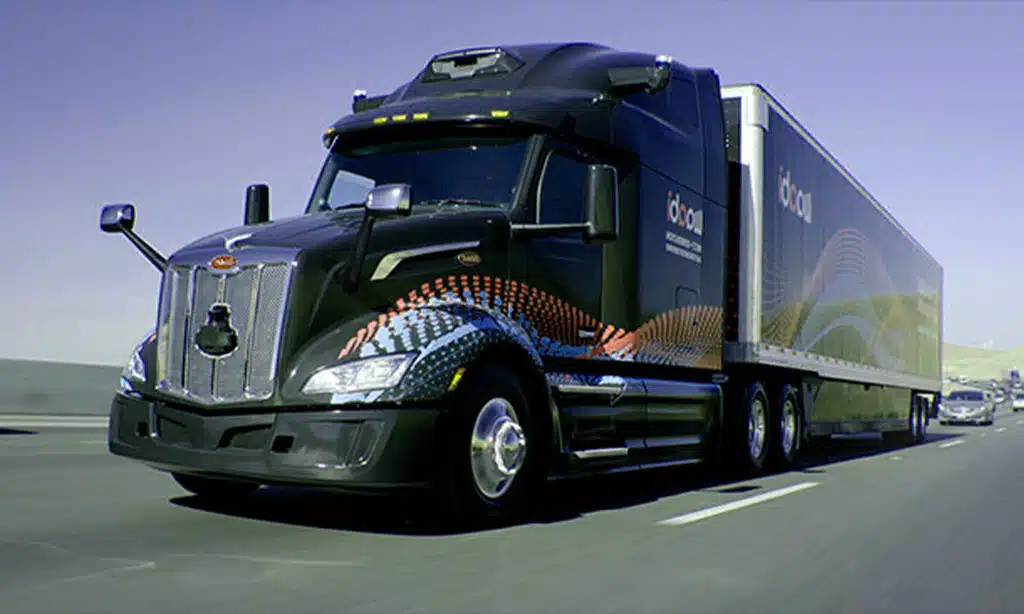
Autonomous trucks are big rigs that can drive with little or no human help. They use smart computer brains, cameras, and sensors to see the road and avoid crashes. Think of them as robot trucks that can steer, brake, and speed up on their own.
These trucks range from basic ones with simple cruise control (Level 1) to fully self-driving models that need no human at all (Level 5). Most trucks on roads today sit at Level 2, where they can do some tasks alone but still need a trucker behind the wheel watching things.
The tech inside these smart trucks is pretty cool. They use AI to make quick choices about traffic and road problems. Kodiak Robotics and other firms are testing trucks that can handle long-haul routes by themselves.
These trucks can “see” with light detection and ranging tools that spot objects far away. They also have systems that keep them in their lanes and can brake fast if needed. The goal is to reach Level 4 soon, where trucks can drive alone in most cases but might still need human help in tough spots like bad weather or tricky city streets.
How Close Are We to Fully Autonomous Trucks by 2025?
We stand at a key point in truck tech right now. Aurora made big news when they started the first real driverless truck service in Texas on May 2, 2025. They work with Uber Freight and Hirschbach Motor Lines to move goods.
Their trucks have moved more than 10,000 loads and gone 1,200 miles with no human help. This shows big steps in self-driving tech.
But full driverless trucks won’t be common soon. Most tests focus on Level 4 automation, where trucks can drive alone in set areas. The road has bumps too. In 2025, the Federal Motor Carrier Safety Administration said no to Aurora and Waymo’s wish to use new warning lights.
Also, Waymo stopped its truck work in 2023 to focus on taxi rides. Experts think it will take 10-20 more years before driverless trucks fill our roads. AI and machine learning keep getting better, but safety rules and real-world tests take time.
Benefits and Challenges of Autonomous Trucks in Freight
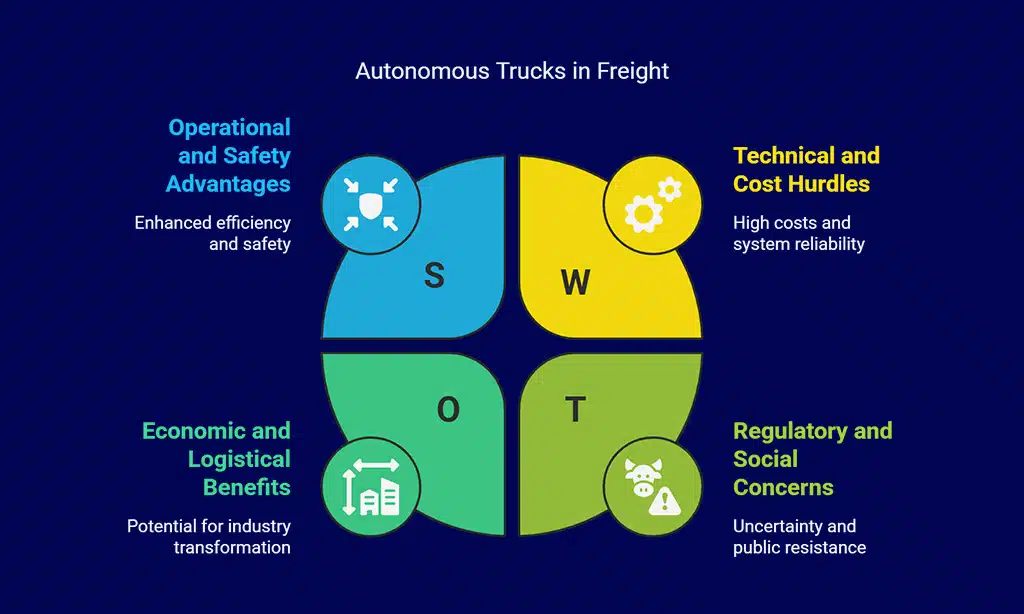
Autonomous trucks stand at a crossroads between revolutionary potential and significant hurdles. Let’s break down what’s at stake for the freight industry.
| Benefits | Challenges |
|---|---|
Non-Stop Operations
|
Tech Limitations
|
Money Savings
|
Legal Roadblocks
|
Safety Improvements
|
Social Concerns
|
Environmental Gains
|
Implementation Costs
|
Driver Shortage Solution
|
Technical Reliability
|
For freight companies, these factors create a complex decision. The promise of round-the-clock operations looks great on paper. Yet technical hurdles remain significant. Most experts agree partial automation will come first. Full autonomy still faces a bumpy road ahead.
Takeaways
Self-driving trucks are coming, but not as fast as some think. By 2025, we’ll see more trucks with smart tech helping drivers, not replacing them. The real magic happens when AI makes trucks safer and cuts costs for shipping companies.
Truck drivers will still have jobs, but their work will change as robots handle boring highway miles. The road to fully driverless trucks is long, with many bumps ahead in rules and public trust.
Still, the freight world is moving toward a mix of human skill and machine power that will shape how goods move across America for years to come.
FAQs
1. What are autonomous trucks and how will they change freight by 2025?
Autonomous trucks use self-driving technology and artificial intelligence to move goods without human drivers. By 2025, these smart trucks could cut fuel costs, drive longer hours, and make roads safer. Companies like Kodiak Robotics are already testing them on long-haul routes.
2. Will truck drivers lose their jobs to AI in trucking?
Not all truckers will lose jobs. Many self-driving trucks will still need humans for city driving and loading. Drivers might shift to fleet management or work as remote operators. The change will happen step by step, not all at once.
3. How do autonomous trucks save money for shipping companies?
Self-driving trucks slash costs in many ways. They don’t need rest breaks, cutting hours of service limits. AI-powered tools help with route optimization and lower fuel consumption. These trucks also need less maintenance and can run day and night.
4. Are autonomous trucks safe for our roads?
Safety is a top focus. These trucks have automatic emergency braking, lane departure warnings, and adaptive cruise control. They don’t get tired or text while driving. Tests show they can be safer than human drivers who might speed or feel fatigue.
5. What level of vehicle automation will trucks reach by 2025?
Most experts think trucks will reach SAE Level 4 automation by 2025. This means fully driverless operations in certain areas and weather. The trucks can drive themselves on highways, but might need help in cities or bad weather.
6. How will AI and machine learning improve the trucking industry beyond just driving?
AI helps the whole supply chain. Predictive maintenance catches problems before breakdowns. Machine learning algorithms manage inventory and plan better routes. AI chatbots handle customer service. The entire system gets smarter, not just the driving part.





















