Worried about all the new student visa rules for Australia? You are not alone. Many future students feel lost as big changes roll out in 2026.Here’s the biggest shock: a student visa application now costs AUD 2,000. But that’s just the start of the new regulations. This guide breaks down every major update for you, from the stricter age limits to the new “Genuine Student” test questions. We’ll keep it simple so your study abroad dreams don’t hit any roadblocks.
So, grab a coffee and let’s go through the exact steps you need to take. Stick around, and I’ll help you get clear answers before you send off that application.
Australia’s Student Visa Changes in 2026
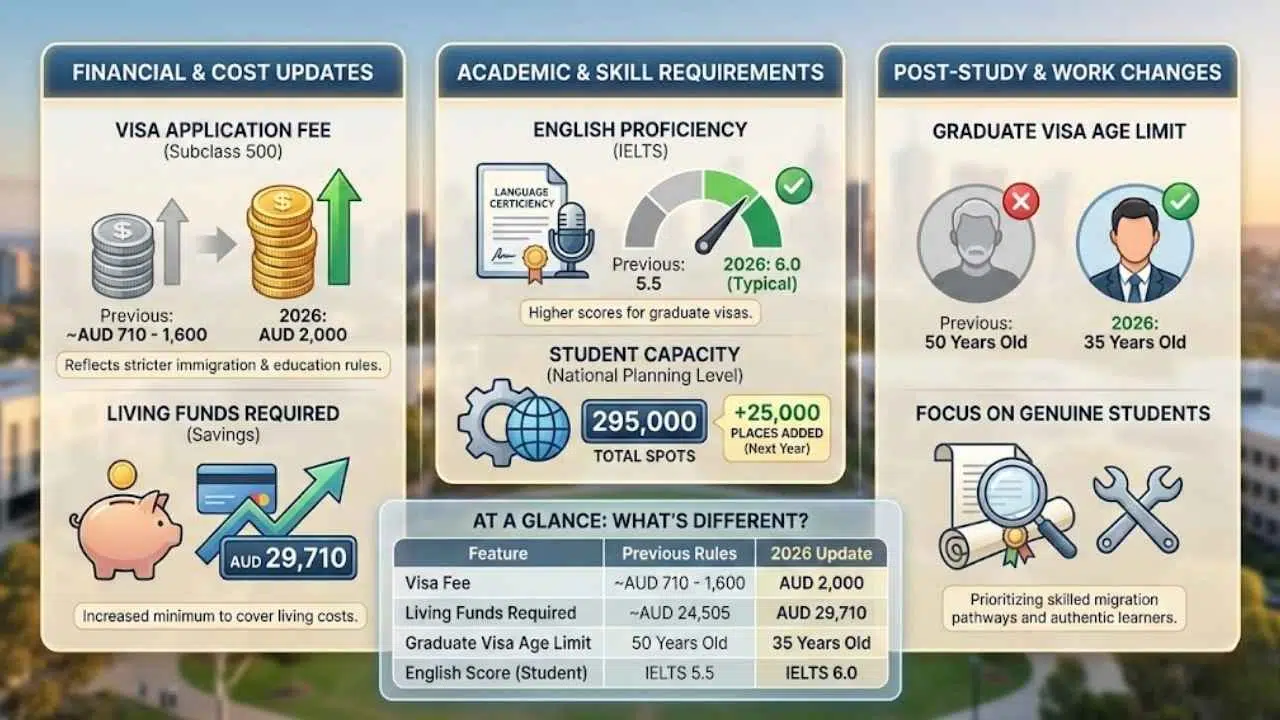
Australia is changing its student visa regulations in 2026 to focus on genuine students and skilled migration. The most immediate change you will notice is the cost.
The government has raised the application fee for the Student Visa (Subclass 500) to AUD 2,000. This increase reflects stricter rules across immigration policy and education system pathways.
There are now stricter English proficiency rules, with a typical IELTS score of 6.0 required for student visas, and even higher for graduate visas. Australia will also add another 25,000 places for international students within its National Planning Level of 295,000 spots next year.
Financial requirements have also gone up. You now need to show you have at least AUD 29,710 in savings to cover your living costs. New age limits apply too; anyone older than 35 cannot apply for the post-study work visa under these new regulations.
At a Glance: What’s Different?
| Feature | Previous Rules | 2026 Update |
|---|---|---|
| Visa Fee | ~AUD 710 – 1,600 | AUD 2,000 |
| Living Funds Required | ~AUD 24,505 | AUD 29,710 |
| Graduate Visa Age Limit | 50 Years Old | 35 Years Old |
| English Score (Student) | IELTS 5.5 | IELTS 6.0 |
Key Updates to the Student Visa (Subclass 500)
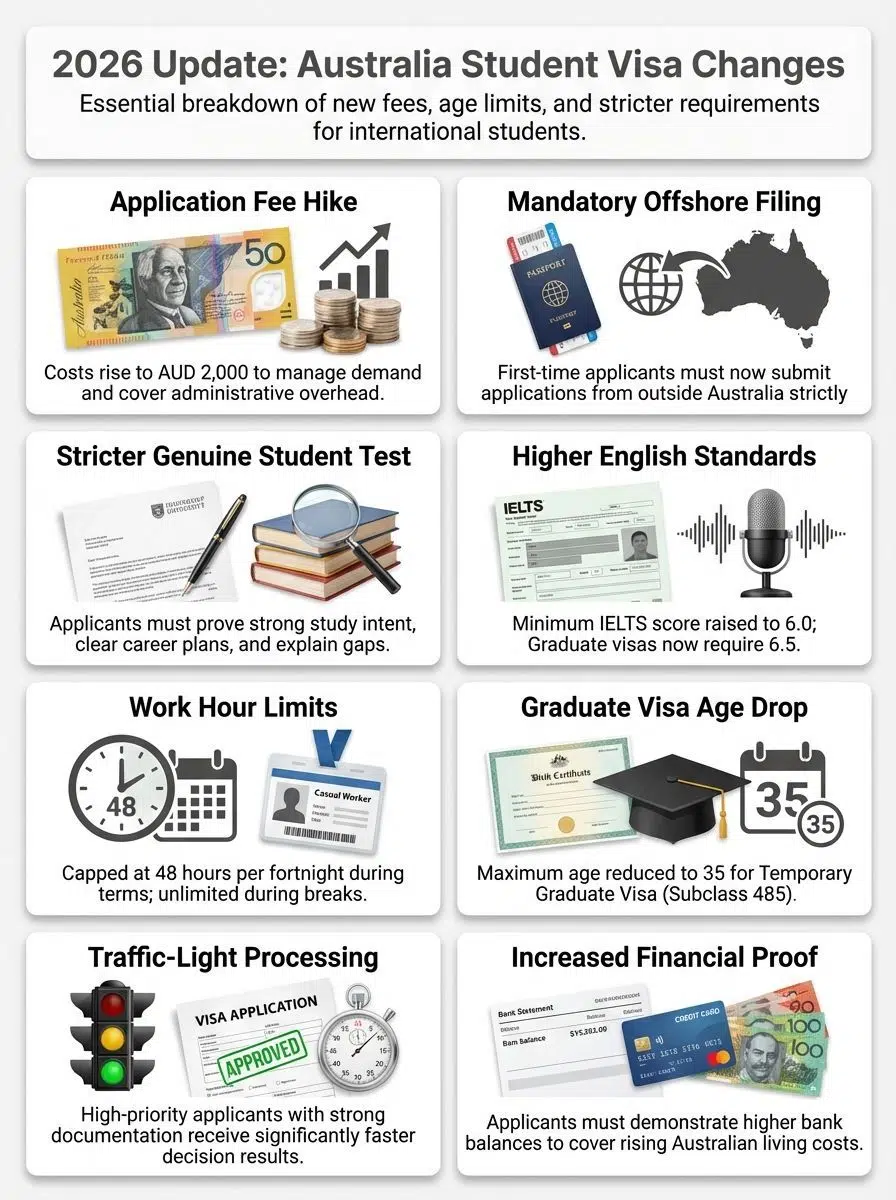
Big changes are shaping the Student Visa (Subclass 500) process for international students eyeing Australia. These updates touch on how you apply, what paperwork you need, and new rules to keep in mind before starting your journey.
Increased application fee to AUD 2,000
Australia now charges a processing fee of AUD 2,000 for the Student Visa (Subclass 500). This jump stands out compared to past years, making it one of the highest application fees among major study-abroad countries.
Many international students will need to show stronger financial proof before even clicking “submit” on their visa application. Reports say this increase aims to help manage demand and cover administrative costs as Australia plans for 25,000 new student places under its migration program in 2026.
Pro-Tip: The Visa Application Charge (VAC) is generally non-refundable, even if your application is rejected. Double-check your documents before paying, because you won’t get that AUD 2,000 back.
Higher upfront fees could mean budgeting is trickier than before. Some families might feel this pinch much more based on their home country’s exchange rates or income levels.
With tougher Genuine Student tests and higher English proficiency standards joining these changes, planning ahead now matters more than ever for every hopeful scholar chasing dreams Down Under.
Mandatory offshore applications for new student visas
New student visa applicants must now apply from outside Australia. This rule stops “visa hopping,” where people enter on a tourist visa and then switch to a student visa to stay longer.
The government aims to improve security and check each applicant’s intent with care before entry. By processing offshore, officers can better enforce the new Genuine Student test.
International students planning to study in Australia should prepare early. An application cannot start inside the country anymore, specifically if you are on a Visitor Visa (Subclass 600).
Updated Genuine Student (GS) requirement
Australia tightened its Genuine Student (GS) requirement in 2026, replacing the old “GTE” statement. Applicants now need to show strong reasons for choosing Australia, with clear study and career plans.
The GS test checks if students truly aim to study and not just use student visas as a backdoor for migration. Instead of a long essay, you now have to answer specific, targeted questions with a 150-word limit each.
The 4 Core Questions You Must Answer:
- Current Circumstances: Details about your family, community ties, and financial stability at home.
- Why this Course? Specific reasons for choosing this exact degree and provider over others.
- Value to Future: How this course directly benefits your career path back in your home country.
- Other Info: Any other relevant details supporting your case.
These stricter questions help officers spot fake applications more easily. Meeting the updated GS standard has become essential for international students wanting to pass the visa application process on their first try.
English Proficiency Requirements
You’ll need a higher English test score now, so check the new rules and find out which language exams count. This is one of the most common reasons for delays, so pay close attention.
Minimum IELTS score of 6.0
Australia has set the bar higher for English proficiency. Student visa applicants now face a minimum IELTS score of 6.0 to even get their foot in the door, while most university courses may require a band of 6.5 and at least 6.0 in each section.
This rule helps international students handle assignments, group work, and lectures without too many stumbles or blank stares. It ensures you can truly participate in the classroom.
Rahul from India, aiming for a spot in Sydney’s crowded classrooms, studies hard to reach this goal because every point counts on his application form under Australia’s updated immigration policy for 2026.
The rule keeps the playing field fair and gives all those wanting to study abroad in Australia a real shot at academic success.
Additional language tests accepted
Students now can meet English proficiency rules using tests beyond IELTS. Besides an overall IELTS score of 6.0 (or 6.5 for graduate visas), scores from other approved language exams are also valid for the Australia Student Visa application process in 2026.
Commonly Accepted English Tests:
- Pearson PTE Academic: Popular for its quick results.
- TOEFL iBT: Widely accepted by universities.
- Cambridge C1 Advanced: Often used for higher-level academic courses.
- OET (Occupational English Test): specifically for healthcare professionals.
Test results must not be older than two years at the time of visa lodgment. Officials want evidence that your language skills fit everyday life and education in Australia’s higher education system.
Visa Duration and Work Limitations
You can work up to 48 hours every two weeks during study, and get unlimited hours on breaks. But be careful—the calculation can be tricky.
48 hours per fortnight during study periods
Student visa holders now face a set limit of 48 work hours every two weeks during study terms. Australia’s new student visa regulations for 2026 enforce this rule so students can focus on their education while earning extra income.
Imagine juggling classes at university and then clocking in at the local café or tech startup. You have to count every shift carefully to ensure you don’t breach your visa conditions.
This change applies across all types of jobs, no matter if you’re stocking shelves or coding apps for a small company. It keeps international students from overworking and supports better academic results.
The Australian government hopes this balance between work and study will help more than 25,000 new international students join the country’s higher education system each year under the updated migration program plan.
Unlimited work hours during study breaks
Australia’s updated visa rules now allow international students to work as many hours as they wish during official study breaks. Many people use this time to save money or gain extra experience before classes start again.
For example, someone studying at a university in Sydney could pick up two part-time jobs during summer break and earn more for tuition or living costs. This helps offset the rising expenses that come with Australia’s new financial requirements.
These unlimited work rights are only active outside study periods. During semesters, students must stick to the strict limit of 48 hours per fortnight.
Changes to Post-Study Work Visas
Dream of working after your course? There are new age limits and rules for the Temporary Graduate Visa. This is perhaps the most critical update for mature students.
Revised Temporary Graduate Visa (Subclass 485) rules
The Temporary Graduate Visa (Subclass 485) rules have become stricter for 2026. Now, only people aged up to 35 years can apply for the standard Post-Higher Education Work stream. This change makes it more difficult for older graduates hoping to stay in Australia after study.
English language requirements are higher too, with an IELTS score of at least 6.5 and no band below 5.5 now needed.
Australia’s migration policy continues to keep skilled workers in focus, so employer sponsorship remains key if you want a more permanent spot later on. The visa changes reflect the country’s plan to fill skilled jobs while limiting longer stays by students who don’t meet new criteria.
Reduced age limit to 35 for eligibility
Australia’s student visa changes now set the maximum applicant age at 35 years. If you turn 36 before lodging your Temporary Graduate Visa (Subclass 485) application, you will not qualify under the new rules.
Before this update, many could apply up to age 50. Now, anyone aged above 35 must look for other migration options if they want to remain in Australia after their studies.
Exceptions to the Age 35 Rule:
- Masters by Research & PhD Graduates: You can still apply up to age 50.
- Hong Kong & BNO Passport Holders: You remain eligible to apply up to age 50.
This shift puts more focus on younger skilled migrants and tightens entry for older candidates. The adjustment is part of a bigger plan that supports Australia’s skilled migration program while managing its education system.
Introduction of Traffic-Light Processing System
Think of the new traffic-light processing for student visas as a fast lane or a slow lane. Your speed depends on your application and your provider’s risk level.
Faster processing for high-priority applicants
Australia now uses a traffic-light system for student visa processing. High-priority applicants can expect much faster results. This includes students with top English scores, strong financial proof, and clear Genuine Student test results.
If you submit an IELTS score above 6.5 and full documents that meet every rule, your application lands in the fast lane. This is often referred to as Evidence Level 1.
Australian immigration policies aim to bring skilled international students in quickly—especially those applying for high-demand study fields or graduate visas under Subclass 485 rules before turning 35 years old.
Time is money, as they say. These changes help get you on campus sooner and into Australia’s education system without long waits.
Stricter checks for lower-priority applications
Lower-priority student visa applications now face sharper eyes. Officers check every detail closely, from financial support to the new Genuine Student test. Miss a step, and delays can pile up fast.
Students from high-risk countries applying to high-risk providers (often called Evidence Level 3) will need to provide every single document upfront.
- Financials: You must prove every dollar of the AUD 29,710 requirement.
- English: You cannot rely on exemptions; test scores are mandatory.
- Interviews: You are more likely to receive a phone call to verify your GS answers.
International students without strong documents or clear study plans may find themselves stuck in limbo. Fee hikes play their part too; at AUD 2,000 per application, those who do not meet requirements could lose out on both time and money.
Financial Requirements for Student Visas
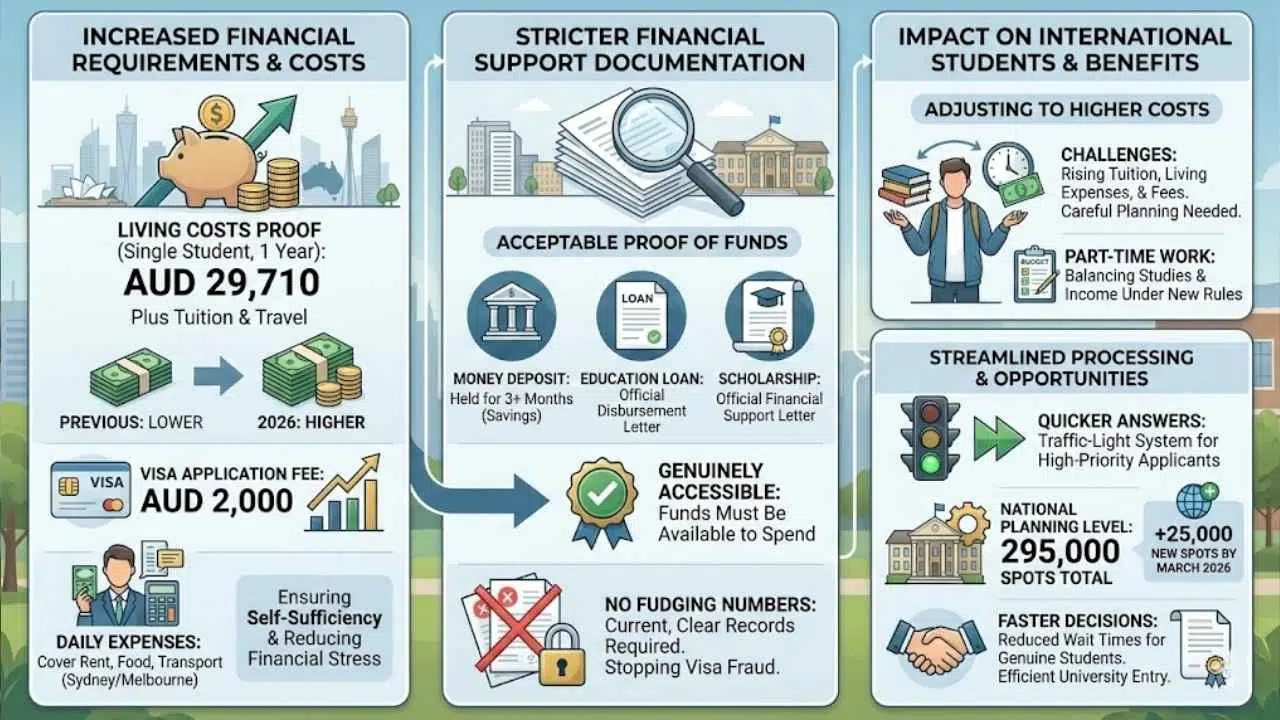
More students now need to show higher bank balances and stronger proof of financial support. The government wants to ensure you can afford the Australian lifestyle without stress.
Increased proof of funds needed
Australia set stricter financial requirements for student visas in 2026. Applicants now need to show higher proof of funds before moving forward with their visa application. This change matches the country’s push for stable, self-sufficient international students.
You must now demonstrate access to at least AUD 29,710 for a single student’s living costs for one year. This is on top of your tuition fees and travel costs.
Many families will feel this new bar, especially because rising tuition fees and living expenses already pinch pockets. The immigration policy aims to prevent students from struggling financially once classes begin.
Before you pack your bags, expect officers to double-check every document showing you can cover rent, groceries, textbooks, and even public transport in big cities like Sydney or Melbourne.
Financial support documentation updates
Student visa applicants now need to show that their funds are genuinely accessible. It’s not enough to just show a balance; you have to prove the money is yours to spend.
The new rules make it harder for families to fudge numbers. Every applicant must submit bank statements, income records, or financial support letters that are current and clear.
Acceptable Proof of Funds:
- Money Deposit: Bank statements showing savings held for at least 3 months.
- Education Loan: An official loan disbursement letter from a recognized bank.
- Scholarship: An official financial support letter from your university.
These updates help stop visa fraud and make sure international students have enough money for fees and daily life. With growing student numbers in 2026, officials want honest paperwork from everyone.
Impact on International Students
Rising costs and new rules may feel like a maze, but fresh opportunities are lighting the path. Knowing what to expect is half the battle.
Adjusting to higher costs
Visa application costs keep going up. Australia now charges AUD 2,000 for a student visa. This is double the fee from just a few years ago, squeezing tight student budgets even more.
On top of this, students must show stronger proof of funds to meet updated financial requirements. Many families feel the pinch as they try to support international study dreams.
Day-to-day expenses like housing and food have risen in major cities too, so careful money planning matters more than ever now. Scholarships help some students, but most juggle part-time jobs under new work hour rules to cover bills and keep their studies on track.
Benefits of streamlined visa processing
Australia’s traffic-light processing system aims to help international students get quick answers. High-priority applicants, such as those with strong academic backgrounds or good financial support, enjoy faster decisions.
This cuts down on wait times and stress, so students can plan their move sooner and worry less about missing course start dates.
Clear rules and strict checks catch fake applications before they become a problem. By March 2026, Australia will add 25,000 new spots for international students under its national planning level of 295,000.
With these changes in the student visa application process, more genuine students find their way into top Australian universities without bumps in the road. Students save time and money while schools fill seats efficiently under the updated immigration policy.
Final Thoughts
Big changes are coming for students who wish to study in Australia, from higher visa fees and stricter language rules to more checks on applications. Applying from outside the country is now required, along with new English and financial standards that set a high bar.
The fresh traffic-light system makes processing fairer and faster for those ready with solid paperwork. All this aims to balance strong education opportunities with safe borders, so students can focus on learning while building real skills for their future jobs.
Helpful links and updates are always available through official government sites, making it easier to stay up-to-date. If I could go back in time, I’d double-check my documents before applying because one little mistake can throw you off course!