

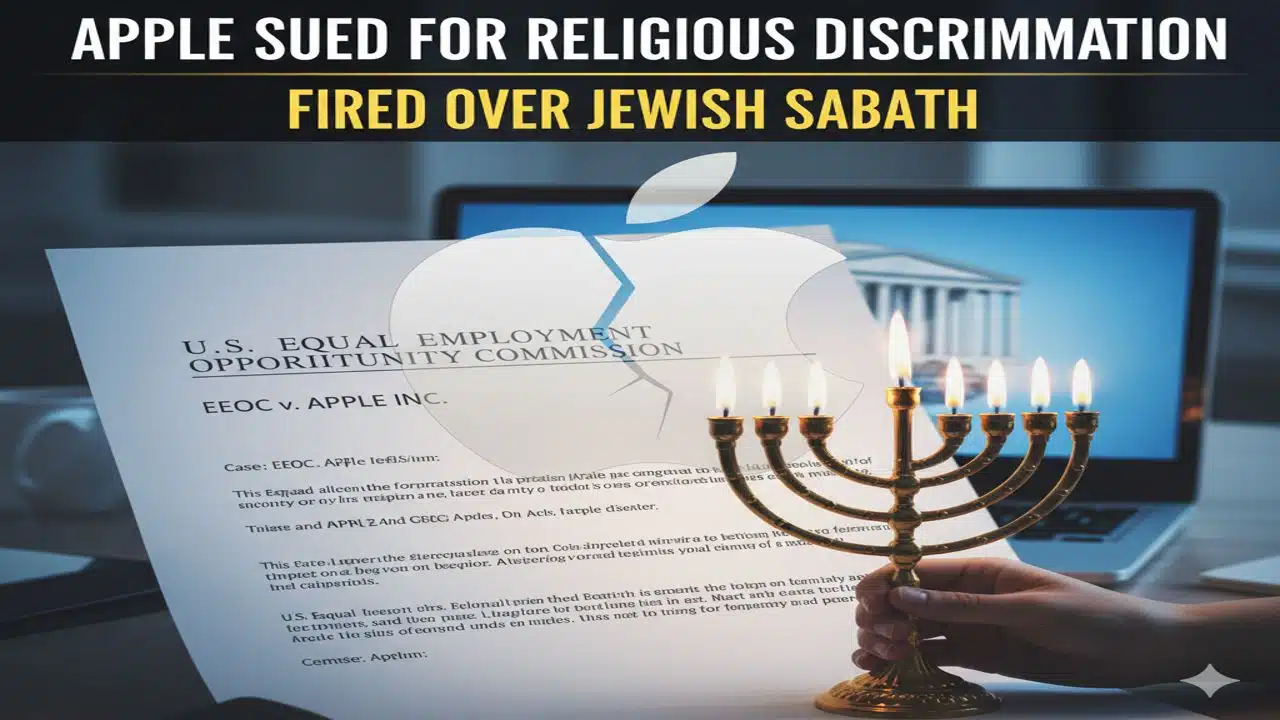
The U.S. Equal Employment Opportunity Commission (EEOC) has initiated a significant legal battle against Apple Inc., filing a federal lawsuit on Tuesday, September 30, 2025. The suit accuses the technology behemoth of religious discrimination and unlawful retaliation, alleging that Apple terminated a long-serving and highly-regarded employee after he requested a schedule adjustment to accommodate his observance of the Jewish Sabbath.
The lawsuit, filed in a U.S. District Court, paints a troubling picture that stands in stark contrast to Apple’s public image as a progressive and inclusive employer. It centers on the experience of an employee who, after converting to Judaism, found his career at one of the world’s most valuable companies allegedly cut short for practicing his faith.
The Employee’s Story and the Central Allegation
According to the detailed complaint filed by the EEOC, the employee had been a dedicated member of Apple’s workforce for several years. His performance record was reportedly strong, marked by consistent positive reviews and successful contributions to his team. The situation took a dramatic turn following a significant personal milestone: his conversion to Judaism.
A central tenet of the Jewish faith is the observance of Shabbat, the day of rest, which begins at sundown on Friday and concludes at sundown on Saturday. During this period, observant Jews traditionally refrain from work and other specific activities. Understanding his new religious obligations, the employee proactively approached his managers to request a reasonable accommodation. The request was straightforward: a scheduling modification that would allow him to be off work during the Sabbath hours.
However, the EEOC alleges that instead of engaging in a good-faith interactive process to find a solution, Apple’s management flatly denied the request. The lawsuit claims that the company made no substantial effort to explore alternatives, such as shift swaps with other employees or adjustments to the weekly schedule. Shortly after this denial, the employee was terminated. The EEOC argues that the termination was not based on performance but was a direct act of retaliation for his request for religious accommodation—an action explicitly protected under federal law.
The Legal Framework: Title VII and the “Undue Hardship” Standard

The EEOC’s lawsuit is grounded in Title VII of the Civil Rights Act of 1964. This landmark federal law makes it illegal for an employer to discriminate against individuals because of their religion. The law’s protections extend beyond just hiring and firing to include all terms and conditions of employment.
Crucially, Title VII requires employers to provide “reasonable accommodations” for the sincerely held religious beliefs and practices of their employees. This could include flexible scheduling, voluntary shift substitutions, job reassignments, or modifications to workplace policies.
An employer can only refuse to provide an accommodation if they can demonstrate that doing so would impose an “undue hardship” on the operation of their business. The legal threshold for “undue hardship” is significant; it is defined as an accommodation that would require more than a minimal cost or burden on the employer. For a corporation of Apple’s immense size, with vast financial resources and thousands of employees, legal experts suggest it would be exceptionally difficult to argue that adjusting one employee’s schedule for a weekly religious observance constitutes an undue hardship. The EEOC’s suit will likely focus on this point, arguing that Apple could have easily granted the request without any meaningful disruption to its business operations.
The EEOC’s Role and Broader Implications
The direct involvement of the EEOC elevates the case beyond a simple dispute between an individual and a former employer. As the federal agency tasked with enforcing anti-discrimination laws, the EEOC’s decision to sue indicates that after an investigation, it found reasonable cause to believe that discrimination occurred. The agency litigates cases that it believes can have a broader public impact, sending a clear message to employers across the country about their legal responsibilities.
This lawsuit against Apple could have wide-ranging ramifications:
- For Apple: A verdict against the company could result in substantial financial penalties, including back pay for the employee, and compensatory and punitive damages. Perhaps more damaging would be the blow to its carefully cultivated brand image as a leader in diversity and inclusion.
- For the Tech Industry: The tech sector is often characterized by a demanding, “always-on” work culture. This case could serve as a major test of how that culture coexists with legal requirements for religious accommodation, potentially prompting other tech giants to review and strengthen their own policies.
- For Employee Rights: A high-profile case against a household name like Apple brings significant public attention to the issue of religious freedom in the workplace. Its outcome could empower other employees to seek accommodations and reaffirm the legal protections available to them.
As of Wednesday, October 1, 2025, Apple has maintained its silence and has not issued a public statement or formal response to the lawsuit’s detailed allegations. The legal proceedings are now in their initial stages, which will be followed by discovery, motions, and potentially a trial if a settlement is not reached. The case will be closely watched by legal experts, civil rights advocates, and corporate leaders alike as a critical test of religious rights in the modern American workplace.
























