

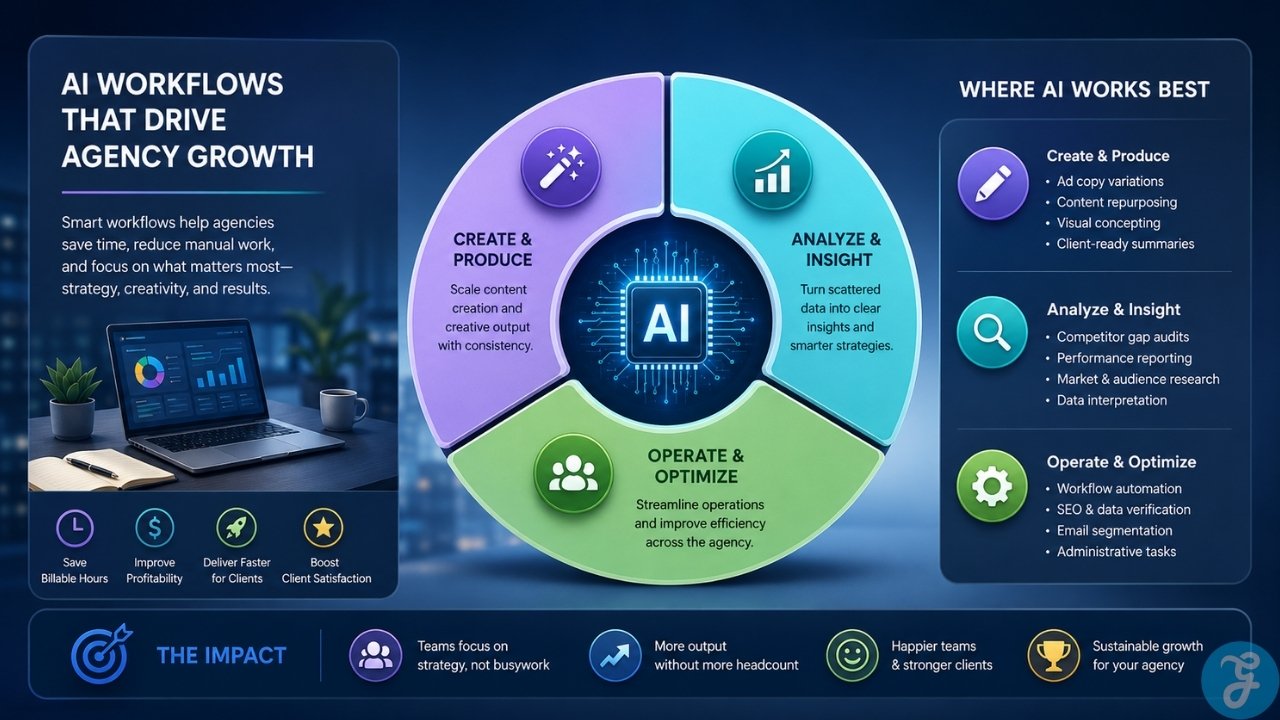
Marketing agencies lose hundreds of billable hours every month to formatting spreadsheets, spinning out minor ad variations, and summarizing client meeting notes. Basic automation handles simple data transfers, but scaling production requires combining distinct tasks into repeatable routines.
Deploying smart processes allows small teams to handle larger accounts without burning out their creative staff. The objective is to offload predictable data sorting and baseline drafting to software, leaving strategic decisions and brand voice positioning to human account managers.
Core Production AI Workflows Marketing Agencies Deploy Daily
Successful ad agency AI adoption relies on clear inputs and predictable outputs. These specific production routines target the most time-consuming parts of daily creative execution.
1. High-Volume Ad Copy Variations
Writing dozens of versions of a single Facebook ad headline is a poor use of a copywriter’s time. Instead, human writers create three core concepts, and the software handles the structural permutations.
-
The Routine: Feed the core approved ad copy into the language tool. Instruct it to generate variations targeting different word counts, formatting restraints, and calls to action.
-
The Limitation: The output will look repetitive if the initial prompt lacks distinct target audience demographics. Human oversight is mandatory to cut out generic phrasing before any ads go live.
2. Document Summarization for Client Onboarding
Onboarding a new client usually involves sorting through messy folders of old brand guidelines, case studies, and internal notes.
-
The Action: Upload raw discovery documents into an isolated text workspace. Use a structured query to extract target personas, restricted brand vocabulary, and key historical metrics.
-
The Value: Account managers get a single, scannable briefing document within minutes, reducing prep time before the kickoff call.
3. Repurposing Long-Form Video Transcripts
Turning a single webinar or podcast episode into cross-channel social snippets traditionally requires hours of manual clipping and drafting. A structured marketing AI workflow automates the initial content breakdown.
| Target Platform | Source Material | Processing Command | Expected Output |
| Video Transcript | Extract three standalone industry insights. | Text posts focusing on tactical metrics. | |
| X (Twitter) | Video Transcript | Identify a singular contrarian viewpoint. | A concise statement under 280 characters. |
| Email Newsletter | Video Transcript | Summarize the main five-step methodology. | A bulleted educational summary framework. |
Research and Data Analysis Routines
Data analysis often bogs down agency teams because platforms store metrics in isolated, incompatible dashboards. These routines help synthesize that information quickly without requiring extensive manual data manipulation.
4. Competitor Content Gap Audits
Identifying what topics a client’s competitor missed usually requires expensive SEO platforms and manual keyword matching. Language models speed up this analysis by comparing raw site maps.
The execution requires exporting the URL structures or blog titles of the top three industry competitors. Instruct the analysis engine to cross-reference these lists against your client’s active content directory to isolate unaddressed user search intents.
5. Turning Raw Performance Data into Client Reports
Clients want to read clear summaries of their performance, not stare at raw CSV exports from analytics platforms.
-
Clean the monthly traffic and conversion spreadsheets to remove extraneous tracking columns.
-
Upload the consolidated data and request a high-level breakdown of month-over-month percentage shifts.
-
Ensure the system explicitly highlights the primary traffic drivers.
6. Background Research for New Business Pitches
Preparing for a new client pitch demands quick, deep knowledge of an unfamiliar industry, its primary complaints, and standard customer journeys. Pull public customer reviews from the prospective client’s top three competitors. Filter the text to find recurring complaints regarding product durability or customer service wait times. Use these specific pain points to build the strategic framework for the pitch presentation.
Operational and Administrative Adjustments
Internal operations benefit from automation just as much as client-facing campaigns do. These technical setups reduce administrative friction.
7. Local SEO Schema Verification
For agencies managing multi-location brands, ensuring that local business structured data matches across hundreds of target landing pages is tedious work.
Use a scraping tool to pull the raw HTML schema blocks from your client’s location pages. Pass the code snippets through a processing model to flag mismatched phone numbers, misspelled street addresses, or broken zip codes instantly.
8. Initial Visual Concepting and Mood Boards
Creative directors often struggle to communicate abstract visual styles to design teams during early brainstorming phases. Use descriptive text generation prompts to create stylistic variants of product mockups or background aesthetics. These rough generated images serve as rapid reference points for human designers, cutting down on early conceptual revisions.
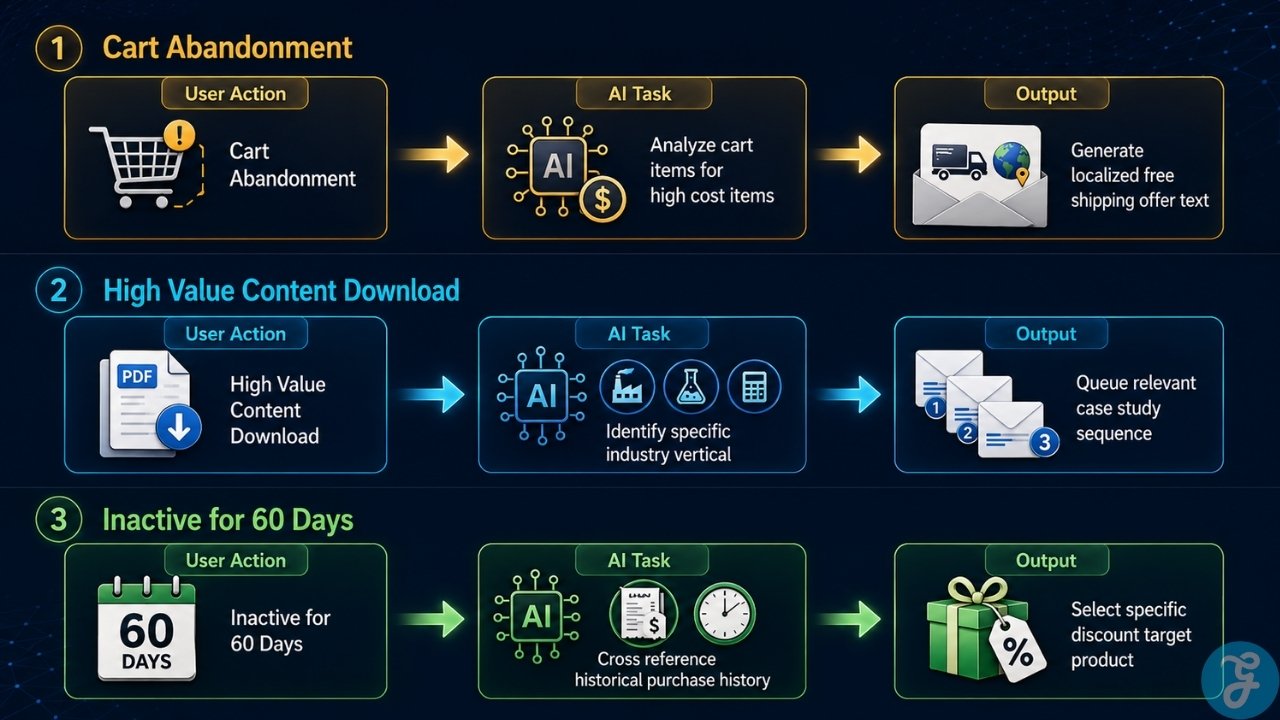
9. Dynamic Email Segmentation Logic
Managing complex email campaigns involves mapping specific messages to distinct user behaviors. This template organizes the logic before building the live automation rules within the customer data platform.
Strategic Risks and Real Limitations
Relying too heavily or uncritically on automated agency AI use introduces critical business risks. Software tools regularly experience hallucinations when handling numerical data, meaning they can easily invent plausible-looking metrics that are completely incorrect. Every single reporting output must be double-checked by a human analyst before it reaches a client’s inbox.
Data security remains a significant compliance factor. Standard free tiers often use input text to train public foundational models. If your team uploads proprietary client roadmaps, internal financial sheets, or unreleased product descriptions into these environments, you run the risk of leaking sensitive assets. Protect your agency by enforcing the use of enterprise accounts that guarantee strict data isolation.
Next Steps for Designing AI Workflows Marketing Agencies Can Trust
To build stable automated systems, avoid overhauling your entire creative department at once. Pick a single manual task, such as compiling monthly ad copy variants or summarizing meeting transcripts, and build a documented prompt framework for it. Test the reliability of the outputs across multiple client accounts for two weeks, refine the instructions based on errors, and document the final process in your agency training materials before expanding your AI workflows marketing agencies deployment to complex account strategies.
Frequently Asked Questions Regarding AI Workflows Marketing Agencies Use
How do agencies protect sensitive client data when adopting these automated routines?
Avoid public, free-tier software. Instead, invest in enterprise accounts with guaranteed data isolation clauses. This setup ensures that client roadmaps, internal financials, and unreleased product descriptions are never utilized to train foundational public models.
Will implementing these systems replace human copywriters and account strategists?
No. Automated setups excel at predictable data sorting and baseline drafting, but they lack the capacity for strategic reasoning and authentic brand positioning. Staff can shift their billable hours away from administration and toward high-level strategy and client relationships.
How do you prevent software tools from generating incorrect metrics in client reports?
Enforce a mandatory layer of human oversight. Language models frequently hallucinate when processing numerical data, meaning they can easily invent plausible metrics that are entirely false. A human analyst must cross-reference every automated narrative summary against raw source data sheets before delivery.
What is the safest way to start scaling the specific AI workflows marketing agencies need?
Target a single manual bottleneck first, such as drafting ad variations or summarizing meeting transcripts. Build and test a clear prompt framework on a few accounts for two weeks, refine the instructions based on errors, and document the process before scaling up to complex operational sequences.