
A model that hits 98% accuracy on a test set can still break down completely once real people start using it. High overall accuracy often hides serious flaws—like a fraud system flagging minority accounts twice as often or an HR tool filtering out qualified female applicants.
Aggregate metrics obscure these failures by grouping everyone into a single average. Teams routinely miss these localized failure modes because broad averages flatten the differences that matter most.
Fixing algorithmic bias requires looking far beyond the model’s codebase. Practical AI Bias Mitigation Strategies start with a wider view of the operational system. Bias creeps in at every stage: how executive teams frame the problem, who labels the training set, which features you feed the algorithm, where thresholds sit in production, and how staff react to the scores. NIST treats AI bias as a combined human and technical failure, breaking it into systemic, statistical, and human factors. Data cleaning helps, but relying on it as your sole safeguard is a recipe for failure.
What AI Bias Actually Means
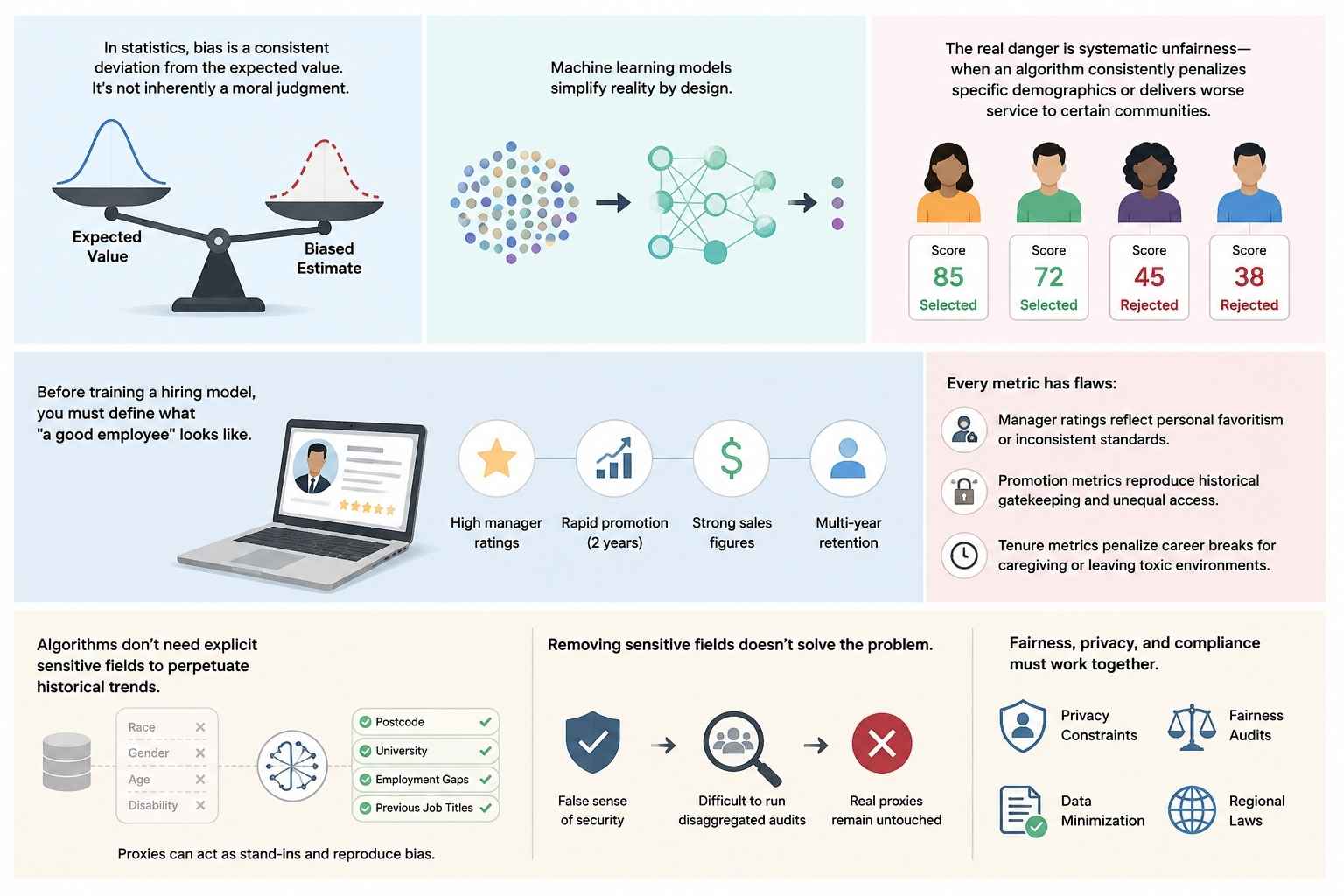
To fix algorithmic bias, you first have to separate mathematical variance from social harm.
In statistics, bias just means a consistent deviation from an expected value—it isn’t inherently a moral judgment. Machine learning models also simplify reality by design. Neither fact automatically proves unfair treatment.
The real danger is systematic unfairness: when an algorithm consistently penalizes specific demographics or delivers worse service to certain communities.
Take automated hiring tools. Before feeding a model any candidate records, you have to define what “a good employee” actually looks like. Does success mean high manager ratings, rapid promotion within two years, strong sales figures, or multi-year retention?
Every metric has flaws:
- Manager ratings frequently reflect personal favoritism or inconsistent evaluation standards across departments.
- Promotion metrics reproduce historical gatekeeping and unequal access to high-visibility assignments.
- Tenure metrics systematically penalize individuals who took career pauses for caregiving or departed toxic work environments.
An algorithm doesn’t need explicit race, gender, age, or disability fields to perpetuate those historical trends. Postcodes act as proxies for race and income, elite degrees track with socioeconomic class, and employment gaps usually mirror family caretaking roles.
Stripping fields like race or age from your dataset doesn’t solve the problem. Removing sensitive variables gives teams a false sense of security while leaving the real proxies untouched—all while crippling your ability to run disaggregated audits to verify whether error rates differ across protected groups.
Privacy constraints, fairness audits, data minimization rules, and regional laws must be resolved as a unified operational strategy.
Bias Often Starts Before the Dataset Exists
A poorly framed question creates a flawed model long before training data is even collected. When product teams fail to define what “risk” or “success” actually means, algorithms simply optimize for historical convenience over real-world fairness.
A Poorly Framed Decision Creates a Poorly Framed Model
“Predicting risky customers” isn’t a usable engineering spec. Risk to whom? What exact behavior constitutes risk? What action triggers when a score crosses the threshold? What happens when the model makes a false prediction?
Fraud detection systems reveal this trade-off clearly. Lowering an intervention threshold catches more fraudulent activity, but it locks out legitimate customers. Raising the threshold reduces user friction while letting actual fraud slip through.
That isn’t a hyperparameter tuning task—it’s a policy decision about who absorbs the cost of error.
Before choosing an algorithm, teams should document:
- The Influenced Decision: Clarifies exact operational scope and prevents scope creep across unauthorized domains.
- The Exposed Population: Maps all affected demographic groups to prevent out-of-distribution sampling gaps.
- The Action Plan: Pre-defines post-prediction workflows to prevent automated actions without validation.
- The Cost of Error Matrix: Evaluates False Positives vs. False Negatives to stop hidden cost transfers onto vulnerable users.
- The Escalation Path: Defines human fallback routes for low-confidence outputs to mitigate automation bias in edge cases.
- Automation Justification: Tests if simpler rule-based logic is safer to avoid deploy-by-default ML implementations.
Without this documentation upfront, fairness metrics become vanity numbers on a dashboard rather than safeguards against concrete harms.
Historical Data Records Unequal Conditions
Historical data shows what happened under legacy conditions; it doesn’t reveal what should have happened.
Past hiring records capture narrow recruitment pipelines. Medical datasets underrepresent populations with limited access to clinical care. Fraud flags cluster heavily in neighborhoods subjected to historical over-investigation.
Coverage gaps occur in subtle ways:
- Speech recognition systems trained on studio audio fail on regional accents, background noise, or budget microphones.
- Computer vision models built on bright, centered imagery degrade when connected to low-resolution security cameras.
The algorithm hasn’t learned an explicitly malicious rule—it was simply trained and evaluated under conditions that diverge from its actual operational environment.
Labels Are Not Automatically Ground Truth
Annotated data columns aren’t objective facts just because they arrive cleanly formatted in a CSV.
Labels reflect human judgments from managers, clinicians, investigators, moderators, or crowdsourced annotators working under vague guidelines. Two content moderators regularly disagree on what constitutes harassment. Two department heads rate identical work differently. Medical diagnoses depend heavily on insurance coverage and regional facility quality.
A thorough label audit evaluates who generated the annotations, what instructions they followed, how disagreements were resolved, and whether error distributions skew across specific offices, regions, or annotator pools.
When underlying labels are flawed, training a more sophisticated deep learning architecture simply optimizes the systematic delivery of those flaws.
The Model Can Recreate Information You Removed
Postcodes correlate with ethnicity and socioeconomic status. Educational background reflects unequal access to resources. Career gaps mirror disability or family responsibilities. Language nuances disclose national origin.
This doesn’t mean every correlated feature must be banned. Many variables hold genuine predictive value. However, engineering teams must justify why each proxy feature is necessary, quantify the performance boost it adds, identify which groups it impacts, and verify if a less harmful variable achieves similar utility.
Derived features require identical scrutiny. A variable named customer_stability might sound neutral while quietly combining address changes, device rotations, payment history, and employment gaps into an aggressive proxy for class and income.
Average Accuracy Hides the Most Important Failures
A model tested on a 90% majority dataset can achieve high overall accuracy even if it fails completely for the remaining 10%.
Depending on the risk landscape, teams should track and compare:
- False Positive & False Negative Rates to balance group-level error costs.
- Precision & Recall to measure signal quality within individual demographics.
- Selection Rates to audit differential access to opportunities.
- Group Calibration to ensure a 0.8 risk score carries identical meaning across all populations.
- Abstention & Override Rates to monitor where the model frequently defers or fails.
The metric must match the real-world harm. In screening scenarios, missing a positive case (False Negative) is the primary risk. In investigation platforms, falsely accusing an innocent party (False Positive) carries greater weight.
No single metric guarantees equity. Picking whichever formula yields the best-looking dashboard is just self-deception.
Tools like Fairlearn’s MetricFrame calculate disaggregated performance and intersectional effects. However, intersectional analysis introduces a critical constraint: slicing data across age, gender, and regional tiers creates small sample sizes ($N$), making variance estimates unstable. Disparities in small subgroups require confidence interval modeling and qualitative audits rather than hasty technical assumptions.
Deployment Can Introduce Bias That Testing Missed
Models rarely stay bounded within their launch context.
An HR tool trained on office roles gets expanded to warehouse operations. An identity verification model calibrated on clear enrollment photos gets attached to low-light security cameras. A credit scoring system calibrated during economic growth breaks down when macro conditions shift.
NIST facial recognition benchmarks demonstrate that error rates fluctuate across demographic groups depending on the operating environment. Image quality is paramount: low lighting and sensor noise significantly increase false-negative disparities.
Vendor claims like “99% fair” are useless. You must test the exact model, threshold, user population, input hardware, and deployment environment you intend to use.
Feedback loops create another operational hazard. If a risk engine directs heightened audit activity toward a specific group, it naturally uncovers more total incidents within that population. The system ingests those new records as fresh training data, taking the higher incident rate as confirmation that its original biased predictions were correct.
Once a model alters the operational process generating its future training data, offline validation is no longer sufficient.
AI Bias Mitigation Strategies That Survive Real Deployment
Mitigation isn’t a launch gate check—it’s an operational workflow that runs for the entire lifecycle of the model.
1. Write a Decision-Impact Record First
Before writing code, draft a brief document defining the decision, affected populations, potential harms, error costs, review mechanisms, and appeal processes.
Be specific. Writing “The system supports recruiters” reveals little. Writing “The system ranks applicants, and recruiters only review the top 20 candidates” highlights how ranking placement dictates applicant visibility.
Use this stage to evaluate if machine learning is appropriate. Fixed rules, keyword search, or expanded human teams are safer choices when prediction variance is unacceptable or historical labels are unreliable.
2. Audit Data and Labels Together
A thorough data audit looks beyond simple demographic counts.
Examine dataset origin, collection timeframes, sampling logic, missing value handling, and hardware variations. Verify whether geographical, linguistic, and environmental coverage matches your production target.
Next, audit the label generation process. Calculate inter-annotator agreement rates, flag regional anomaly patterns, and document policy shifts that render historical labels incompatible with current targets.
Frameworks like Data Cards provide a structured method to document collection provenance, annotation standards, intended uses, and known limits—making implicit assumptions visible before data is repurposed.
3. Test the Groups the Product Will Actually Serve
Subgroup testing must mirror your actual user base, not public benchmark distributions.
Intersectional testing exposes hidden flaws. A system might pass independent age and gender checks, yet fail for older women when those attributes overlap. Always display sample sizes ($N$) alongside subgroup metrics—a metric reported without its denominator is deeply misleading.
Include stressful edge cases during validation: poor lighting, non-standard documents, regional dialects, low-bandwidth connections, and incomplete entries. Bias typically surfaces at the margins, where standard benchmarks provide poor coverage.
4. Fix the Layer That Produced the Harm
There is no universal “debias” toggle in machine learning. Apply fixes directly to the stage where the defect originated:
- Sampling Gaps: Gather fresh, representative data rather than manipulating weights.
- Flawed Annotations: Update labeling guidelines, train annotators, and re-label corrupted records.
- Modeling Artifacts: Apply re-weighting, constrained optimization, or loss-function regularization during training.
- Policy Errors: Adjust decision thresholds, build abstention paths for low-confidence scores, or restrict how downstream teams consume predictions.
Every intervention involves trade-offs. Reweighting loss functions can distort probability calibration. Group-specific decision thresholds create legal and operational complications. Synthetic data generation (like SMOTE) can reinforce underlying generator biases if applied unthinkingly. Re-run the entire evaluation suite after every modification.
5. Give Human Reviewers Enough Power to Matter
“Human-in-the-loop” is an empty promise if reviewers are shown a score and given five seconds to approve it.
For human oversight to work, operators need context, access to source records, clear escalation paths, explicit permission to reject model recommendations, and sufficient time to investigate anomalies. Systematically log all human overrides—including the reason—to identify where human judgment and algorithmic outputs diverge.
Human operators bring their own cognitive biases. Audit override patterns regularly to ensure the user interface isn’t passively steering staff toward blind compliance. Establish an accessible appeal process for individuals impacted by automated outcomes.
6. Document Boundaries and Monitor System Drift
Model Cards capture intended use cases, explicit exclusions, evaluation parameters, subgroup scores, and operational limits. Their main benefit is governance: they prevent a model trained for one task from quietly expanding into others. Ensure these documents reach procurement leads, compliance officers, customer support teams, and deployment engineers—not just research scientists.
Production monitoring must go beyond system uptime. Track input distribution shifts, subgroup error trends, approval rate drifts, false alarm counts, override rates, and formal appeals. Establish clear threshold triggers for manual investigation, temporary fallback, or complete model shutdown.
Operational AI Bias Mitigation Strategies fail when accountability ends at launch. Named owners must remain responsible for determining whether production data still justifies keeping the system live.
Regulation Is Turning Fairness Claims Into Compliance Questions
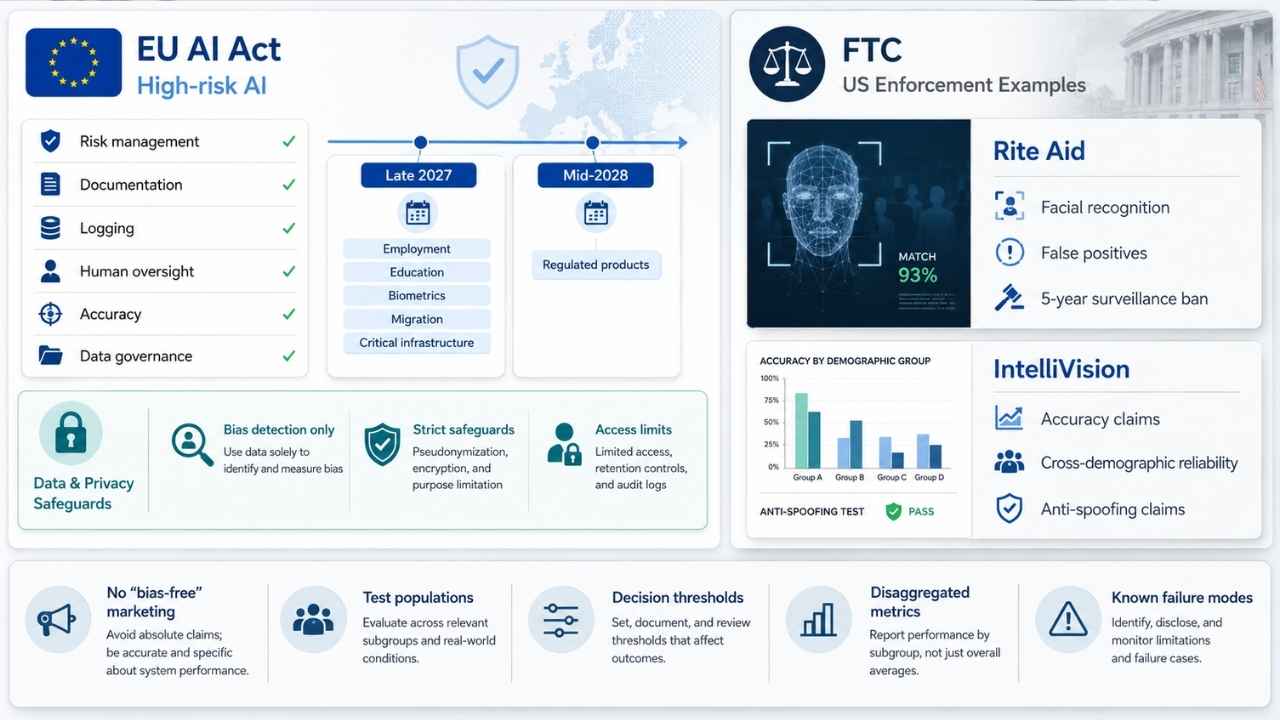
The EU AI Act establishes binding risk-management, documentation, logging, human-oversight, accuracy, and data-governance requirements for high-risk applications. Its data-governance standards explicitly mandate evaluating datasets for biases that could impact health, safety, or fundamental rights.
Implementation timelines continue to evolve. Rules for high-risk standalone applications (in employment, education, biometrics, migration, and critical infrastructure) apply from late 2027, while systems embedded into regulated products extend to mid-2028. Organizations must verify adopted enforcement schedules against active European Commission guidance.
Crucially, the Act includes a narrow exemption allowing high-risk system operators to process special-category demographic data strictly when necessary for bias detection and correction, subject to strict privacy safeguards and access limits.
US regulatory enforcement offers an equally clear warning:
- The FTC barred Rite Aid from using facial recognition for surveillance for five years following allegations that its vendor technology generated thousands of false-positive shoplifting matches that disproportionately affected people of color.
- The FTC finalized an enforcement order against IntelliVision prohibiting misleading claims about facial-recognition accuracy, cross-demographic reliability, and anti-spoofing performance.
Marketing a product as “completely bias-free” is no longer credible. Regulators and enterprise buyers expect transparent documentation showing test populations, operational limits, decision thresholds, disaggregated metrics, and known failure modes.
Weak Fixes Teams Should Stop Accepting
Don’t rely on these common shortcuts as proof of compliance or fairness:
- Stripping protected attributes from training tables
- Balancing a dataset once during initial preparation
- Reporting aggregate accuracy while ignoring subgroup metrics
- Applying uniform decision thresholds across asymmetric risk profiles
- Inserting nominal human review without override authority
- Accepting vendor-provided fairness certificates at face value
- Publishing ethical principles without operational controls
While some of these steps serve as useful inputs, they are incomplete on their own.
Fairness software libraries share these limits. A toolkit can calculate disparities, simulate thresholds, or apply mathematical transformations. It cannot determine whether an automated decision is appropriate, whether underlying labels are trustworthy, which error carries the highest cost, or whether machine learning should be used in the first place.
Final Thoughts
Fairness isn’t a score you achieve once and forget. It’s an ongoing operational audit.
Effective AI Bias Mitigation Strategies begin with the operational decision, not the ML code. Map potential harms before training. Audit raw data and labels instead of trusting clean formatting. Test models under realistic production conditions. Preserve statistical uncertainty when evaluating small subgroup samples. Give human operators real override power, and monitor behavioral metrics post-launch.
No single score can certify a system as universally fair. The true operational benchmark is whether your team can pinpoint where failures are likely to occur, catch them under production conditions, and intervene decisively when the evidence shows the model is causing harm.
Assign that ownership explicitly before launch. Without a team empowered to restrict, pause, or retire a failing model, fairness work remains passive documentation rather than active control.