Machine learning is often introduced as one enormous wall of prerequisites. Learn Python. Finish calculus. Study statistics. Understand databases. Master cloud platforms. Then, perhaps, you will be ready to train a model.
That order keeps beginners busy without helping them become capable.
Learning how to start learning machine learning from zero is easier when the subject is broken into jobs you can actually perform. First, learn enough Python to manipulate data. Then build a simple model, test it properly, and explain where it fails. Deep learning and production tools can come later, once you have a reason to use them.
You need mathematics and coding, but neither has to be mastered before you begin.
The Roadmap at a Glance
A practical sequence looks like this:
- Learn basic Python.
- Get comfortable with tabular data.
- Understand regression, classification, and evaluation.
- Train baseline models with scikit-learn.
- Build a few small projects without following a complete tutorial.
- Learn how leakage, poor metrics, and weak testing create misleading results.
- Explore deep learning when the problem justifies it.
- Deploy one model and learn basic lifecycle management.
Many beginner roadmaps stop after model training. That is too early. Even a small real-world system needs a repeatable environment, validated inputs, saved model versions, and some way to notice when performance declines.
You do not need to begin with Kubernetes or a complicated cloud stack. You should understand that a notebook is only one part of the job.
Do You Need Math for Machine Learning?
Yes, but the usual advice is unnecessarily extreme.
You do not need to complete advanced calculus before building a basic classifier. You also should not treat machine learning as a collection of Python commands that requires no mathematical understanding.
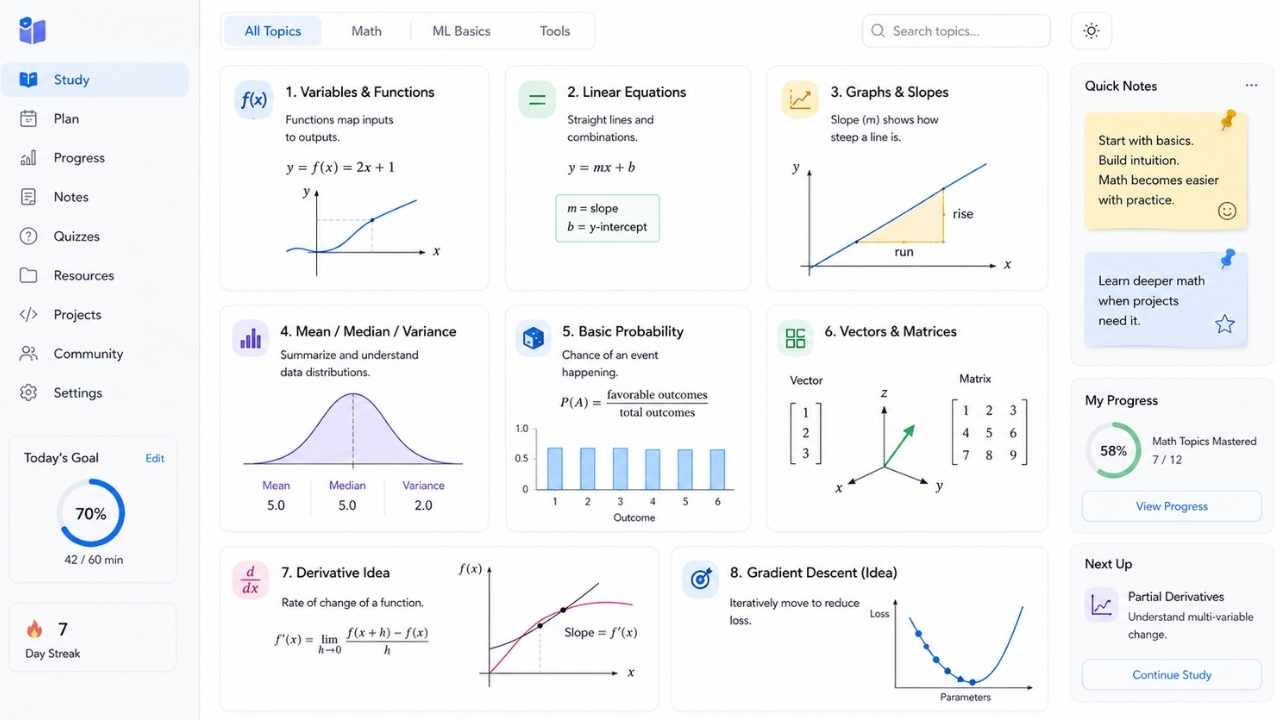
For your first projects, focus on:
- Variables and functions
- Linear equations
- Graphs and slopes
- Mean, median, variance, and standard deviation
- Basic probability
- Vectors and matrices
- The basic idea of a derivative
That foundation is enough to begin understanding regression, classification, model errors, and simple optimization.
Study deeper mathematics when the work gives it context. Gradient descent is easier to understand once you have seen a model minimize a loss function. Matrix multiplication matters more after it starts appearing inside neural-network code.
This approach is slower than memorizing definitions for a week and faster than delaying every project until your mathematics feels complete.
How to Start Learning Machine Learning From Zero
The sheer volume of machine learning advice online is overwhelming. Stuck in analysis paralysis, you probably wonder if you need advanced math or just basic Python. This pragmatic guide cuts through the noise, offering a clear, step-by-step roadmap to take you from absolute beginner to deploying your very first model.
1. Learn Enough Python to Work Without Constant Copying
Python is the most practical starting language because most beginner machine-learning material and major libraries use it.
You do not need advanced software design at this stage. Concentrate on variables, lists, dictionaries, loops, conditions, functions, imports, and reading files. Learn how to interpret a traceback rather than treating every error message as a dead end.
Small scripts are better preparation than endless syntax exercises. Try loading a CSV file, calculating an average, removing invalid values, counting repeated entries, or placing repeated code inside a function.
The official Python tutorial is useful, but it assumes some general programming knowledge. Someone who has never written code may need a more guided introduction before using the documentation as a reference.
Do not wait to “finish Python.” You will learn more of the language while working with real data.
2. Spend Time With Untidy Data
Machine-learning demonstrations often begin with clean tables. Actual datasets contain missing values, duplicate rows, inconsistent categories, mixed date formats, and columns that do not mean what their names suggest.
Before comparing algorithms, learn how to inspect and prepare data with NumPy and pandas. You should be able to filter rows, group records, identify missing values, distinguish numerical from categorical features, and produce a few basic charts.
Browser-based notebooks such as Google Colab are useful when local installation becomes a distraction. They let you begin running code without setting up Python packages on your own computer.
That convenience has a limit. Once your project becomes more than an experiment, move some of the work into ordinary Python files and version control. A notebook with hidden execution order and undocumented dependencies becomes difficult to reproduce surprisingly quickly.
3. Understand the Problem Before Choosing an Algorithm
Beginners often memorize model names before learning how to frame the task.
Start with three common problem types:
Regression predicts a number, such as demand, delivery time, or electricity use.
Classification predicts a category or probability, such as whether an email is spam or whether a customer may leave.
Clustering groups similar records when no target label has been provided.
Before training anything, answer a few plain questions. What does each row represent? Which information will exist when the prediction is made? What outcome are you trying to estimate? Which type of error would create the larger problem?
That last question determines the metric.
Accuracy can look impressive when one class is rare. A system that labels every transaction legitimate may appear accurate if fraud is uncommon, yet it has failed at the only job that matters. Precision, recall, F1, ROC-AUC, and numerical error measures each describe different aspects of performance.
A model score without the surrounding decision context is mostly decoration.
4. Use Scikit-Learn Before Reaching for Deep Learning
For beginners working with spreadsheet-style data, scikit-learn is usually the right place to start.
Its consistent interface lets you prepare data, train models, generate predictions, and evaluate results without first writing a complete training system. Begin with linear regression, logistic regression, a decision tree, and a random forest. Add a simple clustering method once the supervised-learning workflow makes sense.
Build a baseline before tuning anything complicated. For a regression project, that might mean predicting the average target value. For classification, it could mean predicting the most common class.
The baseline tells you whether the model is learning something useful or merely producing a more impressive-looking number.
A complicated model that improves performance only slightly may not justify the slower predictions, harder maintenance, or weaker explainability. Model choice is an engineering decision, not a competition for the most advanced algorithm.
5. Build Projects That Make You Choose
Tutorials hide many of the difficult decisions. They select the dataset, target, cleaning process, metric, and model before you arrive.
Your first independent projects should be small enough to finish but open enough to expose what you do not yet understand.
A useful set would include:
- A numerical prediction problem with a basic baseline
- A classification problem with a confusion matrix
- A small application that lets another program request a prediction
For the classification project, explain whether false positives or false negatives matter more. For the numerical project, translate the error into practical terms. An average error of 12 means little until readers know whether the target is house price, delivery minutes, or monthly product demand.
The application does not need polished design. Saving a model and placing it behind a small API is enough to reveal issues that notebooks hide.
Each project should have a short README explaining the question, data source, cleaning decisions, evaluation method, limitations, and steps needed to reproduce the result. A folder of unexplained notebook cells is difficult for anyone else to assess.
6. Learn the Evaluation Mistakes Early
A model can produce an excellent score for completely invalid reasons.
Data leakage is one of the most common causes. Information from the test set may accidentally influence training, or a feature may contain details that would not exist at prediction time. Preprocessing the full dataset before splitting it can also leak information, depending on what the preprocessing calculates.
Other common mistakes include repeatedly checking the test set while tuning, ignoring class imbalance, using a flattering metric, and comparing models without a baseline.
Keep the final test set untouched until your major modelling choices are complete. Use validation data or cross-validation while comparing approaches.
This is less exciting than adding another algorithm, but it is more important. A simple model evaluated honestly is stronger evidence of skill than an elaborate neural network tested carelessly.
7. Add Deep Learning for a Reason
Deep learning is useful for images, language, audio, and other problems involving complex patterns. It is not a mandatory upgrade for every table of customer or sales data.
Once you understand training, validation, overfitting, and metrics, choose one deep-learning framework.
PyTorch offers a clear beginner sequence covering tensors, datasets, model construction, automatic differentiation, optimization, and saving models. TensorFlow’s beginner material uses Keras and browser-based notebooks to teach a similar workflow.
Fast.ai takes a more application-first route and introduces theory while learners build working models. It is better suited to people who already know basic Python than to someone writing their first loop.
Pick one framework and complete a project. Trying to learn PyTorch, TensorFlow, JAX, and every related library at once produces familiarity with names rather than usable skill.
8. Learn What Happens After Training
A machine learning roadmap for 2026 should include the point where another application can use the model.
At minimum, learn how to save and reload it, expose predictions through an API, pin project dependencies, validate incoming data, and record which model version produced a result.
Experiment-tracking tools such as MLflow can store parameters, metrics, models, and related artifacts. That is useful, but experiment tracking is only one part of MLOps. Production systems also need deployment, monitoring, permissions, data validation, rollback plans, and clear ownership.
Keep the first deployment small. A local API is enough to teach you what happens when an input is malformed, a dependency is missing, or the application cannot find the saved model.
Complex infrastructure can wait until the scale of the project requires it.
Which Learning Resources Should You Use?
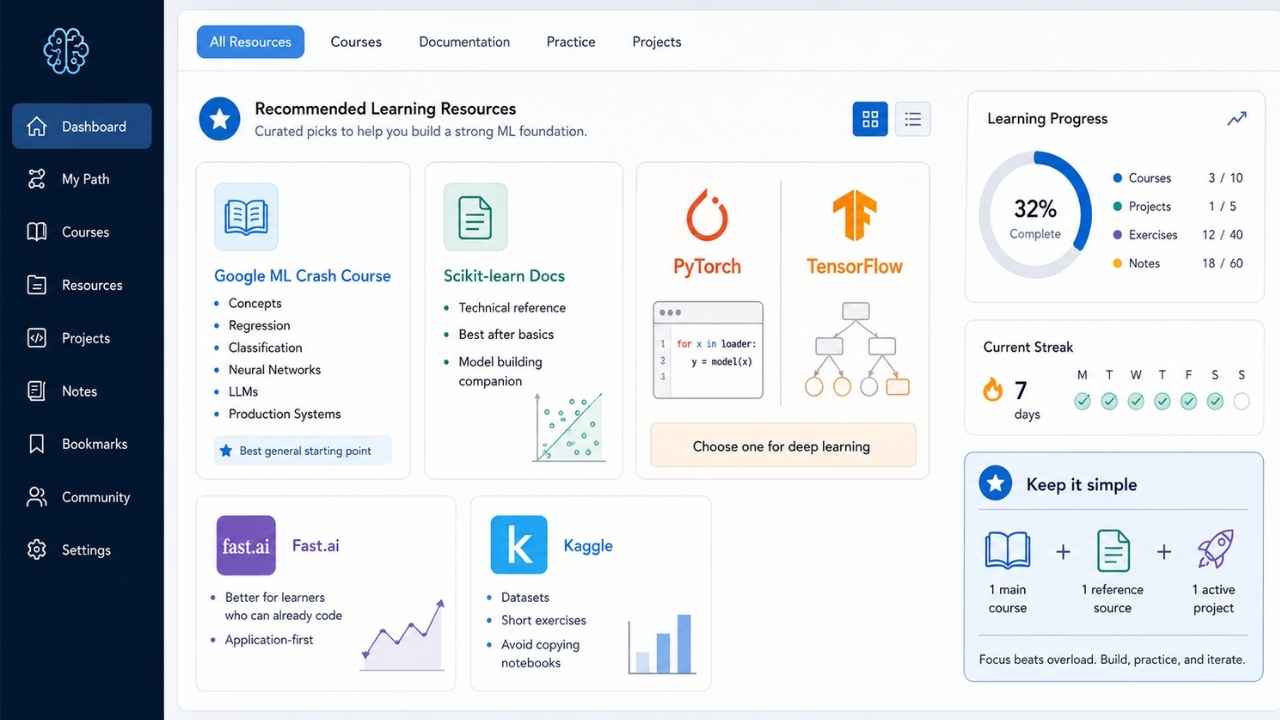
Most beginners need fewer platforms, not more.
Google’s Machine Learning Crash Course is the strongest general starting point for concepts. It covers regression, classification, data preparation, neural networks, large language models, production systems, and fairness. It expects some Python, NumPy, pandas, algebra, and statistics, so complete beginners should prepare those areas first.
Scikit-learn’s documentation is the best companion once you start building models. It is a technical reference rather than a gentle course, which makes it more useful after you understand the basic vocabulary.
PyTorch or TensorFlow should come later, when you are ready to work on a deep-learning problem. Choose one rather than splitting your attention.
Fast.ai is a reasonable option for learners who can already code and prefer to build applications early. It is not the first stop for someone still learning Python fundamentals.
Kaggle can provide datasets and short practice exercises, but it should not become a cycle of copying public notebooks and changing a few parameters. The value comes from making your own decisions and explaining them.
One main course, one reference source, and one active project are enough.
A Realistic 12-Week Starting Plan
This is a study structure, not a promise of professional competence.
- Weeks 1–2: Learn Python fundamentals and write small scripts.
- Weeks 3–4: Work with NumPy, pandas, missing values, charts, and tabular datasets.
- Weeks 5–6: Study regression, classification, train/test splits, baselines, and evaluation metrics.
- Weeks 7–8: Complete two scikit-learn projects and write up the results.
- Weeks 9–10: Improve one project or begin a single deep-learning framework.
- Week 11: Save a model and serve predictions through a basic API.
- Week 12: Add experiment tracking, documentation, and a reproducible environment.
The timetable will stretch or contract depending on how many hours you study and how much programming experience you already have. Its real purpose is to prevent endless prerequisite study.
Final Thoughts
The practical answer to how to start learning machine learning from zero is to begin before you feel fully prepared, but keep the first problem small. Learn enough Python to inspect a dataset. Train a baseline model. Choose a metric that reflects the real cost of mistakes. Write down what the model cannot do. Then make the prediction available outside the notebook.
Do not measure progress by the number of courses completed or frameworks installed. A better first milestone is one project you can explain clearly: what you predicted, why the evaluation was fair, and where the result may fail.
That is where machine learning stops being a collection of tutorials and starts becoming a usable skill.