
A versioned FAQ dataset for an AI agent gives a team a way to tell which answers were approved, what changed, and which release the agent used. The hard part is not saving a spreadsheet: it is connecting a reviewed answer and its source to the version actually loaded by the agent, then testing whether that answer is still correct.
The seven tools below support different parts of that job, from editing a small text file to versioning a larger data repository. This is a comparison of documented capabilities, not a hands-on test or a ranking. None automatically makes an answer accurate, approves a policy, or guarantees that an agent uses the latest release. The choice depends on who edits answers, where data lives, and who operates the publishing pipeline.
Versioned FAQ dataset for an AI agent: seven approaches
| Tool | Documented version mechanism | Practical fit | Important limit |
|---|---|---|---|
| GitHub | Git commits and file history | Small text datasets with code review | Requires a separate ingestion and evaluation process |
| GitLab | Repository commits and merge requests | Teams already using its development workflow | Business editors may need help with Git |
| Hugging Face Hub | Dataset repositories and revision references | Teams distributing datasets for ML work | Check visibility and access before uploading private answers |
| DVC | Git-tracked metadata plus versioned data files | Teams pairing data changes with code | Remote storage and workflow must be configured |
| lakeFS | Branches and commits over object storage | Shared data-lake pipelines | May add operating complexity for a small FAQ |
| DataLad | Git and git-annex dataset history | Teams managing reproducible file collections | Learning its data-transfer model takes effort |
| Weights & Biases Weave | Versioned dataset objects | Teams evaluating agent behavior across examples | Evaluation data still needs approved source content |
1. GitHub: review a small FAQ alongside application code
A private repository can hold a CSV, JSONL or Markdown file containing question-and-answer records. Git commits create a history, while pull requests let a reviewer see proposed differences before the file is merged. A team can tag the approved commit and configure its ingestion job to load that revision rather than an unspecified moving branch.
GitHub is attractive if engineering already reviews code there and the FAQ is small enough to inspect as text. It is not a knowledge approval system by itself: define who approves policy changes, protect access to the repository and keep a separate record showing which commit reached the agent. Nontechnical subject experts may prefer a simpler editing interface upstream.
2. GitLab: keep the dataset in an existing delivery workflow
GitLab exposes a file’s commit history and merge requests. A team can propose a change to a FAQ record, review the difference and connect its existing delivery process to a specific repository revision. That is useful when the agent and its source data already live in GitLab projects.
The same constraint applies as with any Git-based repository: a merged change does not prove that a retrieval index has been rebuilt. Include an explicit deployment step and check its result. Consider whether support or legal reviewers can participate comfortably in the approval flow before making it the only route for urgent corrections.
3. Hugging Face Hub: publish dataset revisions for ML workflows
Hugging Face supports dataset repositories and loading a specified revision. For a team already using its datasets tooling, an approved FAQ snapshot can be distributed as a dataset with a revision identifier rather than copied into several notebooks by hand. A dataset card can explain fields, intended use and limitations.
Decide whether the FAQ contains information that may be shared before choosing repository visibility. A version identifier preserves what was loaded, but it cannot determine whether a customer-facing answer is authorized. Record the approval and test the agent with an unanswered question as well as questions that have an approved answer.
4. DVC: connect file versions to a Git project
DVC tracks data files alongside a Git project using lightweight metadata, while data content can reside in configured storage. This separation helps when a FAQ collection grows beyond a convenient plain-text repository or needs to travel with model and pipeline versions. A release can identify both the Git commit and the referenced data.
Someone must configure storage, access and a reproducible pull or deployment step. For a few dozen short, non-sensitive answers, Git alone may be easier. For larger files, test that a new team member can retrieve the exact snapshot before treating a DVC pointer as a complete backup.
5. lakeFS: branch data in object storage
lakeFS offers Git-like branches and commits over a data lake. A data team could prepare an FAQ snapshot in a branch, validate it, then promote an approved version for downstream ingestion. That approach is worth investigating when FAQ data is one part of a larger shared object-storage pipeline.
Its infrastructure-oriented model may be excessive for a small support team. Establish who operates the service, handles permissions and restores an earlier data state. A branch in storage is not the same thing as a reviewed answer in a help center; the two need a clear ownership and synchronization process.
6. DataLad: preserve reproducible file collections
DataLad uses Git and git-annex to manage versioned datasets and their associated file content. It can be useful when a FAQ dataset is distributed alongside source documents or other large files and the team needs a reproducible record of the collection, not just a single spreadsheet export.
Its decentralized model requires attention to where file content is stored and which collaborators have access. Document the retrieval process and backup locations. A versioned source document may also contain personal data or information that should not be supplied to a customer-facing agent; review its contents and permissions before ingestion.
7. Weights & Biases Weave: version examples for evaluation
Weave documents versioned dataset objects that can be used in AI application workflows. A team can retain a set of representative FAQ questions, expected answers and edge cases, then compare agent runs against that dataset as prompts or retrieval settings change.
Evaluation examples are not automatically the authoritative FAQ corpus. If approved answers live elsewhere, identify the source revision used to construct each test set and refresh it deliberately. Review results for correctness, citations and appropriate refusal; a version number or aggregate score cannot replace a subject expert’s judgment.
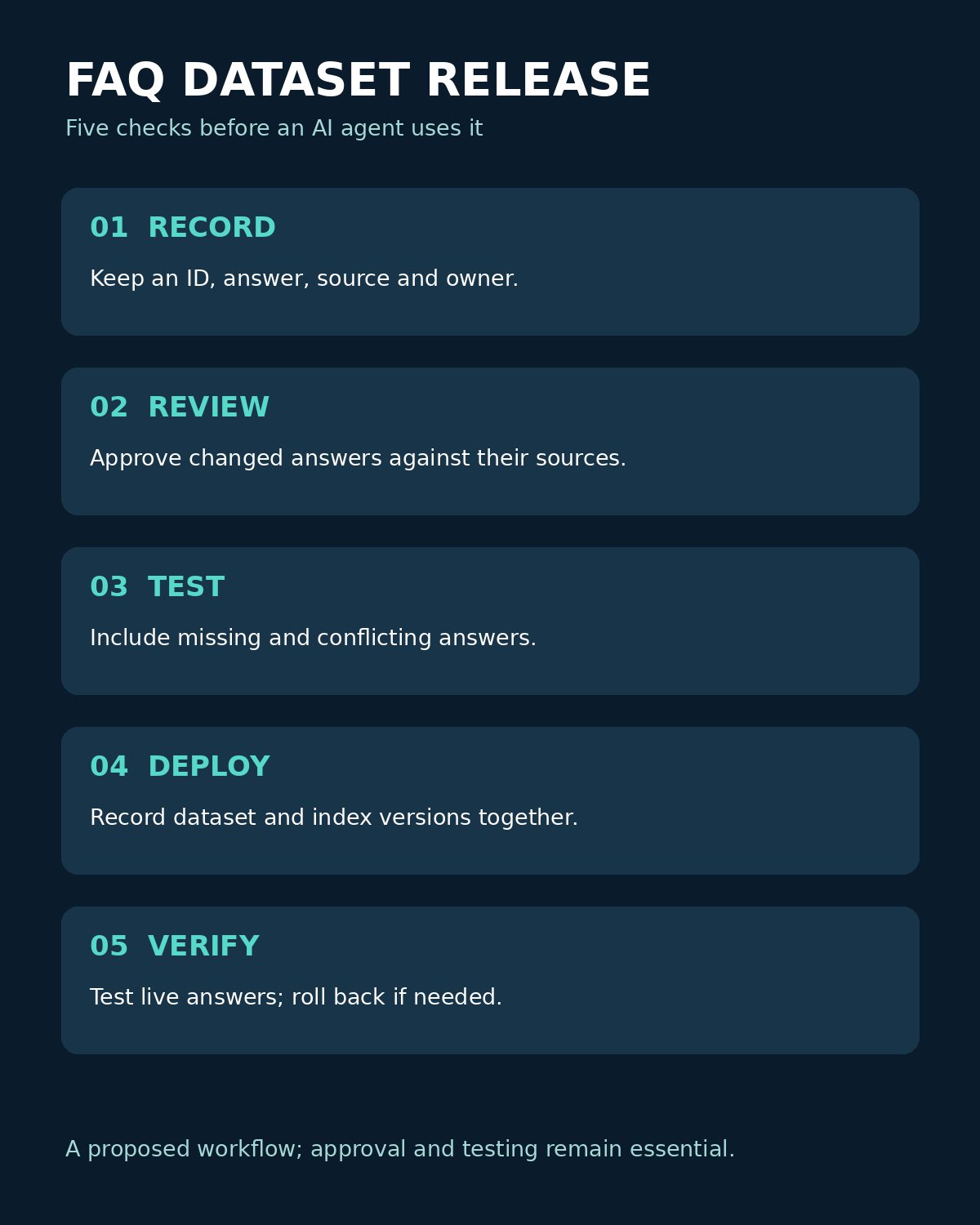
How to release a versioned FAQ dataset for an AI agent
Start with a stable ID for each FAQ, the question, approved answer, source, owner, review date, status and audience. Keep sensitive customer details out of examples unless their use is authorized. A source link should point to the policy or documentation that supports the answer, and access to that source must match the intended audience.
- Export a candidate snapshot and record its version identifier and schema.
- Review changed answers against their sources; assign a person with authority to approve each material change.
- Run test questions covering current answers, outdated or conflicting source material, and questions outside the dataset. Check that the agent can say it does not know.
- Publish the approved snapshot through the actual ingestion pipeline and record both the dataset version and index or deployment version.
- Ask the same test questions after deployment. If the source or index is wrong, roll back to a known approved snapshot and verify the customer-facing result.
This is a proposed workflow, not a test result. Teams buying a broader knowledge platform can use these knowledge-base selection questions to assess permissions, ownership and integration before connecting an agent.
Choosing the right workflow
For a small versioned FAQ dataset for an AI agent, a reviewed text file in an existing Git service may be enough. Choose a data-specific platform when storage, reproducibility or shared pipelines make the extra operational work worthwhile. Whichever tool you select, the next step is the same: prove which approved snapshot the agent actually uses and test the answer after each release.