
The Gemini 4 Oxygen hypothesis begins with a question: could Google combine deep reasoning, fast execution and reliable verification so effectively that its next AI system sets a new standard for Claude and the rest of the industry? Hydrogen and oxygen give us a useful metaphor. Water has properties that neither ingredient has alone. The possibility worth examining is whether a carefully designed AI system could similarly deliver more useful work than its separate components. That is a thesis to test, not a Google product announcement.
No official Oxygen announcement was identified in the sources reviewed for this essay. “Gemini 4 Oxygen” and “Claude Fable 5.5” are unconfirmed working labels for the scenarios examined here. The underlying argument is an evidence-informed, testable hypothesis about the direction of AI development; the names themselves are not evidence. Possible future OpenAI releases described as “6.2” or “6.5” are also scenario labels, not verified product commitments. No unreleased model was tested.
The Gemini 4 Oxygen Hypothesis: Intelligence That Becomes Useful
There is an attractive idea inside the water analogy. An AI system might bring together a planner that understands the assignment, a fast worker that carries it out, a verifier that challenges its assumptions and a memory system that preserves the right context. The result could feel qualitatively better than a chatbot that merely answers the latest question.
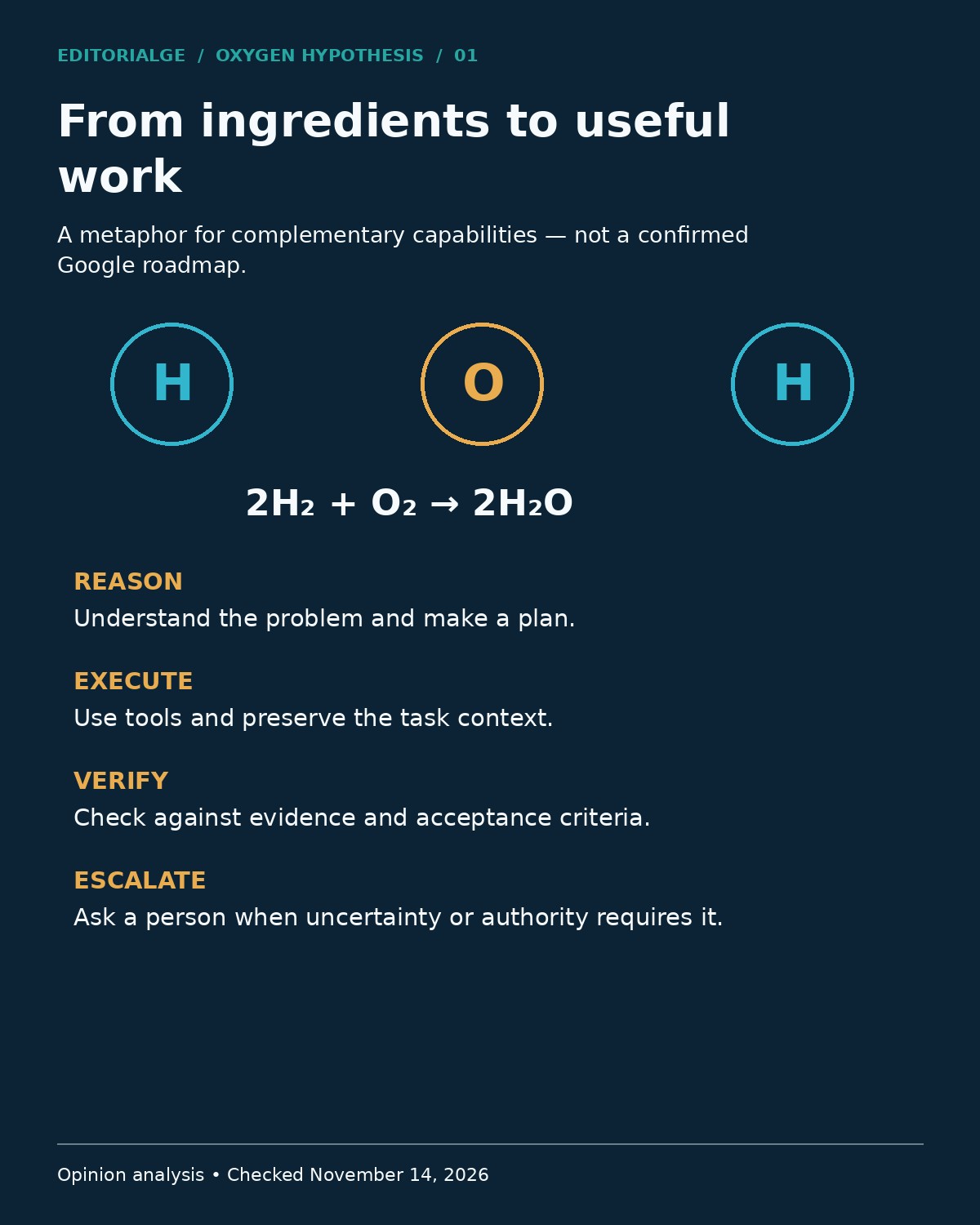
But the chemistry needs its boundary. Water is H₂O; the balanced formation reaction is 2H₂ + O₂ → 2H₂O. Simply placing hydrogen and oxygen together does not automatically produce water. Nor does connecting several models automatically produce dependable intelligence. The conditions and the mechanism matter.
Oxygen supports much of the life familiar to us, but oxygen is not itself life. An AI named after it would not acquire consciousness, judgment or universal competence through branding. The metaphor earns its place only if it helps us ask a sharper engineering question: what makes separate capabilities work together reliably?
The strongest version of this hypothesis concerns integration. A future assistant could make complex work accessible by choosing when to reason, when to use tools, when to spend more computation and when to stop. Whether Google eventually calls that product Oxygen is secondary to whether the system can deliver it.
Evidence Pack: A Plausible Direction, an Unproven Destination
My argument is that Oxygen represents a plausible next step in system design. It is grounded in observable developments, particularly specialization and model orchestration. It does not depend on imagining a mysterious model with unlimited abilities. The important distinction is between evidence for a technological direction and evidence that a particular product will arrive.
| Observed foundation | Reasonable inference | Still unproven |
|---|---|---|
| Google has documented Carbon and Hydrogen working together through orchestration. | A future system could improve how reasoning, execution and verification are combined. | That system is named Oxygen, or represents a wholly new base model. |
| The release record contains closely spaced announcements and access milestones. | Competition and product iteration may continue quickly. | A fixed fourteen-day research cycle or a guaranteed next release. |
| Current competitors show different strengths under different evaluations. | A successor could raise the standard on selected tasks. | Universal superiority over future Claude, OpenAI or Chinese systems. |
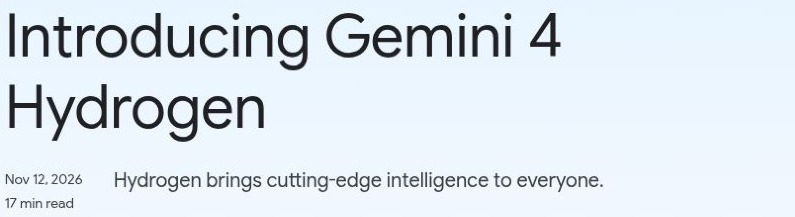
The screenshot is a source artifact, not a laboratory result. The orchestration argument comes from the accompanying documentation reviewed for this essay. Our evidence pack keeps the source address and capture details so an editor can trace the claim. We have not run a controlled comparison of unreleased models, and no screenshot is presented as if we had.
A Twenty-Eight-Day Watch Window, Not a Launch Promise
Taking November 14, 2026 as the starting point, twenty-eight days ends on December 12; one calendar month ends on December 14. That is a useful observation window for this hypothesis, not an evidence-backed prediction that Google must announce Oxygen within it. The pace of recent releases makes the question timely, but it does not establish the probability of that particular name or deadline.
Three outcomes need separate judgments. An official Oxygen announcement would validate the naming prediction. Documentation of stronger orchestration would support the integration thesis, even under another name, but would not make the naming prediction correct. Superiority over a rival would require reproducible, matched-budget comparisons of named model versions on the same tasks, with failures, cost and human correction included.
If there is no announcement by the end of the window, a claim of release within that window has failed. The broader integration thesis could remain plausible, but should not be retroactively described as a successful release forecast. If controlled tests show higher costs, more errors or no useful improvement, the claimed practical advantage also weakens. That willingness to specify what would count against the argument is what makes this a testable hypothesis.
Google’s Release Calendar Raises Questions, Not Proof of a Fourteen-Day Breakthrough
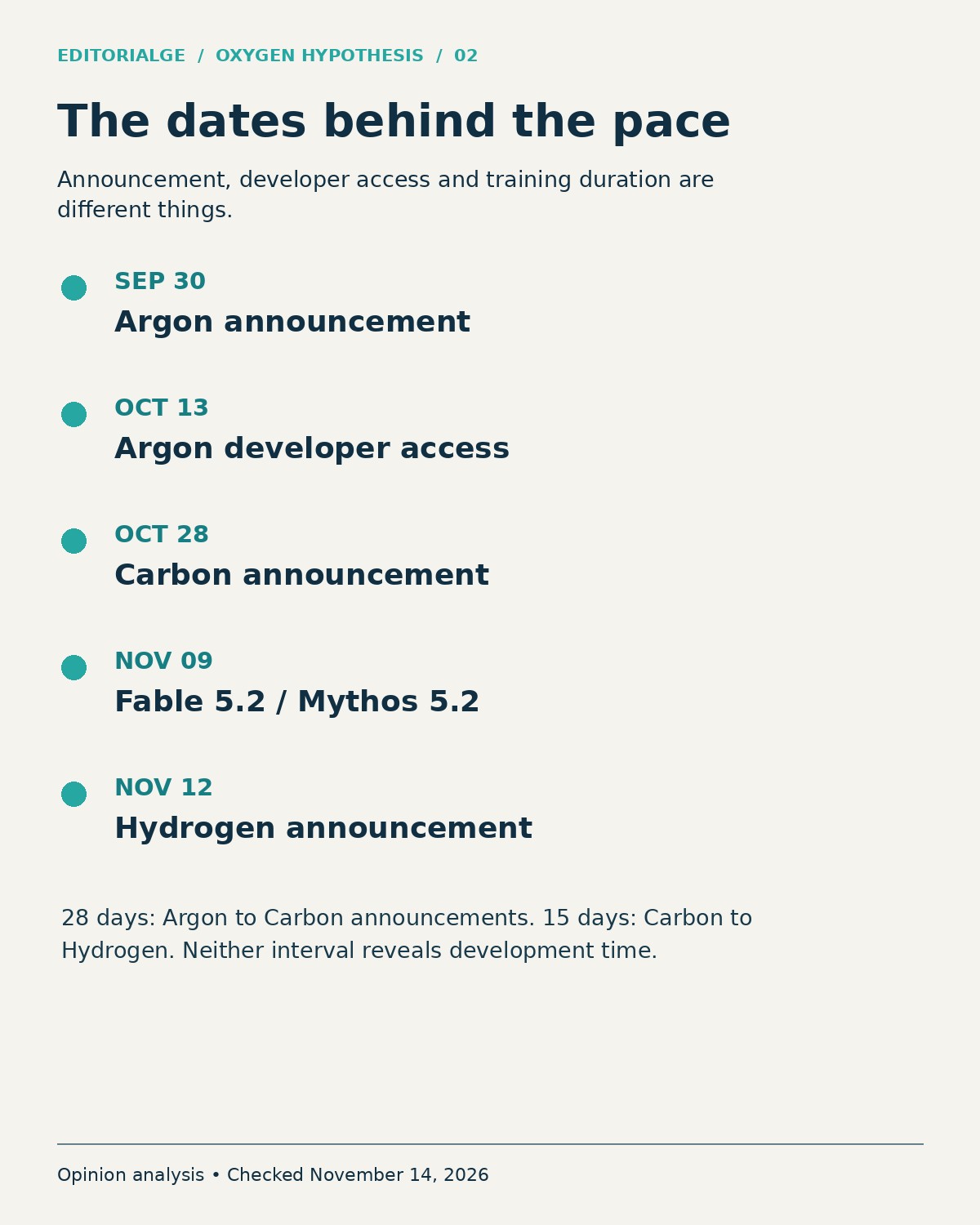
The pace deserves attention. The milestone dates, however, do not support a simple story in which every new model is invented in fourteen days.
| Date in 2026 | Verified public milestone | What it establishes |
|---|---|---|
| September 30 | Argon announcement | Restricted rollout announced |
| October 13 | Argon developer availability | A later access milestone |
| October 28 | Carbon announcement | Another frontier release announced |
| November 9 | Claude Fable 5.2 and Mythos 5.2 announcement | Anthropic’s contemporary reference point |
| November 12 | Hydrogen announcement | Google’s faster execution model introduced |
There are 28 days between the Argon and Carbon announcement dates, 15 between Argon’s developer release and Carbon’s announcement, and 15 between Carbon and Hydrogen. Google’s Carbon post uses a two-week description for the earlier Argon launch. That wording should be read alongside the separate announcement and availability dates.
Public releases can reflect research programs running in parallel, staged safety evaluation, infrastructure readiness or product decisions. They do not expose the training calendar. A model announced this week may depend on work that began long before last month’s release.
Still, the sequence invites serious questions. Are stronger systems helping researchers run more experiments? Are laboratories learning to separate expensive reasoning from routine execution? Is the commercially important product becoming a family of cooperating models? Those questions are defensible. A claim that the calendar proves autonomous self-improvement is not.
The Evidence Closest to the Thesis Already Exists
Documented Case 1: Routing Work Between Models
Google’s November 12 Hydrogen announcement describes Orchestrator switching between Carbon and Hydrogen within a session. It also describes Carbon coordinating tasks while Hydrogen handles worker or verification roles. Google reports near-Carbon task success on Terminal-Bench 4.0 with 24% less quota consumption and 19% faster completion on average.
Those are company-reported results, not measurements reproduced for this essay. They support a narrower proposition: dividing work can improve the balance of quality, latency and resource use in a specified evaluation. They do not establish an Oxygen model or universal superiority. Ars Technica’s coverage of Hydrogen also places it in Google’s developing agentic workflow strategy.
The operator’s question is where the saving survives. Routing has a cost: the system must recognize difficulty before it has solved the problem. An apparently simple request can hide a hard dependency. A competent router must be able to escalate after work begins, rather than defend its first choice.
Editorialge’s guide to autonomous AI agents for workflow automation adds practical context for choosing systems that execute tasks across tools.
Documented Case 2: AlphaEvolve and AI-Assisted Research
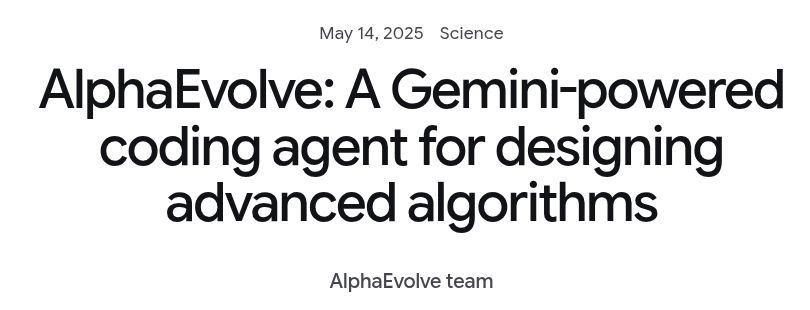
DeepMind’s May 2025 AlphaEvolve announcement provides an earlier example of complementary models and automated evaluation. Its system proposes candidate programs and tests them. DeepMind reports a 23% improvement to a matrix-multiplication kernel that translated into a 1% reduction in Gemini training time.
The different percentages describe different scopes. Improving a component is not the same as accelerating the whole training run by that amount. The result is a vendor disclosure, not an independent replication here.
The implication is substantial even with that limit. AI can contribute to the machinery used to build subsequent AI. Yet useful research requires an evaluator that detects real improvement, not merely attractive output. A feedback loop with a weak evaluator can optimize the wrong thing with impressive speed.
Editorialge’s earlier analysis of AI helping build AI offers related context. The practical extension here is to ask which improvements remain valid after independent tests, deployment constraints and human review.
Ars Technica’s reporting on AlphaEvolve provides further context on its algorithm-search approach and reported applications.
Could Oxygen Overtake Claude Fable?
It could, in the ordinary sense that a future system may outperform a current one. There is no evidence-based way to assign that hypothetical victory to Oxygen today.
The names need precision. Anthropic announced Fable 5.2 and Mythos 5.2 on November 9. Its announcement recommends Opus 5.5 as the starting point for most everyday coding and knowledge tasks, with Fable or Mythos for more ambitious work. Opus 5.5 is not Fable 5.5. Treating every version number as one ladder obscures the product families and their intended uses.
Anthropic also describes advisory and orchestration roles. Google therefore would not be competing against a stationary rival that only offers one large model. Future systems from either company could combine stronger reasoning with selective delegation.
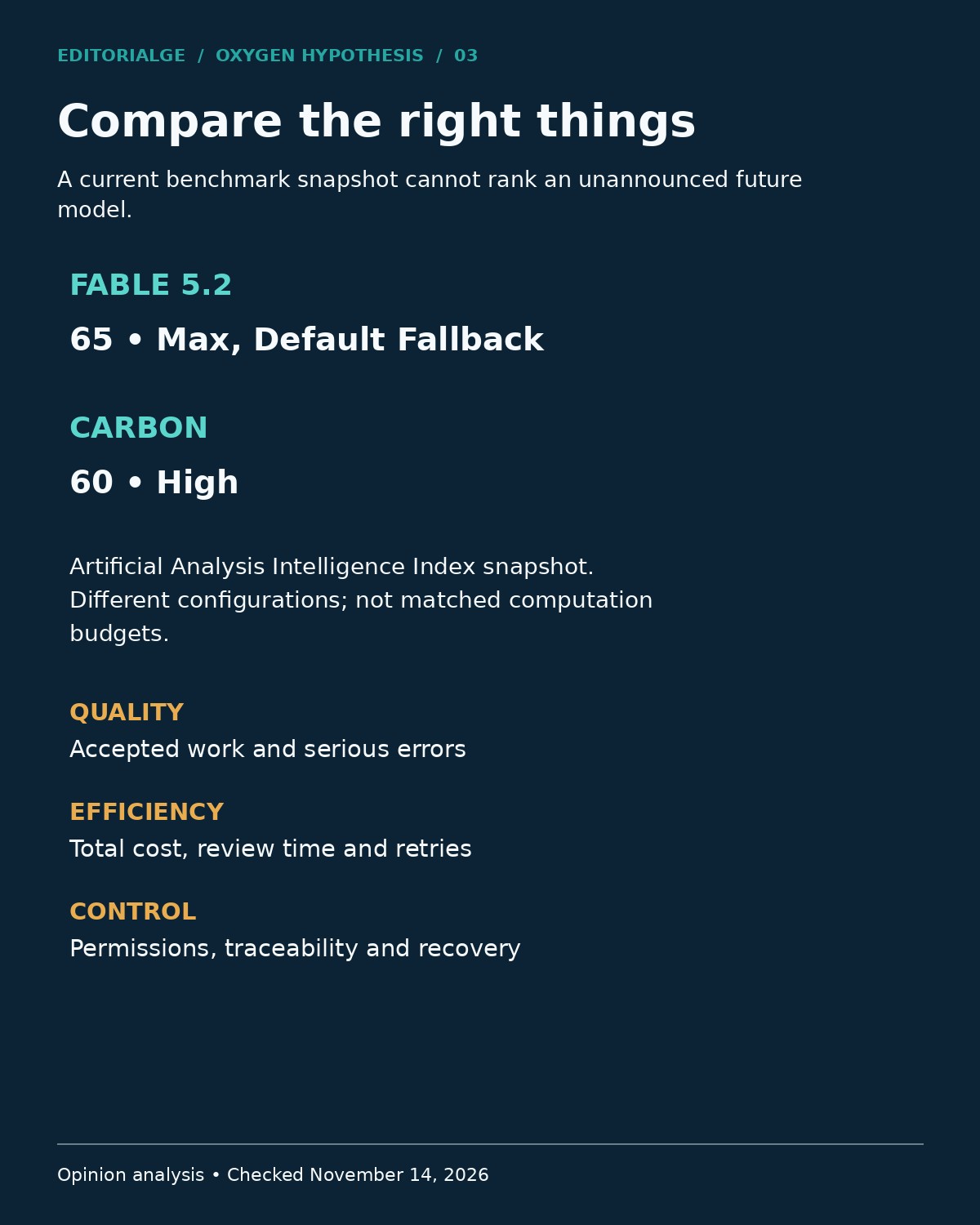
A useful present-day reference is Artificial Analysis’s comparison page, checked November 14. It lists Fable 5.2 at 65 in its Max, Default Fallback configuration and Carbon at 60 in High on the Intelligence Index. Those are different configurations, not matched computation budgets. This is evidence for a lead on that reported measure, not proof that Fable wins every workflow or that an unreleased successor will do so.
A future comparison needs two views. One should ask what each system can achieve under a comparable cost and time budget. The other should ask what it can achieve at its highest practical quality setting. Mixing the two would let a cheaper model win on price while silently allowing a rival much more reasoning time—or the reverse.
The strongest counterargument to the Oxygen thesis is straightforward: a sufficiently capable single model may be easier to control, cheaper to integrate and less prone to context loss than a team of specialized assistants. More coordination is not automatically more intelligence. Oxygen would need to beat that simpler alternative.
OpenAI’s Next Version Could Change the Question
The imagined “ChatGPT 6.2” or “6.5” comparison should remain hypothetical. A chat product’s name and the model behind it are not interchangeable, and an unreleased version number tells us nothing dependable about its capabilities.
For this scenario, assume a future OpenAI assistant becomes substantially better at carrying context across documents, applications and long assignments. Google might then face a competitor whose advantage lies in completing the whole workflow, even if selected reasoning benchmarks remain close.
Conversely, an assistant with strong reasoning can disappoint when its tools fail, permissions are unclear or it cannot inspect the file it just created. The real contest would include the surrounding software: execution environments, retrieval, recovery, export quality and the visibility of unfinished work.
That leaves room for several winners. One provider may lead research tasks, another software maintenance, another low-cost multilingual operations. A claim to be the strongest AI ever would need a defined date and evaluation scope. It cannot reasonably promise permanent leadership over future competitors.
China’s Challengers Are Already Moving
The possibility of a surprising Chinese release deserves analysis without turning secrecy into evidence. No source reviewed establishes that a particular laboratory is holding a hidden world-leading model for a coordinated launch. Private research is normal; its unknown results cannot be ranked.
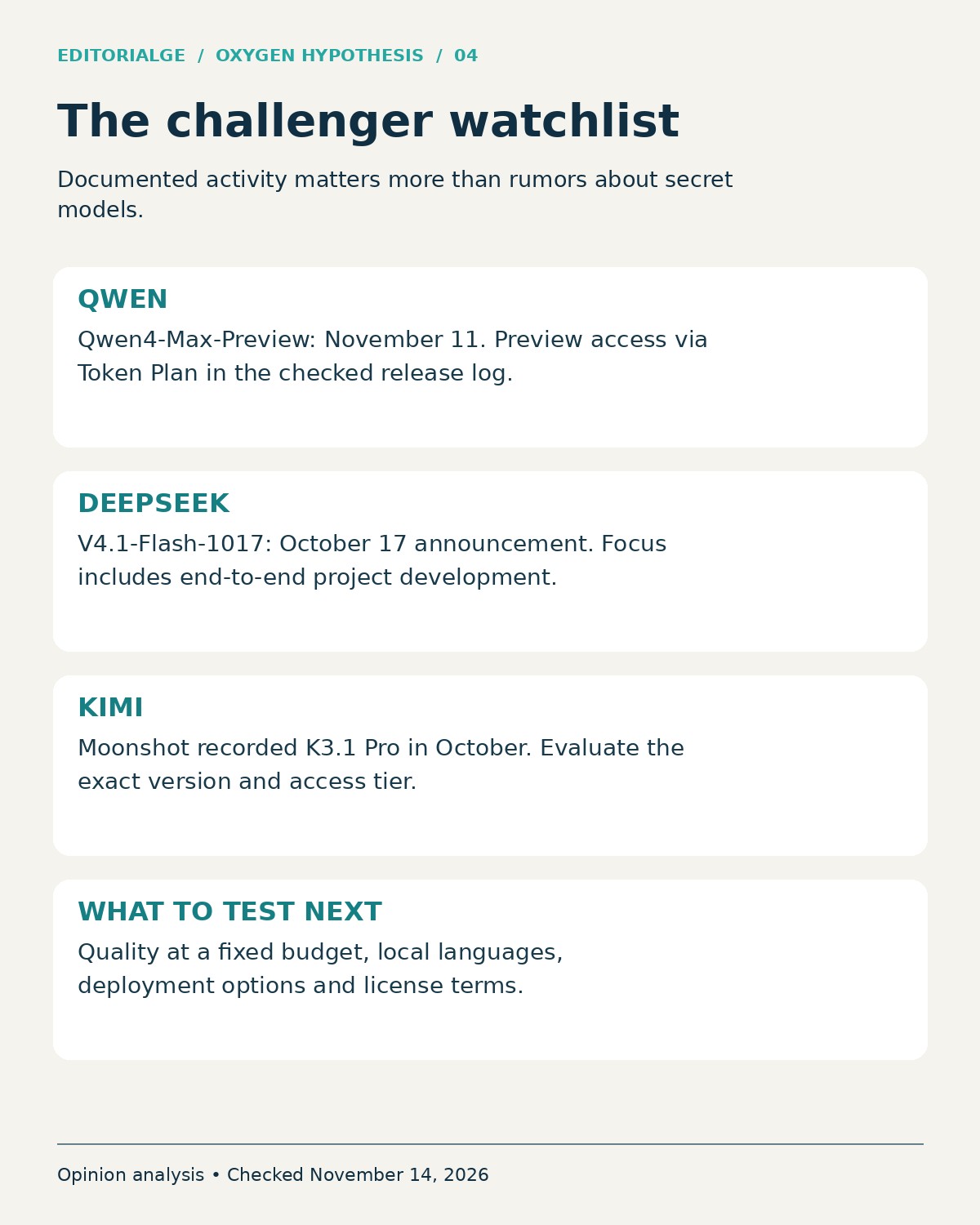
What can be observed is more useful. QwenCloud’s release log records Qwen4-Max-Preview on November 11, with access limited to its Token Plan at the time checked. DeepSeek’s October 17 announcement describes V4.1-Flash-1017 and improvements aimed at end-to-end project development. Moonshot’s official announcement forum records Kimi K3.1 Pro in October. These are active development lines, not hypothetical entrants waiting outside the contest.
Consider three ways a challenger could alter the market. A reasoning advance could narrow a quality gap. A more efficient model could make an existing capability affordable at scale. A better deployment or licensing arrangement could give organizations control they cannot obtain from a hosted service. None requires the same company to dominate all three.
Qwen, DeepSeek, Kimi and Z.ai’s GLM also should not be treated as one national product. They have different versions, access paths and operational constraints. Model origin is not a substitute for evaluating accuracy, license terms, data handling and suitability for the task.
For a business serving clients across India, Bangladesh and other markets, local language performance matters. An assistant that handles English benchmarks well may still misunderstand Bengali tone, mixed-language instructions or regional business terminology. That is a testable procurement question, not a reason to assume either Chinese or American superiority.
Editorialge’s broader examination of Chinese and American AI provides context for this competition. The next surprise might be a headline-grabbing model. It might equally be a dependable system that makes acceptable work much cheaper.
Three Hypothetical Cases That Make “Strongest” Measurable
The following cases are fictional decision exercises. They are not customer results, author experiences or tests of any named model.
A Newsroom: The Fastest Draft Can Still Lose
Imagine a newsroom commissioning a launch analysis. A coordinated assistant assigns research, writing and fact-checking to separate agents. A rival keeps the assignment in one sustained session. The first system finishes sooner, but every agent relies on the same incomplete source summary. A planned feature becomes an available feature in the published draft.
The mistake is shared evidence, not a lack of agents. An independent check would reopen the original release note and verify availability. The slower system could win by identifying uncertainty before publication; the coordinated system could win after its evidence flow is corrected.
The acceptance criteria should include unsupported claims, broken citations, missing qualifications and editor correction time. First-draft speed alone rewards an unfinished product.
A Digital Agency: Price the Accepted Result
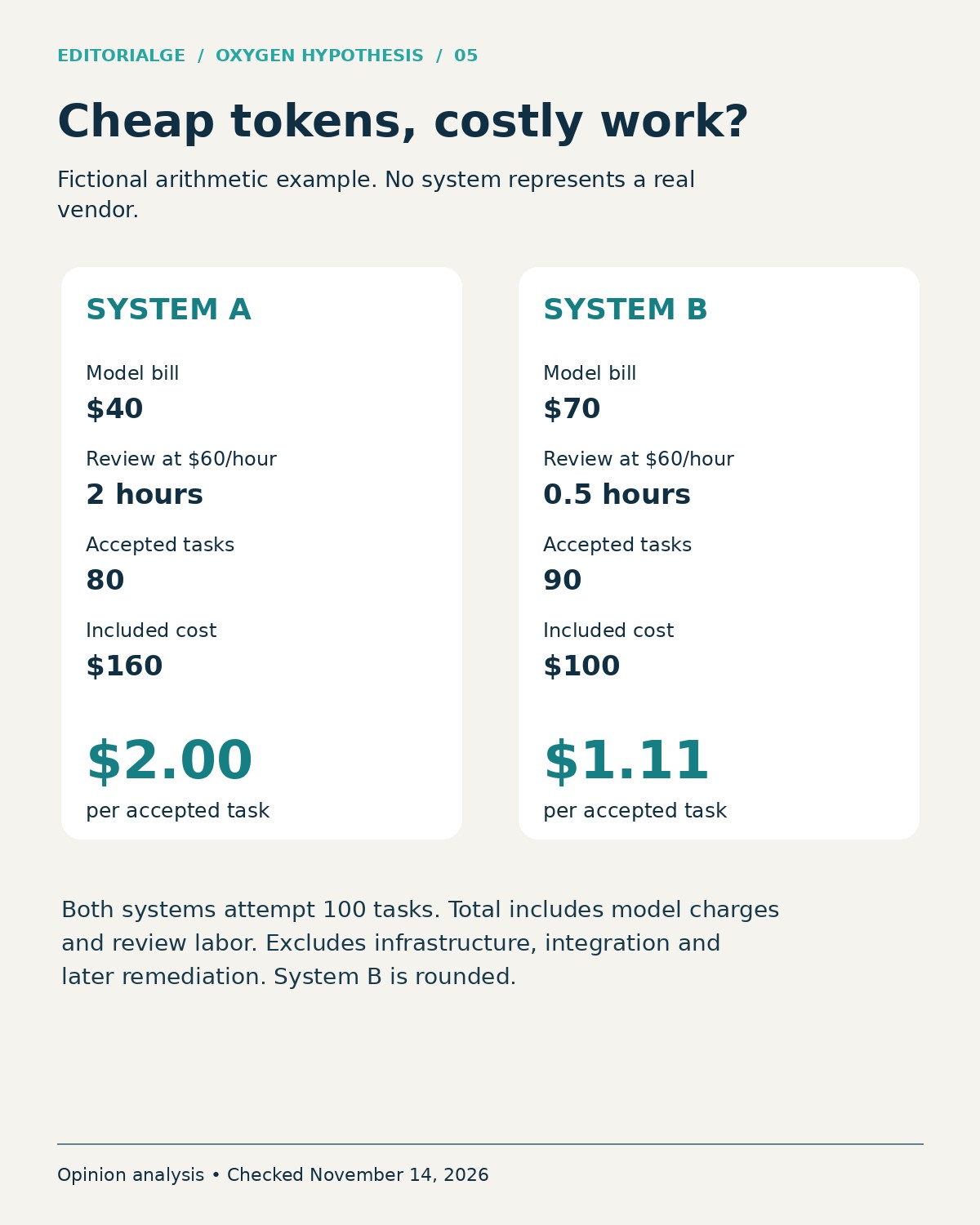
Assume two anonymous systems attempt 100 tasks. System A costs $40 in model usage and requires two hours of review at $60 per hour; 80 results are accepted. System B costs $70 and requires half an hour of review at the same rate; 90 results are accepted.
The included cost per accepted task is $2.00 for A: ($40 + $120) ÷ 80. It is about $1.11 for B: ($70 + $30) ÷ 90. These invented numbers demonstrate the calculation, not a vendor ranking. Infrastructure, integration and later remediation are excluded and would have to be added in a real decision.
For Oxygen to matter commercially, it would need to improve a measure like this while preserving quality. A Chinese challenger or future Claude could win the same test without being the highest scorer on a general intelligence index.
A Software Team: Passing Tests Is Not Enough
Imagine a client portal update. One agent writes the code and another writes tests. Both overlook a requirement that customers must not view one another’s records. The test suite passes because it never checks the missing boundary.
The remedy is an acceptance test derived independently from the requirement, an explicit permission review and a controlled release decision. A reviewer repeating the same mistaken assumption is not verification. This is why recovery, auditability and limits on authority belong in an intelligence comparison.
A useful assistant should preserve completed work when a tool fails, identify what remains undone and request the specific information needed to continue. A dashboard that says “complete” while hiding an unresolved step is operationally worse than an honest partial result.
What Could Break the Oxygen Thesis?
Several risks deserve equal weight with the opportunity. Handoffs can discard essential context. Coordinators can create more work than they save. Several agents can confidently agree because they share the same blind spot. Tool access can expand the consequences of a mistake, and long workflows can make responsibility difficult to reconstruct.
There is also an economic limit. A system that spends expensive reasoning on every small task may be impressive but impractical. A system that routes too aggressively to cheaper components may require more correction. The desirable balance depends on error costs, not only token prices.
Integration creates another tension. A tightly connected assistant can save time while making it difficult to move files, memory and workflows to a rival. Buyers should inspect exportability and failure recovery alongside the demonstration. Convenient automation is more valuable when people retain control over it.
Even the environmental story requires measurement. Faster execution does not establish lower total energy use without information about hardware, utilization and workload volume. Lower unit costs can encourage much more usage. A claim that Oxygen would be greener simply because it is efficient would run ahead of the evidence.
For the measurement concepts behind this distinction, see our guide on how to evaluate an AI model before interpreting an aggregate score as a guarantee of real-world success.
The Test That Would Change This Opinion
The coordination thesis would strengthen if a mixed-model system repeatedly produced more accepted work, fewer serious errors and lower total costs than a strong single-model baseline on unfamiliar tasks. It would weaken if the apparent gains disappeared after counting handoffs, review labor and retries.
A credible evaluation would preserve the exact task packet, model identifiers, reasoning settings, tool permissions and budget. Reviewers should assess outputs without seeing vendor names. Every failure should remain in the record. Repeated trials should report variability, not just the best result.
The same test should include multilingual research, document production and software tasks, with separate results for each. A combined score can be useful, but its weights should be disclosed. A serious permissions failure should not disappear because the system wrote attractive prose elsewhere.
This is a proposed protocol. It has not been executed for this essay, and the source screenshot is not a substitute for it.
A Conditional Verdict on Gemini 4 Oxygen
The Gemini 4 Oxygen hypothesis is plausible as a vision of integrated capability. Existing work on model coordination and AI-assisted optimization gives it substance. There is still no basis here for announcing Oxygen, assigning it a score, declaring it superior to a future Fable or predicting that it will do every kind of work.
The more defensible expectation is a shifting contest. Google could gain from making complementary models work together. Anthropic could improve reasoning and delegation. OpenAI could make complete workflows more reliable. Chinese laboratories could change the price, capability or deployment assumptions behind the whole comparison.
The water metaphor is most useful at the point where poetry meets accountability. Separate ingredients become valuable through the conditions that let them work together. For AI, those conditions include sound evidence, reliable tools, independent checks and human authority.
If a future Oxygen delivers that combination, it could set a new standard. Until then, the question worth keeping open is more demanding than who wins the next leaderboard: which system can people trust to finish meaningful work, show its limits and remain under their control?
Methodology and Disclosure
This source-led opinion was prepared with AI-assisted research, drafting and visual production on November 14, 2026. Official announcements establish what companies disclosed; they do not independently prove performance. The Artificial Analysis figures are an evaluator’s published snapshot, not an Editorialge benchmark. The retained screenshot documents a source header. No firsthand model-comparison session or access to an unreleased system is claimed. The five infographics explain facts, concepts or explicitly fictional assumptions. The featured image is a conceptual illustration.