What if Google’s next big idea were called “Gemini 4 Oxygen”? The name is my thought experiment, not an announced product. After Argon, Carbon, and Hydrogen, it is tempting to imagine a system that brings their strengths together—and an imagined Claude Fable 5.5 arriving to challenge it. But the most interesting question is not which company chooses the better name. It is whether the next leap in AI comes from a stronger individual model, better coordination among models, or a more productive partnership between machines and people.
Scope, November 14, 2026: I found no official announcement establishing Gemini 4 Oxygen or Claude Fable 5.5 in the sources checked for this article. Both names are hypothetical placeholders here. No release date, architecture, price, or intelligence score is being predicted as fact. The case studies below are explicitly fictional scenarios, not customer results or tests of unreleased products.
My working hypothesis is that the next commercially important AI leader may be the system that turns reasoning, execution, verification, and human expertise into dependable finished work. It might be sold under one name while using several models. It might also lose to a less spectacular competitor that makes fewer expensive mistakes.
As a publisher and founder working across media and creative technology, that is the contest I care about. In my earlier Chinese AI vs American AI article and its follow-up on AI helping build AI, I considered leadership from the user’s side. This essay takes the next step: what would have to happen for a future contender to deserve our confidence?
The Oxygen Metaphor: An Opening, Not a Roadmap
Hydrogen and oxygen form water, and water sustains life. As a metaphor for separate capabilities creating something useful together, that is powerful. It gives us a way to imagine AI becoming more helpful in ordinary work.
But chemistry does not predict a technology company’s naming decisions. Argon, Carbon, and Hydrogen do not establish that Oxygen must follow. Combining model capabilities does not make a system alive, conscious, or self-directed. Nor does putting three models behind one interface automatically preserve the best qualities of all three.
I use “Oxygen” as shorthand for a possibility: a coordinated assistant that knows when to think deeply, when to act quickly, when to check its work, and when to ask a person. The hypothesis concerns those capabilities. It can remain useful even if Google never uses the name.
What the Release Timeline Actually Tells Us
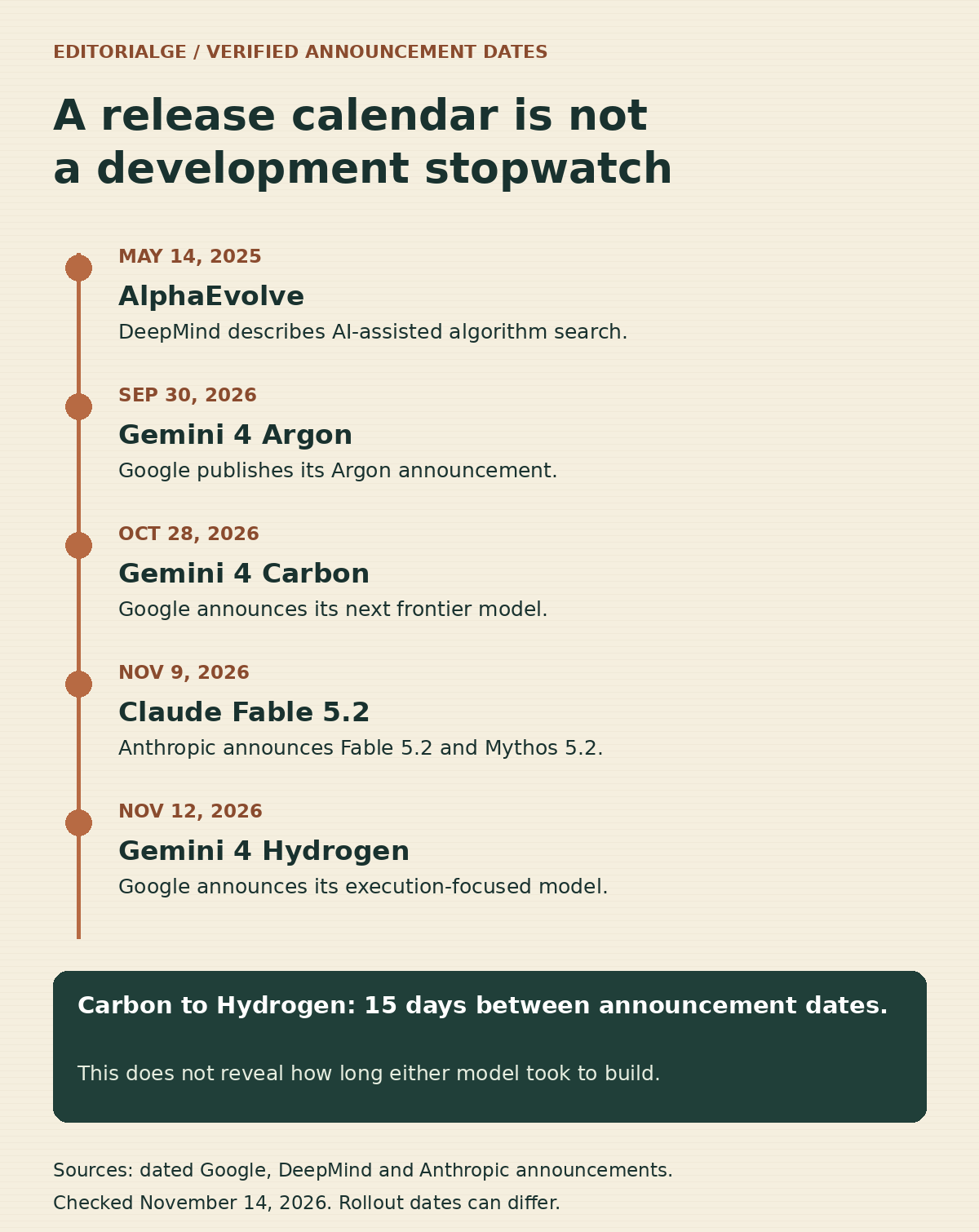
The dated announcement pages tell a more careful story than “AI built a new AI in fourteen days.” Google’s Argon announcement is dated September 30, 2026. Its Carbon announcement is dated October 28. Anthropic announced Fable 5.2 on November 9, and Google announced Hydrogen on November 12.
| Date | Documented milestone | What it does not establish |
|---|---|---|
| May 14, 2025 | DeepMind announces AlphaEvolve. | Unrestricted, autonomous AI self-improvement. |
| September 30, 2026 | Google publishes its Argon announcement. | The start date of the model’s development. |
| October 28, 2026 | Google announces Carbon. | That all research and training happened since the previous release. |
| November 9, 2026 | Anthropic announces Fable 5.2 and Mythos 5.2. | A confirmed future Fable 5.5 release. |
| November 12, 2026 | Google announces Hydrogen. | An announced Oxygen successor. |
Carbon’s announcement describes a two-week interval from an Argon launch milestone, while the earlier Argon announcement carries a September date. That distinction matters: announcement, restricted access, developer availability, and broad rollout can mark different events. Carbon to Hydrogen’s announcement dates are fifteen days apart. Neither interval is a disclosed end-to-end development schedule.
Teams can work in parallel. A faster model can draw on research completed much earlier. A release may wait for infrastructure or evaluation. The calendar shows a fast public cadence; it does not isolate what AI contributed or how long the work took.
AI Helping Build AI Is Already More Than a Metaphor
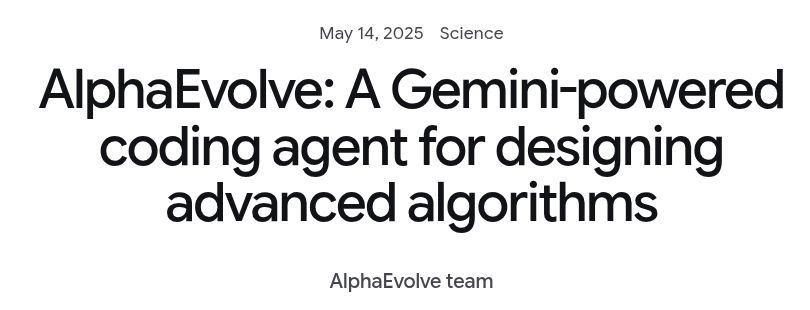
There is a concrete basis for the larger question. In its AlphaEvolve announcement, DeepMind describes a system that proposes programs, evaluates them automatically, and develops promising candidates. The company reports applications to computing infrastructure, chip design, and AI training.
That is significant, but the mechanism matters. A human-defined objective and a dependable evaluator can make repeated search useful. They do not establish a machine independently choosing its own research agenda, redesigning itself without meaningful oversight, and guaranteeing that every generation will be better.
My expectation is that more research work will become partly automated. My confidence is lower about how much this shortens the full development cycle. More experiments are valuable only if their results survive scrutiny. Faster production of plausible mistakes would create a larger review burden.
The bottleneck may shift from generating ideas to judging them. A laboratory that can tell a genuine improvement from a test-specific shortcut may gain more than one that simply produces more candidate solutions.
For reporting beyond the company announcement, Ars Technica’s coverage of AlphaEvolve explains its algorithm-search approach and reported applications.
A Documented Example: AlphaEvolve’s Training Optimization
DeepMind reports that AlphaEvolve improved a matrix-multiplication kernel used in Gemini by 23%, translating into a 1% reduction in training time. Those are two different denominators: a substantial improvement in one component produces a smaller change across the full training process. This is a vendor-reported result, not an Editorialge replication. It supports the narrower claim that AI-assisted optimization can improve AI development; it does not establish that an entire frontier model can be created in fourteen days.
Would Gemini 4 Oxygen Be One Model or a Team?
Google’s Hydrogen announcement already describes an Orchestrator that switches between models such as Carbon and Hydrogen. It also describes Carbon coordinating work while Hydrogen serves as a worker or verifier. This is a company-described product direction, not evidence for a secret Oxygen model.
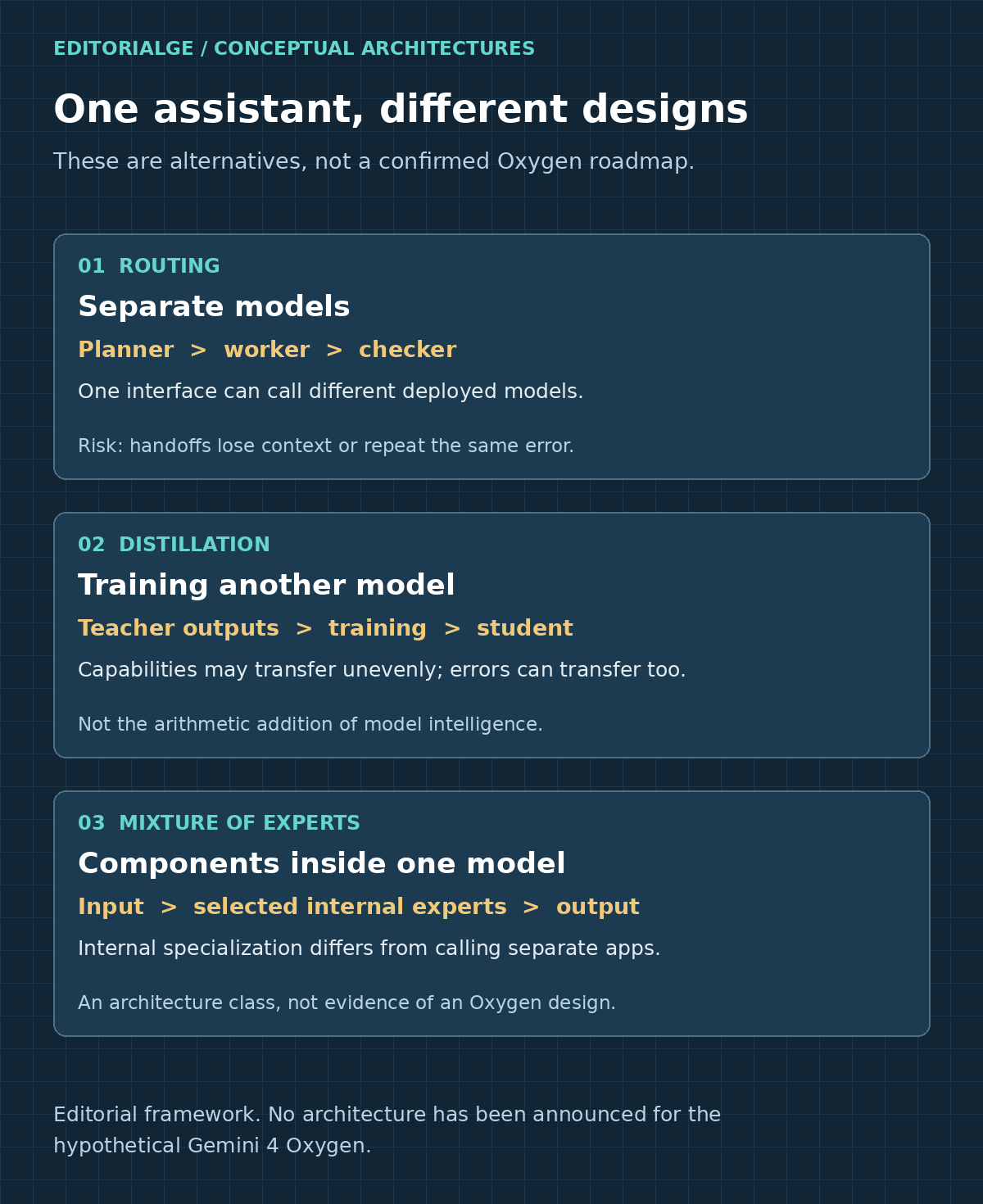
It points toward three possibilities that readers should keep separate.
Ars Technica’s Hydrogen launch report provides additional context on its rollout and role in agentic coding. This reporting does not establish an Oxygen successor.
1. One Product, Several Models
A routing system could send difficult planning to a stronger model, routine execution to a faster one, and selected outputs to a checker. Users might experience one assistant. The underlying models would remain separate. Its success would depend on routing decisions, shared context, tool permissions, and the cost of handoffs.
For practical deployment context, see Editorialge’s guide to autonomous AI agents for workflow automation. Product selection and model architecture are related but different decisions.
2. A New Model Trained With Help From Others
Researchers could use outputs or feedback from existing systems to help train another model, subject to data rights and suitable validation. This broad approach includes forms of distillation. It is not equivalent to adding model scores together: strengths may transfer unevenly, and errors can transfer too.
3. Specialized Components Inside One Model
A mixture-of-experts architecture activates selected internal components for a given input. That is different from an app calling three separately deployed assistants. DeepSeek’s published V3 documentation provides a real example of the architecture class; it is not evidence of Google’s hypothetical design.
The practical question is which arrangement produces dependable outcomes at an acceptable cost. A coordinated system adds failure points: the planner can choose the wrong task, a worker can misunderstand it, and the reviewer can approve the same mistaken assumption. Agreement between agents is not independent verification.
Imagining a Rivalry With Claude Fable 5.5
The future Fable name in this essay is deliberately speculative. Anthropic’s current Fable 5.2 announcement already describes advisor and orchestrator roles: a stronger model can help other models with difficult questions or delegate simpler work. Coordination is therefore not an exclusively Google idea.
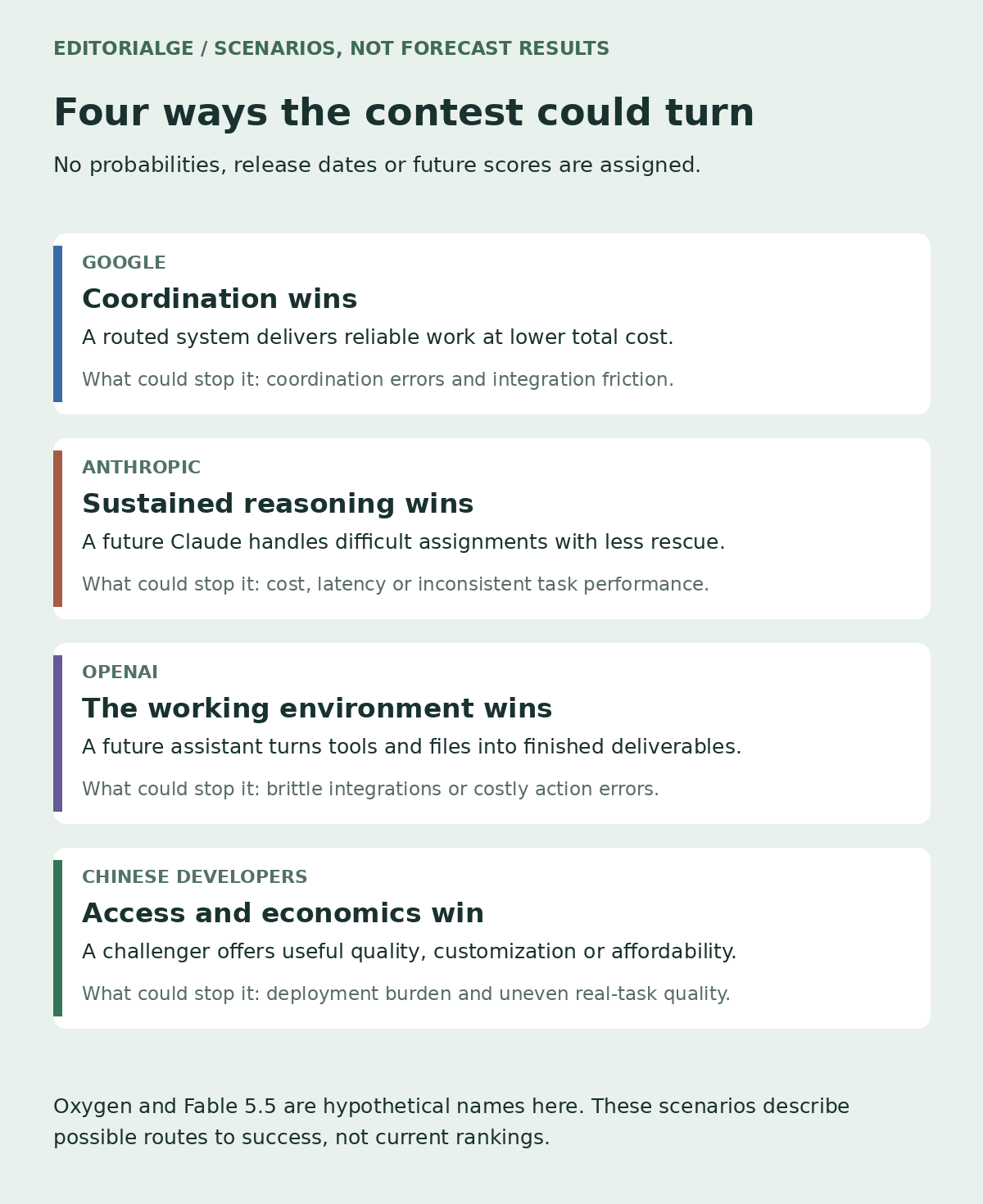
In a hypothetical next round, Google might compete through efficient routing and integrated tools, while Anthropic might compete through sustained reasoning and dependable delegation. These are scenarios to examine, not forecasts of unreleased specifications. Either company could pursue both approaches.
If future models reached similar intelligence scores, the tie would make practical differences more important. How often do they require rescue? Do they preserve instructions over a long assignment? Can they identify missing evidence? What does a completed, accepted task actually cost?
I would not forecast equal scores in advance. A comparison needs the same evaluation version, disclosed settings, comparable tool access, and attention to uncertainty. Even then, one aggregate result can hide large differences between tasks.
OpenAI and Chinese Developers Could Change the Contest
OpenAI’s Astra announcement emphasizes computer use and professional workflows. That gives us a documented direction to examine, not a name for its next release. A future OpenAI system could gain ground by making the passage from request to finished deliverable more reliable. It could also lose ground if integration creates brittle dependencies or costly mistakes.
Chinese developers should be evaluated individually. DeepSeek has published work on efficient model architectures. Moonshot develops Kimi. Alibaba’s Qwen and Z.ai’s GLM have released downloadable models. Their histories establish credible participants, not guaranteed winners or identical strategies.
A future challenger might make strong performance affordable for more businesses, support useful customization, or improve a neglected language or workflow. Accessible weights can expand deployment choices, but they do not automatically make a system inexpensive, private, or easy to operate. Hardware, licenses, maintenance, and evaluation still matter.
Manus belongs in this discussion with a distinction. Its published account of building agents emphasizes an application built around frontier-model capabilities. An agent platform can win a customer’s workflow without inventing the highest-scoring foundation model. Treating every assistant brand as the same kind of competitor would hide that possibility.
For an AI and digital media company founder in Bangladesh, the desirable outcome is more bargaining power and usable choice. A market in which businesses can change providers without rebuilding everything may be healthier than one with a single permanent champion.
Three Hypothetical Case Studies: Where the Rivalry Becomes Real Work
All three cases below are fictional decision exercises. The organizations, outcomes, and numerical assumptions are illustrative. They are not Editorialge experiments, customer testimonials, or measurements of any named model.
Case 1: A Newsroom That Needs a Defensible Draft
Imagine a small newsroom covering a software launch. An “Oxygen-style” assistant divides the assignment among a researcher, writer, and checker. A hypothetical future Fable system handles more of the work in a single sustained session.
The coordinated assistant produces an attractive draft first. But its researcher mistakes a planned feature for an available one, and the checker merely reviews the researcher’s summary. Three stages have repeated one error. The alternative assistant is slower but marks availability as unresolved and leaves a precise question for the editor.
In that imagined outcome, the slower draft is more useful. Change the conditions—give the checker direct access to release documentation and require evidence for availability—and the coordinated system could improve. The case illustrates a design requirement, not a verdict on either vendor.
I would evaluate the final accepted article: unsupported claims, source traceability, corrections required, and editor time. Counting how quickly the first draft appeared would miss most of the work.
Case 2: A Creative Agency Discovers That Cheap Output Can Cost More
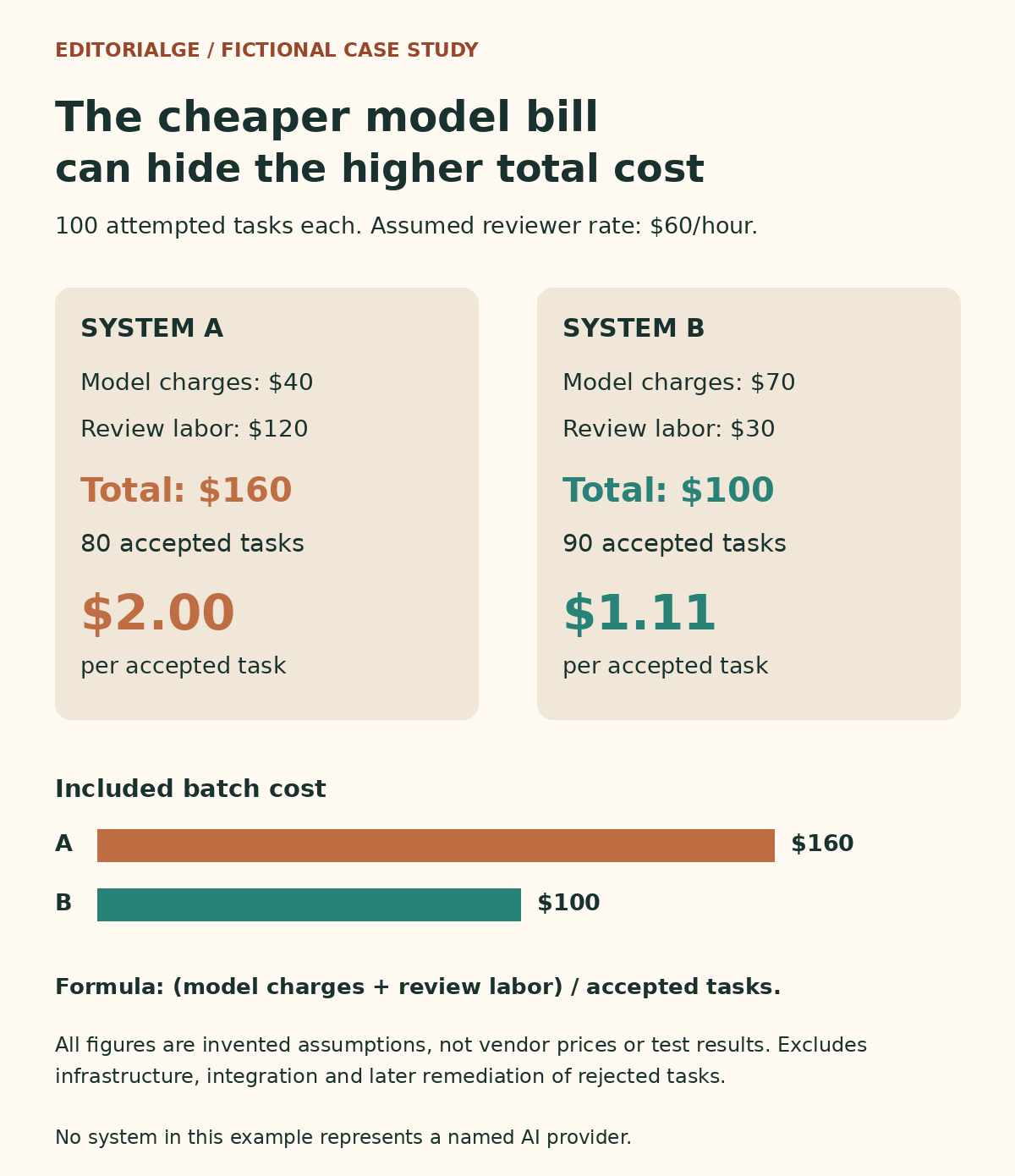
Consider two anonymous systems completing a batch of 100 client tasks. Assume a reviewer costs $60 an hour. System A incurs $40 in model charges, requires two review hours, and produces 80 accepted tasks. System B incurs $70, requires half an hour of review, and produces 90 accepted tasks.
| Illustrative assumption | System A | System B |
|---|---|---|
| Attempted tasks | 100 | 100 |
| Model charges | $40 | $70 |
| Review labor | 2 hours × $60 = $120 | 0.5 hours × $60 = $30 |
| Total included cost | $160 | $100 |
| Accepted tasks | 80 | 90 |
| Included cost per accepted task | $2.00 | About $1.11 |
In this invented example, the system with the higher model bill has the lower cost per accepted task. That is arithmetic, not a claim about Google, Anthropic, or OpenAI. No hypothetical system is mapped to a real vendor.
The calculation includes the cost of the whole attempted batch but excludes infrastructure, integration, and later remediation of rejected tasks. Real procurement would need those costs too. The lesson is to define “finished” before deciding what is cheap.
Case 3: A Software Team Tests Whether Agents Can Check One Another
Imagine a software company asking an assistant to update a customer portal. One agent writes the change; another writes tests. Both use the same incomplete specification and miss a permissions requirement. All tests pass, but the implementation is still wrong.
A better process would retain separate acceptance tests written from the actual requirements, check permissions independently, and let a human approve deployment. A Chinese open-weight system, a future OpenAI assistant, or either imagined rival could succeed under that process. The brand alone would not solve the specification gap.
This case is why I would ask for evidence of recovery as well as success. A useful assistant should notice when its plan fails, preserve what worked, explain what remains unresolved, and avoid expanding its authority to make the dashboard look green.
Our guide on how to evaluate an AI model offers background for interpreting scores before turning them into purchasing decisions.
What Would Support—or Weaken—My Hypothesis?
A prediction becomes more useful when we say what could change our minds. My coordination hypothesis would gain support if mixed-model systems consistently delivered more accepted work at lower total cost than strong single-model alternatives under comparable conditions.
It would weaken if handoffs repeatedly lost context, if reviewers merely endorsed the planner’s mistakes, or if a single capable model achieved the same quality with less complexity. A strong new model could make yesterday’s elaborate routing system unnecessary.
| Signal to watch | Evidence I would want |
|---|---|
| A new product name | An official announcement and actual access—not a naming pattern. |
| A claimed intelligence lead | Comparable independent evaluations with disclosed settings. |
| More efficient AI-assisted research | Validated improvements and a credible account of AI’s contribution. |
| A practical business lead | Accepted-task quality, total cost, intervention rates, and recovery behavior. |
| Autonomous self-improvement | Evidence that distinguishes bounded human-directed optimization from repeated autonomous capability improvement. |
I would also watch who controls the working environment. A company that owns the place where files, tools, permissions, and approvals meet can become difficult to replace even without winning every benchmark. That creates a tension: convenient integration can help customers while also increasing dependence.
My Prediction: Expect Several Leaders, and a Harder Definition of Winning
I expect stronger competition over systems that complete work, rather than a permanent settlement around one model’s score. That is a directional judgment, not a timetable. Google, Anthropic, OpenAI, and Chinese developers could lead different parts of the same market.
The strongest version of the Gemini 4 Oxygen hypothesis is therefore not “Google will release the world’s best AI under this name.” It is that combining complementary capabilities with trustworthy evaluation could create a better working assistant. A future Claude, an unnamed OpenAI release, or an unexpected challenger could realize that idea just as effectively.
Water is a useful final metaphor if we keep its limits. What matters is not the poetry of the ingredients but whether the result sustains something worthwhile. For AI, I would measure that in better research, clearer information, more accessible tools, and work that people can trust and control.
If a future “Oxygen” helps a small team accomplish more without hiding its uncertainty or removing human judgment, it will have earned attention. If it only gives us a new name to argue about, the revolution will still be waiting at the editing desk.
Evidence Ledger: What Readers Can Verify
The distinction between an announcement, a measured result, and an opinion matters more than the number of screenshots. This ledger explains how the sources linked in the article are used.
| Evidence | What it supports | What remains unproven |
|---|---|---|
| DeepMind’s AlphaEvolve announcement and technical description | A documented method for generating and evaluating candidate programs; reported applications to AI infrastructure. | Independent replication of every reported gain or unrestricted autonomous self-improvement. |
| Google’s Hydrogen announcement | Google’s description of model routing, coordination, and worker roles. | A confirmed Oxygen product, its design, or its performance. |
| Anthropic’s Fable 5.2 announcement | Anthropic’s description of advisor and orchestrator roles. | A confirmed Fable 5.5 release or a future benchmark victory. |
| The agency cost calculation in this essay | A reproducible arithmetic example: (model charges + review labor) divided by accepted tasks. | Real vendor pricing, measured productivity, or a purchasing recommendation. |
How to Turn the Fictional Cases Into a Real Test
A publishing team could preserve the exact assignment and source packet, record the model identifier and date, and document reasoning settings, tool access, memory, and cost limits. It should retain every output—including failures—and have reviewers apply the same acceptance criteria without seeing the model names. Repeat tasks to distinguish a consistent pattern from one lucky response. Report factual corrections, accepted-task rates, review time, total cost, and unresolved errors together. This is a proposed protocol; no such controlled comparison was conducted for this essay.
Author Perspective and Production Transparency
Sukanta Parthib is the founder and CEO of Editorialge Media LLC. The perspective here is that of a publisher evaluating useful work, editorial accountability, and business costs—not a claim of access to unreleased models or insider knowledge of a laboratory’s roadmap.
This article was prepared with AI-assisted research, drafting, and visual production. The featured image is a generated conceptual illustration, not a photograph of the author. The four infographics are editorial explanations; the source screenshot is a separate, authentic capture. No firsthand test of Oxygen or Fable 5.5 is claimed.
Methodology: Source-led opinion prepared November 14, 2026. Official announcements, technical documentation, and research descriptions informed the factual background; vendor disclosures are not independent performance verification. No unreleased model was tested. All forward-looking scenarios and case-study figures are explicitly hypothetical.