
Jensen Huang’s Nvidia resignation turns a leadership controversy into a test of whether the company can separate its future from its founder. NVIDIA announced his departure on November 12, 2026, naming finance chief Colette Kress interim CEO. The immediate question is why he left. The more consequential one is how the business will make decisions, manage political pressure, and maintain confidence without him at the top.
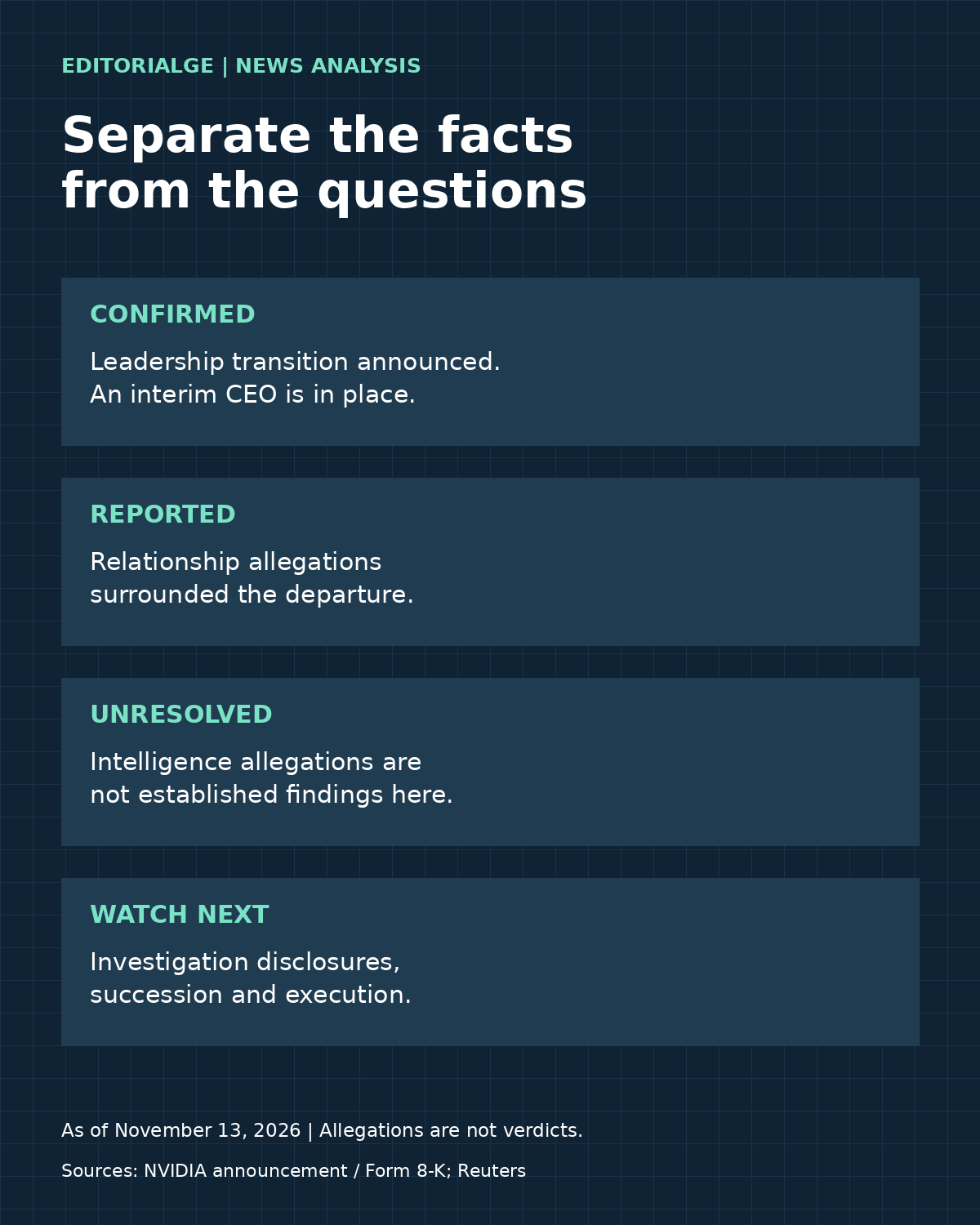
The answer requires care. A confirmed resignation, reported personal relationships, and an unresolved intelligence allegation are different things. Treating them as one proven chain of wrongdoing would mislead readers.
What Is Confirmed About Jensen Huang’s Nvidia Resignation?
NVIDIA says Huang has left the positions of president, CEO, and director. Kress will retain her CFO responsibilities during the interim period, and the board will consider both internal and external candidates for the permanent role. Harvey C. Jones becomes board chair. These are corporate decisions, not findings about criminal conduct.
The company’s transition announcement does not provide a detailed account of its internal deliberations or establish that confidential information was compromised. Its message emphasizes operational continuity. Whether that reassurance holds will have to be judged through subsequent results and disclosures, rather than accepted as an outcome already achieved.
Why Did Huang Leave?
Reuters links the departure to mounting pressure over reported affairs and an intelligence inquiry. It also reports that the Justice Department had not concluded whether Alice Huang was a spy; Beijing denies the allegation. Alice Huang is a former Megaspeed executive. Separate reporting concerned Kimberly Powell, NVIDIA’s healthcare vice president. The resignation does not establish espionage or a transfer of secrets.
That reporting explains the pressure surrounding the departure. It does not give outsiders access to every discussion between Huang and the board. The most defensible analysis is that several questions converged: confidence in executive judgment, oversight of potential conflicts, the demands of an investigation, and the company’s ability to keep operating while its leader remained the story.
A board can decide that a leadership change is necessary without reaching the same conclusions a court or an intelligence investigation might reach. Its operational question is whether the existing arrangement continues to serve the company. The evidentiary question is what the investigation can actually prove. Those questions should remain separate throughout this story.
The Timeline: What Happened and Why It Matters
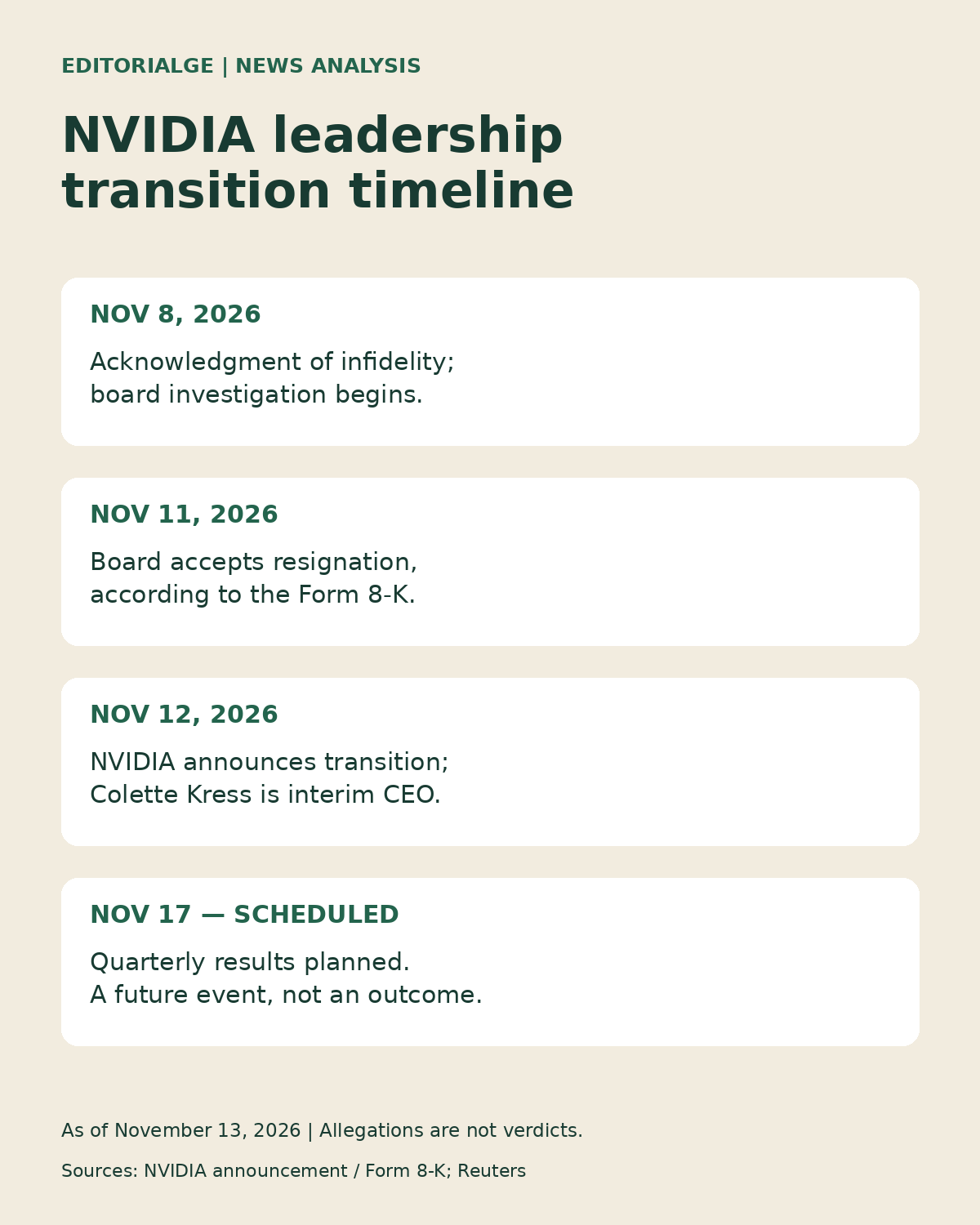
The dates below distinguish the board’s action from the public announcement. They are not a chronology of proven wrongdoing.
| Date | Development | Why it matters |
|---|---|---|
| November 8, 2026 | Huang acknowledged infidelity; the board opened an investigation. | The issue moved beyond media reporting into a formal corporate response. |
| November 11, 2026 | The board accepted his resignation, according to the company’s Form 8-K. | This is the corporate action date, distinct from the following day’s announcement. |
| November 12, 2026 | NVIDIA publicly announced the leadership transition. | Kress’s interim appointment and the search for a permanent CEO became official public information. |
| November 13, 2026 | This analysis assesses the disclosed transition. | Unresolved allegations remain unresolved; later reporting may change the picture. |
| November 17, 2026 — scheduled | NVIDIA plans to report quarterly financial results. | The event offers an opportunity to assess management’s explanation of continuity and execution. It has not yet occurred. |
The November 11 action date appears in the reproduced NVIDIA Form 8-K; the accompanying company announcement is dated November 12. A one-day difference between those dates is therefore not necessarily a contradiction.
Three Pressures That Help Explain the Exit
1. A Question of Executive Judgment
Personal conduct becomes a corporate issue when it creates a possible conflict with professional responsibilities. A relationship involving a business partner or a reporting line can raise questions about access, disclosure, favoritism, and whether decisions were independently reviewed.
Those are questions to investigate, not automatic findings. An allegation alone does not establish that a commercial decision was improper. A serious review would distinguish the existence of a relationship from any effect on contracts, personnel decisions, access to information, or compliance.
That distinction matters for readers as well as directors. The public can understand why a board faces pressure without assuming facts that have not been established.
2. An Investigation That Competes With the Day Job
An executive can remain capable of running a business while facing allegations. But a prolonged inquiry can make ordinary leadership unusually difficult. Employees need clear decisions, customers need reliable commitments, and investigators need access to records and people without concern about interference.
A transition can reduce that tension. It gives an interim leader a defined operational mandate while directors handle oversight. This is an explanation of why such arrangements can be useful, not a claim that NVIDIA has disclosed this as its specific reason for accepting the resignation.
3. Confidence in a Company Bigger Than One Person
A founder often serves several functions at once: strategist, recruiter, negotiator, product advocate, and final decision-maker. Losing that person creates uncertainty even if the engineering organization and customer contracts remain intact.
The challenge is to identify which responsibilities were genuinely concentrated and which were already distributed. An interim appointment resolves who holds authority today. It does not, by itself, show how the next major strategic disagreement will be settled.
What Kress’s Appointment Does—and Does Not—Tell Us
Kress has served as NVIDIA’s CFO since September 2013. Keeping an experienced executive in charge signals a preference for continuity during the search. The company says its product roadmap and customer commitments should continue without interruption.
That is a reasonable starting objective. Customers need to know who can approve commitments; employees need clarity about priorities; investors need an accountable spokesperson. An interim leader can provide all three while a permanent selection remains open.
However, familiarity with the company is not the same as a settled long-term strategy. The board still needs to determine what the permanent role requires. Should the next leader concentrate on technology direction, operational execution, financial discipline, or rebuilding trust? In practice, the answer may be a leadership team with more clearly divided responsibilities.
The appointment of a board chair also deserves attention. A chair can organize oversight and provide a clearer point of accountability between directors and management. The title alone cannot guarantee stronger governance. The meaningful test is how decisions, conflicts, and sensitive information are handled.
Why This Matters Beyond NVIDIA
The wider AI industry should distinguish a leadership shock from a sudden disappearance of technical capability. Products do not stop existing when a CEO departs. Engineers, software, supplier relationships, and installed systems remain. Yet those assets still require coordination and investment decisions.
For a customer planning an expensive computing deployment, the practical questions are specific: Are delivery schedules unchanged? Who approves exceptions? Are support commitments still funded? Has the vendor changed its product priorities? These questions are more useful than assuming either immediate collapse or complete immunity from disruption.
For suppliers and partners, uncertainty can affect negotiations even without a formal policy change. A decision may take longer while responsibilities are reassigned. Alternatively, clearer delegation could improve responsiveness. Both are possible; neither should be reported as an observed result without evidence.
Editorialge’s earlier analysis of the NVIDIA investigation and AI supply chains provides background to the scrutiny preceding this leadership transition.
China Policy Is a Separate Test
Leadership, export policy, and allegations of intelligence activity overlap in this story, but they are not interchangeable. A company’s commercial preference does not determine what a government permits. Likewise, a political dispute about chip sales does not prove misconduct in a particular transaction.
For readers, the important distinction is between a proposed restriction and an enacted rule. Political statements can change expectations immediately; binding changes require identifiable decisions and implementation. A careful follow-up should specify the responsible authority, affected products, effective date, and any exceptions.
The same discipline applies to security claims. A suspicion should be attributed to the people or institutions making it. A denial should be recorded. An investigation should not be described as a conviction. The pressure to simplify a dramatic story is exactly why these boundaries matter.
What Readers Should Watch Next
First, look for the scope and findings of the investigation. A useful disclosure would distinguish what was examined, what was established, and what remains unknown. Silence or a leadership change should not be used to fill those gaps.
Second, examine the permanent succession process. A credible transition needs more than a recognizable name. It needs an explanation of responsibilities, oversight, and how the leadership team will make difficult decisions.
Third, compare operational promises with observable results. Customer commitments, execution milestones, and management disclosures can help test whether the company is maintaining continuity. A single market reaction cannot answer that question.
Finally, track policy developments through actual decisions. Speculation about tougher controls may be relevant to expectations, but it should remain distinct from rules already in force.
The Larger Meaning of Jensen Huang’s Nvidia Resignation
Jensen Huang’s Nvidia resignation is a leadership event with consequences that extend beyond the executive office. It forces a distinction between the influence of a founder and the durability of the organization built around him.
The available record supports a clear account of the transition and a careful account of the surrounding pressure. It does not support a final verdict on unresolved intelligence allegations or every private motive behind the decision.
NVIDIA’s next test is therefore concrete: show that decisions remain accountable, customers remain supported, and the investigation can proceed on evidence. For readers trying to understand why Huang left, that is a more useful framework than treating either the resignation or the allegations as the end of the story.