Gaming and Esports injuries can start with a sore thumb, an aching elbow, or fingers that tingle after a long session. Esports injuries can involve the same problems, especially when repetitive inputs and long periods in one position leave little opportunity for recovery. Recognizing those early signs gives players a reason to change their routine before discomfort begins affecting everyday tasks.
Mayo Clinic identifies upper-limb overuse problems, neck and back pain, and eye strain among the health concerns seen in competitive players. However, pain alone cannot identify the damaged tissue or prove that gaming and Esports caused it.
The list below explains what players may notice, which habits deserve attention, and when to seek help. It includes both specific injuries and common symptom patterns; eye strain, for example, is not the same as a structural injury. These are conditions to recognize, not a ranking of the ten most frequently diagnosed problems.
Gaming Injuries and Esports Injuries: What Players Should Recognize
Repeated clicking, gripping, and button presses place demands on the hands and forearms. Meanwhile, the neck, shoulders, and back may remain in one position throughout a match. Different problems can produce similar symptoms, so use these descriptions to explain what you feel to a clinician rather than diagnose yourself.
1. Gamer’s Thumb: De Quervain’s Tenosynovitis

Gamer’s thumb commonly refers to de Quervain’s tenosynovitis, a condition involving irritation and thickening around tendons on the thumb side of the wrist. Pain may spread toward the thumb or forearm and worsen when gripping, pinching, or moving the thumb. Swelling or a catching sensation can also occur.
Among esports injuries, this problem is particularly relevant to players using controllers, although the symptoms are not exclusive to gaming and Esports. Cleveland Clinic specifically identifies it as a concern for controller users.
If a movement hurts, stop repeating it. Check whether a frequently used command requires an awkward reach or sustained button hold. Options covered in gaming accessibility technology, including remapping and alternative inputs, may offer a more manageable control layout. They do not replace assessment when pain persists.
2. Other Wrist Tendon Injuries
Several tendons help move the wrist, hand, and fingers. Overuse can irritate these tissues, causing pain during movement, stiffness, swelling, or difficulty gripping ordinary objects.
This category overlaps with gamer’s thumb, so here it refers to other wrist tendons, including those on the little-finger side. A clinician must establish which structure is involved.
These gaming and Esports injuries deserve attention when the discomfort follows you away from the screen. Pain while lifting a mug or opening a door suggests the problem is affecting more than your next match.
Reduce the activity that provokes symptoms and check whether your wrist stays bent during play. Avoid repeatedly testing the painful movement to see whether it has improved. A physiotherapist or occupational therapist can help assess movement, equipment fit, and an appropriate rehabilitation plan.
3. Carpal Tunnel Syndrome
Carpal tunnel syndrome occurs when the median nerve is compressed at the wrist. Typical symptoms include tingling, numbness, burning, or pain in the thumb, index finger, middle finger, and part of the ring finger. Symptoms may wake someone at night, and more advanced cases can cause weakness or dropping objects.
Do not assume all wrist-related gaming and Esports injuries are carpal tunnel syndrome. Tendon problems and other nerve conditions can produce overlapping complaints.
If symptoms recur, arrange an assessment rather than relying on a wrist brace chosen at random. Notice whether your wrist is held sharply upward, downward, or sideways while playing. That information can help a clinician identify aggravating positions. Persistent numbness or declining hand strength deserves prompt attention.
4. Cubital Tunnel Syndrome
Cubital tunnel syndrome involves compression or irritation of the ulnar nerve at the elbow. A familiar pattern is tingling or numbness in the little finger and the adjacent half of the ring finger. Some people also develop an inner-elbow ache, weaker grip, or difficulty coordinating their fingers.
Keeping an elbow bent for long periods or leaning directly on it can aggravate the nerve.
When considering esports injuries, pay attention to what your elbows rest against. A hard desk edge or an armrest pressing into the inner elbow is worth changing.
Avoid prolonged direct pressure and vary your arm position between games. Recurrent tingling is a reason to seek advice, particularly if it persists after play or comes with weakness. The location of the affected fingers is useful information, but it cannot confirm the diagnosis by itself.
5. Tennis Elbow: Lateral Epicondylitis
Tennis elbow affects the tendons attached to the outside of the elbow. Symptoms commonly include outer-elbow tenderness, pain during forearm activity, and reduced grip strength. Despite its name, the condition can develop in people who never play tennis.
Sometimes called gamer’s elbow in discussions of esports injuries, it may make gripping a mouse or controller uncomfortable. Mayo Clinic includes this tendon problem among the overuse conditions seen in players.
Reduce painful activity instead of adding extra practice to compensate for declining accuracy. Keep your controls within comfortable reach and avoid an unnecessarily tight grip.
Players working on aim in FPS games should treat pain as a reason to reassess the session. More repetitions are not a sensible response to an aching elbow.
6. Golfer’s Elbow: Medial Epicondylitis
Golfer’s elbow affects the tendon attachment on the inside of the elbow. It can cause pain or burning, reduced grip strength, and painful wrist or elbow movement. Repetitive forearm activity can contribute, although the condition may also develop without an obvious injury.
The American Academy of Orthopaedic Surgeons distinguishes this tendon problem from nearby ulnar nerve irritation, which can also cause inner-elbow symptoms.
For players, the practical point is to describe the location and triggers accurately. Does gripping hurt? Is there tingling in the fingers? Does discomfort remain after the controller is put down?
Avoid repeatedly loading a painful movement. If symptoms continue, seek an assessment before starting strenuous forearm exercises. A routine intended for an outer-elbow problem may not address the cause of inner-elbow pain.
7. Neck Pain and Muscle Strain
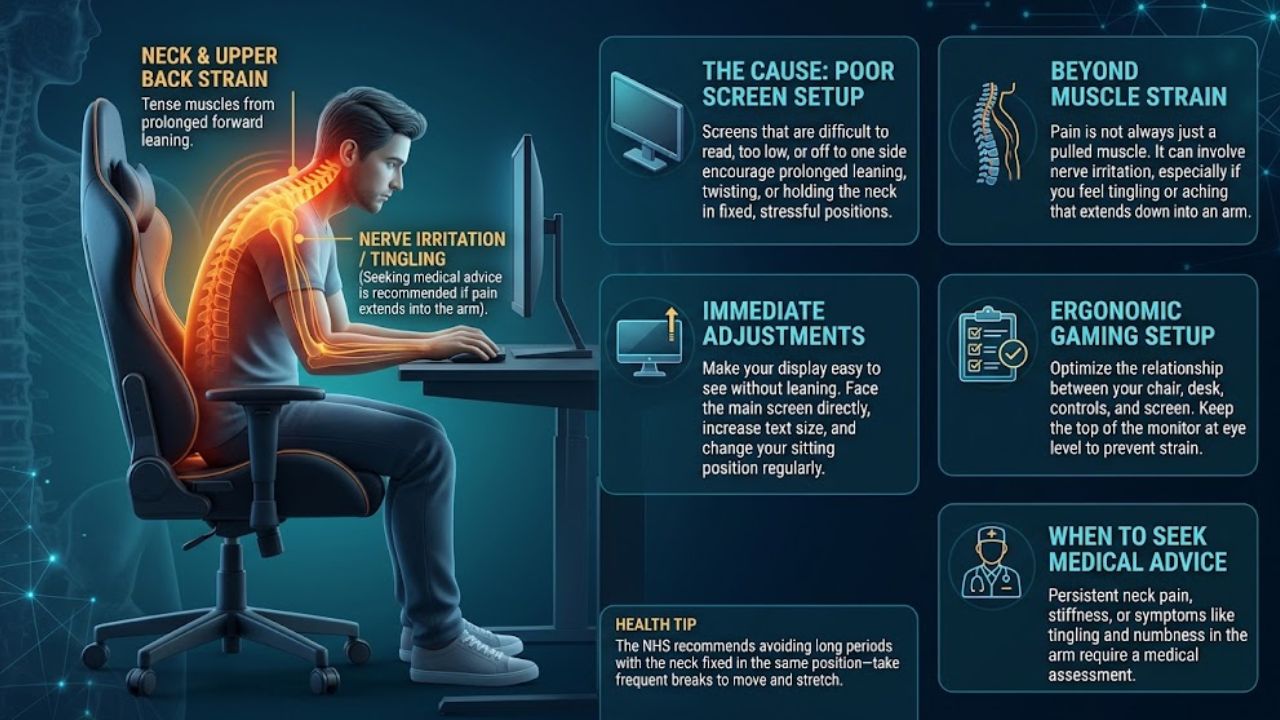
A screen that is difficult to read or positioned off to one side can encourage prolonged leaning or twisting. Holding the neck in one position may contribute to stiffness and aching. The NHS recommends avoiding long periods with the neck fixed in the same position.
Neck-related gaming and Esports injuries are not always a pulled muscle. Nerve irritation and other conditions can also cause pain, especially when symptoms extend into an arm.
Start by making the display easy to see without leaning forward. Increase text size where possible, face the main screen, and change position regularly.
The adjustments in an ergonomic gaming setup can help you examine the relationship between your chair, desk, controls, and screen. Persistent pain or symptoms such as arm tingling need medical advice.
8. Shoulder Pain and Muscle Overload
Holding the mouse arm away from the body or keeping the shoulders raised can make a long session uncomfortable. Workstation guidance recommends relaxed shoulders, with the upper arms resting naturally near the body.
Shoulder complaints discussed alongside esports injuries may involve muscle fatigue, tendon problems, or another cause. A painful shoulder does not establish that a tendon is torn.
Bring the mouse and keyboard closer if you must reach for them. Check whether high armrests make you shrug. Support should allow a relaxed position without trapping you in it.
Continue gentle, comfortable movement while avoiding activities that worsen the pain. The NHS advises getting help if shoulder pain worsens or does not improve after two weeks, and seeking urgent care for sudden severe pain or inability to move the arm.
9. Lower Back Pain
Lower back discomfort can become noticeable during long periods of sitting. However, back pain has many possible causes, and the location of the ache cannot establish whether a muscle, joint, disc, or nerve is responsible.
Mayo Clinic identifies back pain as a concern in esports, while the NHS advises staying active and avoiding prolonged bed rest for ordinary back pain.
For back-related gaming and Esports injuries, look at the whole session rather than searching for one perfect sitting position. Use comfortable back support, support your feet, and make room to stand and walk.
A standing desk provides another position, but it does not remove the need to move. Likewise, an expensive chair cannot compensate for spending an entire evening motionless.
10. Digital Eye Strain
Digital eye strain can cause dry or irritated eyes, blurred vision, headaches, and discomfort around the eyes. Continuous screen use, glare, and reduced blinking can contribute. It is a group of symptoms rather than proof of a structural eye injury.
Cleveland Clinic recommends addressing vision problems, reducing glare, and taking visual breaks. One commonly recommended approach is the 20-20-20 rule: every 20 minutes, look at something about 20 feet away for roughly 20 seconds.
Use a safe opportunity during play, and take a fuller break between matches. Scrolling on a phone keeps your attention on another nearby screen.
If blurred vision or irritation continues despite changes, arrange an eye examination. Avoid assuming every visual symptom is simply the result of a long gaming and Esports session.
How to Reduce the Risk of Gaming and Esports Injuries
Reducing esports injuries involves managing both the demands of play and the time available for recovery. Equipment adjustments are useful, but they work alongside breaks and changes to painful activities.
- Plan breaks before you queue. Choose a stopping point in advance. Online matches usually cannot be paused, so leave time between games and avoid immediately joining the next queue.
- Move away from the setup. Stand, walk, and change position. Cleveland Clinic suggests a few minutes of movement after about 30 to 45 minutes of competition, while advising players to stop sooner if hand or wrist pain develops.
- Keep the setup within reach. Aim for relaxed shoulders, aligned wrists and forearms, supported feet, and comfortable back support. Change position regularly even when the arrangement feels good.
- Count practice as part of the workload. Aim trainers, warm-up maps, ranked games, and other hand-intensive tasks all belong in the day’s activity. The principles of structured esports training offer a useful starting point for planning purposeful sessions.
- Make stopping socially acceptable. Tell teammates when you need a break. Building healthier gaming communities includes respecting another player’s limits without pressuring them into one more match.
Gentle preparation should not become a painful stretching contest. Persistent symptoms need an individual assessment rather than a longer collection of internet exercises.
When Should a Player Seek Medical Help?
Arrange an assessment for suspected gaming and Esports injuries when pain keeps returning, affects ordinary activities, or comes with persistent tingling, numbness, weakness, or dropping objects. A clinician can assess the cause and recommend suitable activity changes, rehabilitation, or other treatment.
Seek urgent care for sudden severe pain, major swelling, or inability to move a limb. Back pain with new bladder or bowel problems, numbness around the groin, or symptoms in both legs requires emergency assessment.
Final Thoughts
Gaming and Esports injuries deserve attention while symptoms are still easy to describe and before they begin disrupting daily life. The same applies to esports injuries, whether someone plays professionally or joins friends after work.
Make the next decision practical: shorten a painful session, adjust an awkward reach, schedule a movement break, or book an assessment for recurring symptoms. Playing through pain should never become part of the training plan.
Frequently Asked Questions
What Injuries Can You Get From Gaming and Esports?
Gaming and Esports injuries can involve thumb and wrist tendons, elbow tendons, or compressed nerves. Players also report neck, shoulder, and back pain. Eye strain is another common complaint, although it is not a structural injury.
Can Esports Players Get Injured?
Yes. Esports injuries can develop through repetitive hand movements and prolonged positions. The symptoms and diagnosis matter more than whether someone is a professional or recreational player.
Is Gamer’s Thumb the Same as Carpal Tunnel Syndrome?
No. Gamer’s thumb usually refers to a thumb-tendon condition. Carpal tunnel syndrome involves compression of the median nerve at the wrist and commonly causes finger tingling or numbness.
How Long Does Gamer’s Thumb Take to Heal?
Recovery varies with severity, continued strain, and treatment. Improvement may take weeks, and some cases take longer. Persistent pain needs assessment rather than a fixed return-to-play deadline.
Should You Wear a Wrist Brace While Gaming and Esports?
Only if it is appropriate for the diagnosed problem. A clinician may recommend a splint for certain conditions, but a brace should not be used to keep playing through worsening symptoms.