
I’ve seen countless brilliant software engineers and visionary educators enter the education technology space with the best intentions, only to hit a brick wall. The truth they discover too late is that how to start an EdTech startup is fundamentally different from launching a consumer app or a standard B2B SaaS product. You aren’t just building a tool for a user; you are building for a highly regulated, tightly budgeted ecosystem.
With the pandemic-era ESSER relief funds largely dried up and school district budgets tightening, the “gold rush” days of throwing software at schools to see what sticks are over. The bar is higher now. If you are ready to navigate this deeply rewarding but complex space, here is the master playbook for taking your EdTech idea from a rough concept to a successful school pilot.
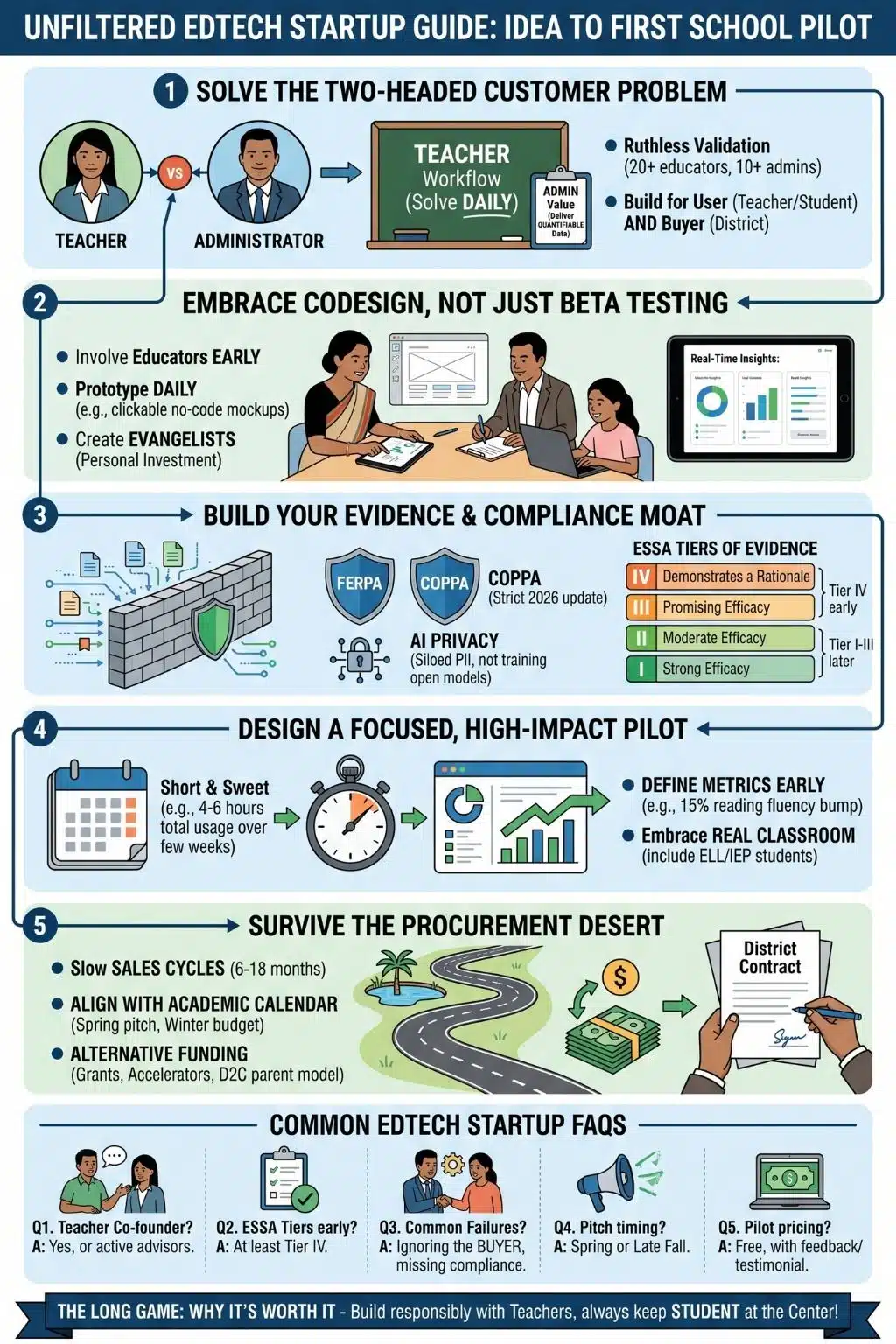
Solve the “Two-Headed” Customer Problem
The biggest trap I see early founders fall into is building a beautiful experience for the student, while completely ignoring the district administrator. In K-12 education, the person using your product (the student or teacher) is almost never the person writing the check (the superintendent, CIO, or curriculum director).
Your product must be a painkiller for the teacher’s daily workflow, but it also has to deliver systemic, quantifiable value to the central office. Before writing a single line of code, don’t pitch your idea. Sit down with 20 educators and 10 administrators. Ask them what specific tasks drain their energy or where their current data falls short. You have to identify the teacher who will act as your internal champion, while building the reporting dashboards that the buyer requires.
Embrace “Codesign,” Not Just Beta Testing
You cannot build an EdTech product in a vacuum and expect schools to adopt it. The most successful founders today use a process called “codesign.”
Instead of building a fully fleshed-out Minimum Viable Product (MVP) in isolation, you bring educators into the development process early. Use clickable, no-code prototypes. Show them to teachers and ask, “Where does this break in a classroom of 30 kids?” By codesigning the solution with your target users, you not only build a more resilient product, but you also create a cohort of early evangelists who are personally invested in seeing your startup succeed.
Build Your Evidence and Compliance Moat
In the early days of Silicon Valley, the mantra was “move fast and break things.” If you do that in EdTech, you will face lawsuits and get blacklisted by procurement departments.
Compliance and evidence are your moats. By 2026, you must navigate FERPA and strict COPPA regulations. If you use AI, you have to guarantee that student Personally Identifiable Information (PII) is completely siloed and not training open models.
Furthermore, you can no longer just promise that your tool is “engaging.” Districts are increasingly demanding that products align with the ESSA (Every Student Succeeds Act) Tiers of Evidence. Even for an early pilot, you should have a documented Logic Model (ESSA Tier IV) that clearly maps out why and how your technology improves learning outcomes. Retrofitting privacy and educational pedagogy into a finished product is a nightmare; build it into your foundation.
Design a Focused, High-Impact Pilot
A school pilot isn’t a QA test to find software bugs. It is a highly structured proof-of-concept designed to generate the evidence administrators need to justify a purchase.
- Keep it Short and Sweet: The most effective early pilots don’t last a whole semester. The sweet spot is a targeted 4-to-6 hour total usage commitment over a few weeks. It’s enough time to prove value, but short enough to respect the teacher’s already overloaded schedule.
- Define Metrics Early: Never wait until the end to decide how to measure success. Lock in your goals beforehand, whether that’s a 15% bump in reading fluency or saving a teacher three hours of grading time per week.
- Embrace the Real Classroom: Don’t just test with the most tech-savvy teacher and the gifted students. Intentionally include English Language Learners (ELL) and students with learning accommodations. A tool that works for the margins works for the whole classroom.
Survive the Procurement Desert
You’ve run a successful pilot. The teachers love it. Now, you wait.
K-12 sales cycles are notoriously slow, typically taking 6 to 18 months from the first conversation to a signed contract. Districts usually assess their needs in the fall, build budgets over the winter, and finalize purchases in the spring for the following academic year.
To survive this desert, you need strategic patience. Align your sales outreach with the academic calendar, pitch in early spring before high-stakes testing begins, or in early summer. In the meantime, seek out EdTech-specific accelerator grants, foundation funding, or even a Direct-to-Consumer (D2C) parent model to generate cash flow while the district wheels slowly turn.
The Long Game: Why It’s All Worth It
Building in EdTech isn’t for the faint of heart. It requires immense patience, a deep empathy for overworked educators, and a willingness to navigate red tape. But when you finally walk into a classroom and see your product helping a student suddenly grasp a concept they’ve been struggling with all year, I promise you, there is no better feeling in the startup world. Stick with it, build responsibly alongside teachers, and always keep the student at the center of your mission.
Frequently Asked Questions on How to Start an Edtech Startup
1. Do I need to be a former teacher to start an EdTech company?
Not necessarily, but you desperately need educators in the room. If you are a purely technical founder, you must bring on a co-founder, an early hire, or an active advisory board of former teachers who deeply understand pedagogy and the chaotic realities of a modern classroom.
2. What is an ESSA Tier of Evidence, and why do I need it?
The Every Student Succeeds Act (ESSA) established four tiers of evidence to help schools identify effective interventions. While you don’t need a massive, peer-reviewed clinical trial on day one, school procurement teams look for at least Tier IV (Demonstrates a Rationale). This means you have a well-researched logic model proving your product is based on actual learning science.
3. Why do so many EdTech startups fail?
They solve a problem for the user (the student) but fail to provide value for the buyer (the district). If your app is highly engaging for kids but lacks the robust security, reporting dashboards, and curriculum alignment that administrators require to justify the budget, it will never scale beyond a few free classroom accounts.
4. When is the absolute worst time to pitch a school?
Avoid September (back-to-school chaos) and late spring (high-stakes state testing windows). The best times to secure meetings are late fall after the initial school year rush settles, and early spring when districts are actively drafting their budgets for the following year.
5. How should I price my product during the pilot phase?
Your primary goal during an initial pilot is not immediate revenue; it is acquiring bulletproof case studies and efficacy data. Offer a free, tightly scoped pilot in exchange for a signed commitment from the school to provide structured data feedback, a case study, and an introduction to the district purchaser if the success metrics are met.