

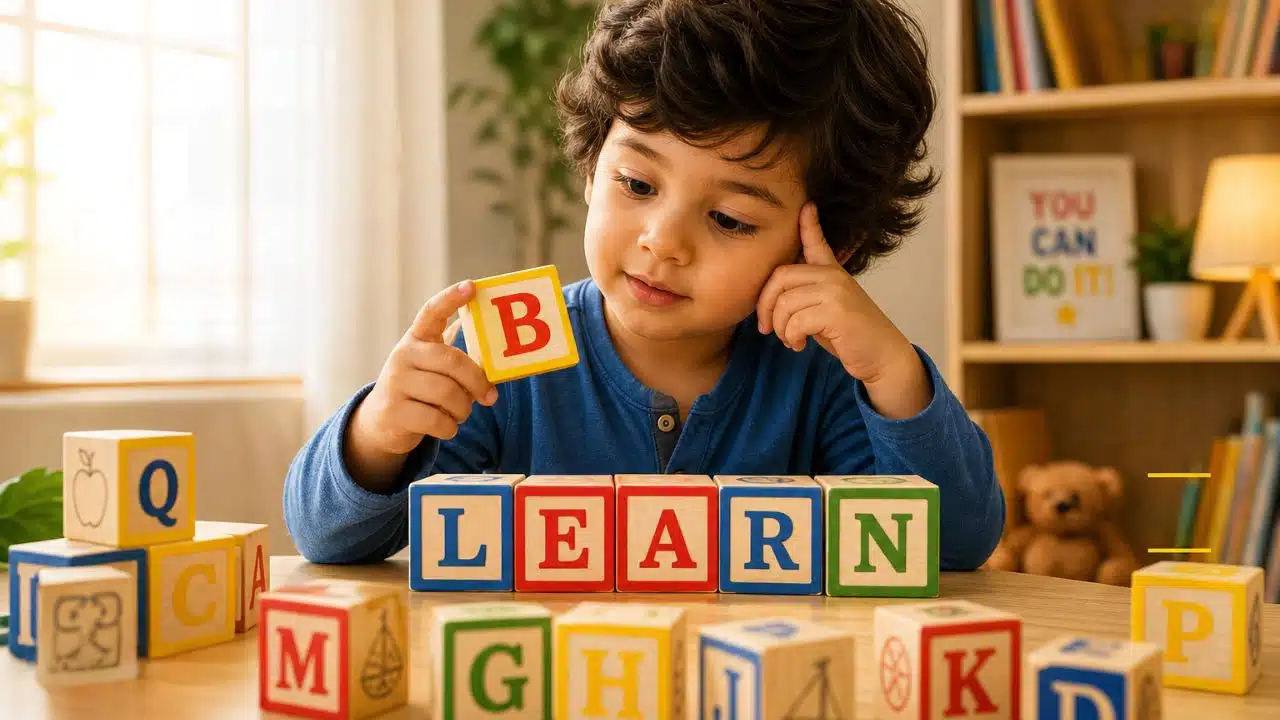
My nephew Zayan is five. Last month he stood in front of the alphabet chart on his bedroom wall and named all twenty-six letters without stopping once. I clapped. Twenty minutes later I opened a picture book, pointed at the S sitting inside a word, and asked him what it was.
He said “M.” Then he said “A.” Then he stopped and watched my face to see which one I wanted.
He wasn’t reading that chart. He was reciting it. The signs had been there for weeks and I kept reading them as progress. If you want to know how to find that your child is guessing letters, you don’t need a test or a tutor. You need about ten minutes and a few small changes to the way you ask.
Guessing Looks Almost Exactly Like Learning
A child who has memorized the alphabet song can produce all twenty-six letter names in order, on demand, at speed. That performance is genuinely impressive. It’s also not the same skill as recognizing a letter shape when it turns up alone, in a different font, or in the middle of a word.
Three things prop up the illusion. Order carries the child from one letter to the next, so pointing along the chart is really just singing with a finger. Position does the rest, because the B on your wall lives in the same spot every single day. And children are excellent at reading adult faces, so a guess followed by a quick correction often gets rewarded before anyone notices a guess happened at all.
None of this means the child is behind. Letter recognition is built in layers, and reciting is a real layer. It just isn’t the one you think you’re watching.
Five Ways to Find Out If Your Child is Guessing Letters
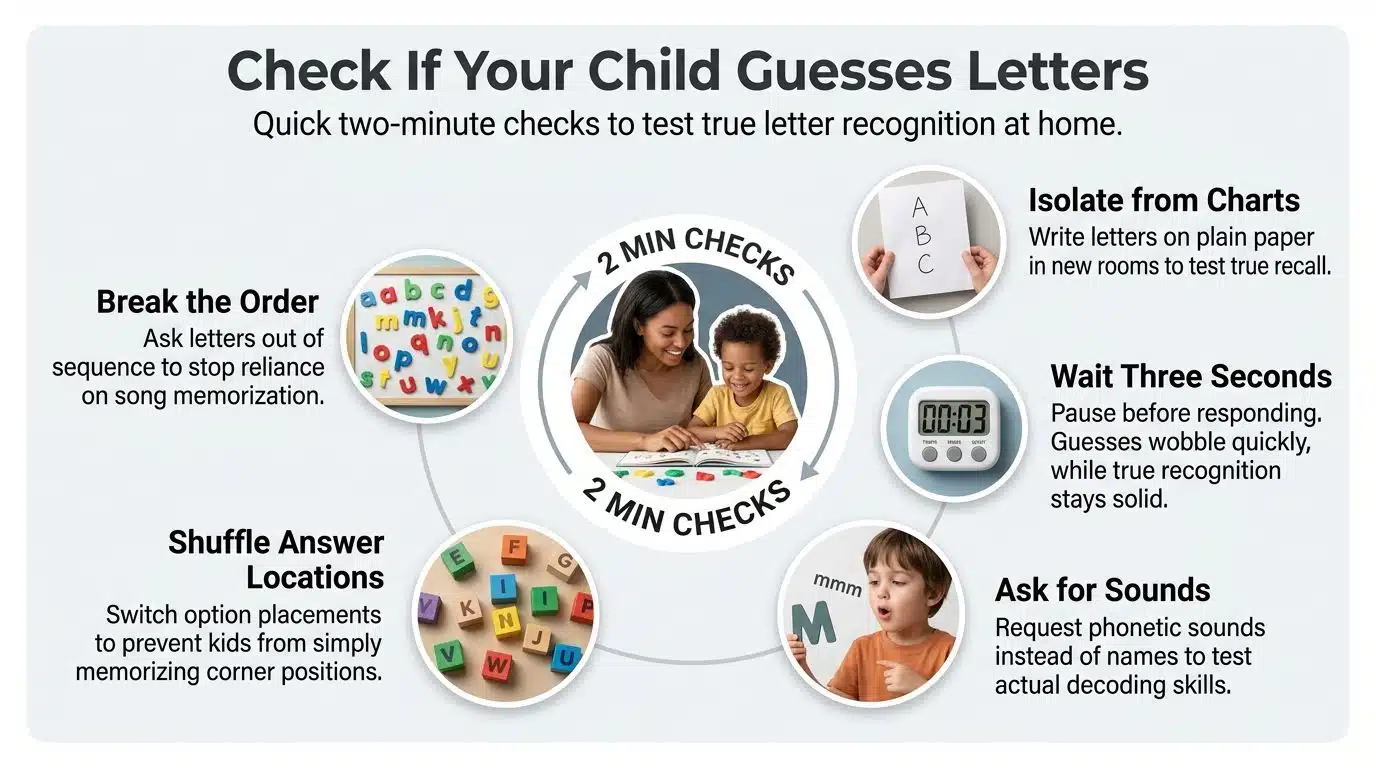
Each of these takes under two minutes. Do them on separate days, not as a drill session.
Break the order
Ask for K, then D, then R. Jumping around removes the song. If the answers were coming from sequence memory, you’ll see the pause immediately.
Take the letter off the chart
Write one letter on a scrap of paper. Show it in the kitchen, not the bedroom. Zayan named F on the wall every time and went quiet when I wrote the same F on the back of a receipt. That gap told me more than a week of chart practice.
Wait three full seconds
This one is hard for adults. Ask, then say nothing. Count to three in your head. Real recognition arrives fast and stays put. A guess arrives even faster, then wobbles, then gets revised the moment you make a sound.
Ask for the sound instead of the name
“What sound does this make?” is a much harder question than “what letter is this?” because it can’t be answered from the song. It’s also the more useful skill: letter-sound knowledge sits closer to actual decoding and spelling than letter names do. The ability to give the sound a letter makes has the closest relationship to sounding words out.
Move where the right answer sits
If you’re using cards or a screen, change the position of the correct option. Children who are tracking position rather than shape will keep tapping the same corner. That was the tell that finally convinced me.
What Guessing Looked Like on a Screen
I’m an uncle who also happens to work on a kids’ app, so I had a slightly unfair advantage here. Our team at Editorialge built Alphabet Magic Trace & Phonics, and I sat next to Zayan while he played it for a few weeks. Disclosure: it’s our app, and that’s exactly why I watched it more critically than a stranger would.
Two of the mini-games exposed the guessing almost immediately.
Star Match asks the child to match letters. Zayan started getting them right at a suspicious speed, so I watched his thumb instead of the screen. He was tapping before the letter finished animating in. Correct answers, wrong process.
Twinkle Tap asks the child to pop the right star. When the target star appeared on the left side twice in a row, he got the third one right without looking at it properly. Move it to the bottom of the screen and he missed.
The most useful thing, though, was the split between tracing and naming. He traced a lowercase b beautifully. His finger knew the stroke. Then I asked him what he’d just traced and he said “d.” Motor memory and visual recognition are separate systems, and a child can look completely fluent in one while the other hasn’t caught up. This is also why games teach the alphabet better than drills when they’re built well. A good game makes the child produce an answer under changing conditions instead of repeating one under fixed conditions.
The Letters He Kept Trading
Zayan’s list was short and boring, which is the good news: b and d, p and q, M and W, n and u, and a stubborn E for F.
Every one of those pairs is either a mirror image or a shape sharing most of its strokes. A chair is still a chair when you flip it, but a b flipped is a completely different letter, and a five-year-old’s brain hasn’t finished learning that direction matters for symbols and not for objects.
Worth saying plainly, because a lot of parents jump straight here: reversing letters is normal in young children and usually not a sign of dyslexia, and most kids grow out of it by the end of second grade. Reversals past seven or eight are worth a conversation with a teacher. Reversals at five are just Tuesday. Most of what worries parents at this stage turns out to be an alphabet teaching myth rather than a warning sign.
What Actually Fixed It
Five letters. Not twenty-six.
We picked b, s, m, a, and t and left the rest alone for two weeks. That felt wrong to me at first, like we were going backwards. It was the single change that made the difference.
The routine was about ten minutes, most days, and it went like this. Sound first, name second. Trace the letter while saying its sound out loud, so the hand and the mouth are doing the same job at the same time. Then hunt for those five letters somewhere outside the house: a shop sign, a bus, a cereal box, or a number plate. Zayan found a huge M on a shop shutter and shouted about it for an entire afternoon.
Three things I tried that didn’t work, so you can skip them:
- Running the alphabet song as practice. It rebuilt the exact sequence memory I was trying to get around.
- Correcting every wrong answer straight away. He stopped answering at all and started asking me instead.
- Quizzing during dinner, in the car, and at bedtime. Turning it into a constant test made him defensive, and a defensive child guesses more, not less.
The chart stayed on the wall the whole time, but we stopped pointing at it in order. If yours is only ever used as a recital tool, it may be worth checking what makes an alphabet chart actually useful, because layout and font choices change how much work the child’s eyes have to do.
Zayan took roughly five weeks to hold those five letters reliably out of order and off the chart. Other children take longer or shorter, and the range is genuinely wide. If the pace is worrying you, how long it takes a child to learn the alphabet is a more honest reference point than comparing notes with the parent of the one kid in class who reads early.
When Guessing Isn’t the Real Problem
Sometimes the child isn’t guessing because they don’t know the letter. They’re guessing because they can’t see it well, can’t hear the sound cleanly, or are simply tired at the end of a long day. Try the same five checks in the morning before you conclude anything.
Ask a teacher or a pediatrician if a child past six or seven still can’t recognize most letters out of order after months of steady, low-pressure practice, or if they’re avoiding books they used to enjoy. That’s a conversation, not an emergency.
Frequently Asked Questions (FAQs)
1. Is guessing letters normal for a 5-year-old?
Yes. At five, most children are still moving from reciting the alphabet to recognizing individual letters on sight. Guessing is a stage in that shift, not a failure of it.
2. Should I correct my child every time they guess wrong?
No. Correcting every miss teaches the child to stop offering answers and start reading your face instead. Give the right answer calmly, move on, and come back to that letter another day.
3. Do letter names or letter sounds matter more?
Both matter, and children usually pick up names first. But sounds are what a child eventually uses to read a word, so if you’re only asking one question, ask what sound it makes.
4. Can an app tell me if my child is guessing?
Only if you’re watching how they play, not just the score. Fast taps, answers that only stay correct while the choices sit in the same place, and a gap between tracing a letter and naming it are all worth more than the number at the end of the level.






















