
Continuing to fund low-performing customer acquisition sources drains your team’s time and dilutes overall campaign ROI. Recognizing the signs to fire a marketing channel ensures your business reallocates capital toward scalable, high-converting growth drivers.
| Sign / Red Flag | Core Operational Metric | Primary Risk | Action Needed |
| 1. Unmanageable CAC | Customer Acquisition Cost vs. LTV | Unsustainable unit economics | Pause campaigns and reevaluate unit margins |
| 2. Low Lead Quality | Lead-to-Opportunity Conversion | Wasted sales team hours on bad leads | Cut channel or rewrite qualification filters |
| 3. Zero Attribution Value | First-Touch / Multi-Touch Assist Data | Paying for phantom conversion paths | Shift funds to proven conversion catalysts |
| 4. High Platform Volatility | Ad Cost Per Mille (CPM) & Organic Reach | Unpredictable month-over-month costs | Diversify into stable, owned media assets |
| 5. Excessive Labor Overhead | Hours spent vs. Revenue generated | Resource burnout for marginal gains | Automate or eliminate low-yield channels |
| 6. Audience ICP Mismatch | Demographic & Intent Alignment | Attracting non-paying or high-churn users | Pivot budget to high-intent channels |
| 7. Vanishing Organic Reach | Organic Impression Decay | High mandatory ad paywalls | Sunset organic effort or convert to paid-only |
| 8. Brand Safety & Compliance Risks | Policy Violations / Toxic Ad Placement | Legal penalties & brand reputation loss | Instantly sever ties with high-risk platforms |
| 9. Diminishing Returns at Scale | Marginal Cost Per Acquisition | Exponentially higher costs for minimal growth | Reallocate incremental spend elsewhere |
9 Clear Signs to Fire a Marketing Channel
1. Customer Acquisition Cost (CAC) Consistently Outpaces Lifetime Value (LTV)
A marketing channel must eventually deliver positive unit economics. If your CAC on a specific platform remains higher than the lifetime value of the customers it generates, the channel is actively eroding your profit margins. Reviewing customer acquisition cost benchmarks helps teams determine whether a high CAC is an industry-wide trend or a clear indicator of an unviable distribution channel.
2. Lead Quality Is Consistently Low Despite Targeting Adjustments
High traffic and low cost-per-lead (CPL) numbers mean nothing if those leads never turn into revenue. If your sales team spends dozens of hours chasing unqualified leads that never convert into sales opportunities, the channel is generating vanity metrics rather than enterprise value.
3. Multi-Touch Attribution Shows Zero Assist or Conversion Value
Not every channel is designed for direct bottom-of-the-funnel conversions. However, if your multi-touch attribution models show that a channel provides neither initial discovery value (first-touch) nor closing assist value (last-touch), it is simply dead weight in your marketing stack. Utilizing marketing attribution models provides clear visibility into whether a channel actively assists the buyer journey.
4. Platform Algorithm Shifts Cause Unpredictable Cost Spikes
Relying on channels subject to sudden policy changes, ad format restrictions, or algorithm shifts introduces severe revenue volatility. When a platform regularly quadruples your CPMs or wipes out organic visibility overnight, maintaining spend on that channel becomes an unmanageable financial gamble.
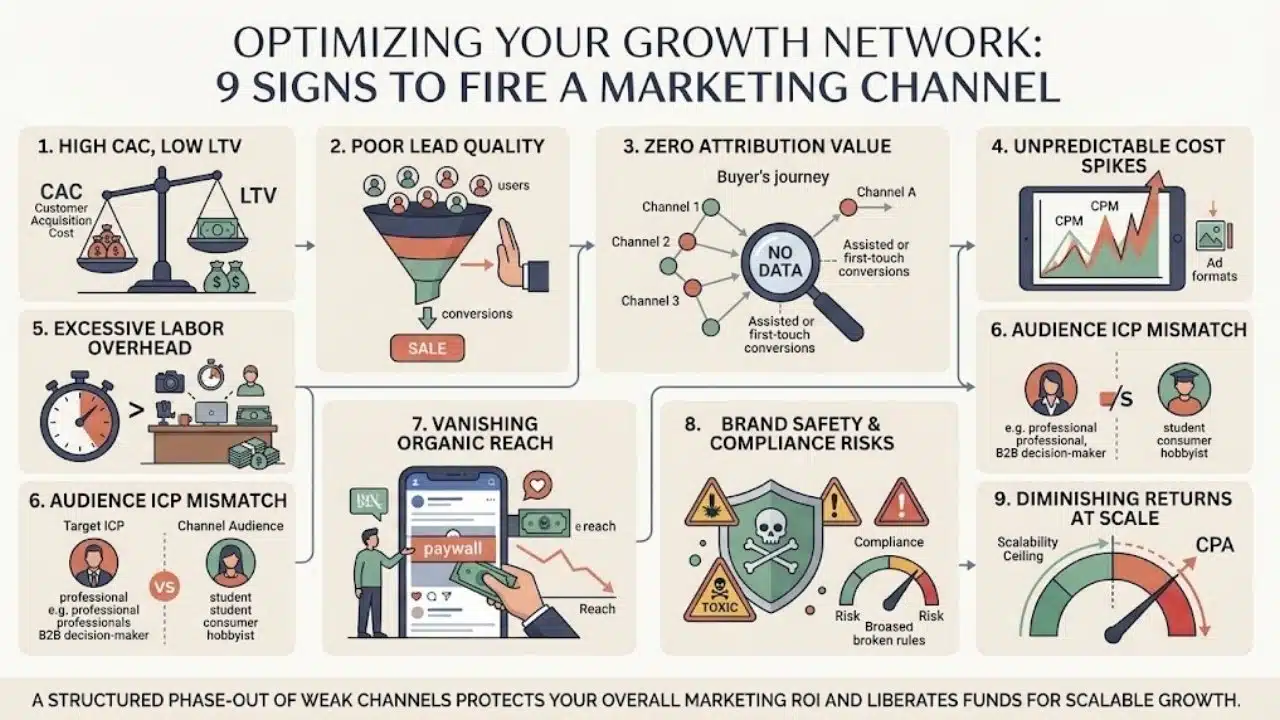
5. Management and Creative Overhead Outweigh Financial Returns
Calculated channel ROI must factor in human labor costs. If a platform requires custom daily video production, continuous design tweaks, and heavy manual management just to break even, the operational drain outweighs the financial return.
6. The Channel’s Audience No Longer Matches Your Ideal Customer Profile (ICP)
Platforms evolve, and user demographics shift over time. If the demographic or professional profile of a platform moves away from your target buyers, staying on the channel results in talking to the wrong audience regardless of how polished your messaging is.
7. Organic Reach Has Decayed Into a Mandatory “Pay-to-Play” Model
When organic reach on a platform drops to near zero, treating it as a “free” content distribution channel is a mistake. If maintaining a presence requires continuous ad spend to reach even your existing followers, evaluate whether that ad budget yields better returns on high-intent search platforms.
8. Platform Governance and Brand Safety Risks Emerge
Brand reputation takes years to build and days to destroy. If a channel becomes plagued by toxic user-generated content, ad fraud, or invasive regulatory scrutiny, staying active on the platform risks alienating your core customer base and incurring legal liability.
9. Incremental Capital Spend Yields Diminishing Marginal Returns
When scaling spend on a channel causes your marginal acquisition cost to skyrocket for every additional customer, you have hit the channel’s efficiency ceiling. Following enterprise capital allocation strategies encourages leadership to pull back incremental budget from saturated channels and test emerging growth avenues.
How to Audit and Offboard an Underperforming Channel
When preparing to eliminate a channel, follow a structured three-step phase-out process to avoid interrupting overall lead flow:
-
Step 1 (Audit & Pause): Freeze new budget allocations for 30 days while leaving tracking infrastructure active. Observe whether overall revenue drops or remains stable.
-
Step 2 (Reallocate Capital): Move the paused funds directly into your top two performing channels to test if marginal returns increase.
-
Step 3 (Formal Offboarding): Document key learnings, archive high-performing creative assets for reuse on other networks, and remove tracking scripts to reduce site latency.
The most uncomfortable truth in modern marketing is that marketing teams frequently hold onto dying channels out of emotional bias and sunk cost fallacy. Marketers often spend months attempting to “fix” a channel simply because they invested heavily in learning its nuances or building a legacy follower base. Admitting that a channel no longer works feels like admitting strategic failure, leading teams to throw good money after bad.
Looking forward, as AI-driven automation and privacy shifts make cross-channel tracking harder, the temptation to spread budgets thinly across every new platform will increase. However, true competitive advantage belongs to agile teams that ruthless prune their distribution stack. Firing an underperforming channel is not a defeat; it is a strategic decision to liberate resources for channels that build real revenue.
Frequently Asked Questions (FAQs) About Signs to Fire a Marketing Channel
How long should you test a marketing channel before deciding to fire it?
Most B2B and direct-to-consumer channels require 60 to 90 days of consistent testing to gather statistically significant data. If performance metrics remain far below benchmarks after optimizing targeting and messaging during this window, it is time to sunset the channel.
What is the biggest mistake teams make when cutting a marketing channel?
The biggest mistake is cutting a channel without reviewing multi-touch attribution data. Some channels appear unprofitable on a direct last-click basis but play a critical role in introducing prospects at the top of the sales funnel.
How do you determine if a channel is dead or if your campaign strategy is flawed?
Run a controlled benchmark test by copying a campaign offer and creative setup that performs exceptionally well on another platform. If a proven, high-converting campaign completely fails on the new channel despite audience alignment, the channel itself is likely the issue.
Should you fire a marketing channel that drives high volume but low-quality leads?
Yes, high volumes of low-quality leads waste valuable sales resources and inflate operational costs. If tightening targeting filters fails to improve lead quality, the channel should be cut.
How should you reallocate budget after firing an underperforming channel?
Direct 80% of the freed capital into your highest-performing, proven channels to maximize immediate ROAS. Reserve the remaining 20% for testing emerging channels or experimenting with new ad formats.