
An EdTech company can enter a country with widespread mobile coverage and still find that a large share of its intended users cannot participate consistently. A student may live within a 4G coverage area but share one phone with siblings. A teacher may have internet at home but an unreliable connection at school. A family may be online every day while carefully managing how much data each person uses.
That gap between nominal connectivity and practical access is shaping the most important EdTech emerging markets trends.
For companies, investors, schools, and governments, the harder question is no longer simply how to put more education online. It is how to make digital education work on inexpensive devices, weak connections, limited budgets, local curricula, and education systems where teachers are already stretched.
The companies that understand those constraints have a better opportunity than those treating emerging economies as lower-priced versions of mature EdTech markets.
Connectivity Numbers Can Overstate the Addressable Market
Internet access has expanded significantly, but the averages hide enormous differences.
The International Telecommunication Union estimated that 74% of the world’s population was online in 2025. Internet use reached 94% in high-income countries but only 23% in low-income countries. Rural access remains particularly uneven: globally, 85% of urban residents were online compared with 58% of rural residents, while only about 14% of rural residents in low-income countries used the internet.
For EdTech planning, coverage is an even less useful measure on its own.
GSMA reported that 96% of the global population lived within mobile broadband coverage in 2025, yet about 3.1 billion people were covered and still did not use mobile internet. Affordability and digital skills remain major barriers, and the device itself is often part of the problem.
That distinction matters when estimating a market. A district with mobile coverage is not automatically a district where every student can stream lessons, install a large app, participate in live tutoring, or use a cloud-based AI service every evening.
Founders should be wary of market-size calculations built mainly from population, smartphone penetration, or network coverage. They tell only part of the story.
EdTech Emerging Markets Trends Are Making “Mobile-First” More Demanding
Calling a product mobile-friendly is easy. Designing for the phones people actually have is harder.
GSMA’s 2025 research found that mobile accounts for most broadband connections in low- and middle-income countries. It also shows continued dependence on feature phones, older smartphones, and borrowed or shared devices. In Sub-Saharan Africa, as many as 60% of people accessing mobile internet were doing so through a feature phone or a 3G smartphone.
That has consequences well beyond screen size.
A large update can consume storage a student does not have. Video that begins automatically can waste limited data. A login flow that repeatedly sends verification codes becomes frustrating when the signal drops. Uploading a homework video may work at school and fail at home.
Good low-bandwidth design therefore includes fairly unglamorous features: downloadable material, resumable uploads, compressed media, text alternatives, progress that survives lost connectivity, and lessons that remain available offline.
Shared devices introduce another complication. Accounts need to handle several users without exposing another student’s progress or personal information. A household phone may also disappear during working hours when a parent takes it to work.
These are product requirements, not edge cases, in many markets.
Home Internet Is a Separate Problem From School Internet
Connecting a school does not automatically create connected students.
UNICEF’s Digital Education Strategy for 2025–2030 estimates that about 1.3 billion school-age children lack an internet connection at home. That creates an obvious limit for homework platforms, online tutoring, parent portals, digital textbooks, and AI study tools that expect students to continue working online after class.
Schools adopting such products need a fallback.
For some institutions, that might mean allowing students to download lessons while on campus. Others may need longer computer-lab access, offline versions, printed material, or assignments that synchronize the next time the learner connects.
UNICEF’s Learning Passport shows what this looks like at a larger scale. Its 2025 report describes offline and low-bandwidth delivery in crisis-affected settings including Bangladesh, Lebanon, Poland, Sudan, and Syria.
The broader point is simple: an education product should not confuse a connected institution with a continuously connected learner.
Public Platforms Are Changing Where Private EdTech Can Compete
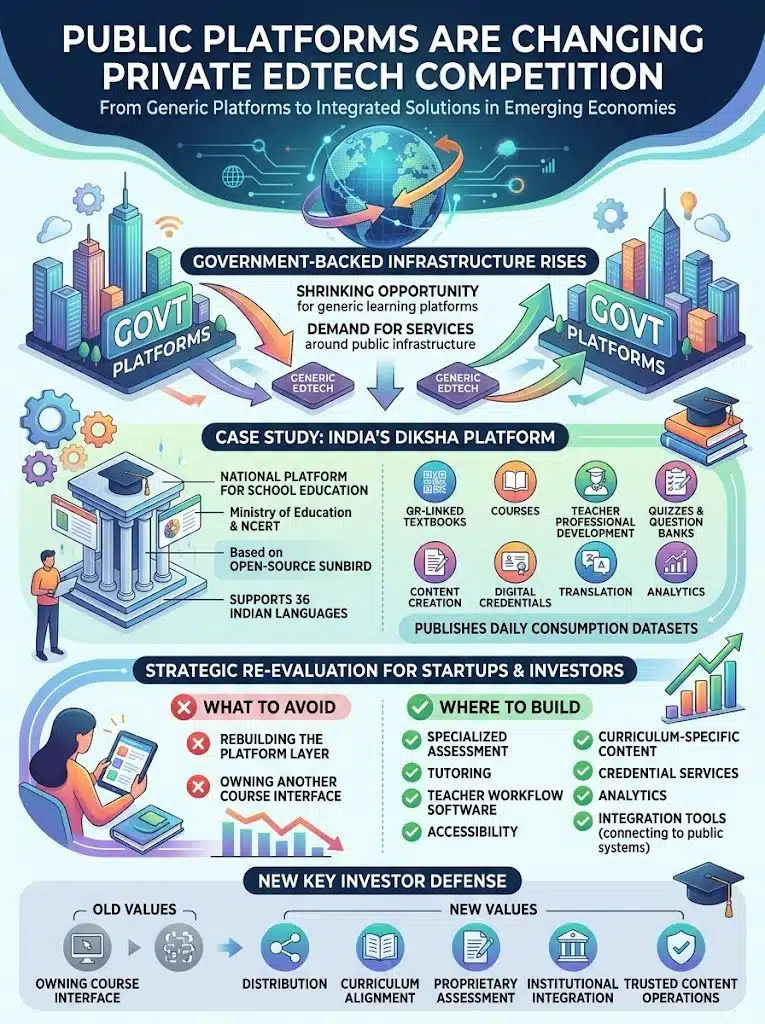
Government-backed digital education infrastructure is becoming more important in several emerging economies. That can shrink the opportunity for another generic learning platform while creating demand for services built around the public infrastructure.
India’s DIKSHA is a useful example.
Launched in 2017 under the country’s Ministry of Education and NCERT, DIKSHA is a national platform for school education. It currently supports 36 Indian languages and is based on the open-source Sunbird infrastructure.
Its capabilities go well beyond hosting lessons. They include QR-linked digital textbooks, courses, teacher professional development, quizzes, question banks, content creation, digital credentials, translation, and analytics. DIKSHA also publishes usage datasets; its consumption dataset is updated daily.
A startup entering an ecosystem like this should ask whether rebuilding the platform layer makes sense.
The better opportunity may sit around it: specialized assessment, tutoring, teacher workflow software, accessibility, curriculum-specific content, credential services, analytics, or tools that integrate with existing public systems.
For investors, this changes what constitutes defensibility. Distribution, curriculum alignment, proprietary assessment, institutional integration, or trusted content operations can be more valuable than owning another course interface.
School Connectivity Is Becoming an Infrastructure Business Too
The joint UNICEF-ITU Giga initiative illustrates how much work sits underneath a functioning digital classroom.
Giga helps governments identify schools, monitor connections, improve procurement, and plan financing. UNICEF reports that 2.3 million school locations had been mapped and estimates that, by the end of 2025, 20 million children in 44,000 schools had benefited from new or improved connectivity.
What happens after installation is less visible but just as important.
Schools need routers that keep working, technical support, device management, electricity, security, software updates, replacement plans, and someone who knows what to do when equipment fails. UNESCO has repeatedly warned that maintenance and total cost of ownership are often underestimated in education-technology projects.
This makes infrastructure-related businesses part of the EdTech opportunity: school connectivity monitoring, device fleets, offline servers, identity systems, cybersecurity, and education-management software.
Buying hardware is relatively easy. Keeping it useful for several school years is where many deployments become difficult.
Teacher Tools May Be More Valuable Than Another Student App
Much of EdTech marketing is student-facing. Some of the less glamorous teacher tools may have clearer institutional value.
The World Bank’s Education and Technology Readiness Index treats digital readiness as six connected areas: school management, teachers, students, devices, connectivity, and digital education resources.
That framework reflects how schools actually operate. Tablets do little if teachers cannot incorporate them into lessons. Connectivity alone does not solve poor curriculum alignment. A strong content library can still sit unused if teachers see the platform as additional work.
Teacher-facing products can tackle tasks that happen every week: preparing lessons, adapting material for different ability levels, creating formative assessments, tracking attendance, giving feedback, translating instructions, communicating with parents, or preparing reports.
The useful metric is not whether staff attended the launch training. It is whether they are still using the product later.
For institutional EdTech, sustained teacher adoption is a much stronger signal than the number of accounts created during rollout.
AI Has Real Uses, but the Deployment Problem Is Often Underestimated
Generative AI expands what education software can attempt. It can help draft lessons, translate material, prepare questions, summarize class performance, provide feedback, or support tutoring.
None of those capabilities removes the infrastructure constraints already discussed.
An AI service that relies on frequent cloud requests adds bandwidth, latency, and recurring computing costs. Performance can differ across languages. Student-facing systems also raise harder questions involving personal data, hallucinations, inappropriate responses, academic integrity, and age-appropriate access.
UNESCO’s guidance on generative AI in education emphasizes privacy, age-appropriate use, human agency, and pedagogical validation. Its AI competency frameworks also make clear that teachers and students need the ability to judge AI systems, not merely operate them.
That makes teacher assistance a particularly practical starting point in many emerging markets.
A system that helps a teacher produce several versions of a reading exercise or create a first draft of a quiz has a narrower operational problem than giving every student unrestricted access to an AI tutor.
The latter may eventually be valuable, but it requires stronger safeguards, infrastructure, evaluation, and economics.
A Large Student Population Is Not a Business Model
Emerging markets produce impressive addressable-market slides because the learner populations can be enormous.
The difficult numbers come later: how many users can pay, how much they can pay, how payments are collected, what it costs to acquire them, and how much support they require.
A consumer EdTech platform can have millions of registrations without a healthy paid business. Low purchasing power and expensive customer acquisition make that particularly risky.
This is one reason institutional models remain important. Schools, universities, employers, governments, NGOs, and telecom companies can provide distribution or pay on behalf of learners.
They introduce different problems. Public procurement can be slow. Schools may require training and integration. Curriculum localization costs money. A government contract can produce impressive revenue while creating dangerous customer concentration.
The business case is easier to defend when the product improves a measurable workflow: reducing assessment time, helping teachers manage larger classes, distributing approved material more cheaply, or extending access to a scarce instructor.
“Digital learning” by itself is not a sufficiently specific value proposition.
What Investors Should Look Past
A polished product demonstration says little about how an EdTech company performs in a rural school, on an older phone, or six months after an institutional rollout.
The most useful diligence questions are operational:
- Does the claimed learning or productivity improvement have credible evidence?
- How does the product behave on older Android phones, small screens, shared devices, and poor connections?
- Are teachers still active after onboarding?
- How much curriculum and language work is required for every new market?
- What do implementation, training, and support do to software margins?
- Is revenue concentrated in one ministry, school group, donor, or distribution partner?
- What happens to student data, and which local rules govern its collection and storage?
- Does geographic expansion require the company to add field staff at nearly the same rate as customers?
Evidence deserves extra scrutiny.
UNESCO’s 2023 Global Education Monitoring Report found that good, impartial evidence about EdTech’s impact remains limited. Technology products also change faster than many rigorous studies can evaluate them, and much of the research comes from wealthier countries.
The appropriate response is not to assume EdTech does not work. It is to stop asking whether “EdTech works” as if it were one intervention.
The better questions are narrower: which product, for which learners, under what conditions, compared with what alternative, and at what total cost?
The Less Visible Parts of EdTech May Offer Better Opportunities
Another generic course library is relatively easy to build. Infrastructure that becomes embedded in daily school operations is much harder to replace.
That leaves room for teacher workflow systems, local-language assessment, attendance, credential verification, school administration, payments, identity, interoperable student records, and curriculum tools.
Technical and vocational education can also be attractive when training is tied closely to recognized competencies, certification, apprenticeships, or employer demand. A catalogue of courses is less compelling than a system that can show how training connects to a credible employment or skills outcome.
Connectivity management, cybersecurity, affordable computing, and device administration sit even further below the visible learning layer, but without them many higher-level products cannot operate reliably.
There will still be profitable premium services aimed at affluent urban students with personal laptops, reliable broadband, and international payment methods.
That is a valid market. It is simply not the same thing as closing the digital divide.
Policymakers Should Spend More Attention on the Foundations
EdTech policy is often most visible when governments buy devices or announce a platform. Some of the more valuable work makes fewer headlines.
Schools need connectivity. Teachers need training. Systems need interoperability rules. Students need meaningful privacy protections. Curriculum material should be available in formats that digital services can actually use. Procurement should leave room for replacement, maintenance, and support rather than concentrating only on the initial purchase.
Interoperability deserves particular attention. Closed systems can make switching suppliers expensive and leave education authorities dependent on one vendor for data, integrations, and future development.
Procurement also needs a clear educational question behind it.
If a platform is supposed to improve mathematics learning, measure that. If its purpose is to save teachers administrative time, measure that instead. Student logins, devices distributed, and lessons downloaded are useful operational numbers, but they are not substitutes for the outcome the technology was purchased to improve.
Final Thoughts
The most consequential EdTech emerging markets trends are pushing the sector away from a simple “more technology equals more access” assumption.
Connectivity is expanding, yet device ownership, home internet, data affordability, teacher capacity, curriculum alignment, language, maintenance, and institutional readiness still determine who can benefit.
Founders should therefore begin with the conditions in which the product must work. Investors should examine implementation costs and repeat usage as carefully as software features. Education authorities should ask what problem a technology solves before deciding how many devices or licenses to buy.
A useful emerging-market EdTech product should still work when the student has an inexpensive phone, the connection disappears halfway through a lesson, several family members share a device, and the teacher has little time for another complicated system.