
The clatter of plastic dice hitting the wooden table. A preschooler takes one glance at the dotted face, doesn’t even raise a finger to point, and shouts, “Five!” He didn’t count them. He just knew.
That split-second recognition isn’t just a neat parlor trick. It’s actually a massive developmental milestone. In the education and child psychology world, we call this subitizing.
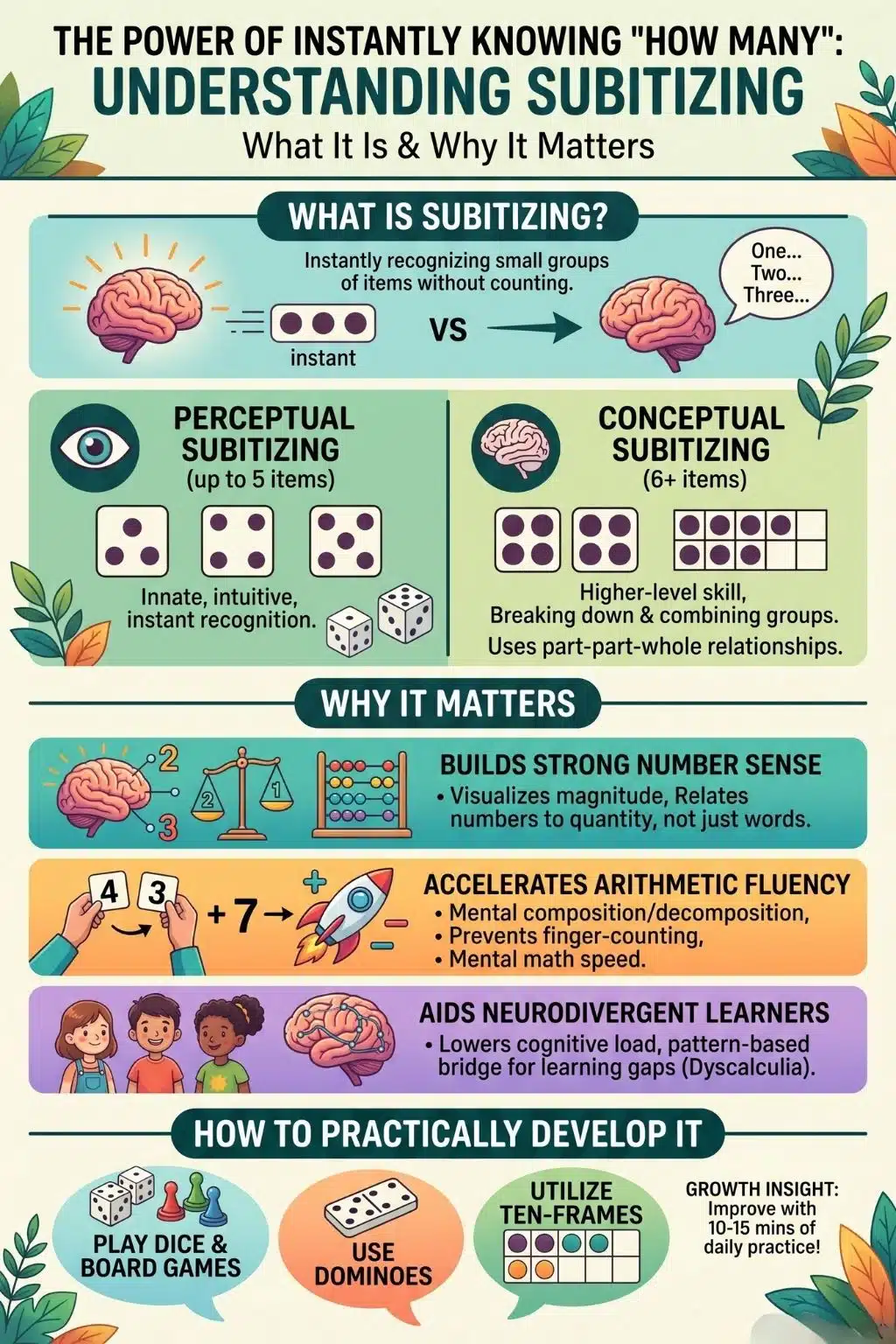
Derived from the Latin word subito (meaning “suddenly”), subitizing is the ability to instantly recognize the number of objects in a small group without counting them one by one. While it looks like a simple visual reflex, it is the bedrock of advanced mathematical thinking.
Here is a breakdown of why this single skill changes everything about how a child learns math, and how I’ve seen it transform early learning.
The Two Stages of Subitizing
When we talk about subitizing, we are actually looking at a two-part progression.
1. Perceptual Subitizing
This is primal instinct. It’s the ability to instantly recognize very small quantities (usually up to four or five items) without any conscious mathematical effort. You look at three apples on a plate and know it’s three. No math required. In fact, research shows that even young babies and certain animals possess this visual reflex.
2. Conceptual Subitizing
This is where the real math magic happens. Conceptual subitizing is an advanced skill that develops later, where the brain recognizes a larger quantity by instantly breaking it down into smaller, familiar chunks. When a first grader sees an eight-dot domino, they aren’t scanning eight individual dots. Their brain flashes “four and four” and instantly outputs eight.
Why Does It Actually Matter?
It’s easy to dismiss this as just fast counting. But subitizing physically alters how a child’s brain handles numbers.
It Builds True Number Sense
Before subitizing clicks, a number is just a word in a memorized song to a child, much like a letter in the alphabet. Subitizing teaches them that “four” has a physical shape and a tangible weight. It bridges the massive gap between rote memorization and true understanding.
It Accelerates Mental Math
Have you ever watched a child painfully count out 5 + 3 on their fingers, lose track, and have to start over? Conceptual subitizing eliminates that frustration. By seeing a group of seven as “five and two,” they organically learn how numbers break apart and piece together. This mental flexibility is the absolute foundation of addition and subtraction.
It Breaks Barriers for Neurodivergent Learners
A struggle with subitizing is one of the earliest and most robust red flags for dyscalculia, a math-based learning disability. Kids with dyscalculia often rely entirely on counting one-by-one, which quickly exhausts their working memory and leads to intense math anxiety. The incredible news? Subitizing can be explicitly trained. Just 15 minutes of visual number games a day can drastically lower cognitive barriers and build lasting confidence.
Check out our teacher approved app, 1 2 3 Magic number fun: Math kid for Kid’s early math learning.
How to Practice It Naturally
You don’t need expensive flashcards or a rigid curriculum to build this skill. I’ve found it works best when you seamlessly bake it right into everyday life:
- Board Games with Dice: The ultimate subitizing tool. Standard dice train perceptual subitizing perfectly because the dot patterns are consistent and repetitive.
- Dominoes: Perfect for the conceptual stage. Having a child look at a tile and quickly combine the two halves trains their brain to see parts making a whole.
- Everyday Visuals: Making a snack? Arrange four crackers in a square. Ask, “How many?” Encourage them to see the shape of the number rather than touching each cracker sequentially.
Final Thought
Math doesn’t start with worksheets or memorizing equations; it starts with training the eyes to see patterns in the world. When we step back and help a child visualize numbers rather than just recite them, we aren’t just teaching them to count faster. We are giving them the confidence to realize that math is a language they already know how to speak.
Frequently Asked Questions About Subitizing
1. At what age should a child start subitizing?
It starts earlier than you might think! By age two, most children can perceptually subitize one, two, or three objects. By the time they enter kindergarten (around age five), they should easily recognize groups of up to four or five, and naturally begin the transition into conceptual subitizing.
2. How is subitizing actually different from counting?
Counting is a sequential, step-by-step process (pointing and saying “1, 2, 3”). It requires working memory. Subitizing is an instant, holistic visual recognition. It’s a rapid pattern-matching reflex that requires almost zero active thought.
3. Can adults subitize large numbers?
Not perceptually. The human brain naturally caps out at perceptually subitizing about four or five items. Beyond that, our brains automatically switch to either estimating or conceptual subitizing (breaking that large, chaotic number into smaller, recognizable chunks).
4. What happens if a child struggles with subitizing?
If a child cannot subitize, they will lean entirely on one-by-one counting. This works fine for very small numbers, but as math gets more complex in elementary school, it drains their cognitive load, making arithmetic slow, frustrating, and highly prone to errors.
5. How long does it take to improve this skill?
Remarkably little time. Research has shown that practicing visual number games for just 10 to 15 minutes a day can yield significant improvements in a child’s subitizing speed and overall math fluency in as little as three weeks.