Most creative teams I speak to are not short of AI tools. They are short of somewhere to put them. A five-person agency ends up paying for one service for images, another for video, a third for voiceovers, and a fourth for a writing model, and then nobody can answer a simple question at the end of the quarter: what did that campaign actually cost to produce?
I work as chief technical advisor on ImagineLab.art, and that question has shaped more of our architecture than any model benchmark ever has. So this is not a neutral survey. It is an opinion, formed while building one of these platforms, about where the future of all-in-one AI creative platforms is heading and which parts of the problem the industry is still avoiding.
My short version: the model layer is nearly solved and nearly worthless as a differentiator. The billing layer is not solved, and it is where the next three years will be won or lost.
Thirty Eight Models is the Least Interesting Number on Our Site
Our models page currently lists 38 unique models across seven workspaces. Image Lab runs nine, including GPT Image 2, Nano Banana Pro, FLUX 2 Max and Seedream 5 Pro. Video Lab runs thirteen, from Veo 3.1 down to Runway Gen-4 Turbo and Kling v3.0 Standard. Voice, music, writing, and Imagine Chat cover the rest, with Claude, Gemini and GPT models sitting alongside our own in-house builds.
That number is the first thing people ask about. It is also the number we care least about.
Model catalogues are becoming commodity inventory. Half of what we list today will be superseded within two or three quarters, and when it is, swapping it out is a routing change and a pricing update, not a rebuild. Any competitor with funding and a provider account can match a catalogue. Nobody wins on catalogue size alone, and I would be suspicious of any platform that leads with it.
What is genuinely hard to copy is everything wrapped around the catalogue: one history, one wallet, one permission model, and one place where a video generated on Monday can be handed to a voiceover on Tuesday without leaving the workspace. Those are boring, unglamorous systems. They are also the reason a team stays.
The Billing Layer is Harder than the Model Layer
Our credit unit is EDT, the Editorialge Digital Token. On the surface it looks like every other credit system. Underneath, it is the most complicated thing we run, because no two labs cost money the same way.
| Lab | What the price is actually based on | Planning range |
|---|---|---|
| Image Lab | Model, mode, image size, quality, editing route | About 6–60 EDT |
| Video Lab | Model, duration, resolution, creation mode | About 35–747+ EDT |
| Voice Lab | Script character count and voice model | About 1–84 EDT |
| Music Lab | Flat per track for some models, duration-based for others | About 8–19 or 36–1,050 EDT |
| Writing Lab | Input and output text volume, task size, model | About 1–8 EDT |
Read those ranges next to each other and the design problem becomes obvious. A short writing task can cost one EDT. A single long video generation can cost seven hundred. That is a spread of nearly three orders of magnitude inside one interface, and the user is expected to move between them casually, sometimes within the same project.
This is where I think a lot of platforms are quietly making a mistake. Flattening everything into “one credit, one generation” makes for a clean pricing page and an unsustainable business. Either the platform loses money on video, or it silently caps quality, shortens durations and routes people to cheaper models without telling them. Both outcomes end the same way: users stop trusting the number on screen.
We went the other direction and exposed the messiness. Prompt enhancement is charged separately from generation, at two to four EDT depending on the lab, because it genuinely is a separate provider call. Imagine Chat bills from actual token usage rather than per visible message, which means a long conversation costs more than a short one because the earlier context gets resent. Users occasionally find that annoying. I would rather they find it annoying and accurate than comfortable and wrong.
Why We Publish a Conversion Rate and then Tell People Not to Rely on It
For budget planning, our wallet guide uses roughly $0.0143 per EDT. A 500 EDT top-up sells at $7. Straightforward enough.
Then there is the example in our own documentation: a wallet showing 9,244 EDT with an approximate value of $129.42, while the planning formula produces $132.19. We printed both figures and explained the gap rather than rounding one of them until it matched.
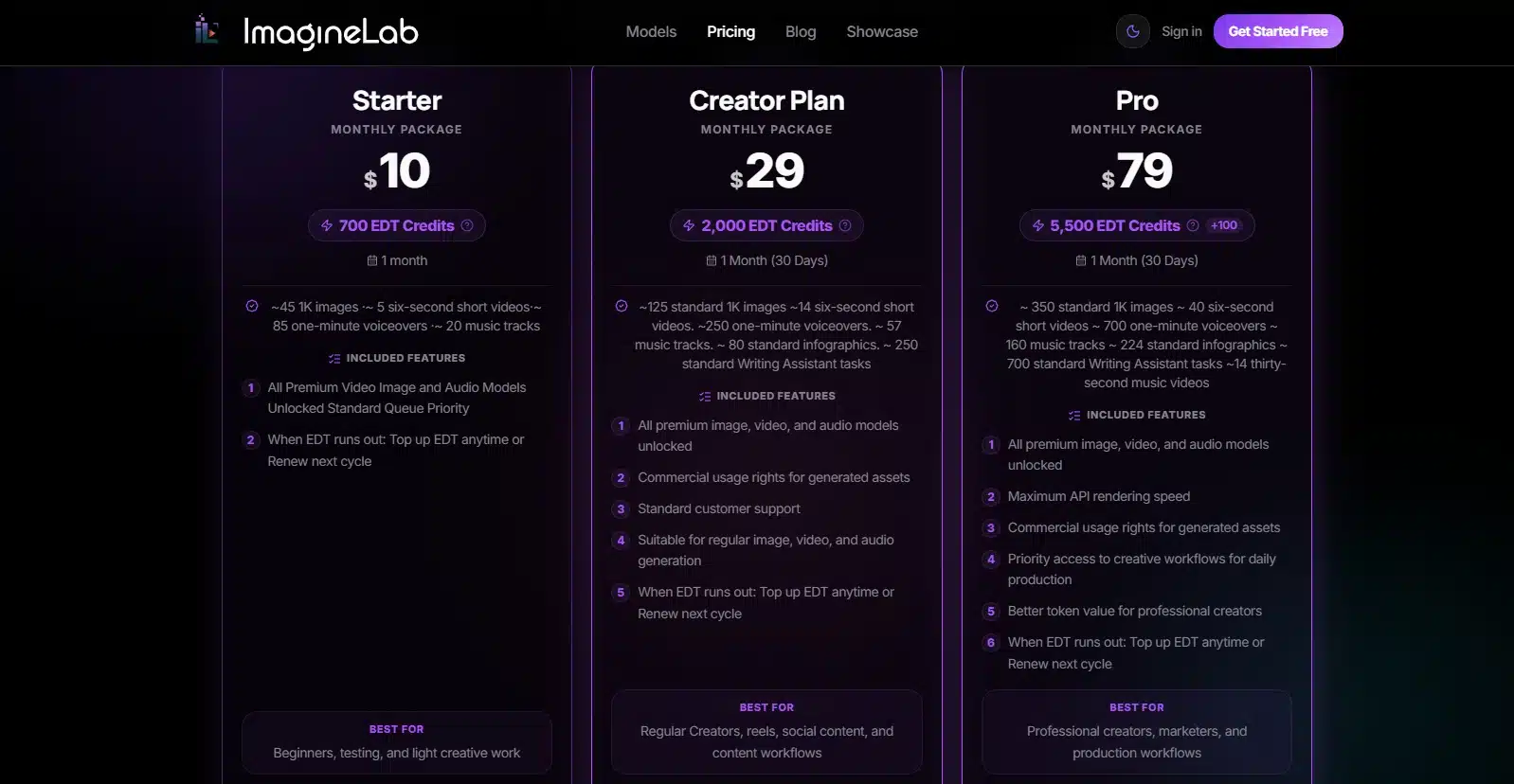
That decision gets questioned internally more than any other, and I still think it was correct. Every credit-based platform has this discrepancy somewhere, between account-level conversion, provider rate changes and display rounding. The choice is whether to document it or hope nobody notices. Publishing it means we can state the rule plainly: the amount shown inside the app before you confirm a generation is the real charge, and everything in the PDF is planning material. A user who understands that will not feel cheated when a model price shifts. A user who was promised a fixed rate will.
Where the Future of All-in-One AI Creative Platforms Gets Decided: The API
Our API is a REST interface over HTTPS with bearer-token auth, and generation is asynchronous by design. You POST to get a record back with status “pending” and a credit_cost already attached poll/generations/{id}/status until it completes, then fetch the outputs.
The important detail is in that second step. Creating a job reserves its credit cost immediately, and a request against an insufficient balance fails with a 402 before anything runs.
I will defend that choice against the obvious alternative, which is charging on completion. Charge-on-completion feels friendlier and creates a hole you cannot close: a user queues forty video jobs with credits for three, the upstream providers process all forty, and the platform absorbs the difference. Reserve-then-settle is less elegant and it holds up under load.
Where I think our own documentation is currently too simple is the flat cost table, which lists text at 2 credits, images at 5, videos at 15, and so on as indicative figures. Those numbers are fine as a rough guide and they do not reflect the real per-model spread I described earlier. My view is that any serious creative API needs a cost-estimate endpoint, so an integration can price a job before submitting it rather than discovering the charge after the fact. That is a gap, and I would rather name it than let a developer find it in production.
We also gate programmatic access to the top two plans, Ultimate Visionary Studio and Titan Studio, with scoped keys issued per integration. That looks restrictive for a platform our size. It is deliberate. An API key on a multi-provider generation stack is a spending instrument, and handing them out freely before the rate limiting and abuse tooling is mature is how platforms end up eating five-figure provider bills.
What We Got Wrong
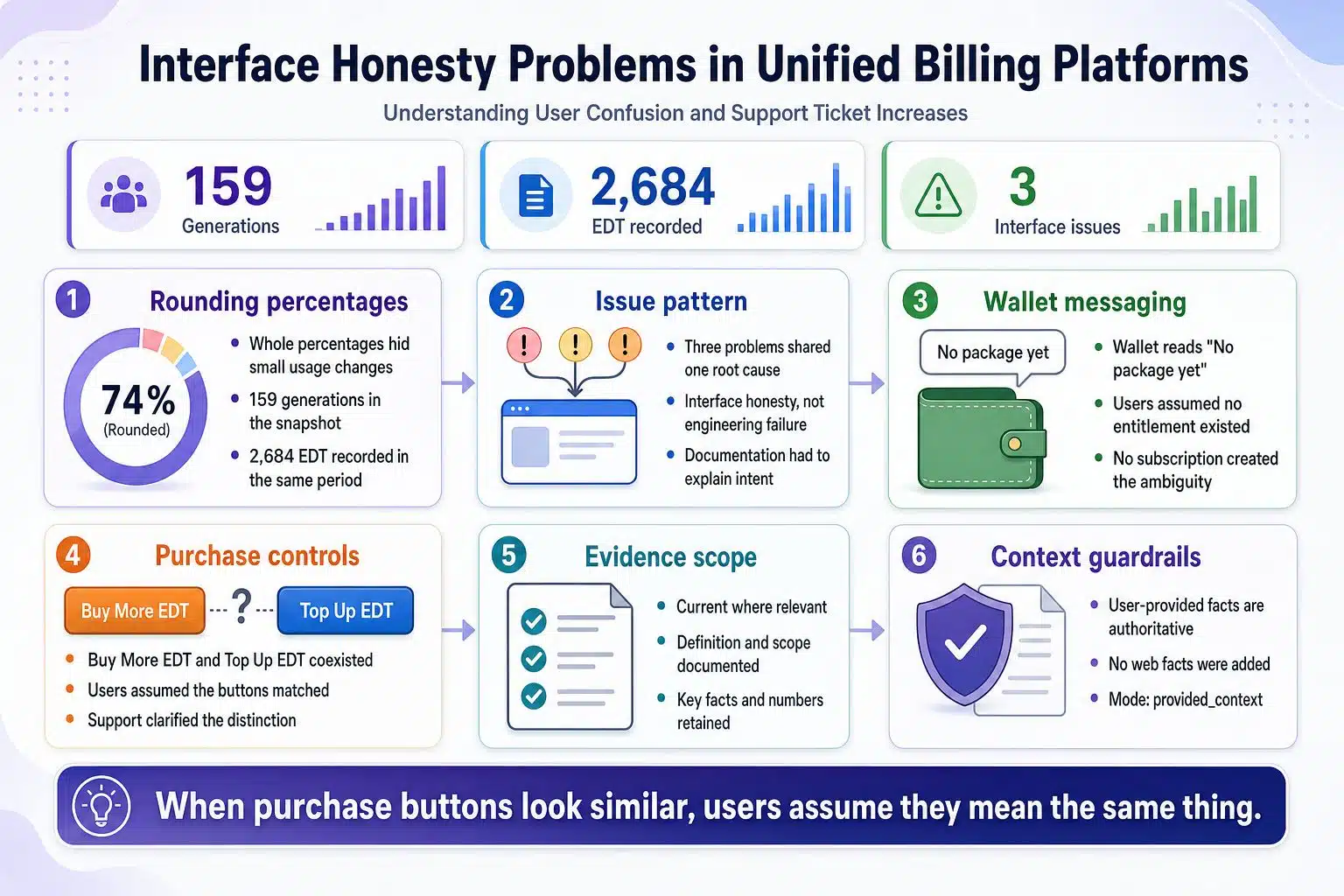
Three things, all interface honesty problems rather than engineering ones:
- We shipped two separate purchase controls, Buy More EDT and Top Up EDT, and users reasonably assumed they were the same button. They are not, and we had to document the difference instead of fixing the naming.
- Our spending panel rounds to whole percentages, so a lab with genuine activity can display 0%. In one representative 30-day snapshot covering 159 generations and 2,684 EDT, writing, voice, and music video all showed 0% despite real usage.
- The wallet reads “No package yet” when no subscription is attached, which a number of users interpreted as having no credits at all.
None of these were hard problems. All three cost us support tickets, and every all-in-one platform will hit their equivalents, because a unified interface means one screen has to explain six different billing models at once.
Where the Pricing Model Goes Next
The hybrid we run now, a subscription package for the access tier plus a wallet for volume, is not the end state. It is a reasonable middle.
What I expect to become standard within two years: per-project budgets with hard caps, cost preview at the point of generation rather than only a running balance, team-level credit allocation so a studio lead can hand a junior 2,000 EDT for one campaign, and routing that picks the cheapest model clearing a stated quality bar instead of asking the user to guess between thirteen video engines.
That last one matters most. Right now, choosing between Seedance 2.5 at roughly 24 EDT per second and Hailuo 3 at roughly 31 requires knowing what each is actually good at. Most users do not and should not have to.
If You Are Evaluating One of These Platforms
Five questions worth asking any vendor, including us:
- Can you see the exact cost of a generation before you confirm it, or only your balance afterwards?
- Are prompt enhancements, retries and failed jobs charged, and is that stated anywhere in writing?
- What happens to unused credits when you cancel?
- Is there an API, and does it reserve cost at job creation or bill on completion?
- When the vendor’s documentation and the app disagree on price, which one do they tell you to trust?
A platform that answers all five without hedging has thought about the hard part. A platform that answers with model counts has not.
Final Thoughts
The future of all-in-one AI creative platforms will not belong to whoever integrates the most providers. Integration is now a solved engineering task with a known cost. It will belong to whoever can tell a working creative team, before they start, what a finished piece of work is going to cost, and then charge them exactly that.
We are not fully there yet, and I have pointed at our own gaps above rather than pretending they close themselves. If you are choosing a platform this year, spend less time on the model list and more time in the billing documentation. That is where you will find out what the company actually thinks of you.