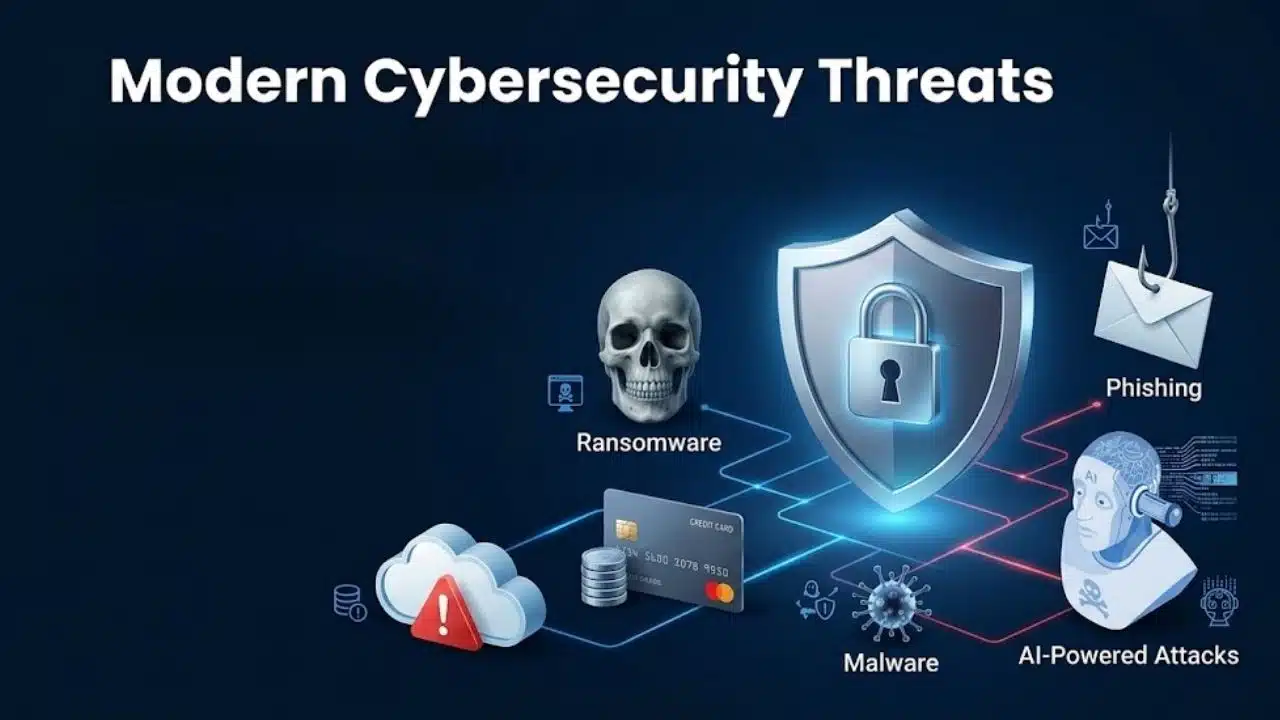
Modern security leaders rarely struggle to find another threat report—the challenge lies in deciding which warnings justify immediate budget, engineering time, and executive focus. While sophisticated AI-assisted exploits and autonomous bots dominate headlines, many damaging incidents still stem from foundational gaps like exposed edge appliances, stolen session tokens, or untested recovery playbooks.
Emerging cybersecurity threats demand a strategic shift toward continuous threat exposure management, post-quantum readiness, and zero-trust identity frameworks. This guide prioritizes critical digital risks by total enterprise exposure, operational impact, detection difficulty, and recovery complexity—helping CISOs align immediate technical controls with long-term business resilience.
Our Selection Criteria
Each threat was assessed against four practical questions:
- How widely are enterprises exposed?
- Can the threat bypass commonly deployed controls?
- How difficult is it to detect and contain?
- Could one compromise spread across business units, customers, suppliers, or physical operations?
Longer-term issues such as post-quantum migration also belong here because enterprises cannot solve them through a rushed purchase when the deadline becomes urgent.
What Most Cyber Threat Lists Get Wrong
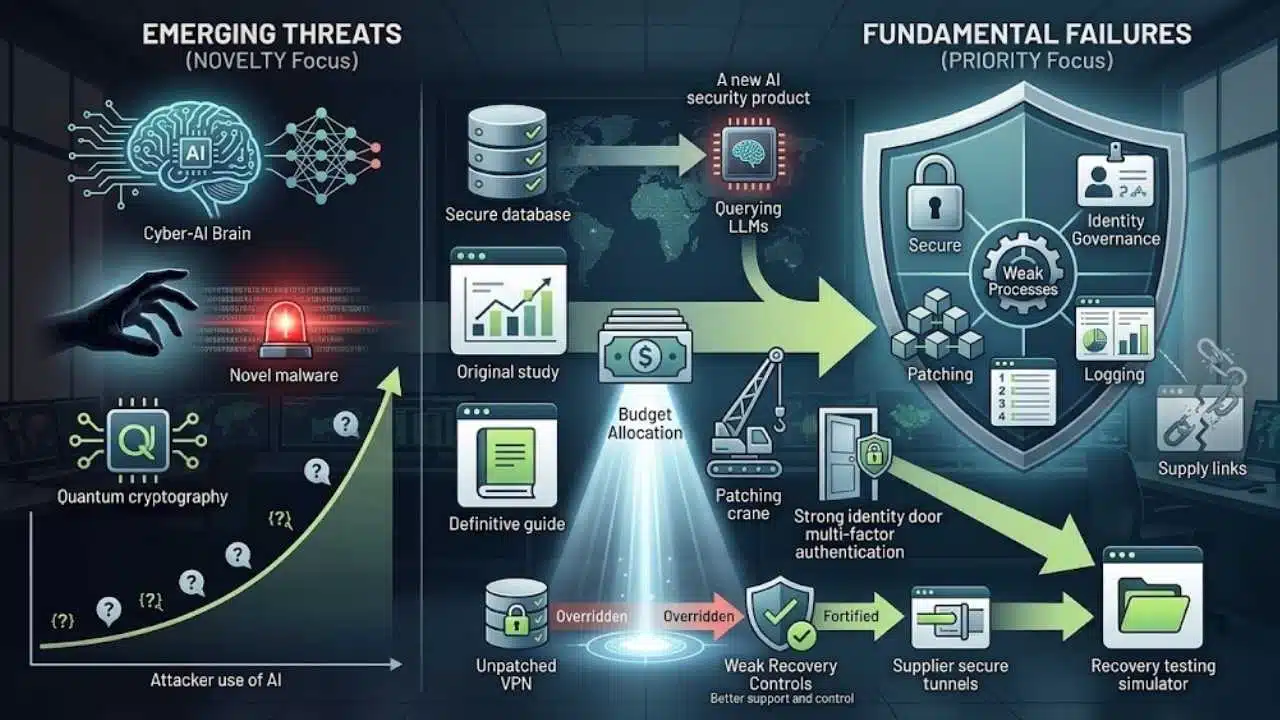
Novel attacks attract attention, but novelty is a poor substitute for priority. Mandiant’s investigations covering 2025 documented growing attacker use of AI, including malware that queried large language models during execution. Its broader finding was less dramatic: most breaches still arose from human error, weak processes, exposed systems, and other familiar security failures.
That should influence 2026 budgets. Enterprises need to prepare for emerging attack methods without neglecting patching, identity governance, logging, supplier access, and recovery testing. A new AI security product will not compensate for an unsupported VPN appliance or an administrator account with weak recovery controls.
12 Cybersecurity Threats 2026 Security Plans Must Address
These cybersecurity threats do not carry equal weight for every organization. The list prioritizes risks by enterprise exposure, potential disruption, detection difficulty, and recovery demands. Security leaders should adjust the order for their industry, infrastructure, data sensitivity, regulatory duties, geopolitical profile, and dependence on cloud or operational technology systems accordingly.
1. Exploitation of Internet-Facing and Edge Systems
Firewalls, routers, VPN gateways, email appliances, and remote-management systems offer attackers a direct route into enterprise networks.
Verizon’s 2026 Data Breach Investigations Report found that vulnerability exploitation accounted for 31% of breaches, making it the leading single recorded initial-access category in its dataset. That does not mean identity attacks have become less important. It does mean exposed infrastructure can no longer sit behind slow monthly patch cycles.
Mandiant estimated a mean time-to-exploit of negative seven days in its observed cases, indicating that some exploitation started before a fix existed. Patching alone cannot address that problem.
Security teams need an accurate inventory of internet-facing systems, named owners, current support status, centralized logging, and a tested way to isolate or replace a device quickly. An appliance that cannot run normal endpoint monitoring requires more scrutiny, not less.
2. Ransomware and Multi-Extortion
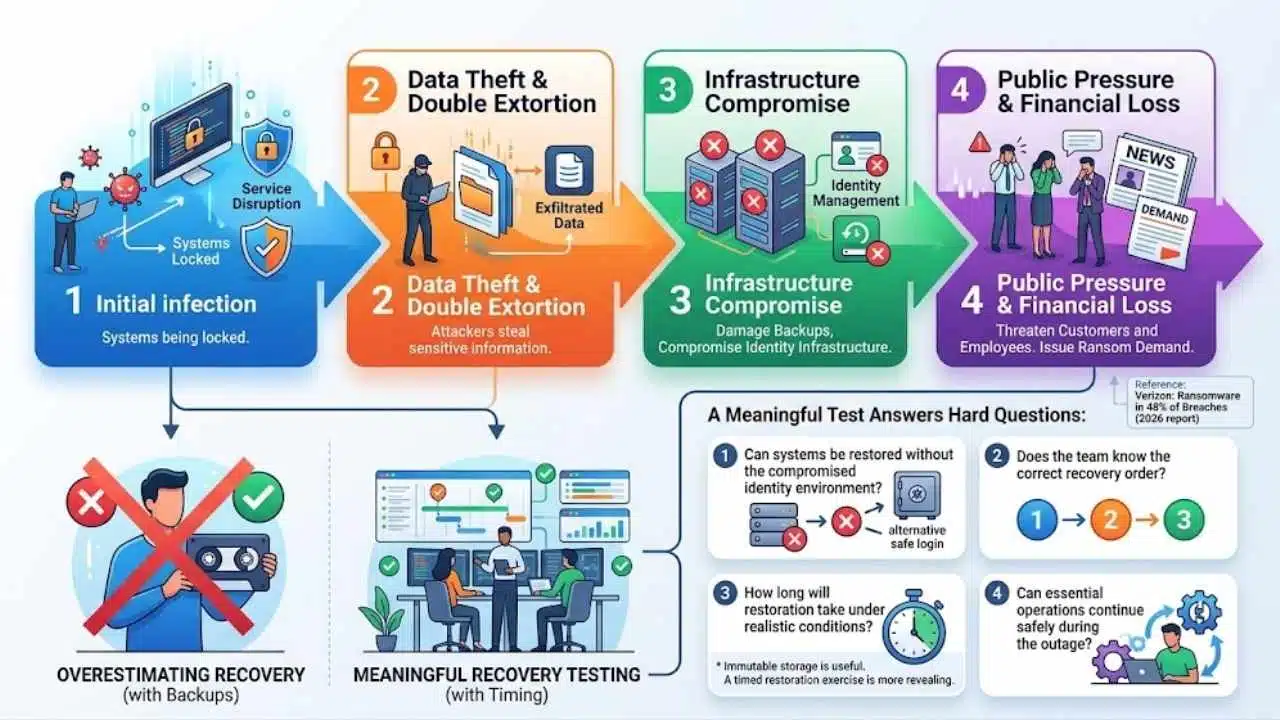
Ransomware remains a top enterprise threat because it combines service disruption, data theft, public pressure, and financial loss. Verizon reported ransomware involvement in 48% of the breaches covered by its 2026 report.
Encryption is only one part of a modern ransomware incident. Attackers may steal sensitive information, damage backups, compromise identity infrastructure, or threaten customers and employees before issuing a demand.
Many organizations overestimate their recovery readiness because they have backups. A meaningful test should answer harder questions:
- Can critical systems be restored without relying on the compromised identity environment?
- Does the team know the correct recovery order?
- How long will restoration take under realistic conditions?
- Can essential operations continue safely during the outage?
Immutable storage is useful. A timed restoration exercise is more revealing.
3. Credential Theft and Session Hijacking
Multifactor authentication has made some account takeovers harder, but it has not solved identity compromise. Attackers now pursue active session cookies, OAuth tokens, recovery processes, and unauthorized authentication-device enrollment.
A stolen session can bypass the login challenge an organization expects to stop an intruder. Changing the password may not terminate every session or application grant.
Phishing-resistant authentication, including FIDO2 security keys and properly implemented passkeys, should be prioritized for administrators and other high-risk users. Enterprises also need fast session revocation, restricted MFA enrollment, shorter token lifetimes where practical, and reauthentication before sensitive actions.
Login monitoring is not enough. Unusual exports, new forwarding rules, unexpected consent grants, and activity from unmanaged devices may reveal the compromise first.
4. SaaS and Cloud Control-Plane Compromise
A compromised SaaS administrator may control user provisioning, integrations, exports, security settings, and access to connected applications.
Mandiant documented campaigns that used phone-based social engineering and counterfeit login pages to compromise identity and SaaS environments. Attackers sometimes enrolled unauthorized authentication devices or used single sign-on access to reach additional services. These were not necessarily vulnerabilities in the SaaS products themselves. The weakness often sat in the surrounding identity or support process.
Enterprises should inventory privileged SaaS roles, OAuth grants, third-party integrations, emergency accounts, and non-human identities. Cloud posture tools can identify configurations, but they cannot repair unclear ownership or a help desk permitted to reset a powerful account after weak verification.
5. Third-Party and Software Supply-Chain Attacks
A supplier can introduce risk through remote support access, software updates, exposed secrets, shared infrastructure, or compromised employee accounts. The real issue is inherited trust.
An annual security questionnaire does not show what a supplier can reach inside the customer’s environment during an incident. Technical boundaries offer more protection.
Supplier accounts should be limited to necessary systems, monitored while in use, and removed promptly when the relationship ends. Integration credentials should be stored outside source code and replaced with short-lived access where supported.
Software bills of materials can help identify affected components, but they are not proof of security. They become useful only when teams can connect a vulnerable component to deployed systems, responsible owners, and a workable response.
6. AI-Accelerated Attack Operations
AI can reduce the effort needed for reconnaissance, translation, impersonation, scripting, and vulnerability research. That allows attackers to run familiar techniques faster and produce more variations.
Google Threat Intelligence reported one zero-day exploit in 2026 that it assessed as having been developed with AI assistance. The case matters, but it does not establish that AI-generated zero-days are already common.
The more immediate problem is reduced response time. Defenders should focus on hardened external systems, behavioral monitoring, secure development practices, rapid secret rotation, and analysts who can verify automated findings. Buying a tool because it includes “AI” in the product description is not a security strategy.
7. Attacks on Enterprise AI and Agentic Systems
Enterprise AI introduces risks that conventional application testing may not fully capture. Prompt injection can hide hostile instructions in documents, webpages, emails, or retrieved data. Other concerns include poisoned knowledge sources, sensitive-data disclosure, insecure dependencies, and excessive authority.
Risk increases sharply when an AI system can act. A chatbot that summarizes public information is different from an agent that can modify records, send messages, access source code, or approve transactions.
Security teams should document which data each system can access, which external tools it calls, what actions it may perform, and where human approval is mandatory. Prompt and tool activity also need usable logs. Treating every AI application as one risk category will either leave powerful agents underprotected or impose unnecessary controls on low-risk tools.
8. Mobile Phishing, Vishing, and Help-Desk Manipulation
Texts, QR codes, and voice calls often reach employees away from managed workstations and outside normal email controls. Verizon’s 2026 report found that voice- and SMS-based phishing simulations generated higher click rates than comparable email simulations. Simulation performance is not the same as confirmed breach success, but it exposes a weakness in email-only defenses.
Help desks face similar pressure. Attackers may claim a lost phone, request an urgent reset, or try to register a new authentication method.
High-risk resets need independent identity evidence, clear escalation rules, and immediate alerts to the affected user. Support staff must also have permission to delay suspicious requests. Fast service is not helpful when it gives an attacker control of an executive account.
9. Nation-State Persistence in Network Infrastructure
State-sponsored groups continue to target routers, firewalls, telecommunications systems, and identity infrastructure because those systems can provide durable access outside ordinary endpoint monitoring.
CISA has repeatedly warned about state-linked exploitation of vulnerable or misconfigured edge devices. These systems may run outdated software, preserve little forensic evidence, or receive less attention than servers and laptops.
Organizations with elevated geopolitical exposure should review remote-management interfaces, administrative access, software support, configuration integrity, and log retention. Telecommunications, government, defense, critical infrastructure, and research-heavy companies should rank this threat higher than a low-profile business with limited strategic value.
10. Operational Technology and Cyber-Physical Disruption
An operational technology incident can affect production, logistics, safety, environmental controls, or essential services. That makes conventional IT responses potentially dangerous.
Aggressive scanning, automatic isolation, or an untested update can interrupt equipment. OT security changes must account for operational and safety requirements.
A credible program starts with an asset inventory, documented communication paths, controlled remote access, segmentation, and tested manual procedures. Engineers and operations staff should participate in incident exercises because they know which systems can be stopped and which recovery sequence is safe.
For organizations without industrial or connected physical environments, this threat may rank lower. For manufacturers, utilities, transport operators, and some healthcare providers, it belongs near the top.
11. DDoS and Geopolitically Driven Hacktivism
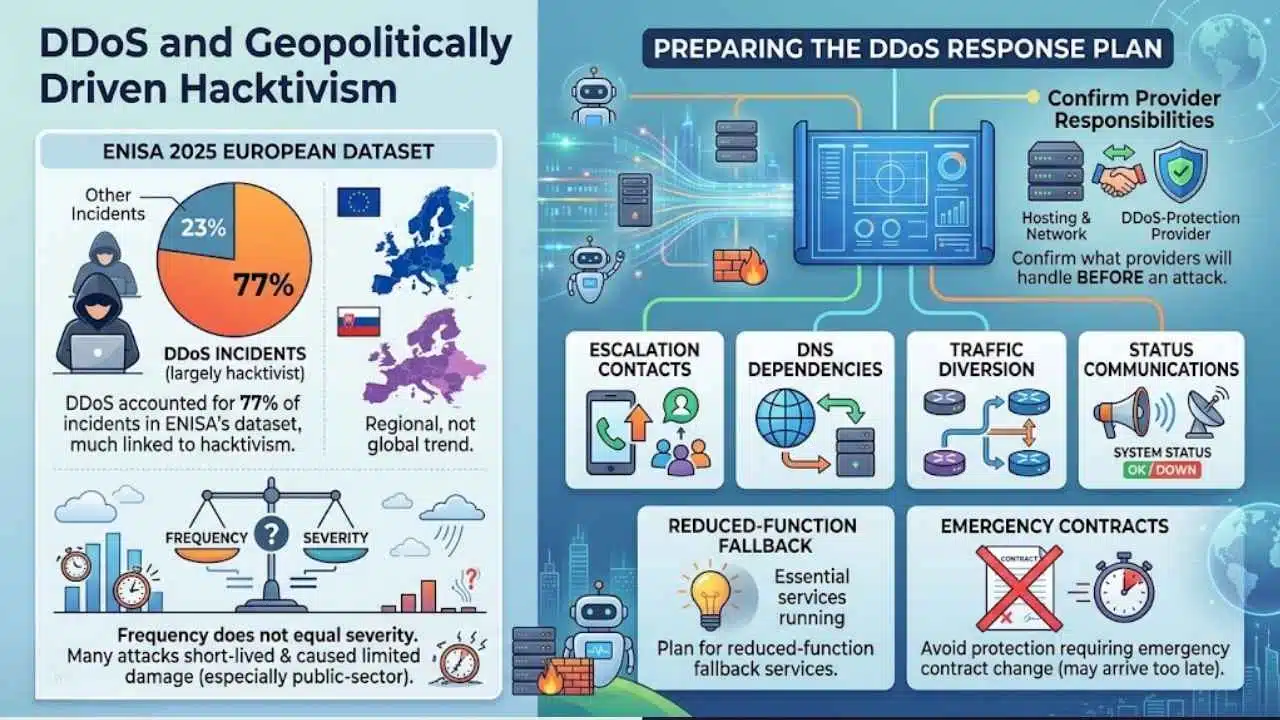
Distributed denial-of-service attacks remain inexpensive, visible, and useful for disruption or political messaging. DDoS accounted for 77% of incidents in ENISA’s 2025 European dataset, much of it linked to hacktivist activity. The number is regional rather than global, and frequency does not equal severity. ENISA also found that many public-sector attacks were short-lived and caused limited damage.
Organizations should confirm what their hosting, network, and DDoS-protection providers will handle before an attack. Escalation contacts, DNS dependencies, traffic diversion, status communications, and reduced-function fallback services should all appear in the response plan. Protection that requires an emergency contract change may arrive too late.
12. Quantum-Vulnerable Cryptography and Long-Lived Data
Quantum computing is not an immediate operational threat on the scale of ransomware or identity compromise. It appears here because cryptographic migration can take years.
NIST finalized its first three post-quantum cryptography standards in August 2024 and has encouraged organizations to begin transition planning. Current federal guidance anticipates deprecating and removing widely used quantum-vulnerable public-key algorithms by 2035, with earlier action for higher-risk systems.
The first step is cryptographic discovery. Enterprises need to locate public-key encryption and digital signatures across applications, certificates, hardware, code-signing systems, vendors, and archives.
Data that must remain confidential for many years deserves earlier attention because an adversary could collect encrypted material now and attempt to decrypt it later. Organizations should build a migration roadmap before vendors, regulators, or expiring technology force a rushed transition.
The Practical Priority for 2026
Most enterprises should begin with three areas: internet-facing assets, identity controls, and recovery capability. These reduce exposure across ransomware, SaaS compromise, supplier incidents, and state-sponsored intrusion.
The next priorities should follow the organization’s actual operating model. Industrial companies need deeper OT involvement. SaaS-heavy businesses need stronger control over integrations and non-human identities. Teams deploying AI agents need action-level permissions and approval boundaries, not only an acceptable-use policy. Organizations holding long-lived sensitive information should begin cryptographic discovery.
For teams assessing cybersecurity threats, 2026 should be the year threat intelligence produces visible operational decisions. Assign an owner to each material exposure, define one measurable improvement, and test the control under realistic conditions. A shorter list with funded actions is more valuable than a perfect threat register nobody uses.