
Targeting the wrong search terms burns content budgets and wastes engineering resources. Asking structured keyword research questions before committing to a topic ensures your team targets search queries that drive qualified traffic, match search intent, and generate measurable revenue.
| Question to Ask | What It Evaluates | Primary Red Flag |
| 1. What is the search intent? | User expectation (informational, transactional) | Mismatch between your page type and top SERP results |
| 2. Does this align with our product? | Business relevance and commercial fit | High traffic volume with zero conversion potential |
| 3. Is search volume sufficient? | Demand and potential audience size | Zero search demand or declining multi-year trends |
| 4. What is the organic click potential? | Real traffic after SERP features take clicks | High search volume dominated by zero-click AI overviews |
| 5. Who dominates the current top 10? | Competitive landscape and brand authority | Top 5 occupied exclusively by high DA mega-publishers |
| 6. What backlink profile is needed? | Link building effort required | Top results have hundreds of referring domains |
| 7. Are SERP features crowding results? | Visual placement and layout density | Local packs, heavy ad stacks, and video carousels |
| 8. What is the commercial value? | Monetization potential and Cost-Per-Click | Low CPC and minimal advertiser competition |
| 9. Is interest seasonal or evergreen? | Sustainability of traffic over time | Sudden seasonal drops or short-lived trend spikes |
| 10. Does it fit our content clusters? | Topical authority and internal link structure | Isolated topic with no logical internal linking path |
10 Critical Keyword Research Questions to Ask Before Targeting
1. What Is the Primary Search Intent Behind the Query?
Search engines prioritize results that satisfy user expectations. Before writing a single word, analyze whether the query demands an informational blog post, a software landing page, a product comparison table, or a quick definition. Understanding user search intent prevents teams from creating long-form articles for queries where searchers only want a transactional pricing tool or product page.
2. Does This Keyword Directly Align With Our Core Offering?
Attracting thousands of visitors yields little value if those readers have no interest in your product or service. Evaluate whether the search term connects logically to a problem your company solves. If the connection is forced, the traffic will rarely convert into active leads or paying customers.
3. Is the Search Volume High Enough to Justify Content Costs?
Creating high-quality content requires significant time and financial investment. Verify that monthly search volume justifies the resource allocation. While niche long-tail terms often carry lower volume with higher conversion rates, broad topics require sufficient demand to warrant comprehensive guides.
4. What Is the True Organic Click-Through Potential?
Search volume numbers can be deceiving. AI overviews, featured snippets, sponsored ad stacks, and knowledge panels frequently satisfy user queries directly on the search engine results page. Evaluating organic click-through rates helps identify whether a query actually generates website clicks or ends as a zero-click search.
5. Who Currently Holds the Top 10 Positions on the SERP?
Examine the websites currently ranking on page one. When analyzing search engine results pages, check if the top positions belong to giant media conglomerates, government agencies, or direct niche competitors. If the top five spots are locked by massive authority publications, ranking a new domain will require substantial link acquisition and time.
6. What Level of Domain Authority and Backlinks Are Required?
Inspect the link profiles of the top three ranking pages. If competing pages boast hundreds of high-quality referring domains, ranking for that term will require an aggressive link-building campaign. Assess whether your domain’s current link authority is strong enough to compete realisticly.
7. Are Dominant SERP Features Blocking Organic Visibility?
Search engine result layouts vary dramatically by query. A keyword might technically yield organic results, but those results might sit below three sponsored ads, a map pack, a video carousel, and a People Also Ask box. Determine how far down the page the first organic listing actually sits.
8. What Is the Commercial or Business Value of the Term?
Check the Pay-Per-Click (PPC) metrics for the keyword, specifically the average Cost-Per-Click (CPC) and competition level. A high CPC indicates that advertisers actively bid on the query because it drives revenue, serving as a reliable signal of high commercial value.
9. Is Search Interest Seasonal, Trending, or Evergreen?
Review multi-year search trends using historical analytics tools. A sudden spike in search volume may reflect a temporary news trend that will fade within months. Ensure you distinguish between stable, evergreen search demand and short-term viral spikes before building long-term assets.
10. How Does This Keyword Fit Into Existing Content Clusters?
Keywords perform best when supported by related content. Consider how the target phrase connects to your existing article hubs and internal linking structures. Building topical authority around interconnected keyword groups yields faster ranking improvements than targeting isolated, unrelated topics.
How to Prioritize Your Keyword Research Questions
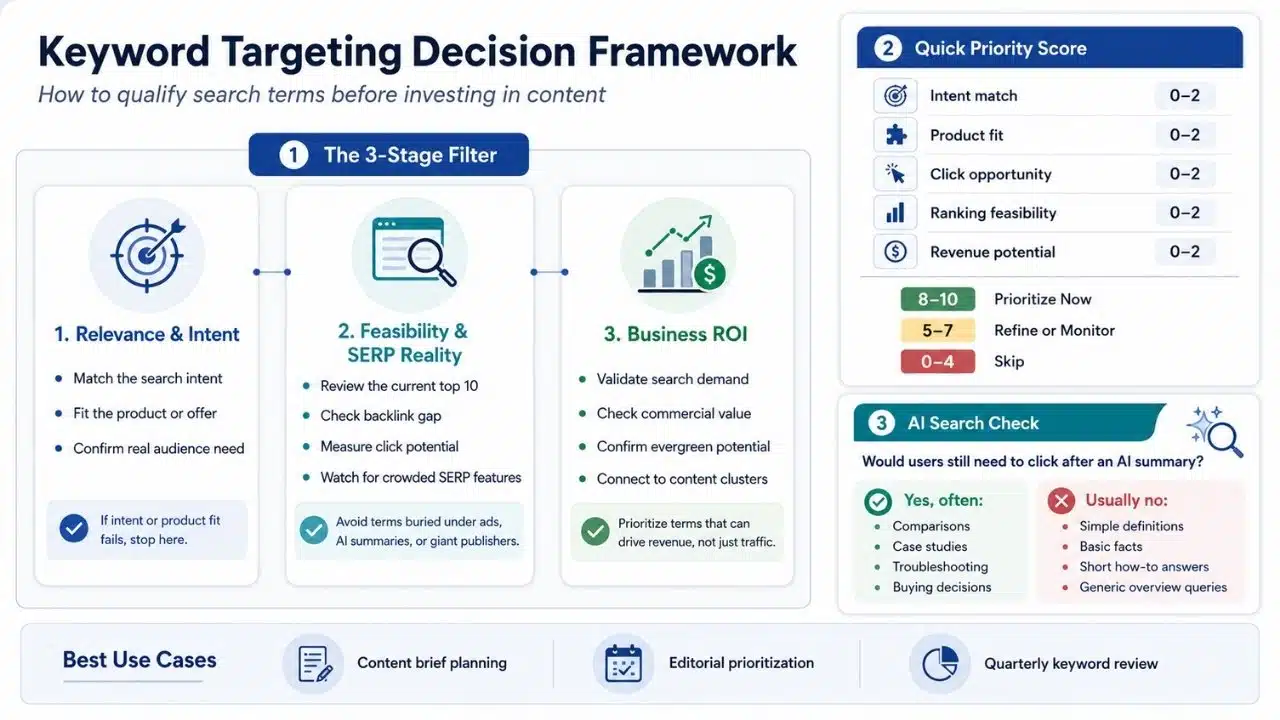
When running through these evaluation criteria, follow a three-stage filtering process:
-
Stage 1 (Relevance & Intent): Filter out any terms that do not align with your product or user intent. If intent mismatches, discard the keyword immediately.
-
Stage 2 (Feasibility & Authority): Assess SERP competition, required backlinks, and SERP feature crowding. Eliminate terms where competing domain authority is unreachable within your current budget.
-
Stage 3 (Business ROI): Rank the remaining viable terms by search volume, CPC, and conversion potential to build an execution roadmap.
Rethinking Keyword Research Questions in the Era of AI Search
Traditional search metrics are rapidly becoming vanity metrics. The uncomfortable reality facing modern SEO is that a high search volume score no longer guarantees organic traffic. As search engines deploy AI overviews directly at the top of the SERP, millions of informational queries now resolve without a single click to a third-party website.
Moving forward, evaluating keywords purely by volume and traditional difficulty scores will lead to wasted investments. Strategy must shift toward asking whether a keyword possesses “AI-resistant” intent. Terms requiring subjective human analysis, proprietary case studies, complex troubleshooting, or high-friction transactional decisions will continue to drive real website visits. If an AI summary can completely answer your target query in two paragraphs, ranking number one for that term may ultimately yield near-zero business value.
Frequently Asked Questions (FAQs) About Keyword Research Questions
Why are keyword research questions important before creating content?
Asking structured evaluation questions prevents teams from wasting resources on terms that are over-competitive or lack buyer intent. It aligns content creation directly with measurable business metrics rather than vanity traffic numbers.
How do AI overviews impact standard keyword metrics?
AI overviews satisfy informational queries directly on the results page, causing organic click-through rates to drop significantly for generic terms. Marketers must look beyond search volume and evaluate whether a query will generate actual website visits.
How do I know if a keyword is too competitive for my website?
Compare your website’s domain authority and backlink metrics against the top five ranking pages on the SERP. If competing pages hold significantly higher authority and established topical coverage, the keyword may require unrealistic link-building resources to rank.
What is the difference between search volume and business value?
Search volume indicates total monthly queries, whereas business value measures how effectively those queries drive revenue or conversions. High-volume terms often attract casual browsing, while lower-volume phrases frequently carry high commercial intent.
How often should teams re-evaluate their target keywords?
Keyword performance and SERP dynamics should be re-evaluated quarterly or whenever search engine layout updates occur. Shifts in competitor strategy, AI features, or user search habits can alter ranking difficulty and traffic potential rapidly.