
SaaS is still growing, but buyers have become far more selective about where they spend. Companies are removing overlapping apps, questioning automatic renewals and asking vendors to prove that their software saves time, lowers risk or produces revenue.
That has not stopped the market from expanding. Gartner’s July 2026 forecast puts worldwide software spending at roughly $1.47 trillion for the year, up 15.5% from 2025. Zylo’s 2026 SaaS Management Index tells the more interesting story: the average company’s app count was almost flat, yet overall SaaS spending rose 8% and spending on AI-native applications increased 108%.
In other words, businesses are not simply collecting more tools. They are concentrating money in a smaller set of categories with clearer operational value.
There is no universal database that measures every SaaS category on identical terms. Some of the best available evidence tracks enterprise spending, some tracks adoption and some comes from public company results. I found it more honest to compare those signals than to manufacture a precise league table from incompatible numbers. The fastest-growing saas categories below are numbered for reading order, not presented as a mathematically exact ranking.
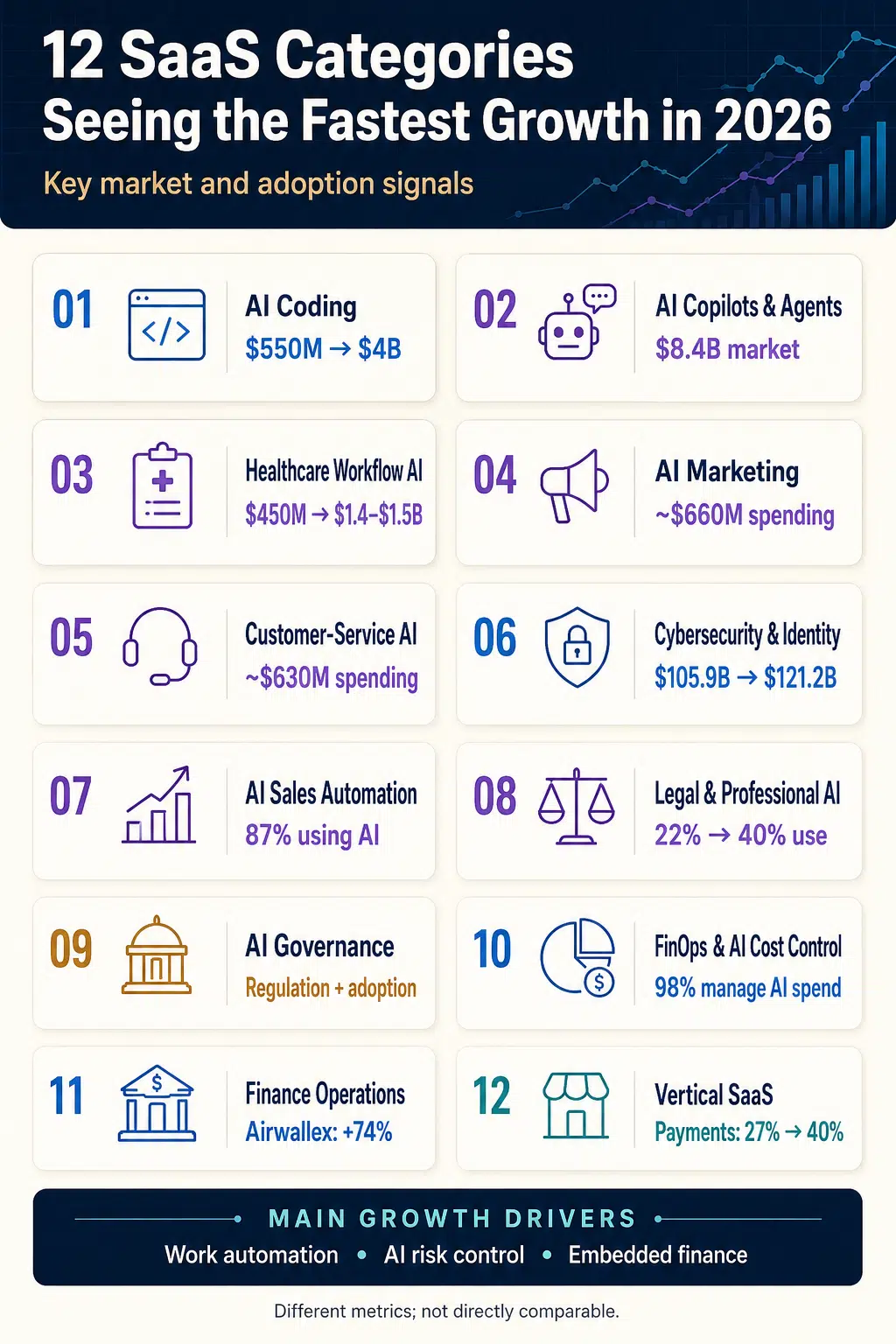
1. AI Coding and Software Engineering
AI coding has the strongest documented claim to being the fastest-growing application software category right now.
Menlo Ventures’ 2025 enterprise AI study estimates that spending on AI coding products rose from about $550 million in 2024 to $4 billion in 2025, more than sevenfold in one year. Code-completion tools represented roughly $2.3 billion of that market, while coding agents and AI app builders grew rapidly from smaller bases.
The category now extends well beyond autocomplete. Products can generate and review code, edit across repositories, write tests, investigate incidents, refactor older systems and help manage deployments.
The appeal is practical: engineering teams can measure whether a tool shortens development cycles, clears backlogs or reduces repetitive work. Developers can also adopt useful products individually before a company signs an enterprise contract, creating strong bottom-up demand.
Basic code generation is already becoming a commodity, though. The more defensible products understand an entire codebase, fit into existing development systems, protect proprietary code and complete multi-step work reliably.
2. Enterprise AI Copilots and Agent Platforms
General-purpose copilots have already become a substantial software market. Menlo Ventures estimates that horizontal AI application spending reached $8.4 billion in 2025, about 5.3 times its 2024 level. Copilots accounted for roughly $7.2 billion, while agent platforms represented about $750 million.
That gap is important. Copilots are widely used for writing, research, summarization, meeting notes and knowledge retrieval. Agents that can act across multiple business systems are promising, but much less mature.
Okta’s 2026 business technology research found that 82% of organizations described their AI-agent adoption as limited or moderate. Governance and identity management were leading concerns. That matches what I would expect at this stage: companies like the potential of agents, but they are cautious about permissions, data exposure, errors, unpredictable usage costs and accountability.
The next phase of growth will come from products that do more than answer questions. Buyers want agents that complete a defined workflow, show what they changed, follow company policy and involve a person when confidence is low.
3. Healthcare Workflow AI
Healthcare is the largest vertical AI market in the available enterprise spending estimates.
Menlo Ventures’ enterprise and healthcare analyses place 2025 spending at roughly $1.4 billion to $1.5 billion, up from about $450 million in 2024. The small range reflects differences in scope and rounding, but both estimates point to approximately threefold growth.
The commercial opportunity is not mainly an “AI doctor.” Most current demand concerns administrative and clinical-adjacent work. Ambient documentation products, which turn a clinician-patient conversation into a draft note—accounted for about $600 million in 2025 and grew roughly 2.4 times.
Other active areas include medical coding, scheduling, patient communication, claims processing, revenue-cycle management and clinical information retrieval.
The value proposition is unusually clear because paperwork consumes expensive clinical time. The constraints are equally real. Products must integrate with health-record systems, protect sensitive data and produce work that clinicians can verify. Long procurement cycles also mean that market interest may turn into recognized revenue slowly.
4. AI Marketing and Creative Operations
Enterprise spending on AI marketing products reached an estimated $660 million in 2025, according to Menlo Ventures. It sits within a broader departmental AI market that grew more than fourfold to $7.3 billion.
This category covers much more than text generators. Marketing teams now use AI to create campaign variations, produce images and video, localize content, personalize offers, organize brand assets and analyze performance.
Demand is growing because teams need more creative variations for more channels, often without larger budgets. AI can compress that production cycle considerably.
Still, this is where I would be careful not to confuse rapid adoption with a durable competitive advantage. A basic writing, image or video feature can be copied or added to a larger platform. The stronger products connect content creation to brand rules, approval workflows, rights management, publishing and performance data. They own a repeatable process rather than a prompt box.
5. Customer-Service and Conversational AI
AI customer-success products attracted an estimated $630 million in enterprise spending in 2025. Salesforce’s service research provides a separate adoption signal: it reported that AI resolved about 30% of service cases in 2025, with service teams expecting the share to reach 50% by 2027.
The category includes chat and voice agents, ticket routing, conversation summaries, knowledge retrieval, quality monitoring and real-time assistance for human representatives.
Customer service is a natural target for automation because support teams handle large volumes of repeated requests. A capable system can explain a charge, locate an order, update an account and recognize when a person needs to take over.
Ticket deflection alone is a poor measure of success. A system that keeps customers away from human help while failing to resolve their problem is not efficient; it is frustrating. The meaningful measures are resolution quality, escalation accuracy, customer satisfaction and cost per completed case.
6. Cybersecurity, Identity and Endpoint Management
Cybersecurity lacks AI coding’s dramatic percentage growth, but it is expanding from a much larger base. That makes it one of the most dependable categories on this list.
Gartner forecasts worldwide security software spending to rise from about $105.9 billion in 2025 to $121.2 billion in 2026, an increase of roughly 14.4%. Cloud security, identity protection, application security and endpoint management are among the main drivers.
AI is adding to the workload. Employees are connecting new tools to company data, attackers can use AI to scale their activity and autonomous agents create non-human identities that require carefully limited permissions.
Okta found that access requests increased more than twelvefold over two years. Its research also showed that 78% of organizations were concerned about permissions for non-human identities, while only 10% had a strategy for managing them.
The strongest opportunities are likely to include cloud protection, identity threat detection, privileged access, API security, data security and control of service accounts and AI agents.
7. AI Sales Intelligence and Revenue Automation
Traditional CRM is not suddenly a hypergrowth category. The faster-moving opportunity is the AI action layer being built around it.
In Salesforce’s 2026 State of Sales research, 87% of sales organizations said they used some form of AI. More than half of sellers had used AI agents, and nearly nine in ten expected to use them by 2027. Those figures measure adoption rather than category revenue, but they show how quickly AI is entering sales workflows.
Useful products research accounts, enrich incomplete records, identify buying signals, summarize calls, prioritize leads and help personalize outreach. They often draw from websites, email and external data that never made it into the CRM.
The danger is easy to see: careless automation can flood prospects with generic or inaccurate messages. Data quality, privacy and email deliverability can turn a promising product into a liability. Lasting vendors will show that they improve qualified pipeline, conversion or win rates, not merely the number of messages sent.
8. Legal and Professional-Services AI
Legal AI grew into an estimated $650 million market in 2025. Adoption is also rising across tax, accounting, risk and government work.
Thomson Reuters’ 2026 professional-services study found that organization-wide AI use increased from 22% in 2025 to 40% in 2026. Fifteen percent of participating organizations had adopted agentic AI, while another 53% were planning or considering it.
These products assist with legal research, document review, contract analysis, drafting, matter summaries, tax research and internal knowledge retrieval. The workflows are text-heavy and expensive, so even a modest time saving can be valuable.
The weak spot is proof of return. Only 18% of respondents in the Thomson Reuters study said their organization tracked AI ROI. Usage is rising faster than rigorous measurement.
This work also leaves little room for confident errors. Successful products need trustworthy source material, visible references within the product, strong confidentiality controls and a review process that leaves a qualified professional responsible for the final work.
9. AI Governance, Compliance and Model-Risk Software
As organizations deploy more AI, they need to know which systems are in use, what data those systems can access, how outputs are tested and who is responsible when something goes wrong. That operational burden is turning AI governance into a distinct SaaS category.
The software helps businesses inventory AI systems, classify risks, evaluate model behavior, log activity, enforce policies, document human oversight and prepare audit records.
Regulation is adding urgency. Under the European Union’s current AI Act timeline, transparency rules for certain AI systems began applying on August 2, 2026. Some high-risk requirements were moved to late 2027 and 2028, giving affected businesses more preparation time rather than removing the need for controls.
There is not yet a clean, authoritative growth rate for this entire category, so it would be misleading to invent one. The demand signal is nevertheless strong: model usage is spreading faster than most companies’ ability to govern it. Even when a business changes models or vendors, it still needs consistent policies, risk assessments and evidence of oversight.
10. FinOps, SaaS Management and AI Cost Control
FinOps started as a discipline for understanding and optimizing cloud-infrastructure costs. It now covers SaaS subscriptions, software licenses, private infrastructure and AI usage.
The FinOps Foundation’s 2026 survey included 1,192 respondents representing more than $83 billion in cloud spending. Among participating practices, 98% said they managed AI spending, up from 63% a year earlier. Ninety percent managed SaaS or planned to do so, compared with 65% in the previous survey.
This expansion makes sense because AI disrupts the predictability of a conventional per-seat subscription. A company may pay for tokens, model calls, generated minutes, completed tasks or several of those at once. A small change in user behavior can create a surprisingly large bill.
The growing software layer covers application discovery, license optimization, renewal management, AI usage tracking, cost allocation, forecasting and unit-economics reporting.
For buyers, the useful question is no longer just, “How much did we spend?” It is, “Which team and workflow created the cost, and was the result worth it?”
11. Finance Operations, Payments and Spend Management
Finance teams are replacing separate tools for cards, expenses, bills, payments and accounting with broader platforms. Several newer providers are reporting strong growth.
Airwallex said its annualized revenue reached $1.3 billion in March 2026, up 74% year over year. Brex reported 80% growth in its enterprise business in early 2025. More mature provider BILL recorded 13% total revenue growth and 16% core revenue growth for its 2026 fiscal year.
These are company results, not a single category-wide growth rate, and the variation is useful. It shows both strong demand and the fact that not every provider is expanding at the same pace.
It is also inaccurate to call all of this SaaS revenue. Finance platforms can earn money from subscriptions, transactions, card interchange, payment volume and interest. Their results still matter because they reveal demand for integrated financial operations, but total revenue should not be confused with recurring software subscriptions.
The best-positioned products combine spend controls, accounts payable, expense management, payments, accounting automation and real-time financial visibility in one system.
12. Vertical Operations SaaS With Embedded Finance
Vertical SaaS is built for the workflows of a particular industry, such as construction, restaurants, medical practices, logistics, property management or home services.
The current generation of platforms goes beyond scheduling and record keeping. It adds payments, payroll, lending, procurement, insurance and AI automation around the core workflow.
Stripe’s 2026 vertical SaaS benchmark, produced with Tidemark, found that median adoption of embedded payments rose from 27% in 2024 to 40% in 2025. Multiproduct platforms grew revenue 49% faster than software-only peers, while platforms with embedded financial products recorded 11% lower annual churn.
Public company results support the broader signal. ServiceTitan, which serves trade contractors, grew platform revenue by 25% in its 2026 fiscal year and increased active customers from about 9,500 to 10,800.
What stands out to me is the durability of this model. A generic feature can be copied. A platform that sits inside an industry’s daily operation, stores years of workflow data and processes payments is much harder to remove.
What These Growth Signals Really Mean
The fastest expansion is happening where software moves from storing information to completing work. That shift explains the momentum behind coding agents, healthcare documentation, customer-service automation and sales intelligence.
AI also creates secondary markets around itself. More models and agents mean more identities to secure, more costs to allocate and more decisions to govern. Cybersecurity, AI governance and FinOps may therefore capture some of the most durable value from the AI cycle, even though they attract less attention than the applications users see.
Finally, workflow depth matters more than novelty. Vertical and finance platforms grow by becoming part of how a business operates, not by adding AI to a feature list. They combine software, data, payments and process knowledge in ways that raise switching costs and make value easier to measure.
Fast growth alone does not guarantee a good business. Creative AI can expand quickly while facing low switching costs. Security can grow more steadily while solving a problem customers cannot ignore. Retention, margins and measurable customer outcomes still matter more than a spectacular headline percentage.
Frequently Asked Questions on the Fastest-Growing SaaS Categories
1. What is the fastest-growing SaaS category in 2026?
AI coding has the strongest documented application-level growth signal. Estimated enterprise spending rose from about $550 million in 2024 to $4 billion in 2025. Enterprise copilots are a larger market, but their percentage growth was lower.
2. Is SaaS still growing in 2026?
Yes. Gartner forecasts worldwide software spending to grow 15.5% in 2026. The market is becoming more concentrated, though: companies are cutting redundant apps while directing more money toward AI, security, cost control and specialized operational platforms.
3. Why is AI driving so much SaaS growth?
AI lets software generate work, make recommendations and carry out tasks rather than simply record information. That creates measurable value in coding, support, healthcare and other labor-intensive workflows. It also produces new demand for security, governance and cost-management tools.
4. Will AI agents replace traditional SaaS products?
Not in the near term. Businesses still need reliable systems of record, permissions, integrations and audit trails. Agents are more likely to become an interface and action layer across those systems, although some standalone apps may be absorbed into larger platforms.
5. Which fast-growing SaaS categories look most durable?
Cybersecurity, healthcare administration, FinOps and deeply embedded vertical platforms have especially durable demand because they address persistent operational needs. AI coding and agent platforms also have major potential, but individual vendors will need reliable outcomes and defensible workflow advantages to last.