Unmanaged software subscriptions drain corporate budgets through redundant licenses, unused accounts, and automatic contract renewals. Implementing structured procurement controls and routine audit frameworks allows finance and IT leaders to cut company saas spend while improving operational visibility across all departments.
| Cost-Reduction Strategy | Implementation Effort | Potential Savings | Primary Focus Area |
| 1. Unused License Auditing | Low | 15% to 30% | Reclaiming idle seats and zombie accounts |
| 2. Duplicate App Elimination | Medium | 10% to 20% | Consolidating overlapping functional tools |
| 3. Contract Benchmark Negotiation | High | 15% to 25% | Securing competitive pricing before renewals |
| 4. Shadow IT Centralization | Medium | 10% to 15% | Eliminating unauthorized department purchases |
| 5. Tier Rightsizing | Low | 5% to 15% | Downgrading over-provisioned enterprise plans |
| 6. Renewal Window Planning | Medium | 10% to 20% | Reviewing vendor contracts 90 days in advance |
| 7. Multi-Year Contract Locking | Low | 10% to 30% | Securing fixed multi-year volume discounts |
| 8. Single Sign-On (SSO) Tracking | Medium | 10% to 15% | Monitoring active app usage via SAML logs |
| 9. Payment Term Restructuring | Low | 5% to 10% | Switching monthly billing to annual prepayments |
| 10. Vendor Feature Bundling | High | 10% to 25% | Replacing single-point tools with platform features |
10 Actionable Strategies to Cut Company SaaS Spend
1. Audit Unused Licenses and Offboard Zombie Accounts
A significant portion of software waste stems from active licenses assigned to former employees or inactive team members. Finance and IT teams should conduct quarterly seat usage audits to identify accounts without logins over the past 30 days. Reclaiming or reassigning these idle seats immediately stops recurring per-user charges without impacting productivity.
2. Consolidate Duplicate Software Applications
Departments frequently purchase separate tools that serve identical functions, such as multiple project management apps or video conferencing platforms. Mapping out functional capabilities across every department reveals duplicate tools. Standardizing on a single enterprise platform reduces total subscription fees and grants procurement teams stronger leverage for volume discounts.
3. Benchmark Vendor Pricing Prior to Contract Renewals
Entering contract renewal negotiations without external pricing data leaves companies at a disadvantage. Finance teams should research market benchmarks to see what comparable organizations pay for identical seat counts. Utilizing established technology governance practices ensures procurement managers enter vendor meetings armed with competitive rate data rather than accepting standard annual price hikes.
4. Centralize SaaS Procurement to Eliminate Shadow IT
When individual department heads use corporate credit cards to purchase software without IT oversight, hidden costs accumulate rapidly. Aligning team spending with established corporate cost management frameworks ensures every new tool complies with security standards and budget allocations while preventing duplicate functionality.
5. Rightsize License Tiers to Match Actual Feature Usage
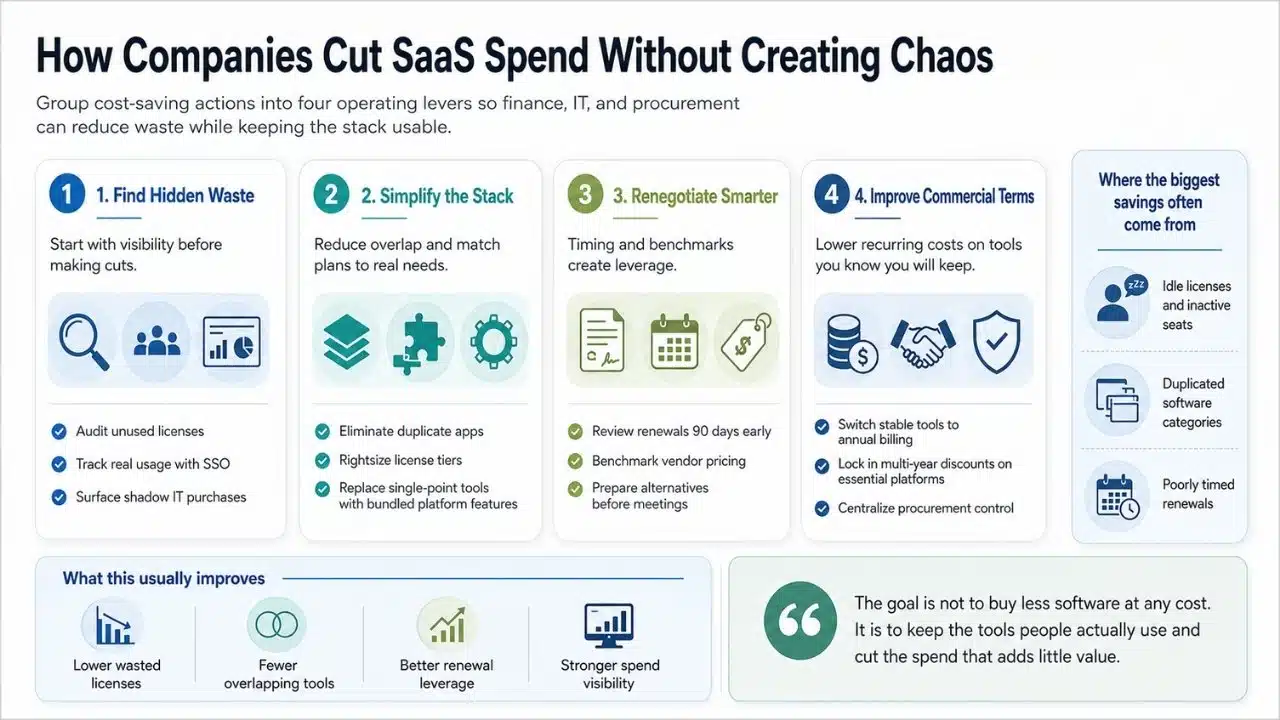
Software vendo rs often upsell organizations to top-tier enterprise plans containing advanced features that employees never use. Reviewing user permission requirements often reveals that a vast majority of staff only require basic or intermediate feature tiers. Downgrading non-admin users to standard licenses delivers immediate per-seat cost reductions.
6. Establish a 90-Day Renewal Management Timeline
Waiting until a week before a contract renews eliminates negotiating leverage, making auto-renewals at higher rates almost inevitable. Establishing a formal tracking system that flags renewals 90 days in advance gives procurement teams sufficient time to evaluate alternative vendors, gather internal usage metrics, and negotiate favorable commercial terms.
7. Commit to Multi-Year Agreements on Essential Tools
For core operational platforms that the company intends to keep long term, switching from annual to multi-year contracts can unlock significant volume discounts. Ensure multi-year agreements include strict price-cap clauses to prevent sudden price hikes when the renewal term expires.
8. Implement Single Sign-On (SSO) to Track True Usage
Relying on self-reported employee app usage is notoriously inaccurate. Routing application access through a central Single Sign-On platform gives IT administrators real-time visibility into exact usage frequency, enabling data-driven decisions when evaluating enterprise software spending across departments.
9. Shift High-Usage Tools From Monthly to Annual Billing
Monthly billing cycles often carry a 15 to 20 percent premium compared to annualized payments. For critical, long-term tools where churn risk is non-existent, converting from monthly recurring billing to annual prepayments yields instant cost savings across the software stack.
10. Maximize Core Platform Feature Bundling
Major cloud providers continually expand their native feature sets to include capabilities previously offered only by niche single-point solutions. Analyzing core enterprise platforms (such as primary productivity suites) often reveals built-in tools that can replace standalone third-party subscriptions for e-signatures, messaging, or cloud storage.
Successfully optimizing software costs requires continuous governance rather than a one-time audit. Finance and IT leaders should begin by establishing a centralized software inventory, enforcing Single Sign-On tracking, and setting up automated 90-day renewal alerts for all top-tier vendor contracts.
Establishing Sustainable SaaS Cost Governance
Reducing software waste requires shifting from reactive cost-cutting to proactive software governance. By auditing inactive accounts, consolidating redundant applications, and benchmarking vendor renewals 90 days in advance, finance and IT leaders can significantly cut company saas spend without compromising team productivity or operational momentum. Establishing a centralized procurement process ensures your organization maintains complete visibility over software subscriptions, protecting corporate margins as your technology stack continues to scale.
Frequently Asked Questions About How to Cut Company SaaS Spend
What is the fastest way to cut company saas spend?
The fastest strategy is auditing inactive accounts and zombie licenses. Identifying ex-employee logins and accounts that have remained idle for over 30 days allows companies to reclaim or terminate licenses immediately without disrupting ongoing operations.
How far in advance should companies prepare for SaaS renewals?
Organizations should initiate contract review procedures at least 90 days prior to the official renewal date. This timeline provides adequate leverage to evaluate market benchmarks, conduct usage reviews, and credibly threaten vendor replacement if pricing demands are unreasonable.
What is shadow IT and how does it inflate software budgets?
Shadow IT refers to software purchased by individual employees or team leads without IT or procurement approval. It inflates budgets by introducing unmonitored expense reimbursements, duplicate app functionality across teams, and missed opportunities for enterprise volume pricing.