
When founders ask whether they should pitch institutional investors or fund their own growth, here’s my solution: default to bootstrapping. I have watched too many solid software companies get derailed by taking venture checks before they were ready. Institutional cash is a powerful accelerator, but taking it too early creates structural pressures that can destroy a business that would have otherwise been wildly profitable.
The Structural Realities of Institutional Capital
Taking venture capital shifts your company onto a high-risk trajectory. A VC fund needs outlier returns to satisfy its limited partners. That means building a stable $10 million software business that pays dividends to its founders is considered a failure in their model. The system is designed to push for a $100 million valuation or a write-off.
When you take institutional money prematurely, your governance dynamic changes instantly. You trade away board control long before you have figured out a predictable sales engine. Your monthly burn rate spikes because your new cap table expects aggressive hiring and rapid top-line growth. Heavy early dilution also means a respectable $20 million acquisition down the road might leave the founding team with surprisingly little payout.
Capital cannot fix a weak distribution strategy. Injecting cash into an unproven go-to-market model just accelerates your burn rate.
Why Bootstrapping Builds Better Muscle Memory
Running lean is far easier today than it used to be. Modern API infrastructure and cloud tooling allow a team of five engineers to deploy systems that used to require a massive technical staff.
Bootstrapping forces operational discipline early on. When every dollar spent comes directly from customer contracts or your personal bank account, you quickly learn to prioritize features buyers actually pay for. You clean up your unit economics because there is no venture safety net to hide inefficient customer acquisition costs.
Maintaining full equity ownership also protects your strategic choices. You keep total authority over your roadmap, your hiring pace, and your exit timeline.
My $1M ARR Line in the Sand
My perspective on bootstrapping vs VC for SaaS growth comes down to a clear operational benchmark: avoid investor meetings until you hit $500,000 to $1,000,000 in Annual Recurring Revenue on your own momentum.
Reaching $1 million in ARR gives you undeniable proof across three critical areas:
-
Real market demand: Customers are actively paying for your software to solve a specific business problem.
-
Distribution momentum: You have unlocked at least one reliable customer acquisition channel rather than relying on random word-of-mouth.
-
Healthy retention: Churn is low enough that new revenue stays in the business rather than leaking out.
Crossing this threshold completely flips the dynamic in pitch meetings. You are no longer asking for emergency funding to keep the lights on. Instead, you are offering an investor the opportunity to participate in a proven, cash-generating business. That leverage translates directly into higher valuations, cleaner term sheets, and founder-friendly board structures.
What Premature Scaling Actually Looks Like
In my years advising and analyzing SaaS growth trajectories, the pattern is consistent. Taking institutional capital before dialing in your core unit economics rarely fixes operational flaws. It amplifies them.
The software landscape is littered with both high-profile cautionary tales and repeating structural traps where cash reserves outpaced actual market traction.
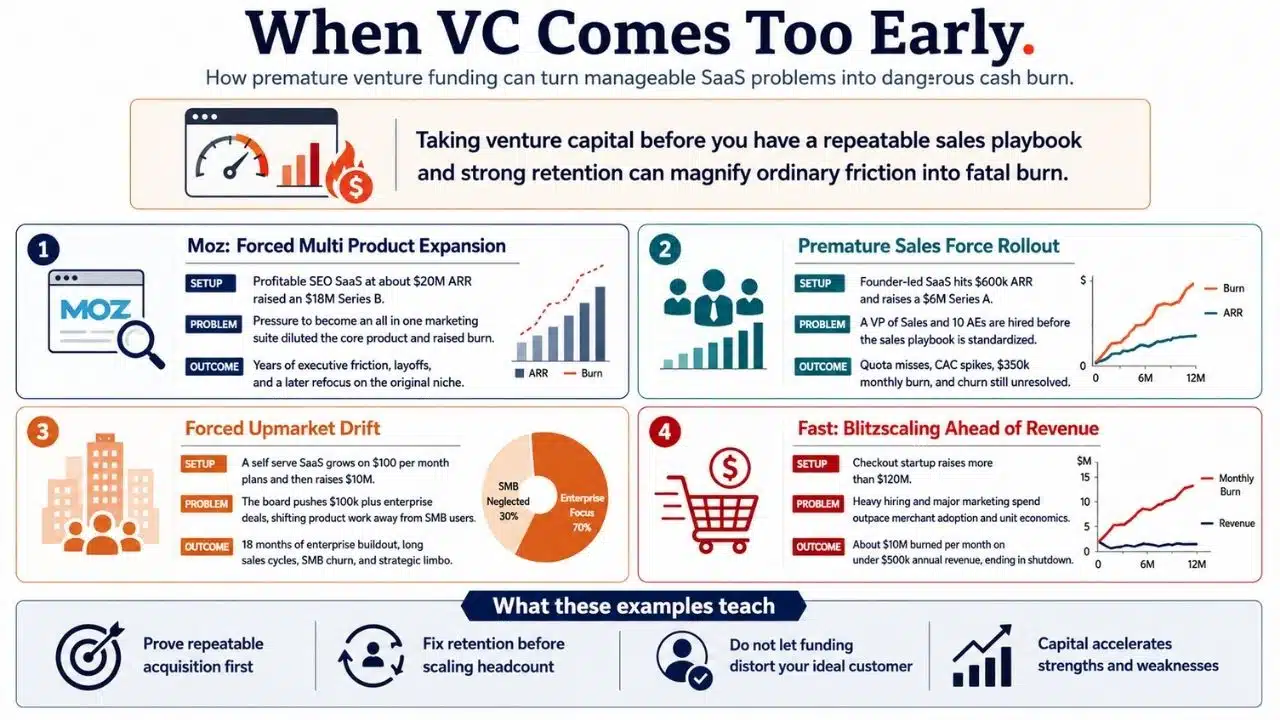
Moz (The Multi-Product Complexity Trap)
Before taking major institutional capital, Moz built a wildly successful, profitable SEO software business that reached roughly $21.9 million in subscription revenue in 2012.
After closing an $18 million Series B, leadership pursued faster, venture-scale growth by expanding into a broader portfolio covering content, social, local search, and analytics. As founder Rand Fishkin later noted, the growth pressure was largely structural to the VC model.
Following another $10 million round in 2016 to accelerate this multi-product push, spending outpaced revenue growth. Moz ultimately had to lay off roughly 28% of its workforce and refocus strictly on its core search products.
Fast (Scaling Headcount Ahead of Traction)
One-click checkout startup Fast raised around $124 million in venture funding, including roughly $102 million Series B in 2021. They expanded aggressively, growing to over 400 employees and signing high-profile marketing deals.
However, reporting from The Information and TechCrunch revealed that Fast generated only about $600,000 in 2021 revenue while burning roughly $10 million per month.
When follow-on financing failed to materialize, the company shut down entirely in April 2022. It stands as a stark lesson in what happens when burn rate outruns commercial reality.
Illustrative Scenario: Premature Sales Hiring
I regularly see developer-focused SaaS companies reach $600,000 ARR through founder-led sales and immediately raise a $6 million Series A.
Pressured by VC expectations to triple ARR annually, leadership hires a VP of Sales and ten Account Executives before establishing a repeatable sales playbook.
Reps miss quota, Customer Acquisition Cost (CAC) skyrockets, and the business burns $350,000 a month without resolving its underlying product-market fit or churn issues.
Illustrative Scenario: Forced Upmarket Shift
Consider a product-led SaaS business with a thriving user base paying $100 per month on self-serve plans. Upon closing a $10 million venture round, structural targets push executive leadership to hunt $100,000 enterprise contracts.
The engineering team spends 18 months building complex compliance frameworks and custom integrations, neglecting the core self-serve tool.
Long 14-month sales cycles stall out, core SMB users churn due to product neglect, and the business gets caught in a cash trap between two incompatible models.
Weighing the Trade-Offs
Evaluating bootstrapping vs VC for SaaS requires looking closely at how each path impacts your daily operations:
-
Growth speed and focus: Bootstrapping prioritizes healthy net cash flow, retention, and sustainable 20% to 50% year-over-year growth. Venture funding demands rapid 100%+ annual expansion to hit the metrics required for follow-on rounds.
-
Equity and governance: Bootstrapped founders retain majority control and full operational authority. Raising VC means giving up board seats, taking on liquidation preferences, and diluting your equity stake with every raise.
-
Risk exposure: The bootstrapped route keeps your burn rate tight and downside risk low, though your initial growth may be slower. The venture-backed path offers deep capital reserves, but carries a high failure rate if your growth trajectory stalls out.
Final Thoughts
Deciding how to fund your software startup will dictate your daily life for the next decade. Venture capital makes sense if you are building in a winner-take-all market with massive upfront infrastructure expenses. For the vast majority of modern B2B SaaS products, bootstrapping to $1 million ARR gives you the leverage needed to build a lasting business on your own terms.