| Use Case | Primary Data Source | Business Objective | Core Benefit |
|---|---|---|---|
| 1. Brand Reputation & PR | Social media, forums, news | Monitor brand perception & crisis signals | Early detection of PR crises |
| 2. Customer Support & Churn | Support tickets, chat logs, calls | Prioritize tickets by frustration levels | Reduced churn & faster resolution times |
| 3. Voice of Customer (VoC) | NPS surveys, open-ended reviews | Understand deep emotional sentiment | Unbiased feedback analysis at scale |
| 4. Product Roadmap Planning | Feature requests, app store reviews | Aspect-based feature evaluation | Data-driven feature prioritization |
| 5. Competitive Intelligence | Competitor reviews & mentions | Benchmark brand perception vs. rivals | Uncover market gaps and competitor flaws |
| 6. Marketing Campaign Tuning | Ad comments, campaign replies | Measure emotional resonance of messaging | Optimize ad spend before overcommitting |
| 7. Sales Call Intelligence | Call recordings, CRM transcripts | Evaluate buyer hesitation & interest | Higher deal win rates & refined pitches |
| 8. Financial Market Analysis | Financial news, earnings calls | Gauge market mood and stock trends | Informed investment & risk decisions |
8 Key Applications of Sentiment Analysis for Business
1. Real-Time Brand Reputation and PR Crisis Management
Online brand perception shifts instantly. By monitoring social media mentions, blog comments, and news feeds, sentiment analysis algorithms categorize brand conversations into positive, neutral, or negative categories. When negative sentiment spikes around a product launch or policy change, PR and communications teams receive automated alerts to address issues before they escalate into full-scale public relations crises.
2. Automated Support Ticket Routing and Churn Prevention
Customer support queues are traditionally prioritized by submission time or account tier. Integrating sentiment analysis into helpdesk systems allows AI to evaluate the emotional intensity of incoming support tickets. Tickets exhibiting high levels of frustration or threat of cancellation are immediately escalated to specialized retention agents, directly lowering customer churn.
3. Voice of Customer (VoC) and Survey Analysis at Scale
Businesses collect thousands of open-ended survey responses, net promoter score (NPS) comments, and third-party reviews. Manually reading every response introduces reviewer bias and operational bottlenecks. Sentiment analysis processes millions of feedback words in seconds, converting qualitative verbatims into structured charts that highlight general satisfaction levels.
4. Aspect-Based Product Roadmap Prioritization
Aspect-based sentiment analysis goes beyond simple positive/negative labels by tying emotion to specific product attributes. For example, a mobile app review might praise its clean interface while criticizing slow load times. Product managers use this granular breakdown to fix bugs and build requested features without dismantling popular aspects of the application.
5. Competitive Intelligence and Market Positioning
Understanding how your brand ranks against competitors requires more than tracking market share. Applying sentiment analysis to competitor reviews, user forums, and social channels uncovers where rival products fail. Marketing teams leverage these insights to target market gaps where customer dissatisfaction with competitors is highest.
6. Optimizing Marketing Campaign Resonance
Launching an expensive advertising campaign without tracking audience sentiment risks brand misalignment. By monitoring early feedback, comment threads, and social sharing around campaign assets, marketing teams assess whether messaging evokes trust, humor, or skepticism. If sentiment tilts negative, teams adjust messaging midway through a campaign to protect marketing budgets and brand authority.
7. Sales Call Transcripts and Conversation Intelligence
Modern sales teams use automated speech-to-text combined with sentiment analysis to process call recordings and CRM notes. Algorithms detect changes in tone when pricing, specific competitors, or contract terms are discussed. Sales leaders analyze these micro-moments to coach reps on handling objections and improving conversion rates.
8. Financial Sentiment and Market Trend Forecasting
Financial institutions, equity analysts, and algorithms monitor news feeds, social trends, and earnings call transcripts to gauge market sentiment toward public companies. Positive shifts in public sentiment ahead of quarterly reports often signal strong consumer demand, helping traders make data-backed investment decisions.
What to Do Next
Identify your organization’s highest-volume text channel—whether support tickets, app reviews, or survey forms—and run a sample batch through an aspect-based sentiment tool to locate your biggest operational friction points.
Maximizing the Value of SaaS Founder Networks
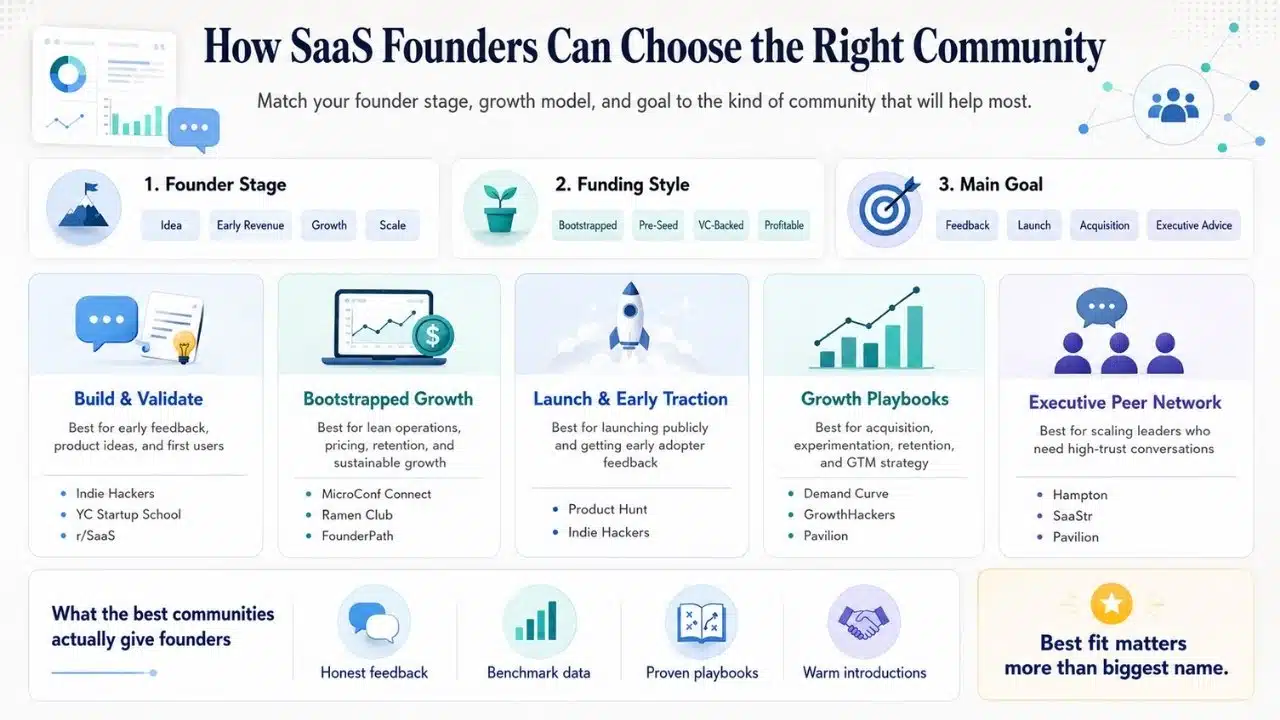
The true return on investment from joining a SaaS community comes down to consistent participation and honest peer exchange. While platforms like MicroConf, SaaStr, or Hampton provide immediate access to growth playbooks, lasting value is created by contributing your own operational insights, discussing real business challenges candidly, and building genuine relationships over time. Select one or two communities that align directly with your current ARR and funding model, engage regularly, and leverage collective founder wisdom to navigate scaling hurdles with confidence.
Frequently Asked Questions (FAQs) on Best Communities for SaaS Founders
How accurate is sentiment analysis for business data?
Modern AI models trained on transformer architectures achieve 80–90% accuracy on standard business text. Accuracy increases significantly when models are fine-tuned on industry-specific jargon, sarcasm, and regional slang.
What is the difference between general sentiment analysis and aspect-based sentiment analysis?
General sentiment analysis scores an entire document or review as positive, neutral, or negative. Aspect-based sentiment analysis breaks down individual sentences to evaluate specific features—such as praising pricing while criticizing customer service within the same review.
What tools do companies use to run sentiment analysis?
Businesses typically rely on all-in-one social listening tools (e.g., Sprinklr, Sprout Social), customer feedback analytics software (e.g., Thematic, Chattermill), or custom NLP libraries like spaCy, Hugging Face, and Google Cloud Natural Language API.