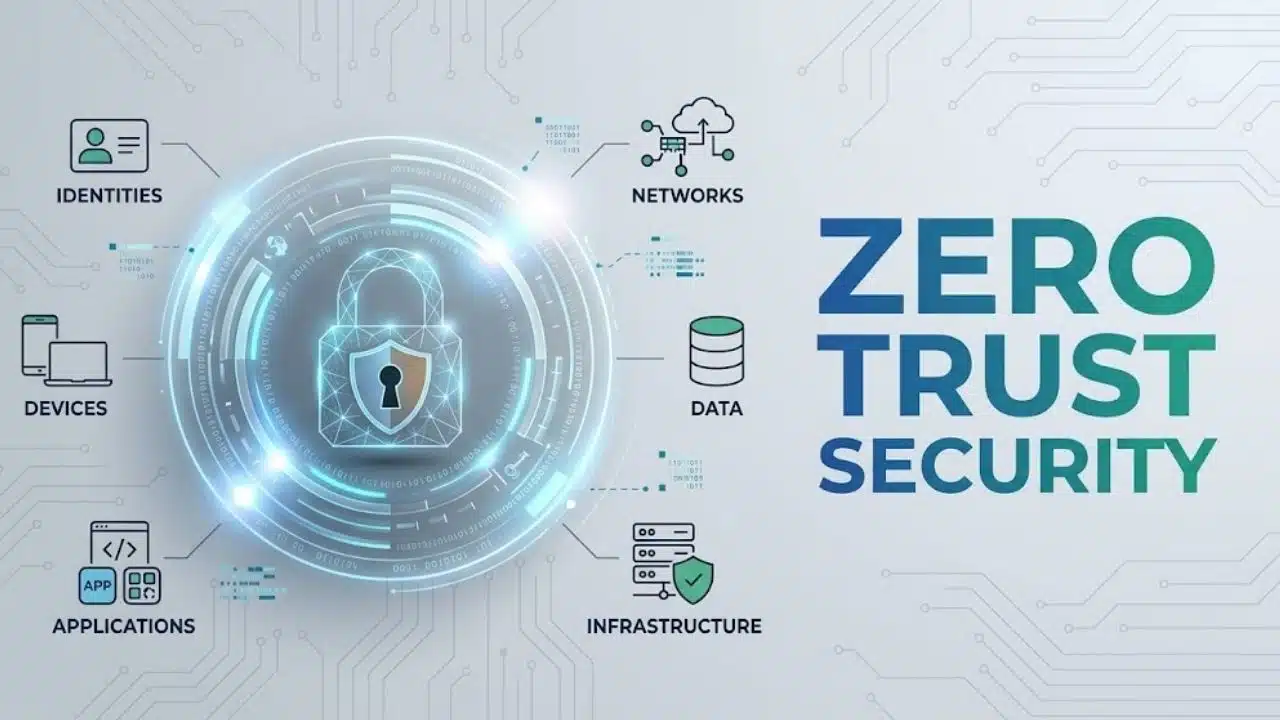
Zero Trust Security is an IT framework and operational model that eliminates implicit trust by requiring continuous, context-aware verification for every access request. Rather than assuming safety based on network location, company device ownership, or a successful initial login, Zero Trust treats every user, device, and connection as potentially compromised.
As enterprises expand across hybrid networks, cloud platforms, and remote workforces, a single valid login is often the start of a breach. Zero Trust Security mitigates this risk by enforcing strict least-privilege access, granular micro-segmentation, and real-time authentication. By continuously evaluating contextual risk signals, organizations limit lateral movement and secure critical systems across modern, distributed environments.
What Zero Trust Security Changes
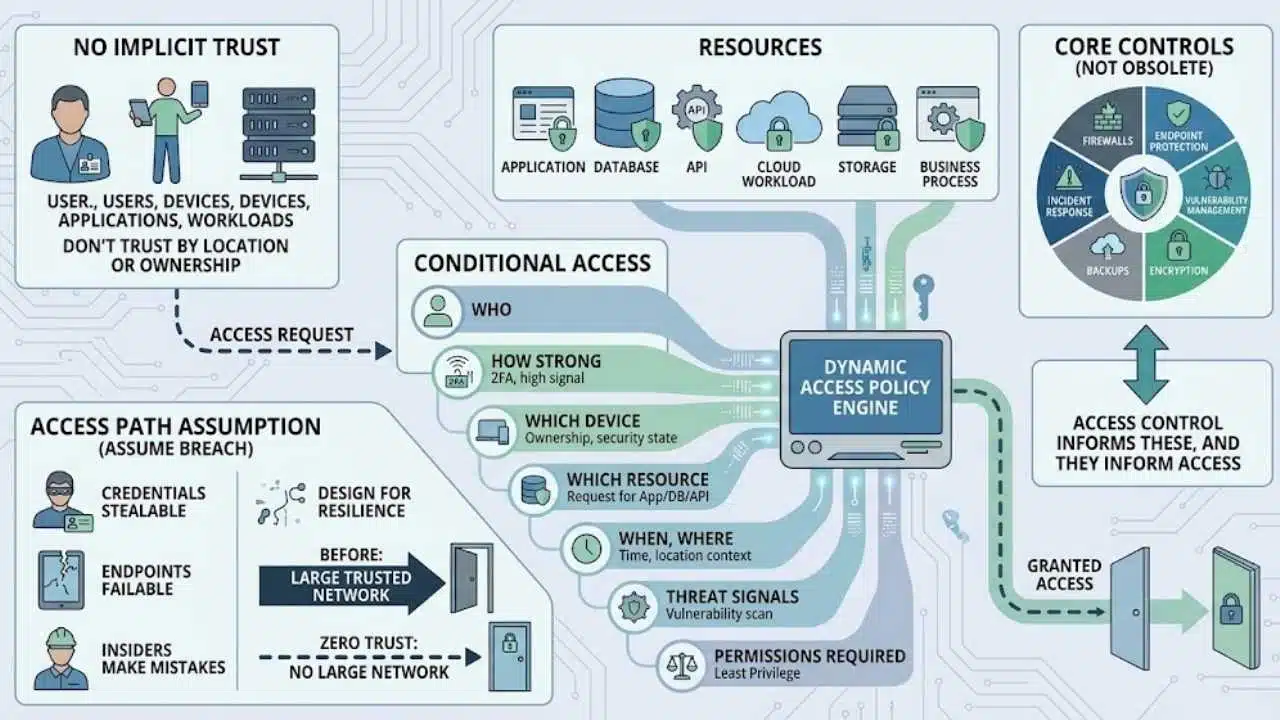
NIST defines zero trust around a central principle: users, devices, applications, and workloads should not receive implicit trust because of their location or ownership.
Access is granted to a particular resource under defined conditions. The decision may consider:
- The identity making the request
- Authentication strength
- Device ownership and security condition
- The application, service, or data being requested
- Time, location, and recent activity
- Known vulnerabilities or active threat signals
- The permissions required for the task
A resource could be an application, database, API, cloud workload, administrative console, storage service, or business process. Rather than admitting someone to a large trusted network, zero trust tries to place enforcement closer to the resource they actually need.
The phrase “assume breach” is often used to describe this position. It does not mean treating every employee as malicious or declaring every device infected. It means designing access paths on the assumption that credentials can be stolen, endpoints can fail, and trusted insiders can make mistakes.
Zero trust does not make firewalls, endpoint protection, vulnerability management, encryption, backups, or incident response obsolete. A company that neglects those controls will not rescue its security posture with conditional access policies. Zero trust changes how existing controls inform access and how much confidence any single signal can create.
How a Zero-Trust Access Decision Works
NIST’s reference architecture describes three central logical roles. The policy engine decides whether access should be granted, denied, restricted, or revoked. The policy administrator carries out that decision by establishing or terminating the connection. The policy enforcement point applies it between the user or system and the protected resource.
These roles do not have to be separate products. Depending on the design, enforcement might happen through an identity-aware proxy, application gateway, endpoint agent, firewall, API gateway, host control, or cloud access service.
Consider a payroll administrator requesting access to a finance application. The decision could examine the administrator’s role, authentication method, device-management status, encryption and patch condition, endpoint protection, location, and recent account activity.
A normal request from a compliant device may be approved. An unmanaged device might trigger stronger authentication or receive no access. Read-only access is possible only if the application or enforcement layer supports that distinction. Some older applications can grant or deny a session but cannot adjust permissions dynamically.
Continuous evaluation should not translate into constant authentication prompts. Many checks can happen through identity, endpoint, session, and network telemetry. Reauthentication or session termination becomes necessary when policy requires it and the supporting systems can act on the change.
The comparison below describes the architectural emphasis rather than every conventional enterprise network:
| Access Question | Perimeter-Led Pattern | Zero-Trust Emphasis |
| Does internal location create trust? | It may carry substantial weight | It is only one signal |
| What can a connection reach? | A network or subnet | A defined resource or small resource set |
| How long does access remain valid? | Often for the session | It can be reassessed |
| What informs the decision? | Credentials and network placement | Identity, device, resource, behavior, and risk |
| What follows a compromise? | Other internal paths may remain reachable | Granular controls restrict lateral movement |
Mature networks may already use segmentation and contextual access. Zero trust makes those restrictions an architectural default rather than an extra hardening step.
Why Companies Are Moving Toward Zero Trust
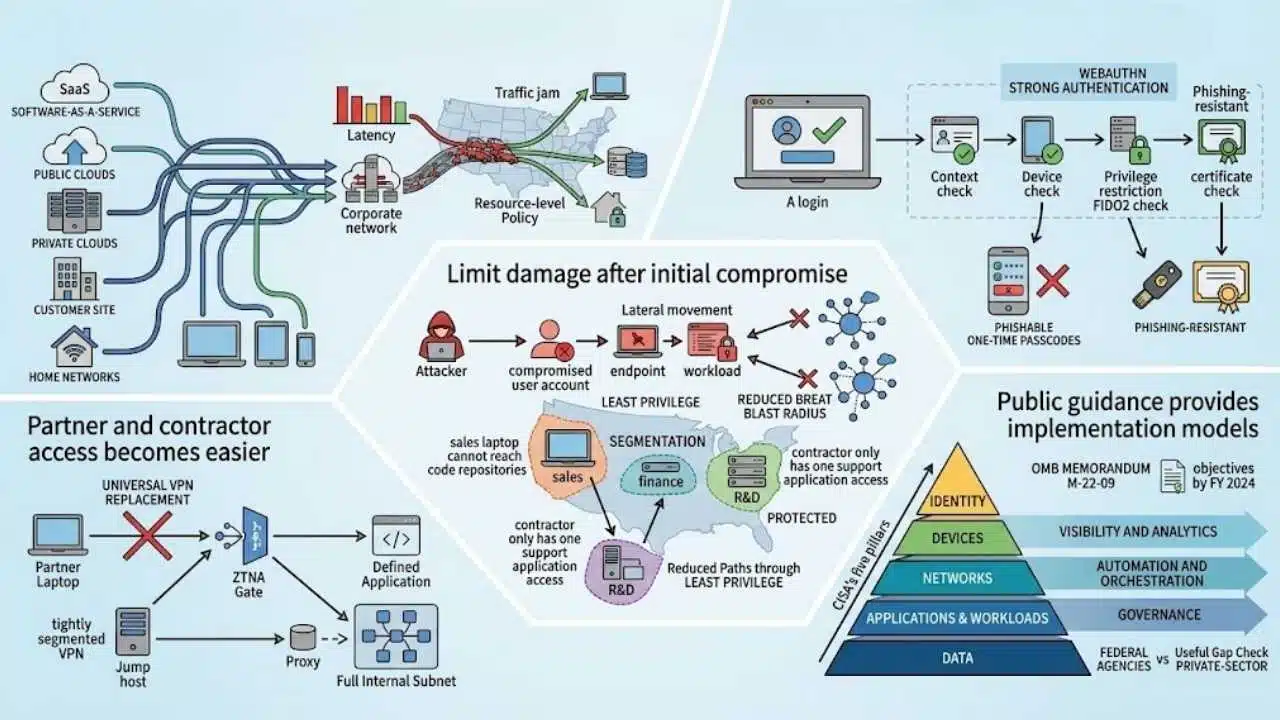
Organizations are shifting to Zero Trust Security to defend against sophisticated credential theft, compromised endpoints, and the collapse of traditional network perimeters. By enforcing strict least-privilege access and continuous contextual verification, Zero Trust stops lateral movement and reduces breach blast radiuses across hybrid and multi-cloud environments. Beyond mitigating cyber threats, this model satisfies stringent compliance mandates while enabling secure, frictionless productivity for globally distributed workforces.
The network perimeter no longer matches the business
Important resources now sit across software-as-a-service platforms, public clouds, private clouds, data centers, and partner environments. Employees may access them from an office one day and a customer site or home network the next.
Sending every connection back through a corporate network does not restore the old perimeter. It can add latency, complicate cloud access, and concentrate traffic around a few gateways. Resource-level policy fits distributed infrastructure more naturally.
Credentials alone provide weak assurance
Passwords, session tokens, API keys, and administrative credentials can all be stolen or misused. Strong authentication reduces the risk, but a successful login answers only one part of the access question.
Current NIST guidance recognizes WebAuthn, as used by FIDO2 authenticators, as a phishing-resistant method. Suitable certificate-based mechanisms can also provide phishing resistance. Manually entered one-time passcodes do not meet that standard because an attacker can relay them to the real service.
Privileged and high-impact roles deserve the strongest practical authentication controls. Those controls still need support from account-lifecycle management, device checks, privilege restrictions, and monitoring.
Companies need to limit damage after initial compromise
Preventive controls will not stop every incident. Security architecture also has to restrict what an attacker can reach after compromising an account, endpoint, or workload.
A sales laptop should not have an unnecessary path to source-code repositories or production databases. A contractor approved for one support application should not receive access to a full internal subnet. A service account used by one workload should not hold permanent permissions across unrelated systems.
Zero trust can reduce these paths through least privilege, segmentation, resource-level policy, and shorter-lived access. It cannot guarantee containment. Undocumented integrations, excessive permissions, and unmanaged exceptions can preserve the same exposure under a newer label.
Partner and contractor access becomes easier to separate
Traditional remote-access VPNs often connect users to a network before application controls take effect. Zero-trust network access can instead connect an approved identity to a defined application without exposing the surrounding network.
That makes it useful for consultants, vendors, temporary workers, and acquired businesses. Treating it as a universal VPN replacement is too simplistic. Legacy protocols, administrative tools, and specialized systems may still require a tightly segmented VPN, controlled virtual desktop, proxy, or jump host.
Public guidance has provided clearer implementation models
OMB Memorandum M-22-09, issued in January 2022, required covered U.S. federal agencies to meet specified zero-trust objectives by the end of fiscal year 2024. It did not create a private-sector mandate.
CISA’s Zero Trust Maturity Model Version 2.0 organizes planning across identity, devices, networks, applications and workloads, and data. Visibility and analytics, automation and orchestration, and governance apply across those five pillars.
Although designed for federal agencies, the model offers other organizations a useful gap check. It should not be treated as a global standard or converted into a shopping list.
A Practical Implementation Path
Established companies will probably operate a mixture of zero-trust and perimeter-based controls for years. NIST recommends incremental adoption rather than wholesale infrastructure replacement.
Its final SP 1800-35 practice guide, published in June 2025, documents 19 example architectures built with commercially available technologies and input from 24 industry collaborators. The range of designs reinforces an important point: no single vendor stack represents the official zero-trust architecture.
1. Choose a valuable but manageable workflow
Start with a defined access path, such as administrator access to a cloud console, contractor access to one application, developer access to production, or remote access to a finance system.
Document the users, devices, resources, data, and dependencies involved. Decide what should happen when an expected security signal is missing. A narrow pilot exposes policy and integration problems without putting every business process at risk.
2. Inventory resources and access paths
NIST places discovery near the beginning of the implementation journey. The inventory should cover hardware, software, applications, cloud services, data, users, contractors, service accounts, API credentials, and existing security controls.
Machine identities deserve particular attention. Service accounts rarely appear in employee access reviews, yet they may hold permanent production privileges.
Observe traffic before blocking it. Older integrations often become visible only when a new policy interrupts them. Unknown traffic is not automatically malicious, but it should not remain unexplained.
3. Improve identity and device information
Centralized identity, reliable onboarding and offboarding, multifactor authentication, privileged-access controls, and timely account removal provide the base for better decisions.
Device signals may include management enrollment, encryption, patch status, endpoint-protection state, certificates, and known vulnerabilities. Policies also need a deliberate route for partners, personal devices, operational technology, and systems that cannot run an endpoint agent.
Smaller organizations can make meaningful progress here. Strong administrator authentication, managed endpoints, prompt account removal, and least-privilege application access matter more than buying a large suite too early.
4. Place enforcement near the protected resource
Enforcement may happen at the application, host, network, workload, or data layer. The appropriate point depends on what the existing systems can support.
A company moving away from full-device VPN access might first observe existing traffic, identify the applications each role requires, and then introduce per-application access. Moving directly to blocking risks breaking undocumented workflows.
Legacy applications are harder. A proxy, isolated network, virtual desktop, or jump host may reduce their exposure, but these are compensating controls. A high-risk system that cannot support adequate protection eventually needs modernization or retirement.
5. Connect telemetry to defined responses
Identity, endpoint, cloud, application, and network systems already produce useful signals. The difficult part is deciding what should happen when those signals change.
A noncompliant device might lose access to sensitive applications while retaining access to remediation services. A departing employee’s active sessions may require immediate revocation. A workload behaving abnormally might be isolated pending investigation.
Automated denial also carries operational risk. A bad signal can interrupt payroll or production as effectively as an outage. Escalation ownership, manual overrides, emergency access, and recovery procedures should be settled before automated blocking expands.
6. Expand gradually and test failure conditions
Identity, policy, and enforcement services become critical dependencies in a zero-trust architecture. Test what happens when they are unavailable.
Fail-open and fail-closed behavior should reflect resource sensitivity and operational impact. A production-control system and an employee knowledge base may justify different responses.
Emergency accounts also need controlled storage, monitoring, and regular testing. A break-glass process that exists only in a document is unreliable.
Common Mistakes That Weaken the Architecture
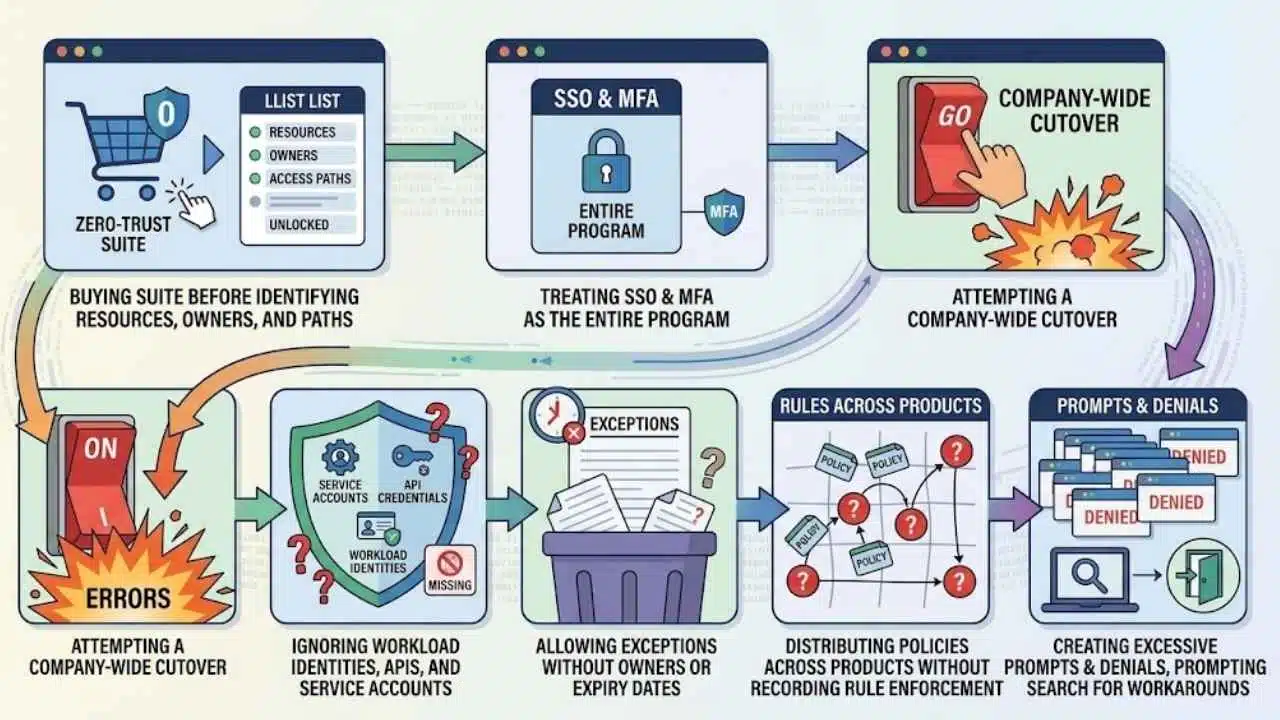
- Buying a zero-trust suite before identifying resources, owners, and access paths
- Treating single sign-on and MFA as the entire program
- Attempting a company-wide cutover
- Ignoring service accounts, API credentials, and workload identities
- Allowing exceptions to remain without owners or expiry dates
- Distributing policies across products without recording where each rule is enforced
- Creating so many prompts and denials that employees search for workarounds
The first mistake is especially common. Product selection should follow architecture and policy design, not substitute for them.
How to Measure Meaningful Progress
A maturity percentage cannot show whether dangerous access paths have actually disappeared. More useful measures include:
- Sensitive applications covered by contextual access policies
- Privileged accounts using phishing-resistant authentication
- Managed devices supplying current posture information
- Stale accounts and standing administrative privileges removed
- Time required to revoke active access
- Systems reachable from a compromised test endpoint
- Unowned or expired exceptions
- False denials and access-related support requests
Security coverage and operational friction belong in the same measurement set. Ignoring either produces a distorted view of progress.
Final Thoughts
Zero Trust Security is most useful when it forces a company to understand who can reach a resource, under what conditions, and for how long. The label itself provides no protection.
Start with one high-value workflow. Map its dependencies, observe real access, strengthen the weakest identity and device controls, and add enforcement in stages. A smaller implementation that the security and operations teams can explain is more valuable than an expensive program built around vague promises of being “zero trust.