
Have you ever looked at an old blog post on your site and thought, “This used to bring in so much traffic. What happened?” I’ve been there too. Your content works hard for you, pulling in visitors from search engines and keeping readers around. Then, slowly, it gets old. Search engines notice. Readers notice too. That’s where content optimization for SEO comes in.
Content optimization for SEO means improving the pages you already have so they stay fresh, interesting, and strong in search results. You’re not starting from scratch. You’re making what already exists work better, like tuning up a car that still runs but could use more power.
Here’s why this matters so much. Redundant, outdated, and trivial content, often called ROT, drags down how search engines rank your pages. It pushes readers away too. And since more than half of all traffic to research websites comes from search engines, that’s a number you can’t brush off.
So when does your content need attention? When it gets old, when visitor numbers drop, or when you spot room to make it stronger. Smart website owners review their content every 12 months, and fast-moving industries need checks more often than that.
The good news? The process is simple: pull back your old content, rebuild it, rewrite the words, and put it back online with a fresh date.
I’m going to walk you through the tactics that actually work, plus the mistakes that trip most people up. Grab a coffee and let’s go through it together.
Content Optimization for SEO
Content optimization for SEO means making your web pages better so search engines rank them higher. You fix old content, rewrite weak sections, and add the right keywords to match what people actually search for.
Definition and Importance
Content optimization means improving your existing website pages to keep them fresh, engaging, and competitive in search results. You take old articles, blog posts, or web pages and make them better.
This process satisfies human readers and helps your content appear in AI-generated answers. Modern search engine optimization focuses on real user experience and quality writing instead of stuffing keywords everywhere. Search engines like Google reward pages that readers actually find helpful and easy to read.
Well-crafted SEO content boosts audience engagement, conversion rates, and your bottom line. When you improve your pages through keyword research, better structure, and stronger visual elements, search algorithms notice.
Here’s what that looks like in practice:
- Your online visibility grows and readers stay longer on your site
- Visitors click more links and buy more products
- Structured data, meta descriptions, and on-page SEO work together to lift your rankings
- Technical SEO wins like mobile-first indexing and core web vitals add extra strength
You track everything with Google Analytics and Search Console to see what works. This balance between search engine requirements and human readability makes content optimization so important for online business success.
Core Elements of Content Optimization
Content optimization asks you to get comfortable with several key pieces that work together. These elements form the foundation of strong SEO content marketing and better search performance.
- Keyword research identifies what people search for, including long-tail keywords and secondary keywords that match search intent. Tools like Semrush One and MarketMuse help you find the right terms for your audience. If you’re weighing that first tool, here’s some helpful context: according to Semrush’s October 2025 product announcement, Semrush One launched on October 29, 2025, combining traditional SEO data (a 142-database keyword index and a 27.5-billion keyword database) with AI-search visibility tracking across ChatGPT, Gemini, and Perplexity, with introductory pricing starting at $165 per month for new annual customers. Knowing the price and what it covers helps you decide if it fits your budget.
- Content structure organizes your material with clear H1 tags, H2 subheadings, and short paragraphs that readers can scan quickly. Good structure helps both people and crawlers understand your message.
- Meta tags, including title tags and meta descriptions, appear in search results and influence click-through rates. Write descriptions that accurately reflect your page content.
- Schema markup adds structured data to your pages, helping search engine algorithms understand context better. This code tells Google and other engines what your content means.
- Image optimization means using short, descriptive alt text and compressing files for faster loading. Visual search and image optimization improve your overall page performance.
- Internal links connect related articles and spread search authority throughout your site. These connections guide readers to helpful resources while strengthening your digital marketing strategy.
A few more pieces round out the picture:
- Technical SEO covers site speed, mobile responsiveness, and robots.txt setup for better crawling. Sitemaps and canonical tags prevent duplicate content issues that hurt rankings.
- Content quality matters more than quantity. Fresh, valuable information keeps readers engaged, and regular updates with new statistics maintain credibility over time.
- Video optimization and YouTube integration expand your reach beyond text-based search results. Multimedia content increases time spent on your pages.
- AI tools like ChatGPT can help with brainstorming and content creation, though human review remains a must. The Hemingway Editor helps simplify your writing for better readability.
Benefits of Content Optimization
When you improve your content, search engines rank your pages higher on Google search results. Your website traffic climbs, and more readers find what you have to share.
Improved Search Performance
Your search engine optimization efforts pay off fast when you update old content with fresh information. Search engines favor updated material, especially when you add new data or insights that readers haven’t seen before.
Google Search and other platforms reward sites that keep their content current. Over 50% of traffic to major research libraries comes straight from search engines, which shows how much search visibility matters for your website.
And here’s a number that raises the stakes: according to a 2025 Graphite analysis of U.S. website traffic trends, organic search traffic across more than 40,000 top U.S. websites dropped 2.5% year-over-year in 2025. The baseline is shrinking, not just sitting flat. That makes protecting the organic traffic you already have more urgent than ever.
Content quality matters far more than keyword stuffing these days. Modern algorithms look at user experience and how well your content answers real questions.
A few things give you an extra edge here:
- Schema markup helps search engines understand your pages, which boosts your visibility in search results
- Quality backlinks act like votes of confidence, telling Google your content deserves higher rankings
- Ongoing SEO content optimization and SERP analysis help you spot what works and what needs adjusting
Track these metrics regularly and you’ll catch problems early. That’s how you keep your search performance climbing steadily instead of guessing.
Maintains User Confidence
Your readers come back when they trust you. Outdated or wrong information kills that trust fast, and sites with stale content lose credibility while visitors leave for competitors who stay current.
Regular updates to high-traffic pages restore lost visibility and show your audience you care about accuracy. When you fix old facts, add new data, and remove broken links, readers see a site that works hard to serve them well.
That trust builds loyalty. It keeps people reading and makes them more likely to share your content on social media and Google Discover.
The flip side is just as true. Your search engine optimization efforts fail if visitors don’t believe what they read, because outdated content undermines both your rankings and your reputation. By keeping information current, you show visitors that your e-commerce site, blog, or service page deserves their attention.
People stick around when they know you deliver reliable, truthful material. That consistency turns casual readers into loyal followers who trust your guidance and return for more.
Eases Long-term Management
Here’s a benefit people rarely talk about: well-maintained content becomes easier to manage over time.
Large content libraries can grow messy fast. ROT content, which stands for Redundant, Outdated, and Trivial material, piles up and costs more to fix later. Proactive content management stops the problem before it starts, and teams that update their work regularly spend less time on expensive overhauls down the road.
Search engine optimization tools help you track which pages need attention, so you can spot declining performance early. This saves money and keeps your site running smoothly.

A mid-size ecommerce site with a 1,200-page product and content catalog ran a full annual audit to identify ROT and prioritize rework. The audit flagged 310 pages as ROT, recommended 180 consolidations, 80 removals, and 50 rewrites. After acting on those recommendations, the team estimated their content management time dropped by 38 percent. One team member noted that nearly one quarter of the library was costing time and lowering discovery, and consolidating redundant pages cut maintenance effort significantly.
This kind of structured review shows you exactly where your resources drain away and which fixes deliver the biggest return.
Strategic improvement also scales better as your content grows. Managing fifty pages takes less effort than managing five hundred pages of mixed quality, and regular content audits identify weak spots before they multiply.
Teams using an SEO toolkit can spot trends across their entire library. Build a system, and your content stays useful, discoverable, and persuasive long after publication. Search Central resources and keyword overview tools make this work manageable for any team size.
Tactics for Effective Content Optimization
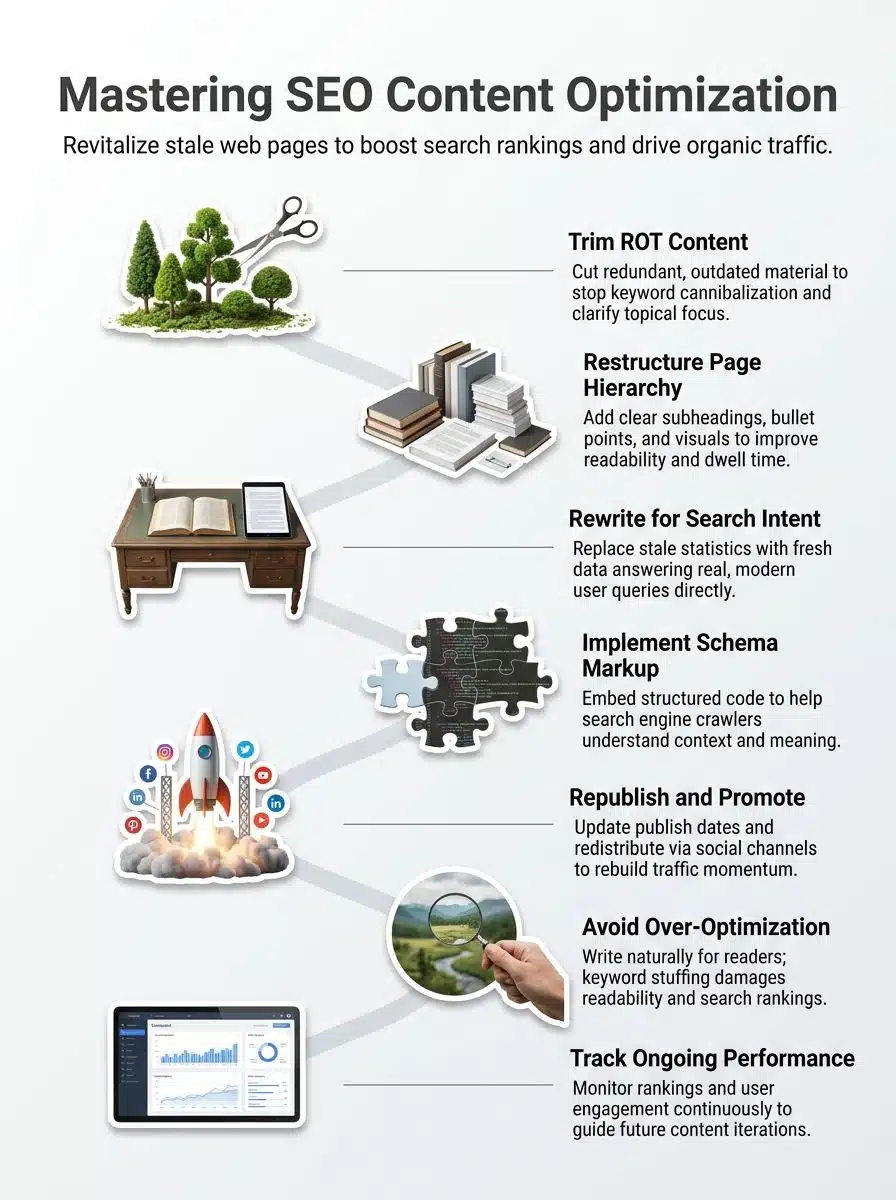
You can pull back old content, rebuild it from the ground up, rewrite it completely, and push it back out into the world. Each move shapes how search engines rank your pages.
Rip Back Content
“Rip back content” means removing unnecessary material from your existing articles while keeping only the valuable information. Think of it like cleaning out a cluttered garage: you toss the broken tools and keep the ones that actually work.
This tactic fights ROT, the redundant, outdated, and trivial content that overlaps or offers little user value. Search engines get confused when your pages say similar things, and that confusion can hurt your rankings. By trimming the fat, you help search engines understand what your page is really about, and you stop content cannibalization in tracks.
Start by running regular audits to spot content that should be trimmed or consolidated. One editorial team built a simple trimming workflow that shows how well this works:
The team identified candidates through analytics, marked overlapping pages, and then trimmed 20 to 30 percent of word count on selected pages. After updating headings and internal links, they tracked engagement for 60 days. A pilot test on 25 pages showed an average time-on-page increase of 22 percent and a bounce rate drop of 15 percent. Trimming repeated sections and tightening headings made the pages easier to scan and measurably improved engagement within two months.
Look for paragraphs that repeat information from other sections, outdated statistics, or examples that no longer matter to your audience. Remove those weak spots and watch your search engine optimization improve.
The remaining content should align with current search intent and your business goals. Clear content speaks directly, and direct content ranks better.
Restructure Content
Restructuring your content means rearranging how you present information to readers. You move sections around, add clear subheadings, and create a logical flow that makes sense. This helps search engines understand your material better, which boosts your search engine optimization efforts.
A few structural moves make a big difference:
- Bullet points, tables, and visuals break up dense text so readers can scan quickly
- Shorter paragraphs and better organization reduce bounce rates because people stay longer
- Internal links connect related topics and spread authority throughout your site
- Mobile responsiveness keeps your restructured content working on phones and tablets
Competitor research reveals gaps in your approach and shows you what works for similar articles. Fill those gaps with original insights and you create something readers actually want to read.
Restructuring also tackles page speed and technical factors that affect rankings. There’s fresh evidence this pays off: according to a 2026 ranking-position analysis of Core Web Vitals pass rates following Google’s March 2026 core update, pages ranking in position 1 show a 10% higher Core Web Vitals pass rate than pages sitting in position 9. That’s a solid reason to treat Core Web Vitals fixes as part of your restructuring work rather than a separate technical afterthought.
Generative AI tools can help you identify which sections need reworking based on user behavior data. The goal is simple: make your content easier to navigate and more valuable. Strong structure signals quality to both search engines and your audience, turning casual visitors into engaged readers who return for more.
Rewrite the Article
Rewriting your article breathes new life into old content that search engines have forgotten. You dig into the original piece and rebuild it with fresh language, current data, and answers to questions your readers actually ask today.
This step matters because search engine optimization requires content that speaks to what people search for right now, not what they searched for three years ago. You swap out old statistics for new numbers, replace tired examples with recent case studies, and reframe your message to match how readers think today.
LLMs can help you generate new angles and phrasing, but you steer the ship. You decide what stays and what goes.
Fresh writing also fixes problems the original article had with user intent. Read through comments, search queries, and feedback to spot what readers truly wanted. Maybe they needed step-by-step instructions instead of broad overviews or real-world examples rather than theory.
Rebuild sentences to be shorter and clearer. Add subheadings that answer specific questions. Weave in keywords naturally so the search engine optimization feels invisible to the reader.
The result serves both humans and search algorithms at the same time. Your article ranks better, gets more clicks, and actually helps the people who land on it.
Republish the Optimized Content
Push your updated article live to signal freshness to search engines. One caution before you do: keep the original URL. According to a 2025 Ahrefs analysis of content update performance, updates that keep the original URL rank an average of 83% faster than the same content published under a new URL. Changing the address when you refresh a page throws away ranking momentum you’ve already earned.
Google and other search platforms pay attention when you update your published date. This tells them your content still matters and remains current, and it shows you care about accuracy.
Social media channels and email lists are your main distribution channels. Share the refreshed article across platforms to rebuild momentum and recapture reader attention.
A B2B software blog post shows what republishing can accomplish. The 1,400-word article went back out after keyword alignment, updated examples, and schema markup were added, and the team tracked metrics for 90 days:

| Metric | Before Republish | After Republish (90 Days) |
|---|---|---|
| Monthly organic sessions | 420 | 1,050 |
| Click-through rate | 2.1% | 4.7% |
| Average ranking position | 28 | 12 |
After repairing structure and adding basic schema, the post moved from page three to page one in three months and more than doubled its organic visits. These are the KPIs to watch after you republish your refreshed content.
Monitor your performance metrics closely after republishing. Track clicks, impressions, and ranking positions to see what changes, because those numbers reveal whether your search engine optimization tactics worked or need adjustment.
Apply schema markup or structured data to boost visibility in search results. Performance data then guides your next round of improvements, creating a continuous cycle that keeps your content competitive and readers engaged.
Common Mistakes in Content Optimization
Many content creators fall into traps that hurt their search engine optimization results. These mistakes can undo all your hard work and send your rankings backward.
Over-optimization
Search engines penalize over-optimization. Your article’s ranking drops when you stuff keywords into every sentence, because readability suffers and users leave your page. Search engine algorithms detect this behavior and lower your visibility.
Keyword stuffing feels unnatural to readers, and search engines know it. They reward content that flows smoothly and answers real questions.
Going overboard shows up in a few common ways:
- Excessive focus on technical SEO can undermine content quality and user engagement
- Chasing backlinks too hard may result in low-quality links that harm credibility
- Forced keywords make sentences sound like they came from a robot, not a person
- Prioritizing SEO tactics over readers reduces how effective your content actually is
Search engines see through these tactics. They notice when links come from irrelevant sources and when your content prioritizes rankings over reader value. Your bounce rate climbs, your time-on-page drops, and visitors click away because everything feels forced.
Think of it like seasoning food: a little salt improves the dish, but too much ruins it.
Write for humans first, then adjust for search engines. This approach builds trust with your audience and authority with search engines. Both matter for long-term success.
Neglecting User Intent
Many content creators make a critical mistake: they chase keywords instead of chasing answers. Your readers come to search engines with real questions, not random words.
Someone searching for “Who’s the best for SEO in Lincoln?” needs a direct answer, not a page stuffed with search engine optimization jargon. Failing to address user questions directly makes your content less effective, and your rankings suffer as a result.
Your content becomes invisible because search engines now prioritize what readers actually want. You write about techniques, but your audience needs solutions to their specific problems, and that gap creates a dead end.
Prioritizing keywords over user needs produces trivial, low-value content that nobody wants to read. Your pages rank for nothing because they don’t solve real problems.
Here’s how the failure plays out. You spend hours polishing SEO metrics, yet your bounce rate climbs higher. Readers arrive, scan your page, and leave within seconds because they found no value and got no answers. Search engines notice this behavior and push your content down the rankings.
The fix is flipping your approach: start with what your audience needs, then build your search engine optimization strategy around those genuine needs. Your content becomes useful, readable, and actually ranks because it serves people first.
Optimizing Without Follow-up
You publish your refreshed content and feel satisfied. Then you move on to the next project.
This approach leaves money on the table. Skipping performance analysis after an update creates missed opportunities for further gains, because your search engine optimization efforts need tracking and refinement after you hit publish.
Analytics data tells you what works and what doesn’t. Without it, you can’t make smart decisions about your next steps. Your content might rank better, but you won’t know why, and you won’t spot patterns that could help other articles perform well too.
Regular updates keep your content meeting current SEO standards and trends. Build these habits into your routine:
- Track click-through rates, bounce rates, and keyword rankings on a regular schedule
- Test different headlines or calls-to-action to see what drives engagement
- Revisit your updated pieces every few months and measure their performance
- Adjust your strategy based on what the analytics show
This follow-up work turns a one-time fix into a system that keeps producing results. Your search engine optimization strategy grows stronger when you treat this as an ongoing cycle, not a one-shot event.
Final Words
Content optimization beats creating new pages from scratch, and these twenty tactics give you the roadmap to win.
Ripping back old material, restructuring it, rewriting sections, and republishing with fresh dates (on the same URL) turns ROT content into search engine gold. Search engine optimization works best when you fix what already exists, boost readability with short paragraphs and clear headers, and weave keywords naturally throughout your text.
Regular reviews every twelve months keep your articles sharp. Evergreen topics need fewer tune-ups than fast-moving fields like law or marketing.
Start today with one underperforming article. Apply these methods and watch your search rankings climb while readers stay longer on your pages.
The real power sits in your hands, not in chasing new content endlessly. So grab that decaying piece and make it shine.