Most in-house SEO teams are not short of work. They are short of proof. You publish. You fix crawl errors. You send the monthly report. The traffic line still goes sideways, and someone in a meeting asks what SEO is actually doing. So this is an honest review of SEO strategy 2026 so far.
This is not a list of everything you could do. But this is a short list of what moved traffic on real sites, what quietly ate a full quarter and gave nothing back, and how to check both on your own site without asking for a budget.
Cutting Pages Did More Than Adding Pages
This is the one that surprises people, and it is also the one most teams put off. Pull a report of every URL on your site with clicks over the last 12 months. On most sites that have been publishing for a few years, a big share of pages get close to zero. Not low. Zero.
Those pages are not neutral. They split your topic across five weak articles when one strong article would do. They compete with each other for the same search. They soak up crawl time. And they drag down the average quality of everything a search engine sees when it looks at your site.
The fix is boring:
- Merge pages that cover the same topic into one better page, and redirect the old URLs to it.
- Redirect thin pages that have nothing worth saving to the closest useful page.
- Keep pages that have backlinks, sales, or a seasonal spike, even if they look weak today.
- Improve, do not delete, pages that get impressions but no clicks. Those have a title or intent problem, not a value problem.
Two warnings before you start. Check backlinks first, because deleting a page with links throws away the one thing that is hard to get. And never bulk delete with a plugin. Go URL by URL. It is slower and it saves you from a bad week.
What This Looked Like on a Site With 10,000 URLs
One client site had close to 10,000 URLs. About 6,000 of them had zero clicks in 12 months. Not low traffic. None.
We merged the ones worth saving into bigger, stronger pages and redirected them. The rest were served a 410, which tells a crawler the page is gone on purpose instead of leaving it to work that out over months of return visits.
Clicks to the surviving pages went up roughly 35% within two months. Nobody rewrote them. No new titles, no new links, no new content. The only thing that changed was how many weak pages were sitting around them.
Two months is a short window, and part of any lift can be seasonal, so treat that number as a direction rather than a promise. But a jump that size on pages nobody touched is hard to explain another way.
Internal Links by Hand Beat Any Plugin
Automatic internal linking tools drop links where the words match. That is not the same as sending value where you want it.
The manual version takes about a weekend:
- List the 10 to 20 pages you actually need to rank. Not every page. The ones tied to sales or sign-ups.
- For each one, find pages on your site that already get clicks and cover a related topic.
- Add 5 to 10 links from those pages into your target page, inside the body text, with anchor text that says what the page is about.
- Write it down in a sheet so you can see which target pages are still thin on links.
It costs nothing. No approvals, no vendor, no waiting. On sites with a few hundred pages, this is usually the fastest thing an in-house team can do without help from anyone else.
Pages Built on Your Own Data Survived, Summaries Did Not
Here is the pattern almost everyone reports now.
If a page is a tidier version of the current top ten results, it fades. Search engines can answer that question directly, and readers no longer need to click for it. Nothing you do to the title will save it.
Pages that hold something only you have are different. Support ticket patterns. A survey of your own customers. Real screenshots from inside your product. Pricing you actually paid. A number from your own account dashboard. That material cannot be copied from someone else’s page, so it keeps getting cited and it keeps pulling clicks.
You do not need a research budget for this. Most in-house teams are sitting on it already. Sales calls, onboarding questions, refund reasons, and your own product data are all original material that no competitor can write.
One practical note: check your analytics for referrals from AI assistants and set them up as their own channel. Many teams are still counting that traffic as direct, then wondering where it came from.
Brand Searches Quietly Did the Heavy Lifting
On a lot of sites, the biggest single traffic source is people typing the brand name. That number rarely comes from SEO work. It comes from video, podcasts, community posts, newsletters, and people recommending you. It is worth tracking as an SEO metric anyway, because it is the one line that keeps growing when rankings wobble.
SEO Strategy 2026: What Did Not Work
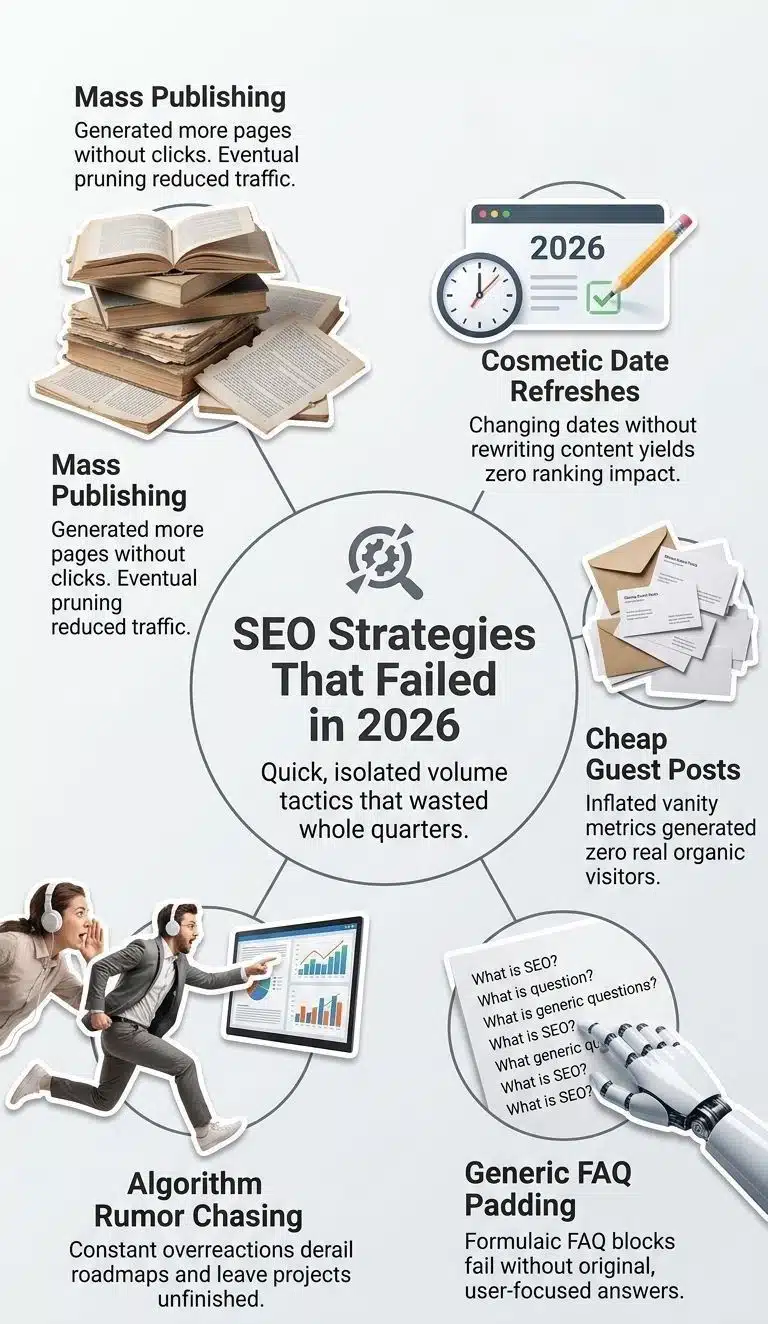
Short and blunt, because these are the ones that soak up whole quarters.
| What teams tried | Time cost | Result |
|---|---|---|
| Publishing more posts per month | High | More pages, same clicks. Often fewer, once the pruning maths caught up. |
| Changing the date on old posts | Low | Nothing. If the content is the same, a new date is not a refresh. |
| Cheap guest posts on high DR sites | High | No traffic. Metrics that look good in a slide and do nothing else. |
| Adding an FAQ block to every page | Medium | Padding. Only helped when the questions were real and the answers were new. |
| Reacting to every algorithm rumour | Endless | Half-finished projects and a team that never sees a change through. |
The pattern is easy to miss. Every failed item above is something a team can do quickly, in volume, without talking to anyone outside the SEO team. Everything in the worked list is slower, needs judgment, and often needs someone else in the company to hand over information.
How to Test This SEO Strategy on Your Own Site
You can do all of this in a week without asking for a budget.
Day one. Export every URL and its clicks for the last 12 months. Sort by clicks. Count the zeroes. That number is your case.
Day two. Sort those zero-click URLs into merge, redirect, keep, and improve. Do not touch anything yet.
Day three. Pick your 10 most important pages. Map internal links into each one.
Day four. Add the links. This is the fastest win on the list, so do it before anything can interrupt you.
Day five. Ask sales or support for the five questions they answer most often. That is your next month of content, and it is content nobody else can write.
Then leave it alone for 60 days. Changing five things a week is how teams end up unable to say what worked.
Final Thoughts
The most useful SEO strategy 2026 has offered so far is not new. It is smaller. Fewer pages, better links between them, and content built on information your competitors do not have.
The hard part is not the work. It is the reporting. Deleting 200 pages looks like nothing in a slide deck, and it is a strange thing to defend in a meeting when last quarter’s plan was to publish 200 more.
So make the case with numbers before you start. Screenshot your click report today, do the week above, and screenshot it again in 90 days. That comparison will do more for your next budget conversation than any strategy document.