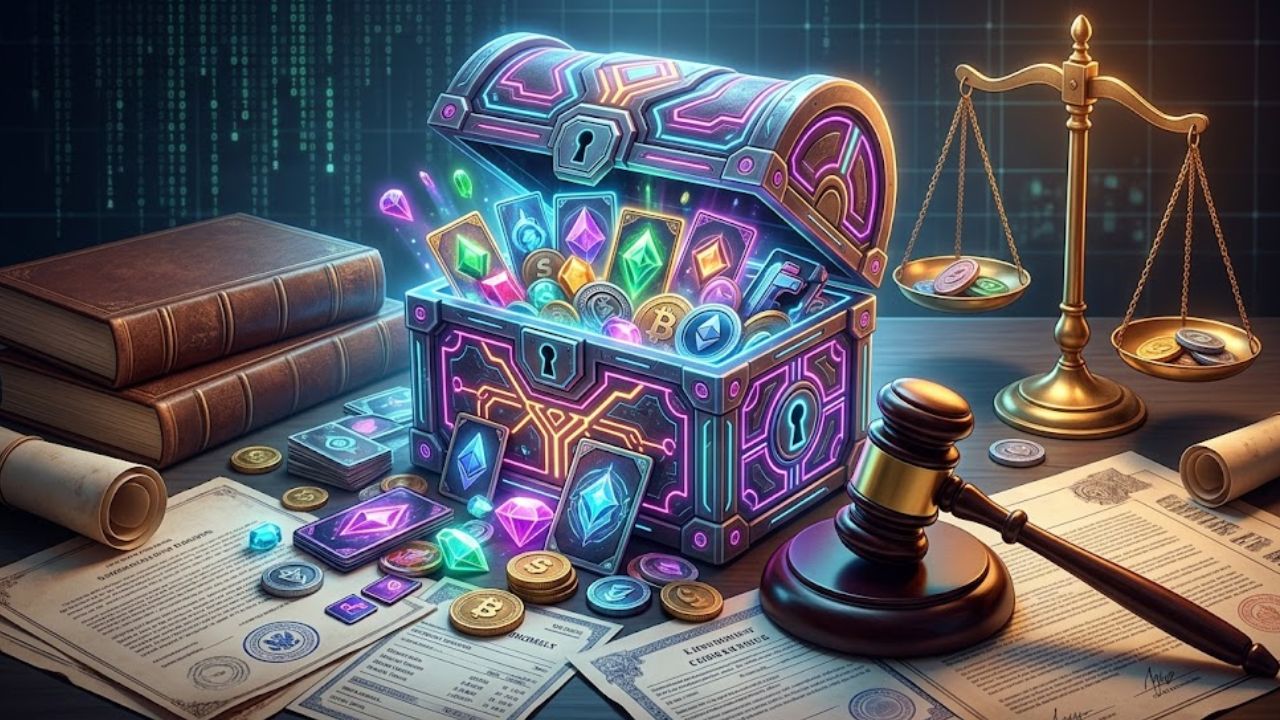
A random reward can look simple on screen: pay for a pack, open it, see what appears. The legal questions begin when the reward has a real-world value, a child can buy it without a parent’s knowledge, or the price and odds are hard to understand. These loot box legal questions do not have one global answer. The game’s design and the player’s location both matter.
Some governments assess loot boxes under gambling law. Others focus on consumer protection, children’s privacy, or clear disclosure of odds. The examples below show why a rule in one country cannot automatically be applied to another. This is general information, not legal advice.
1. When does a loot box count as gambling?
A common legal test asks whether there is payment or a stake, an element of chance, and a prize. A paid loot box clearly involves chance. Whether its reward counts as a legally relevant prize is often the harder question.
In Great Britain, the Gambling Act 2005 defines gaming around playing a game of chance for a prize, generally meaning money or money’s worth. In its 2022 response, the UK government said most loot boxes then on the market did not meet that definition because rewards were usually confined to the game and could not be converted into real-world money. The government also left open the possibility that particular systems could fall within existing gambling law.
That is why loot box legal questions cannot be settled by saying a mechanic “feels like gambling.” Regulators and courts apply the law to the product’s actual features, including how players acquire and use the rewards.
2. Does a virtual item need to be sellable for cash to count as a prize?
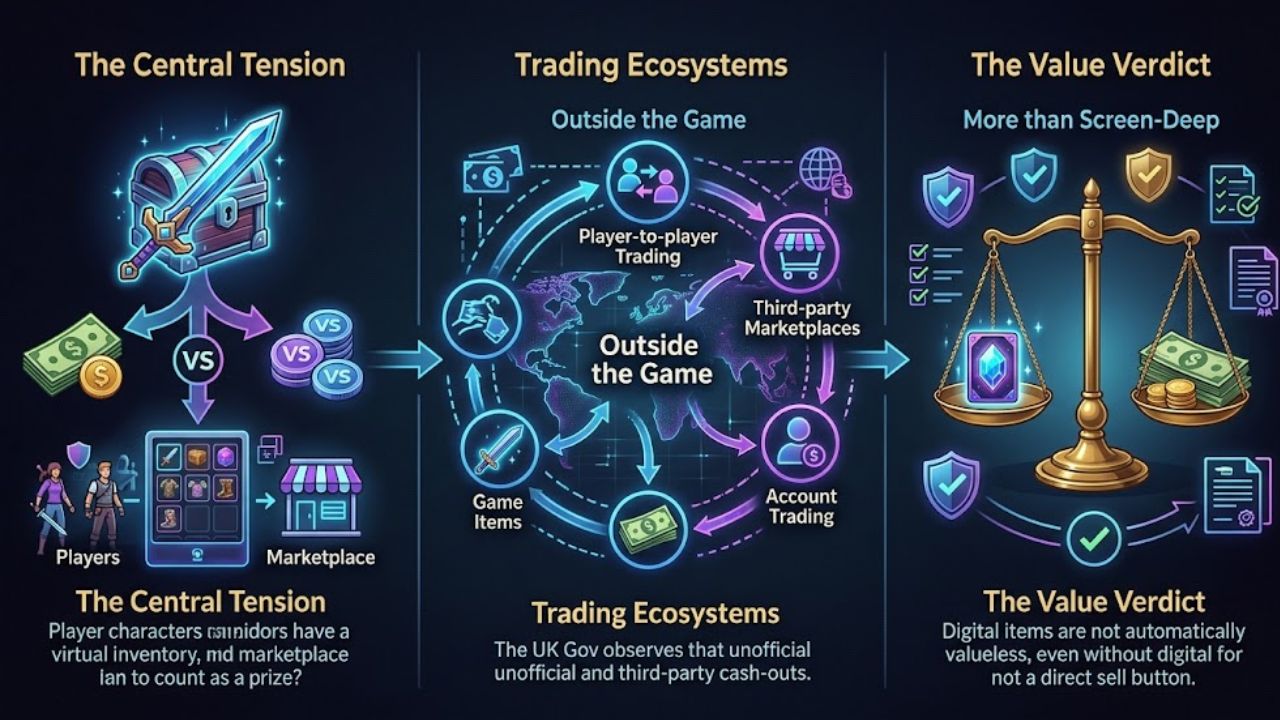
Tradability can change the analysis, but it is not a universal test. An item that can be cashed out or readily exchanged for money may be more likely to count as having real-world value under some laws.
The UK government noted that a reward readily exchanged for cash might count as “money or money’s worth.” It also pointed to trading through third-party websites, even when a game itself has no official cash-out feature.
For developers, checking only whether the game has a “sell” button may miss how items move in practice. Player-to-player trading, outside marketplaces, and account transfers could all be relevant. For players, the practical point is simple: a digital item is not automatically valueless just because it stays on a screen.
3. Are loot boxes illegal everywhere?
No. National laws and regulator positions differ, and a ruling on one game does not decide every case.
Belgium has taken a restrictive position on paid loot boxes under its gambling law. The Netherlands offers a useful contrast: in 2022, the Council of State ruled that FIFA packs in the case before it were not a separate game of chance requiring a gambling licence. The court considered the packs in the context of the wider game. It did not declare every loot box lawful.
The UK government decided in 2022 not to extend the Gambling Act generally to loot boxes at that time. It pointed to existing consumer protections and industry measures, while noting that a specific system could still meet the law’s definition.
The European Parliament has called for stronger, more consistent player protection and an assessment of whether existing consumer law is sufficient. Those calls are policy recommendations, not a Europe-wide ban.
A headline that says “loot boxes are banned” is incomplete without a country, product, and date. Loot box legal questions need a jurisdiction attached.
4. Must games disclose the odds of each reward?
Not everywhere, but some jurisdictions require disclosure. Odds matter because a player needs a clear idea of their chances before spending money.
South Korea is a strong example of a disclosure-based approach. Its Game Industry Promotion Act requires game businesses to identify probability-based items and provide information about the probability of obtaining them. The Act also includes liability provisions for failures or false disclosures that cause damage to users.
Elsewhere, consumer-protection or advertising rules may still apply even without a specific loot-box odds law. A displayed percentage should be accurate and describe the system players actually encounter.
Before paying, players should check what the odds cover: one opening, a bundle, a limited-time reward pool, or a system that guarantees an item after repeated attempts. A percentage without that context can be misleading.
5. What protections apply when children buy loot boxes?
Child protection can involve parental consent, privacy, age-appropriate design, advertising, and unauthorized purchases. A loot box can raise these concerns even if it is not classified as gambling.
The UK government said children and young people should not be able to buy loot boxes unless a parent or guardian enables the purchases. Industry guidance published in 2023 called for technological controls and clear spending information. That guidance is not a law applying uniformly to every game company, and the government noted that its reach across the industry was incomplete.
In 2025, the U.S. Federal Trade Commission announced a settlement with the developer of Genshin Impact. The case addressed allegations about children’s privacy, marketing, costs, and odds; the settlement included a restriction on selling loot boxes to players under 16 without parental consent. It applies to a specific developer and game, not to all loot boxes in the United States.
Parents can set platform purchase approvals and spending limits, but those tools do not replace a company’s legal duties. Loot box legal questions for children should include who can buy, what consent is needed, and what personal data the game collects.
6. Can a loot box be lawful while its purchase flow breaks the law?
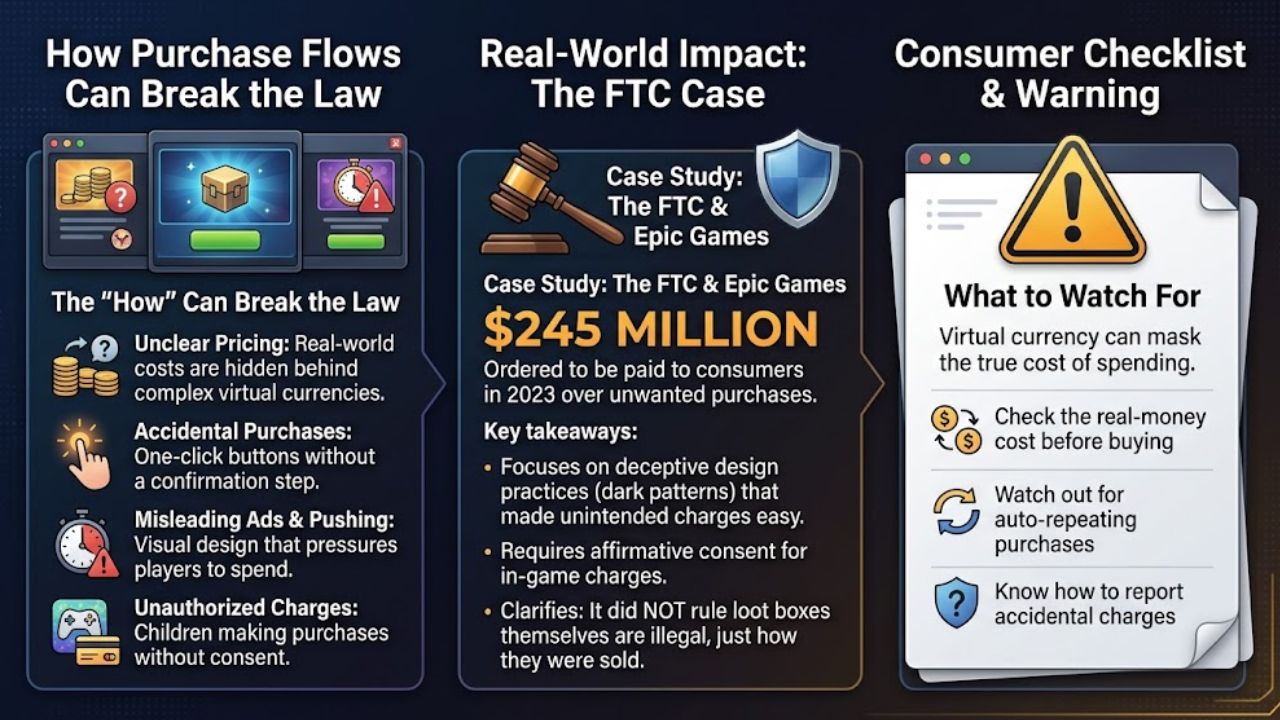
Yes. A regulator can challenge how a game sells digital items even if the loot box itself is not legally gambling. Unclear prices, accidental purchases, misleading advertising, or design that pushes players into spending may raise consumer-protection issues.
In 2023, the FTC finalized an order requiring Epic Games to pay $245 million to consumers over allegations involving unwanted Fortnite purchases and design practices that made unintended charges easier, including for children. The order required affirmative consent for charges and addressed the practices in that case. It did not rule that loot boxes generally are illegal.
Virtual currency can make real spending harder to track, especially when a player must exchange money several times before opening a box. Before confirming a purchase, check the real-money cost, whether the purchase repeats automatically, and how to report an accidental charge.
7. Do platforms and app stores have legal responsibilities too?
Sometimes. A publisher may control the reward system, while a platform has separate duties under local law, store policies, privacy rules, or consumer-protection standards. The answer depends on the law and each party’s role.
The UK’s work on player protections involved both games companies and platforms, reflecting how safeguards can depend on more than one party. The government’s 2023 update also acknowledged that its industry guidance did not cover the entire games sector.
That does not make a platform automatically liable for every loot box. Publishers still need to check local requirements and storefront rules. A platform policy may be stricter than local law; its standard parental settings may also fall short of a specific legal requirement.
8. How should a global game handle different national rules?
A publisher should review the system in each market where the game is offered. Gambling definitions, odds disclosures, parental consent, privacy, advertising, and consumer rights can vary.
Some companies may choose to meet the strictest applicable requirements worldwide. Others may adjust features by region, such as limiting trading, disabling paid random rewards, displaying probabilities, or restricting purchases by younger players. Either approach calls for clear records of how rewards are bought, what the odds mean, whether items can be transferred, and what controls are available.
For players, this variation explains why a general online answer may not settle the question for their own account. Check local guidance and the game’s current terms. Loot box legal questions should be answered for the specific game and the player’s location.
Final Thoughts
If you are a player, check the real price, reward odds, trading options, and parental controls before spending. If you are a developer, review how the system works in every market where the game is sold; a single global assumption can leave important gaps.
The core loot box legal questions are practical ones: What does a player pay? What can they receive? Can they exchange it for value? Can a child purchase it? How clearly does the game explain the transaction? Those answers give players a better basis for deciding and help developers spot legal issues before launch.
Frequently Asked Questions (FAQs) About Loot Box Legal Questions
Are loot boxes always gambling?
No. Classification depends on local law and details such as payment, chance, and whether rewards have real-world value.
Can a publisher face consequences for misleading loot-box odds?
Yes, where disclosure or consumer-protection rules apply. The requirements and available remedies differ by jurisdiction.
Are free loot boxes treated the same as paid ones?
Not necessarily. A free reward may raise different gambling-law questions, but its links to later purchases, advertising, or children’s data may still matter.