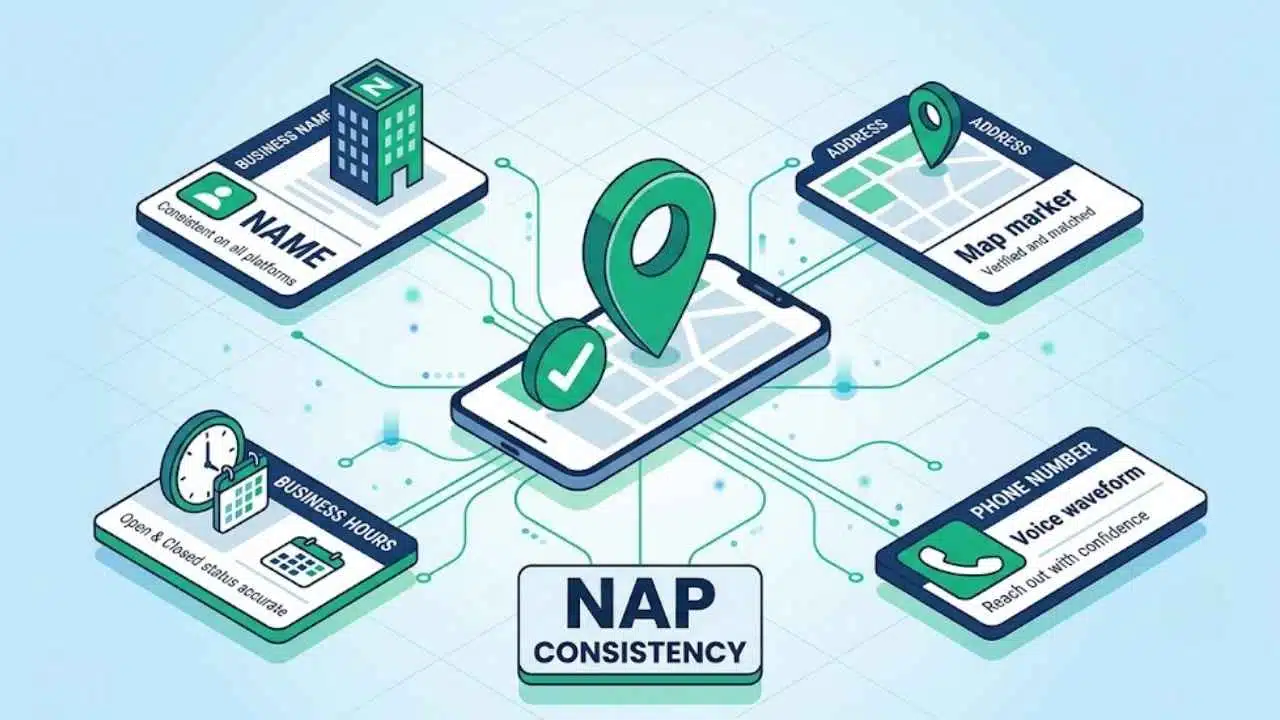
NAP consistency refers to the uniform presentation of a business’s core contact details—its Name, Address, and Phone number—across all online directories, mapping services, social channels, and web properties.
For search engines and AI engines, NAP consistency serves as a primary entity-verification signal, helping search systems confirm that a local business physically exists, operates at its stated location, and can be trusted by consumers.
While minor formatting variations like “Street” versus “St.” rarely harm search rankings, material discrepancies—such as outdated street addresses, disconnected telephone numbers, duplicate profiles, or artificial keyword-stuffed business names—create significant algorithmic friction. Eliminating these material conflicts resolves entity confusion, protects consumer trust, and ensures search platforms confidently showcase the business in local search and map results.
What NAP Consistency Actually Means
NAP consistency means that a business’s core identity remains accurate and recognisably aligned wherever it appears.
For a single-location company, those details may appear on its:
- Google Business Profile;
- official website;
- major mapping services;
- social profiles;
- industry directories;
- booking or delivery platforms;
- LocalBusiness structured data.
The records do not need identical typography. Address databases often shorten “Avenue” to “Ave,” move a suite number to another line, or display phone numbers in domestic and international formats.
What matters is whether the information describes the same legitimate business.
A useful check is straightforward:
- Does the address lead to the correct operating location?
- Does the number reach the right business or branch?
- Does the name match the brand customers see in the real world?
- Are former locations clearly closed?
- Can one branch be distinguished from another?
- Does the official website confirm the information shown on Google?
“25 North Road, Suite 6” and “25 N Rd Ste 6” point to the same place. “25 North Road” and the company’s former office on the other side of town do not.
Why Google Checks Information Beyond the Business Profile
A Google Business Profile is not an isolated record that relies only on information submitted by its owner.
Google explains that business details may come from owners, official websites, licensed data providers, public web content, user contributions, and its own interactions with local places. That allows it to fill missing information and identify details that may have changed.
In practical terms, Google must decide which separate records refer to the same real-world organization. Local SEO professionals often describe this as entity resolution. It is a useful technical explanation, but it is not a named Google ranking factor.
Consider a dental practice that moves to a new clinic. The manager updates its Google profile but leaves the old address in the website footer, appointment platform, Facebook page, and several healthcare directories.
Google now sees one updated source surrounded by conflicting records. Customers may continue receiving the wrong directions. Users may suggest edits based on the old information. A former profile may remain visible, or the outdated address may reappear after another update.
None of those outcomes is automatic. The underlying problem is that the business has left enough conflicting evidence online to make the correct location less clear than it should be.
NAP Consistency Is Not a Map Pack Shortcut
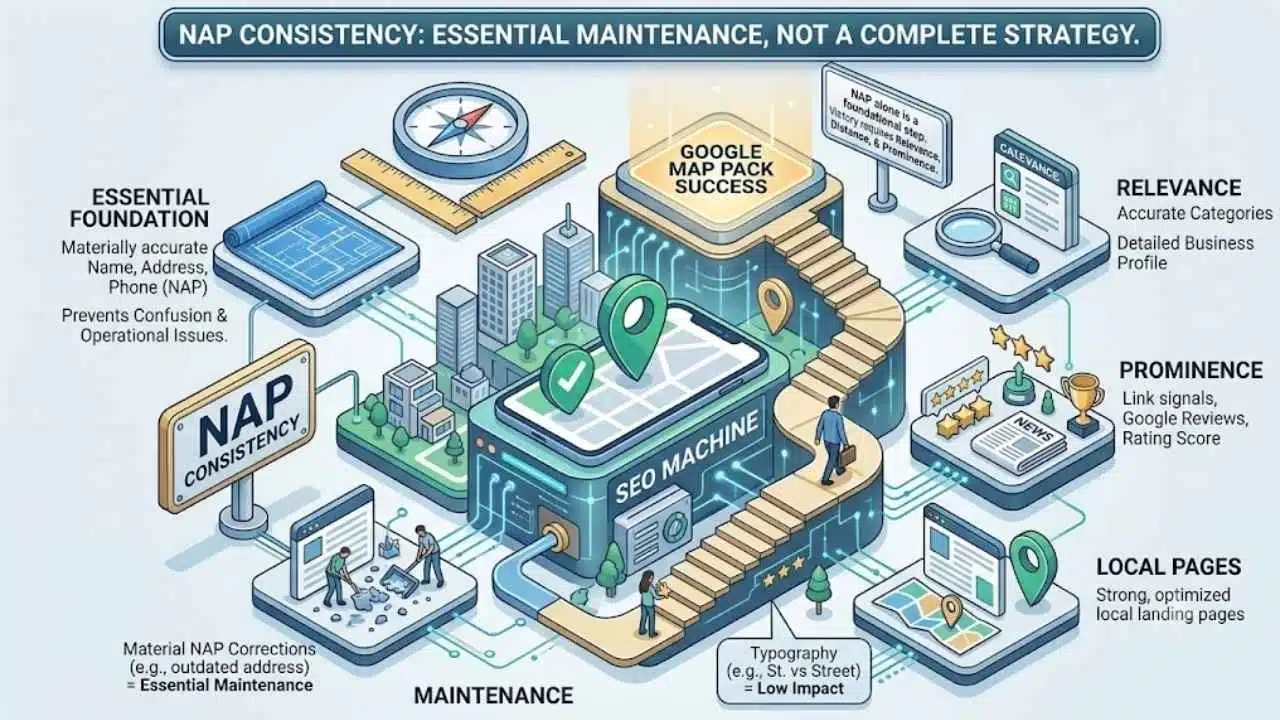
Google’s published local-ranking guidance centres on relevance, distance, and prominence.
Relevance concerns how well a Business Profile matches the search. Distance considers how close the business is to the searcher or the location named in the query. Prominence reflects how well known the business is and can include signals such as links, reviews, and ratings.
Google does not list NAP consistency as a separate fourth factor.
That does not make accurate information unimportant. Complete business details help Google understand the company and show useful information to customers. Correcting duplicates and outdated listings can also prevent operational problems that damage calls, visits, bookings, and reviews.
What it does not do is replace the rest of local SEO.
A business with the wrong primary category, weak local pages, few credible reviews, and little local prominence will not become competitive because every directory now uses the same comma placement.
For most businesses, material NAP corrections are essential maintenance. They are not a complete Map Pack strategy.
Which NAP Problems Deserve Attention First?
The most useful audits rank inconsistencies by consequence rather than counting every variation equally.
The Public Business Name Is Wrong
Google requires a Business Profile name to reflect how the company is represented and recognised in the real world. That usually means the name displayed on the storefront, website, stationery, and branding.
A company publicly known as Hartwell Plumbing should not rename its profile Hartwell Plumbing Emergency Boiler Repair Manchester simply to target more searches.
Problems worth fixing include:
- an old name remaining after a rebrand;
- unrelated name variations across important platforms;
- city names or service terms added for ranking purposes;
- separate profiles created for individual services;
- inconsistent franchise or chain naming.
A legal suffix does not always create a conflict. “Hartwell Plumbing Ltd” in formal company information and “Hartwell Plumbing” in public branding can still describe one clear identity.
The issue is not perfect repetition. It is whether customers can recognise the same business across every important source.
The Address Points Somewhere Else
Address conflicts usually deserve more urgency than formatting differences because they can send people to the wrong place.
Google requires storefront businesses to use an accurate, real-world operating location. P.O. boxes and remote mailboxes are not eligible substitutes. A mailing-only virtual office is also ineligible.
A business using a co-working location generally needs its own signage, customer access during stated hours, and staff from that business present at the location.
Serious address problems include:
- leaving a former address online after moving;
- using a registered office where customers are not served;
- listing a mailbox or virtual office as a storefront;
- omitting a necessary suite or unit number;
- placing the map pin at the wrong entrance or building;
- leaving both the old and new Business Profiles active;
- creating several profiles for one operating location.
Correct the records that change where the customer ends up before spending time standardising harmless postal abbreviations.
The Phone Number Reaches the Wrong Place
A phone number should connect customers to the actual business or branch represented by the listing.
Google advises businesses to use a local number instead of a central call-centre line where possible. The number should remain under the business’s direct control and should not route customers to an unrelated referral service.
The most damaging phone errors include:
- a closed branch’s number appearing on an active listing;
- one location inheriting another branch’s number;
- an expired tracking number being reassigned;
- a directory routing calls to a lead-generation company;
- a website template showing the wrong contact details;
- a national switchboard that does not reliably direct local calls.
Call tracking is not automatically a problem. The number must connect directly to the correct business, remain controlled by it, and avoid obscuring which location the customer is contacting.
A spreadsheet can confirm that two fields match. It cannot confirm that the number still works. Call important numbers during an audit.
Service-Area Businesses Should Not Force an Address Into Every Listing
A plumber, cleaner, mobile locksmith, or home-care provider may travel to customers without operating a public storefront.
When customers are not served at the business address, Google instructs the company to hide that address and define a service area instead. A business without a storefront is generally allowed one profile for its central operating location. Additional profiles require genuine operating locations with separate staff and service areas.
For these companies, NAP consistency does not mean publishing a home address or renting a mailbox in every nearby city.
A service-area business can establish a clear identity through its:
- genuine business name;
- stable primary phone number;
- official website;
- real service regions;
- booking and contact details;
- licensing or registration information where relevant.
Creating virtual-office profiles to appear in additional towns is not an optimisation tactic. It creates an eligibility problem.
Structured data also requires care. Google’s LocalBusiness rich-result documentation is built around physical business locations and includes an address as a required property. A service-area business should not invent an address or expose a private residence merely to complete the markup.
Multi-Location Brands Have a Database Problem, Not Just a Citation Problem
A company with 60 branches does not have one NAP record. It has 60 location entities connected to one wider brand.
Each eligible branch needs accurate information of its own:
- Business Profile;
- physical address and map pin;
- local or branch-specific phone number where practical;
- opening and special hours;
- dedicated location-page URL;
- internal location identifier;
- location-specific structured data.
Google expects chains to use consistent names and core categories unless real-world branding or operations genuinely differ. Adding city names, slogans, or services to individual profiles can create policy and management problems when those terms are not part of the public brand.
The biggest multi-location failures usually begin inside the company’s systems:
- two branches share the same phone number;
- a closed store remains in the locator;
- profiles point to the wrong location pages;
- opening hours differ across the website and Google;
- store IDs are reused;
- a national feed overwrites accurate local information;
- a website migration changes every location URL without updating external profiles.
The best fix is a central location database that acts as the operational source of truth. Business Profiles, store pages, feeds, directories, advertising platforms, and booking systems should draw from that record wherever practical.
Automation does not remove the need for verification. A wrong address distributed perfectly across 15 platforms is still wrong.
The Website Should Confirm Each Location Clearly
The official website is one of the sources Google may use when understanding a business. It should confirm important details rather than hiding them in an image, inaccessible store locator, or conflicting templates.
A single-location business should provide accurate contact information on a clear contact page and, where appropriate, in the site footer.
Multi-location brands generally benefit from a dedicated page for each branch. A useful location page can include:
- the location name and full address;
- phone number and opening hours;
- directions and parking details;
- services available at that branch;
- accessibility information;
- locally relevant photographs;
- appointment or contact options.
A page titled “Bristol Office” should not display a London address and generic national content without evidence of a genuine Bristol operation. Thin location pages created only to target city names do little to clarify the business entity.
LocalBusiness structured data can reinforce visible information by presenting it in a machine-readable format. Google recommends defining each physical location separately, using a working location-specific URL and a primary customer phone number with country and area codes.
The markup should confirm the page, not contradict or replace it.
A Practical NAP Consistency Audit
A useful audit does not begin by buying hundreds of directory corrections. It begins by establishing which information is actually true.
Create a verified master record
For every location, document the approved public name, full address, suite or unit, map pin, primary phone number, location-page URL, opening hours, primary category, and relevant profile IDs.
Confirm these details with the location or operations team. Old CRM data should not be treated as proof.
Check high-impact sources first
Review the Business Profile, official website, Apple Maps and other major mapping services, important industry directories, social profiles, booking services, and delivery platforms.
Prioritise sources that rank for branded searches, receive meaningful traffic, or influence customer decisions. A wrong address on a leading booking platform deserves more attention than a missing full stop on an abandoned directory.
Search old information deliberately
Search the former business name, previous phone numbers, closed addresses, outdated location-page URLs, and common spelling variations.
This often reveals forgotten listings left behind after:
- a move;
- a rebrand;
- an acquisition;
- a branch closure;
- a website migration;
- a change in call-tracking provider.
Correct the original source where possible. Updating the Google profile alone does not remove the old information elsewhere.
Watch for recurring profile changes
Google may suggest or publish updates based on information from users, websites, licensed sources, and other evidence.
If an incorrect address or phone number repeatedly returns, the problem may not be the profile itself. A prominent conflicting source may still be telling Google that the old information is correct.
Repeatedly rejecting the update without correcting that source is usually temporary maintenance rather than a solution.
Formatting Differences Should Come Last
The following variations are usually low priority when they clearly describe the same business:
- “Street” and “St”;
- “Suite 5” and “Ste 5”;
- spaces or parentheses in phone numbers;
- domestic and international versions of the same number;
- minor punctuation in the business name;
- a legal suffix used only in formal company details.
Standardisation is still useful, especially for multi-location databases. It makes records easier to compare and reduces future mistakes.
It should happen after the issues that change meaning have been fixed.
Do not spend days correcting abbreviations while a duplicate profile, former address, dead phone number, or ineligible office remains visible.
Final Thoughts
NAP consistency helps Google and customers recognise the same legitimate business across profiles, websites, maps, directories, and booking platforms.
Its value lies in removing conflicts that change meaning. An incorrect address, obsolete number, duplicate location, or misleading business name deserves immediate attention. A harmless abbreviation does not.
Google’s published local-ranking framework still centres on relevance, distance, and prominence. Accurate NAP information supports that system, but it cannot replace strong categories, useful location pages, real reviews, local links, or proximity to the searcher.
Start with the details most likely to misdirect a customer. Verify every location against real operations, correct the most visible sources, and investigate any outdated information that keeps returning.
The aim is not character-for-character perfection. It is a business identity that stays clear wherever people or search platforms encounter it.