Local Business GEO is becoming a serious visibility issue for small businesses. I used to treat local SEO as a familiar checklist: optimize the Google Business Profile, clean up citations, collect reviews, improve service pages, and track map rankings. That still matters. But AI search has changed the customer journey.
Now people can ask ChatGPT, Google AI Mode, Gemini, Copilot, or Perplexity questions like, “Who is the best emergency plumber near me?” or “Which dental clinic in my area is good for nervous patients?” Instead of opening ten websites, they may trust one AI-generated answer and call the business it recommends. That is why I started looking at Local Business GEO more seriously.
To me, it means making a local business easy for AI engines to find, understand, verify, compare, and cite. It is not about gaming AI. It is about building a clear, consistent, trustworthy business footprint across the web. After testing local AI visibility, my biggest takeaway is simple: AI engines do not always mention the loudest business. They often mention the business with the clearest proof.
What I Mean by Local Business GEO
Local Business GEO stands for local-focused Generative Engine Optimization. Traditional local SEO asks, “Can this business rank in local search and maps?” Local Business GEO asks, “Can an AI engine confidently mention this business in an answer?” That difference matters.
A normal search result can show a title, URL, and a short snippet. The user decides what to click. An AI answer does more work. It may summarize businesses, compare options, explain why one company is useful, and sometimes cite sources behind the answer.
Google’s own AI optimization guidance still points site owners back to normal SEO foundations: crawlable pages, helpful content, good page experience, clear structure, and content written for people first. Google also says generative AI features rely on its Search systems, so this is not a separate “AI-only” game. That matches what I see in local audits.
If a business has a thin website, outdated listings, weak reviews, and confusing contact details, AI engines have little reason to trust it. If the business has a clean profile, useful pages, real reviews, third-party mentions, and consistent details across the web, it becomes easier to understand and recommend.
So I do not treat Local Business GEO as a replacement for local SEO. I treat it as the next layer. Local SEO gets the business found. Local Business GEO makes the business explainable.
Here is the simplest way to look at it:
| Area | Local SEO | Local Business GEO |
| Main goal | Rank in local search and maps | Get mentioned or cited in AI answers |
| Main asset | Google Business Profile and website | Website, listings, reviews, sources, proof |
| Key question | Can Google rank me? | Can AI trust and explain me? |
| Main risk | Low ranking | Being invisible in AI-generated answers |
How I Audit Local Business GEO in Real Life
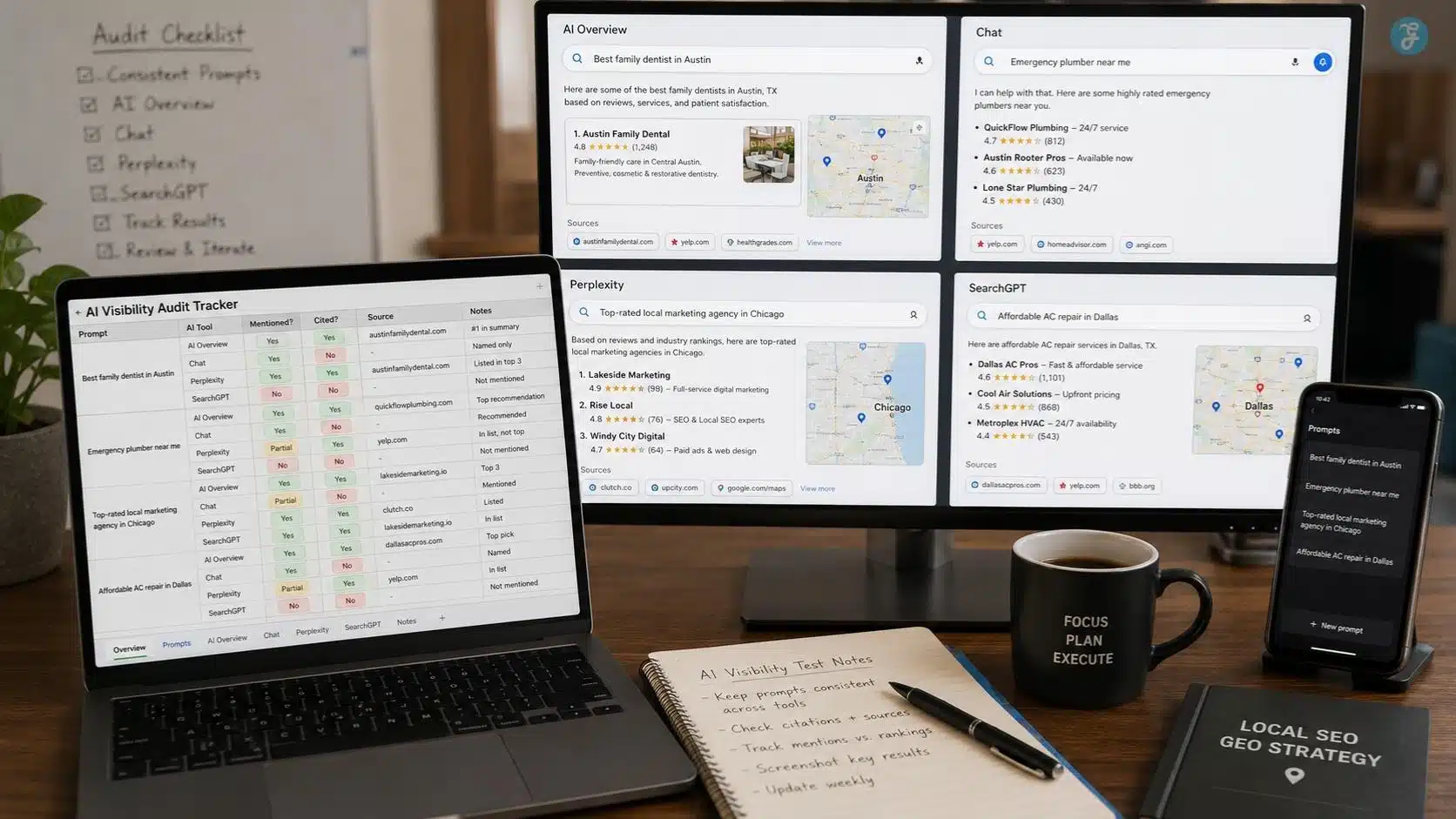
When I check a small business for AI visibility, I do not begin with a complicated tool. I begin like a customer.
I search for the business category in different ways. I use prompts like:
- “Best family dentist in [city]”
- “Affordable web design agency near [area]”
- “Emergency AC repair open now in [city]”
- “Best restaurant for families in [neighborhood]”
- “Top-rated roofing company with strong reviews in [city]”
Then I compare what appears in normal search, maps, and AI-style answers. I look at three things.
First, does the business appear in traditional search and maps? If it is not visible there, it usually has a harder time showing up in AI answers.
Second, does the business appear in AI-generated answers or cited sources? I do not treat one answer as final. AI answers change depending on the wording, location, tool, and source access.
Third, I check the proof behind the business. This is where most small businesses struggle. Their Google Business Profile may be decent, but their website says very little. Or the website is useful, but the business has no Bing listing, no Apple listing, no third-party mentions, no local directory consistency, and no detailed reviews.
That is not only an SEO problem. It is a trust problem. And Local Business GEO is mostly about fixing that trust problem.
The First Layer: A Complete and Accurate Business Profile
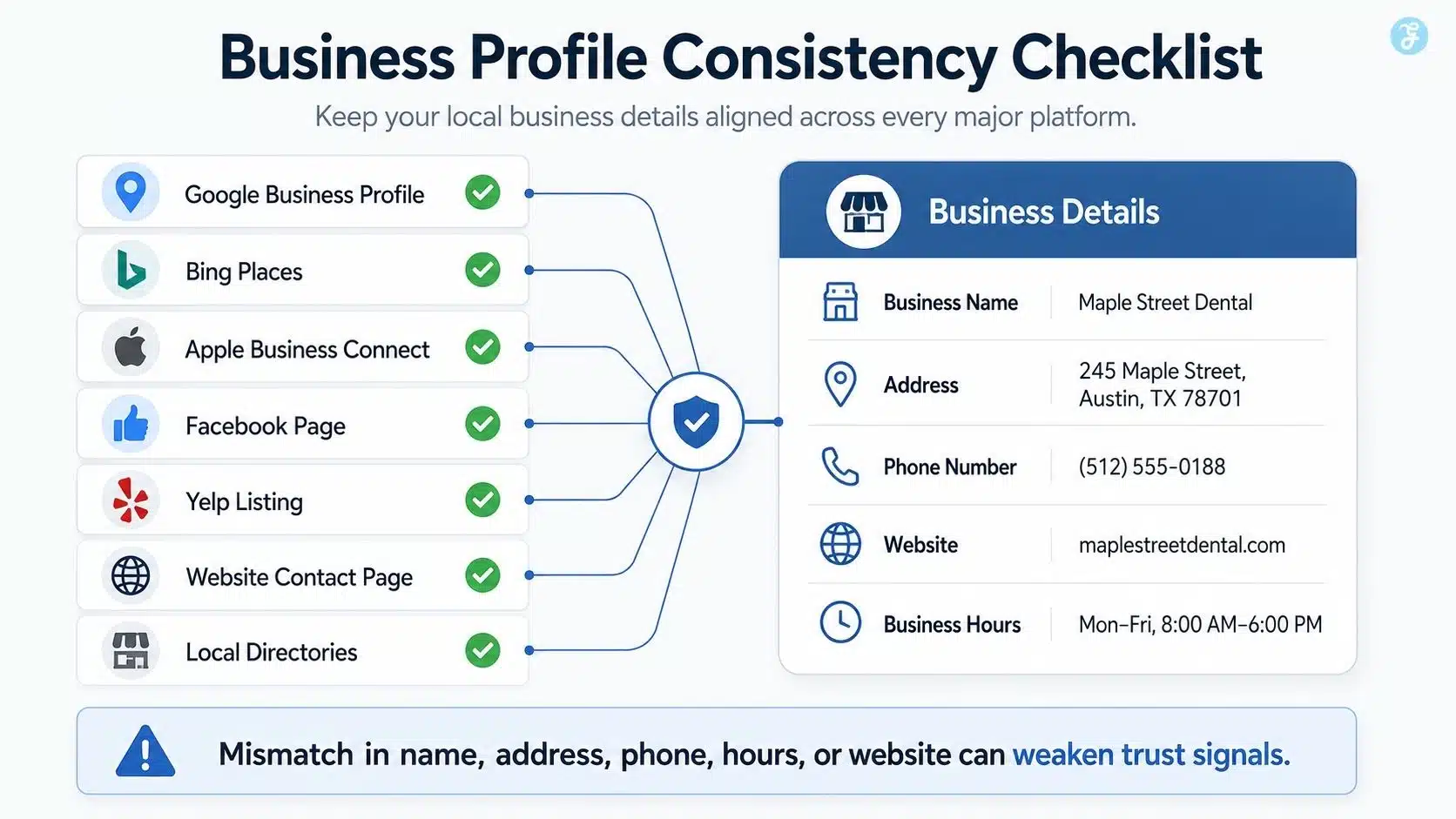
The first thing I check is still the business profile. Google says complete and accurate Business Profile information helps customers understand what a business does, where it is, and when they can visit. Google also explains local ranking through relevance, distance, and prominence. That sounds basic, but basic things often decide whether AI engines can connect the dots.
A business should not have one phone number on Google, another on Facebook, old opening hours on Yelp, and a slightly different business name on its website. When machines see conflicting details, they may choose a cleaner competitor.
Here is what I check first:
| Business Detail | What I Look For |
| Business name | Same name across the website, Google, Bing, Apple, and directories |
| Address | Same address format, including suite or floor number |
| Phone number | One reliable primary phone number |
| Website | Correct live URL, not an old domain |
| Hours | Updated regular hours and holiday hours |
| Category | Specific business category |
| Services | Clear service list |
| Photos | Real business photos, not only stock images |
| Reviews | Recent, detailed, and professionally answered |
I also check non-Google listings. Bing Places lets businesses manage how they appear in Bing Search and Bing Maps, while Apple Business Connect allows businesses to manage place cards across Apple Maps, Siri, Messages, Wallet, and other Apple apps.
This is important because AI-powered discovery is no longer only a Google problem. A small business needs a clean identity across the web. Google, Bing, Apple, Facebook, Yelp, industry directories, local chamber pages, and niche platforms all help confirm that the business is real. That repeated confirmation is powerful.
Why Reviews Are Now Part of AI Visibility
Reviews used to be treated mainly as a conversion tool. Get more reviews, improve the star rating, and win more calls. That still matters. But reviews also help AI engines understand what a business is known for.
BrightLocal’s 2026 local consumer research found that 45% of consumers had used AI tools for local business recommendations, up from 6% the year before. The same research found that ChatGPT was leading among AI tools for local recommendations, with Google’s AI tools also playing a major role.
That is a big shift. When I review a business’s reputation footprint, I do not only ask, “How many Google reviews does it have?” I ask better questions:
- Are the reviews recent?
- Do they mention specific services?
- Do they mention the city, neighborhood, or service area?
- Do customers describe real problems and outcomes?
- Has the business replied in a helpful way?
- Are reviews visible across more than one trusted platform?
Generic reviews like “Great service” are nice, but they do not say much. Detailed reviews are stronger.
For example:
“Same-day AC repair in Mirpur.”
“Helped us choose the right bamboo flooring for our café.”
“Explained the dental implant cost before treatment.”
“Arrived within 40 minutes for an emergency plumbing issue.”
“Very helpful for small business tax filing in Austin.”
These small details help humans decide. They also help machines understand what the business actually does. That is why I tell small businesses to build a review system, not a review panic button. Ask consistently. Reply properly. Do not beg only when rankings drop. Do not copy-paste the same response to everyone.
Reviews are not just testimonials anymore. They are local proof.
The Website Must Answer Real Customer Questions
A lot of local business websites still feel like digital visiting cards. They have a homepage, an about page, a contact page, and one service page that says, “We provide high-quality service at affordable prices.” That may look clean, but it does not help much.
For Local Business GEO, the website has to answer real customer questions. An AI engine cannot confidently summarize a business if the website only gives vague claims. For example, a local cleaning company should not only say, “We offer cleaning services.” It should explain:
- Which areas does it serve
- What types of cleaning does it offer
- What is included
- What is not included
- How booking works
- What products does it use
- Whether it brings supplies
- How long does the service usually take
- What affects the price
- What makes it different from nearby competitors
This does not mean creating hundreds of weak city pages. Google directly warns against making separate pages for every possible search variation, mainly to manipulate rankings or generative AI responses. That warning matters. A small business does not need 200 lazy “near me” pages. It needs a smaller number of strong, specific, useful pages. The page should sound like it came from someone who knows the work.
That means adding details like process, pricing factors, photos, service area, customer questions, limitations, guarantees, and real examples. A plumber, dentist, accountant, salon owner, repair technician, lawyer, or local agency should all be able to explain their service better than a generic AI-written page. If they cannot, AI engines may pick a better source.
Structured Data Helps, But It Cannot Save Weak Content
I like schema. I use it. But I never treat it like magic. LocalBusiness structured data helps search engines understand business details in a standard format. Google says LocalBusiness structured data can tell Google about opening hours, departments, reviews, and other business information. Google also recommends testing structured data with tools like the Rich Results Test.
For a local business, I usually want schema to support details like:
- Business name
- Address
- Phone number
- Opening hours
- Service area
- Business type
- GEO coordinates
- Website URL
- Social profile links
- Booking or appointment URL, where relevant
- Price range, where relevant
But the schema must match the visible page. If the page says one thing and the schema says another, that is not optimization. That is confusion.
My rule is simple: write the page for people first, then use schema to help machines read the same facts more clearly.
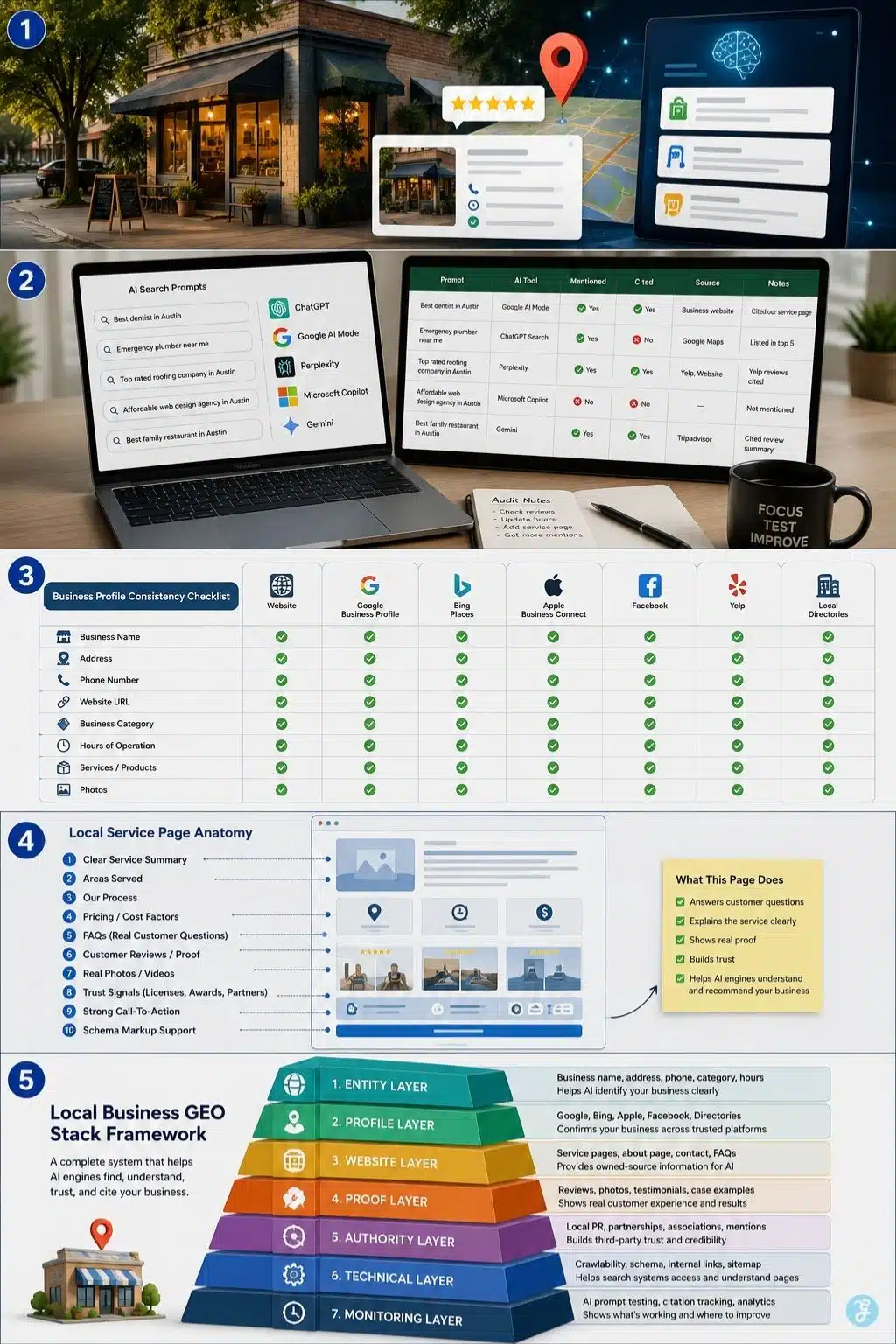
My Local Business GEO Stack
When I build a Local Business GEO plan, I organize the work in layers. This keeps the process practical and stops people from chasing random AI tricks.
| Layer | What I Improve | Why It Matters |
| Entity Layer | Name, address, phone, category, hours | Helps AI identify the business clearly |
| Profile Layer | Google, Bing, Apple, Facebook, key directories | Confirms the business across trusted platforms |
| Website Layer | Service pages, about page, contact page, FAQs | Gives AI-owned source information |
| Proof Layer | Reviews, photos, testimonials, job examples | Shows real customer experience |
| Authority Layer | Local PR, associations, partnerships, mentions | Adds third-party trust |
| Technical Layer | Crawlability, schema, internal links, sitemap | Helps search systems access and understand pages |
| Monitoring Layer | AI prompt testing and citation tracking | Shows where the business appears or disappears |
This stack is not glamorous. It is not a shiny hack. But it works because it solves the real problem: unclear business information.
- Without the entity layer, everything is messy.
- Without the website layer, the business has no strong owned source.
- Without the proof layer, the content sounds like self-promotion.
- Without the authority layer, competitors may look more trustworthy.
Small businesses often want the advanced tactic first. I prefer fixing the boring foundation first. The boring foundation usually has the biggest leaks.
How I Make a Local Business More Cite-Worthy
A cite-worthy business page makes the answer easy. If someone asks, “Which pest control company in this area handles termite treatment?” the page should clearly answer that. It should state whether the business handles termite treatment, where it works, what the process looks like, what proof it has, and how to contact the team.
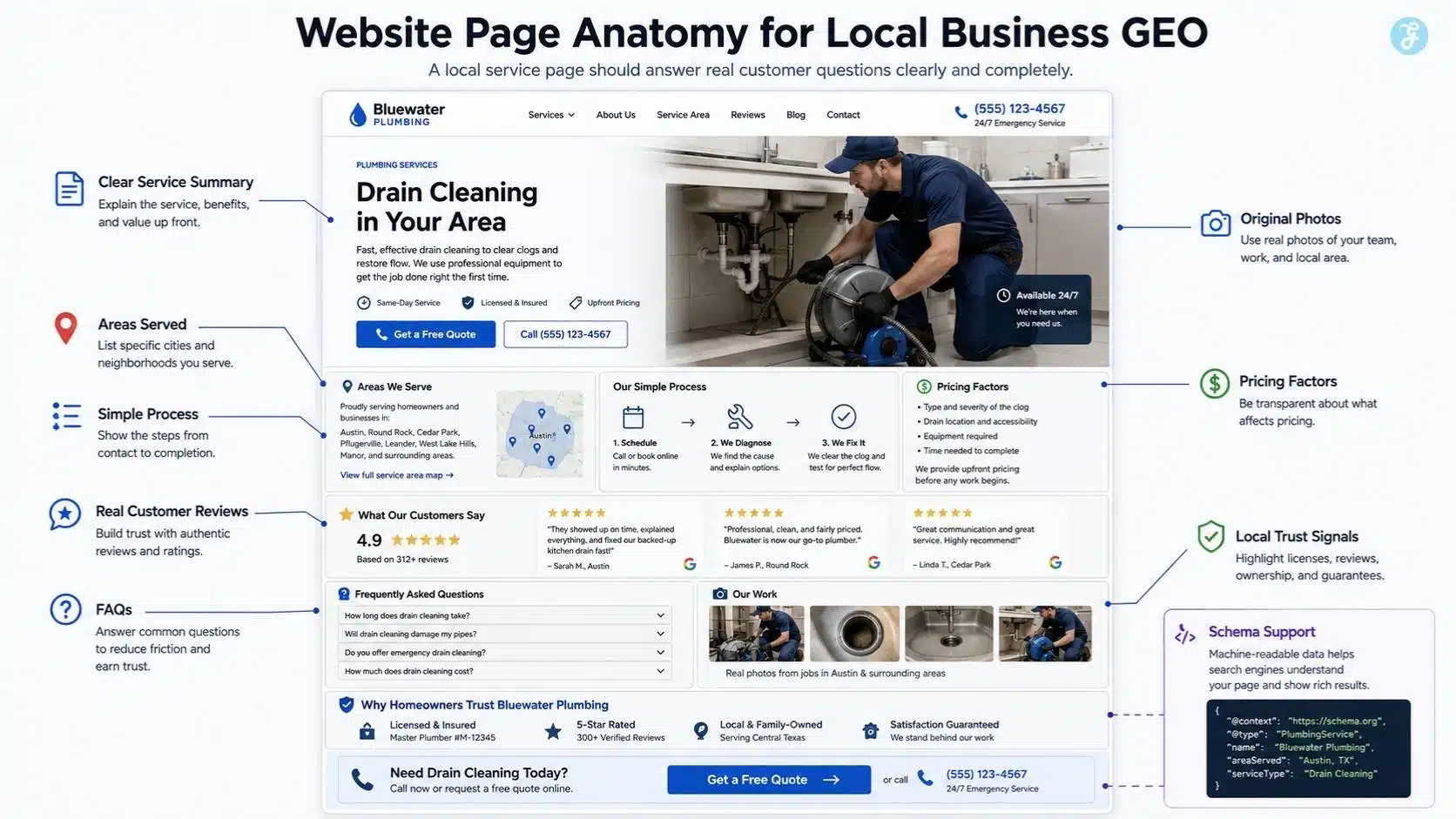
I usually improve local pages with these sections:
A clear service summary: Say what the business does in plain language. No vague “solutions provider” nonsense.
Service area details: Mention real areas served, but do not spam every nearby neighborhood.
A simple process section: Explain what happens after someone calls, books, or requests a quote.
Pricing guidance: Exact prices are not always possible, but the page can explain what affects cost.
Customer proof: Add reviews, testimonials, photos, short case examples, or before-and-after details.
Local trust signals: Mention licenses, years in business, local partnerships, awards, certifications, or community work when they are true.
FAQs from real customers: Use questions people actually ask on calls, emails, WhatsApp, live chat, or social media.
Original photos and videos: Google’s AI optimization guidance says high-quality images and videos can create more opportunities for content to appear in generative AI search experiences.
The goal is not to make the page long for no reason. The goal is to remove doubt. A good local page should make a customer think, “Yes, this business understands my problem.” That is also the kind of page AI can summarize.
What I Would Not Do for Local Business GEO
Local Business GEO is still new enough that bad advice is everywhere.
- I would not create fake reviews.
- I would not publish fake “best of” lists to secretly promote one business.
- I would not build hundreds of copied city pages.
- I would not hide text for crawlers.
- I would not stuff “near me” into every heading.
- I would not invent fake awards, fake authors, or fake offices.
- I would not buy low-quality directory links and call it AI visibility.
Google’s spam policies are clear that sites using deceptive techniques to manipulate Search systems, including generative AI responses, may rank lower or may not appear in results.
That should be enough warning. The safer path is also the smarter path: make the business easier to verify.
- Real reviews.
- Real pages.
- Real photos.
- Real locations.
- Real services.
- Real mentions.
That is slower than a shortcut, but it survives longer.
How I Track Whether Local Business GEO Is Working
I do not rely on one AI answer. That would be risky. AI answers can change depending on the tool, prompt, location, source access, and timing. So I track patterns, not one lucky mention.
Here is the simple tracking sheet I use:
| Prompt | AI Tool | Was Business Mentioned? | Was It Cited? | Source Used | Notes |
| Best [service] in [city] | Google AI Mode | Yes/No | Yes/No | Website, directory, review site | Check accuracy |
| Affordable [service] near [area] | ChatGPT Search | Yes/No | Yes/No | Source URL | Compare competitors |
| Top-rated [business type] | Perplexity | Yes/No | Yes/No | Source URL | Check review mentions |
| Emergency [service] open now | Google Search/Maps | Yes/No | N/A | Business Profile | Check hours |
| Who offers [specific service]? | Copilot/Bing | Yes/No | Yes/No | Bing, website, listing | Check Bing profile |
I repeat the same prompts every month. I also test different wording because real customers do not search in one perfect format. One month of data does not prove much. Three to six months gives a clearer pattern.
I also check whether AI tools are pulling from the business website or from third-party sources. If they only cite directories, that tells me the website is probably not strong enough. If they mention competitors but not my business, I compare the missing proof: reviews, listings, service pages, photos, local mentions, and structured data.
This makes Local Business GEO measurable. Not perfect. But measurable enough to improve.
My Honest Take on Local Business GEO
Local Business GEO is not a shortcut. It is a cleanup job, a proof-building job, and a content quality job rolled into one. Small businesses do not need to panic about AI search. But they should not ignore it either. People are already using AI tools to ask for local recommendations, compare businesses, and narrow choices before they visit a website or make a call.
The businesses that win will not always be the biggest ones. They will be the ones with clear information, consistent listings, useful pages, real reviews, strong local proof, and enough third-party trust for AI engines to feel safe mentioning them.
That is the opportunity. A small business may not beat a national brand in raw authority. But it can beat messy local competitors by being easier to understand, easier to verify, and easier to recommend. That is what Local Business GEO means to me: not tricking AI engines, but giving them better evidence. And honestly, that is what good local SEO should have been doing all along.
Frequently Asked Questions About Local Business GEO
1. What Is Local Business GEO?
Local Business GEO means optimizing a local business so AI engines can find, understand, trust, and cite it in AI-generated answers. It combines local SEO, business listings, reviews, website content, schema, and third-party proof.
2. Is Local Business GEO Different From Local SEO?
Yes, but they are connected. Local SEO helps a business rank in search and maps, while Local Business GEO helps AI engines confidently mention or cite the business in answers.
3. How Can a Small Business Get Cited by AI Engines?
A small business needs a clear and consistent online footprint. That means complete Google, Bing, and Apple listings, useful service pages, real reviews, accurate business details, schema markup, and trusted mentions from local or industry sources.
4. Do Reviews Help With Local Business GEO?
Yes. Detailed reviews help AI engines understand what a business is known for. Reviews that mention services, location, customer problems, and real outcomes are more useful than short generic reviews.
5. Does My Website Need Schema for Local Business GEO?
Schema helps, but it is not enough by itself. LocalBusiness schema can make your business details easier for search engines to read, but the page still needs helpful content, accurate information, and real proof.