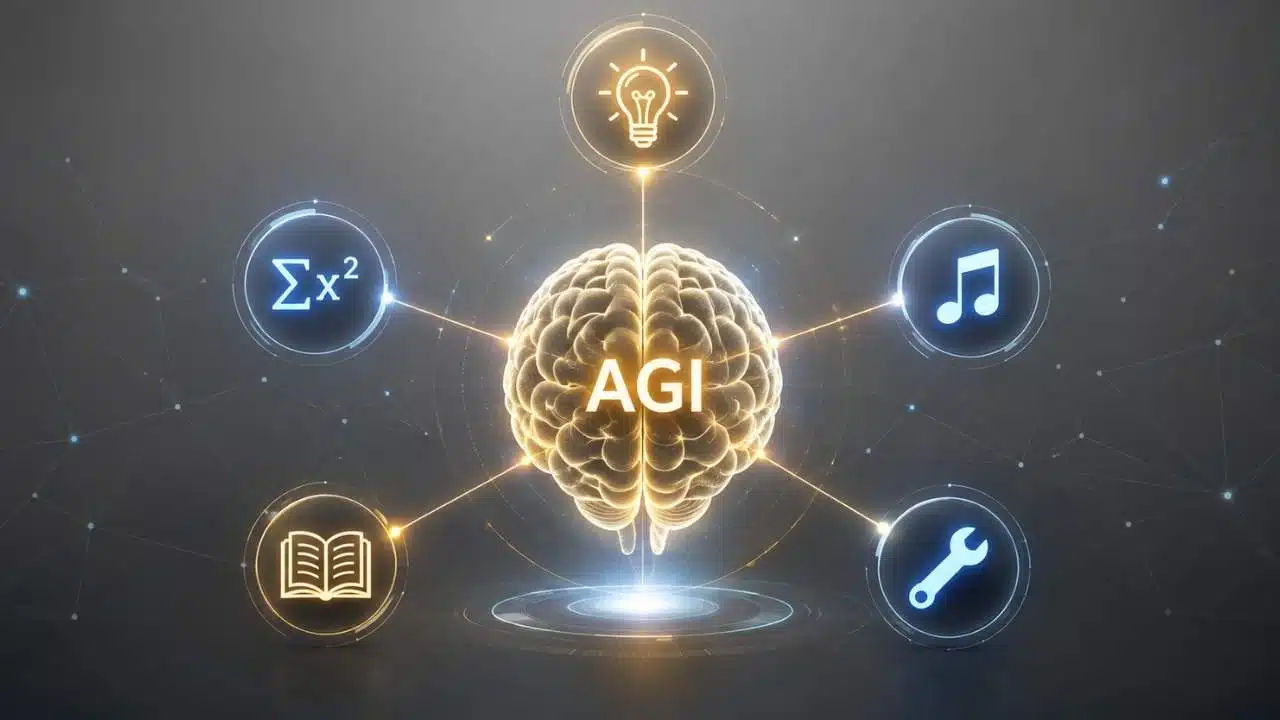
What Is AGI? Artificial General Intelligence refers to autonomous systems that match or surpass human cognitive abilities across a broad spectrum of tasks, including reasoning, adaptive learning, and complex problem-solving.
Unlike today’s specialized systems—which excel at math or coding yet struggle with changing environments—true AGI requires cross-domain adaptability, continuous learning without retraining, and reliable autonomous execution.
While recent breakthroughs in multimodal models and agentic workflows bring us closer to broadly capable machines, achieving true AGI remains hindered by critical engineering challenges in real-world adaptability and long-horizon autonomy. Understanding AGI requires evaluating not just raw benchmark scores, but a system’s ability to operate dependably across unfamiliar, dynamic, and economically valuable domain tasks.
What Is AGI, Exactly?
Artificial general intelligence usually means an AI system that can perform successfully across a wide range of intellectual tasks rather than being confined to one specialised function.
That definition sounds tidy until each word is examined.
How wide must the range be? Must the system equal an average adult, a skilled professional, or the best human specialists? Does it need to learn continually? Must it function in the physical world, or would mastery of digital work be enough? How much supervision can it require before “general intelligence” becomes the wrong description?
Researchers and AI companies answer these questions differently.
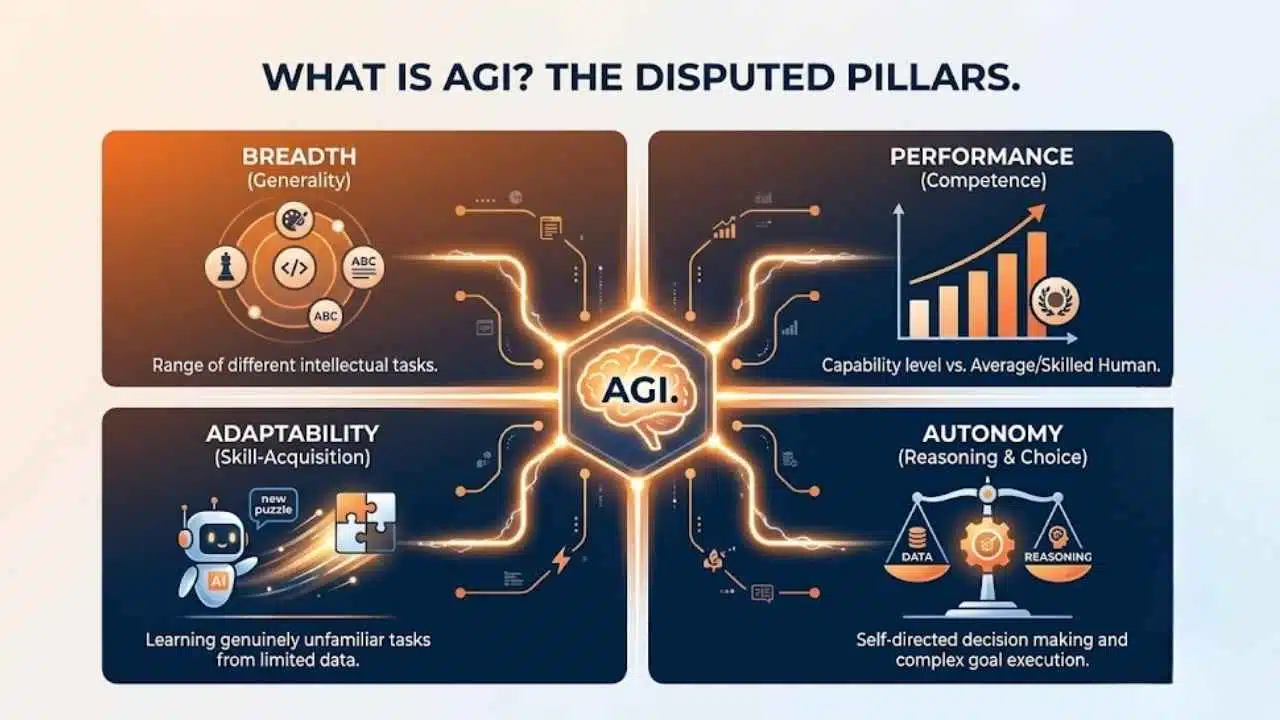
OpenAI’s charter uses an economic definition: highly autonomous systems that outperform humans at most economically valuable work. A Google DeepMind research framework separates generality—the breadth of tasks a system can perform—from performance, while treating autonomy as an additional deployment characteristic.
François Chollet has argued for a different emphasis. In his account, intelligence is not simply the number of skills a system already possesses. A system trained on enormous amounts of data may reproduce a vast range of patterns without being equally capable of learning a genuinely unfamiliar task. Skill-acquisition efficiency—how well a system adapts from limited experience—therefore matters more than accumulated competence alone.
These views overlap, but they set different finish lines.
It helps to distinguish four commonly blurred terms:
- Narrow AI handles a restricted task, such as image classification, route planning, or fraud scoring.
- General-purpose AI can work across many domains through language, images, code, audio, and software tools. Current frontier models fit here.
- AGI would add dependable competence and meaningful adaptation across changing or unfamiliar tasks.
- Artificial superintelligence would exceed human capability across most relevant cognitive domains. It remains hypothetical and should not be used as a synonym for AGI.
The difficult boundary is not between narrow AI and modern foundation models. That line has already moved. The difficult boundary is between broad capability and dependable generality.
Why Current AI Looks General Until the Task Changes
Modern models have absorbed patterns from enormous collections of text, images, code, audio, and other data. They can apply those patterns across subjects without being separately programmed for each request.
This is real progress. Describing these systems as nothing more than autocomplete is no longer useful.
In structured evaluations, leading systems have reached gold-medal-level performance on 2025 International Mathematical Olympiad problems. Coding agents have also become capable of completing some tasks estimated to take a human programmer roughly half an hour. Both achievements would have seemed implausible only a few years earlier.
Yet capability remains uneven.
The same system that solves a difficult proof may fail to count objects reliably, follow an unusual spatial instruction, or notice that a long workflow has gone off course. It may write a competent program and then mishandle a missing dependency, changed requirement, or ambiguous request.
This unevenness is often described as “jagged” intelligence. Hard and easy failures do not appear in the order a person would expect.
Product demonstrations tend to hide this problem. The task is chosen carefully, the prompt is refined, tools are configured, and failed attempts may be removed. Real work is less accommodating. A business process can involve outdated records, undocumented internal software, unavailable credentials, unclear ownership, policy exceptions, and success criteria that cannot be checked by a simple test.
A broadly knowledgeable model may help with that work. General intelligence would require it to respond competently when the expected pattern breaks.
Benchmarks Measure Performance, Not AGI
Benchmarks remain necessary. Without them, every capability claim would be reduced to a promotional demo or anecdote.
Their limits are just as important.
Stanford’s 2026 AI Index reported that frontier models improved by 30 percentage points in one year on Humanity’s Last Exam, a test built around difficult expert-level questions. The same report noted that some evaluations expected to remain challenging for years were being saturated far more quickly.
Those gains matter. They do not mean a benchmark measures pure reasoning.
A high score may combine recalled knowledge, reasoning, retrieval, code execution, repeated sampling, specialised prompts, and additional software wrapped around the model. Once a public benchmark becomes influential, developers also have an incentive to train toward its format. With web-scale training data, ruling out exposure to similar questions or solutions is difficult.
ARC-AGI was designed to reduce some of these advantages. Its visual reasoning tasks require systems to infer a rule from a small number of examples and apply it to a new case. The winning entry in the 2025 Kaggle competition scored 24.03% on the private ARC-AGI-2 evaluation under the contest’s rules. Separately evaluated commercial and refinement systems achieved higher scores outside that setup.
The distinction matters. “The best system scored 24%” would be inaccurate. The result belonged to a particular competition with specific constraints.
ARC also measures only one form of adaptation. A model could improve substantially on abstract visual puzzles while remaining poor at social judgment, long-term planning, scientific investigation, or operating in the physical world.
A serious AGI evaluation would need to combine private and frequently changing tests across unrelated domains. It would need to examine performance when instructions are incomplete, tools fail, costs are constrained, and answers cannot be checked instantly. Independent teams would also need to reproduce the claims.
Even then, the result would describe a capability profile. It would not produce an objective AGI certificate.
The More Important Gaps Are Operational
Discussions of AGI often focus on model architecture. For companies deciding what AI can safely do, the more immediate gaps are visible in ordinary work.
Learning Without Extensive Preparation
Frontier models can adapt to instructions and examples supplied in a prompt. They can also retrieve external information and use task-specific tools. That is not the same as learning an unfamiliar domain reliably, preserving the useful lesson, and transferring it to a different problem.
A general system should not need thousands of closely related examples whenever the task family changes. It should be able to identify relevant structure while avoiding assumptions carried over from the wrong context.
Current models sometimes manage this. They do not do it consistently enough for efficient generalisation to be considered solved.
Completing Long, Messy Work
Most professional tasks are not one prompt long. They involve dependencies, changing information, unavailable people, conflicting instructions, tool failures, and decisions about when to stop.
METR’s task-completion time horizon is one useful attempt to measure progress. It estimates the human task duration at which an AI agent is predicted to succeed at a specified rate. Results show that agents are handling increasingly long software tasks.
The measure is easy to misreport. A two-hour time horizon does not mean the agent can replace any worker for two hours or operate independently for that period. METR’s task set is concentrated in well-specified software engineering, machine-learning, and cybersecurity work. It also warns that estimates above 16 hours are unreliable with the current evaluation suite.
Ordinary workplace tasks contain more organisational friction. A person may need to negotiate priorities, question an instruction, interpret a policy exception, or recognise that the requested outcome would create another problem. Those actions are difficult to represent in a benchmark with a clean answer.
Knowing When Not to Continue
Current AI systems can express uncertainty, but confident language does not reliably indicate a correct answer. A polished response may contain an invented source, a faulty assumption, or a calculation that was never checked.
External tools help. Calculations can be verified, code executed, documents retrieved, and actions placed behind approval steps. The harder problem is deciding when checking is required.
For an AI drafting meeting notes, occasional mistakes may be tolerable if a person reviews the result. For an agent deploying software, changing account permissions, transferring funds, or updating customer records, recognising uncertainty is part of the core capability.
A system that completes nine tasks successfully and causes serious damage on the tenth may still look impressive in a demonstration. It is not ready for unrestricted autonomy.
Memory and the Physical World Remain Uneven
AI products can store user preferences, retrieve company documents, search databases, and maintain external task histories. These features create useful continuity, but they are usually engineered systems around the model rather than evidence that its underlying knowledge is continually and safely updated.
Persistent memory introduces its own problems. Records become outdated. Conflicting details accumulate. False information may be saved. Privacy rules can limit what should be retained in the first place.
AGI would not need to copy human memory, but it would need a dependable way to preserve relevant knowledge, revise incorrect beliefs, and distinguish temporary context from lasting facts.
Physical interaction adds another layer. Robots must cope with noisy sensors, incomplete visibility, hardware wear, changing environments, and actions that cannot simply be undone. General-purpose AI still struggles to translate its digital competence into reliable household or workplace robotics.
This does not rule out an economically significant form of AGI arriving first through software. A system could automate large amounts of knowledge work while remaining poor at folding clothes, repairing machinery, or navigating an unfamiliar building. Once again, the timeline changes with the definition.
How Close Are We to AGI?
There is no technically credible countdown.
Under an economic definition, AGI may appear relatively close if systems become capable of performing much of remote knowledge work through software. They would not need to think like people or master every physical task. They would need to produce enough reliable work to outperform human labour across a large share of valuable activities.
Under a stricter definition centred on learning, adaptation, judgment, and reliability in unfamiliar settings, the gap looks larger. Current systems still depend heavily on carefully designed tools, structured feedback, considerable computing resources, permission limits, and human review.
A 2023 survey of 2,778 researchers who had published at leading AI venues illustrates the uncertainty. The aggregated forecast placed a 50% probability on unaided machines outperforming humans in every possible task by 2047. The same survey placed the 50% date for full automation of all human occupations at 2116.
The 69-year difference does not provide a useful countdown. It shows how dramatically forecasts change when the question changes.
Survey responses are beliefs, not measurements derived from a technical model of progress. They can shift after a major product release, an unexpected scientific bottleneck, a change in funding, or a different interpretation of AGI.
Progress is also likely to remain uneven. AI may outperform many professionals at specific analytical tasks while remaining poor at managing a long project. It may automate much of coding, research, customer support, or accounting without replacing the jobs built around those activities.
AGI, should it emerge, may not arrive as one model crossing a visible line. It may look like a series of systems taking over larger and more connected pieces of work until the old categories no longer describe them well.
What Enterprise Leaders Should Measure Instead
A vendor’s AGI claim should carry little weight in a purchasing decision. The relevant question is what the system can complete reliably in the organisation’s actual environment.
Before deployment, teams should ask:
- Can it finish the entire workflow, or only create a convincing first draft?
- How often does an expert need to correct or restart the work?
- Does performance survive incomplete, unusual, or contradictory input?
- Can a failure be detected before it reaches a customer or production system?
- What happens when a tool is unavailable or permission is denied?
- Is the cost of review lower than the process being replaced?
- Can autonomous actions be logged, limited, reversed, and disabled?
High-autonomy systems need stricter controls than chat assistants. Credentials should be limited. Testing and production environments should remain separate. Irreversible actions should require approval, and the system should have a clear route for returning control to a person.
Independent evaluations, incident reporting, data controls, model-change notices, and the ability to restrict tool access are more useful procurement requirements than a supplier’s prediction about when AGI will arrive.
Final Thoughts
So, what is AGI? It is a disputed threshold for AI that can work broadly, adapt to unfamiliar tasks, and remain dependable beyond carefully designed demonstrations.
Current systems have moved far beyond traditional narrow AI. They can support many professional domains and complete increasingly difficult work through software. They also remain brittle in long workflows, uncertain situations, and environments that demand sustained judgment.
We may be close to AI that reshapes large areas of knowledge work without being close to a machine that behaves like a capable person in every unfamiliar setting. Those are different milestones, and both would have major consequences.
For decision-makers, the useful test is immediate: identify what the system can complete, how often it fails, how much supervision it requires, and whether the organisation can contain the damage when it is wrong. That assessment matters more than deciding whether a product deserves the AGI label.