A vertical slice is a major milestone in game development. It is a small, self-contained chunk of gameplay. It shows all major game systems working together. It gives a fully playable portion that matches the intended player experience.
It can look like a playable demo, but it serves a specific development purpose.
Teams build a vertical slice to show vision and polish to the development team, publishers, and potential investors. It brings game mechanics, game design, user experience, and testing together to check integration.
Slices can range from rough prototype systems to more polished showcases. Publishers ask for them to reduce risk, judge funding, and decide on next milestones.
This blog post will guide you through what is a vertical slice, its key features, and why publishers ask you for one before investing time or money. Learn how creating a strong vertical slice can make your project stand out and speed up decisions. Read on to see how vertical slicing could be the milestone that brings your vision closer to reality!
Key Characteristics of Vertical Slices
Vertical slices show complete features from start to finish. They mix different skills and focus on value for the user. This way, everyone sees how pieces fit together in a fun and useful way.
Want to learn more about why this matters?
End-to-end delivery of fully functional features
A vertical slice shows all major game systems working together. It is a small, self-contained part of gameplay that allows players to feel the entire player experience. Developers create this complete and playable section to ensure everything functions well as one.
This includes game mechanics, art, sound, and design elements.
Developers use a vertical slice as an important milestone. It helps them assess if core systems work properly when integrated. This playable demo gives publishers a look at the nearly finished product.
By seeing it in action, they can better understand project viability for funding decisions during development phases.
How vertical slicing differs from horizontal slicing
Vertical slicing and horizontal slicing are two ways to develop software and games. Vertical slicing focuses on creating a small, complete part of the game that shows all major systems working together.
This means players can experience gameplay, game mechanics, and user experience in one cohesive section. It is more than just an advanced prototype or the next step after prototyping.
Horizontal slicing, on the other hand, breaks down development into layers or parts without tying them together. Each layer might focus only on specific features like graphics or sound.
While this method looks at each piece individually, it does not show how they work as a whole. Vertical slices allow for testing core systems in action; horizontal slices often miss this vital integration aspect.
Publishers prefer vertical slices because they provide a clearer view of the game’s playability and functionality across all major systems simultaneously.
Value-driven, cross-functional approach
A vertical slice uses a value-driven, cross-functional approach. This means it brings together different teams to work on all parts of the game. Designers, developers, and testers collaborate closely.
Each group focuses on their tasks while ensuring everything fits well together.
The goal is to create an experience that showcases the full game systems in action. Developers build this playable demo as a near-finished portion of the game. It highlights core mechanics and player experiences effectively.
Publishers look for this holistic view when deciding about funding and support during development phases.
Why Publishers Request Vertical Slices
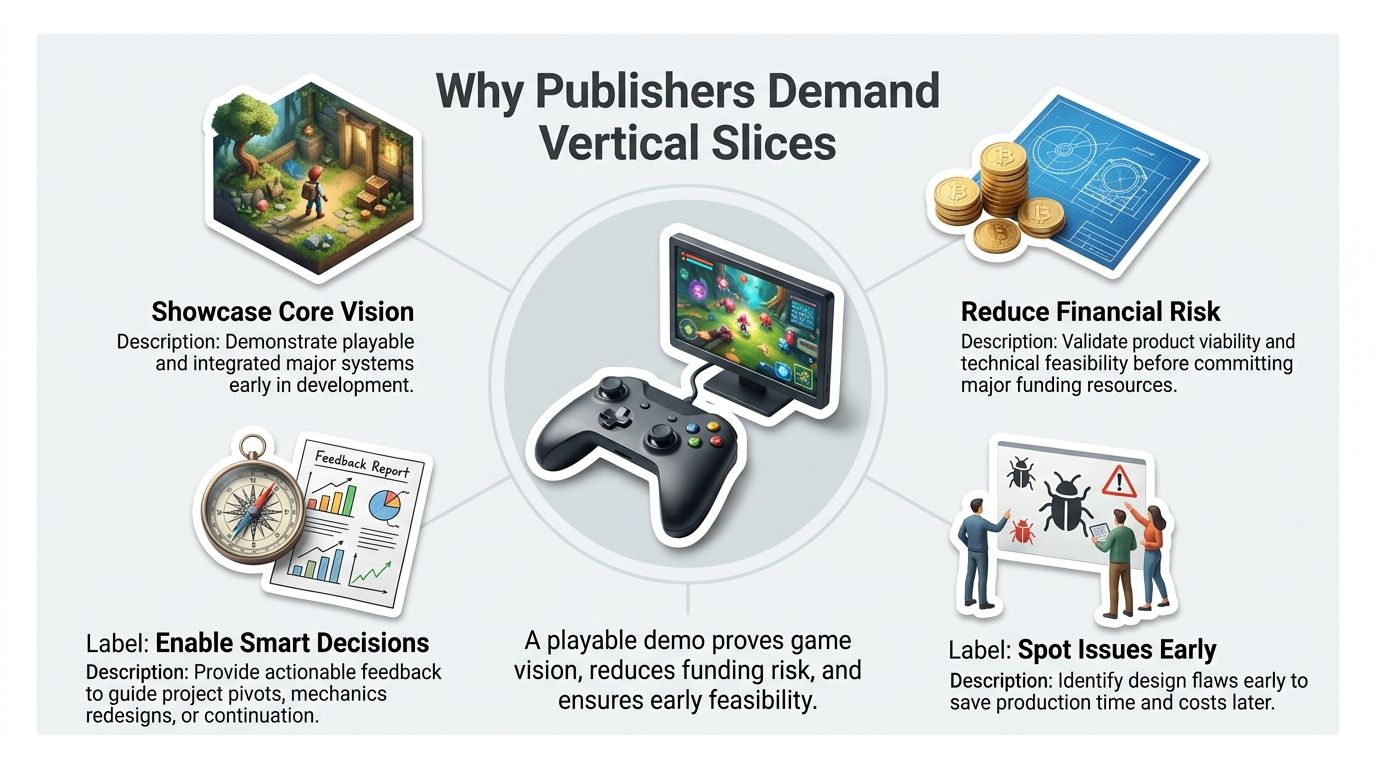
Publishers request vertical slices to see the game’s vision early. This approach helps them assess quality and make better funding decisions.
Early demonstration of product vision and quality
A vertical slice shows the game’s vision and quality early in development. This part of the game is fully playable. It gives a clear view of how all major systems work together. Developers use it to showcase their intended player experience.
A vertical slice helps everyone see the project’s direction.
Publishers find value in these slices for funding decisions. They can assess if a game idea is viable or not before providing money. The demonstration allows for better decision-making during development milestones too.
Overall, a well-made vertical slice reveals both playability and functionality across all game elements at once.
Risk reduction and feasibility assessment
Vertical slices help reduce risk in game development. They show if the game’s core systems work well together. This self-contained piece of gameplay demonstrates the developer’s intended player experience.
Publishers use vertical slices for feasibility assessment before funding a project. They want to see how close the game is to its final form.
Testing a vertical slice allows teams to spot issues early. It cuts down on time and costs later in development phases. Teams can gather feedback from stakeholders during this stage.
This makes it easier to decide whether to continue, change direction, or rethink game mechanics. Overall, vertical slices offer valuable insights and support informed decisions about funding and design choices.
Informed decision-making for funding and development
A vertical slice helps publishers make smart choices about funding and development. It shows a playable demo that highlights the core gameplay and systems of the game. This portion gives all major elements in one intact experience.
Publishers can see if the game is fun and works well before they decide to invest money.
Evaluating a vertical slice allows for risk reduction during the project. Publishers get an early view of what to expect from the final product. They can assess both quality and feasibility with this hands-on showcase before fully committing resources to development efforts.
How Vertical Slices Are Implemented in Practice
To create a vertical slice, teams define the project scope and focus on key features. They build cross-functional teams to deliver these features in a way that showcases the full experience of the game or software.
Steps to create a vertical slice (defining scope, building cross-functional teams, delivering features)
Creating a vertical slice starts with defining the scope. This means deciding what gameplay and features to include. The goal is to show all major systems working together. Next, build cross-functional teams.
These groups should have different skills like design, art, and programming. Each member plays a key role in making the game come alive.
After forming the teams, focus on delivering features. The team will work on core elements of gameplay that showcase player experience. A vertical slice is more polished than an advanced prototype; it shows near-finished quality for publishers and investors.
It tests whether all game systems function properly when combined into one playable demo.
Examples from game and software development
Vertical slices are used in game and software development to show how all parts of a project fit together. In a game, this might mean creating a playable demo that highlights core gameplay mechanics.
It allows players to experience major systems working as one unit.
For example, in the making of an action-adventure game, developers create a vertical slice that includes combat, exploration, and puzzles. This slice showcases player experience and game design choices.
It helps teams test if everything functions properly together before moving on. In software development, vertical slices can demonstrate key features of an app or system at early stages.
Developers use these slices for testing and feedback while refining user experience throughout different milestones.
Integration with Agile workflows
Agile workflows fit well with vertical slices in game development. They allow teams to focus on small, functional parts of the game. Each slice showcases major systems working together.
This helps developers test core gameplay mechanics early. They can get feedback quickly and make changes before moving on.
Teams work closely across different roles during a vertical slice. Artists, programmers, and designers collaborate to bring all elements together. This teamwork boosts communication and keeps everyone aligned with the project’s goals.
As a result, integrating vertical slices into Agile methods leads to better outcomes for both developers and publishers seeking funding or evaluating project viability.
Final Words
Vertical slice helps developers test ideas, find problems early, and improve the player experience. It also gives publishers and investors a clear view of the game’s quality, progress, and potential.
A strong vertical slice can reduce risk, support funding decisions, and keep the team focused. When done well, it can become an important step toward turning a game idea into a successful final product.