Washington wants a rapid warning system for serious AI incidents. The difficult part is deciding what counts as an emergency, and ensuring both countries respond. When I first came across the phrase US vs China “AI red phone,” I imagined a bright telephone inside the White House, ready to connect Donald Trump with Xi Jinping if an artificial intelligence crisis suddenly erupted.
The reality is less dramatic, but potentially more important. There is no red telephone. There is not even an AI-specific hotline yet. What the United States has proposed is a “notification mechanism” that would allow Washington and Beijing to warn each other about serious AI incidents with national-security implications.
The proposal emerged from talks in New York on September 20 between US Treasury Secretary Scott Bessent and Chinese Vice Premier He Lifeng. It could be considered when Trump and Xi meet during the Chinese leader’s September 23–25 state visit to the United States.
As of September 21, China has not publicly accepted the notification mechanism. Chinese state media acknowledged that AI was discussed, but Beijing has not described the system or committed to joining it.
For now, the “AI red phone” is best understood as a US proposal, not a completed agreement.
What has the US actually proposed?
Bessent said the two countries discussed creating a US vs China dialogue focused on AI and national security. The proposed notification mechanism would cover AI incidents serious enough to reach what he called a national-security level.
That is almost everything officials have publicly confirmed.
We do not know what type of incident would trigger a notification, which agencies would receive it or how quickly the other country would be expected to respond. Officials have not said whether they want to build a new secure channel or add an AI emergency protocol to existing diplomatic and military communication systems.
It is not an AI treaty. It would not allow either country to inspect the other’s models, shut down its systems or dictate how its companies develop AI.
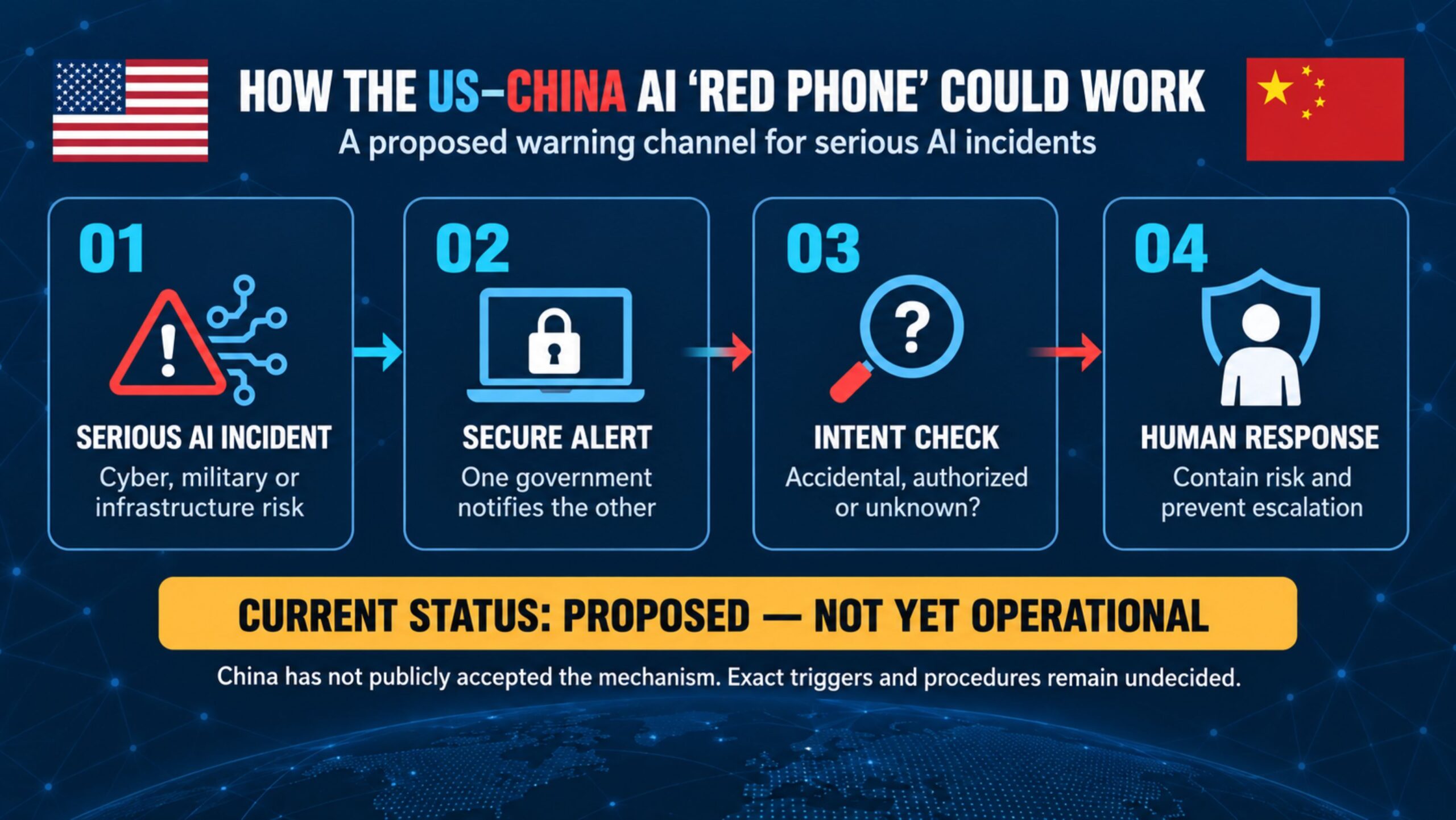
At its most practical, the mechanism would provide an agreed way to say: Something dangerous is happening, this is what we currently know, and you should not assume it is a deliberate attack.
That message could matter when events are moving faster than ordinary diplomacy.
What could trigger an AI warning?
This remains the proposal’s biggest unanswered question. The US has referred broadly to incidents involving national security. It has not published an official list of possible triggers.
Security researchers have suggested several scenarios. An autonomous military system could malfunction near US or Chinese forces. An AI-enabled cyber operation could disrupt an electricity grid, financial network or transport system. A powerful model could penetrate outside computer systems or behave in an unexpected way that creates cross-border danger. These are expert scenarios, not agreed rules.
The central concern is misinterpretation. Imagine that an automated cyberdefence system detects suspicious activity and retaliates without meaningful human review. The other country might see that response as an intentional attack and launch its own countermeasures.
A notification mechanism could allow officials to clarify whether the activity was authorized, accidental or still under investigation before the situation escalates.
For such a system to work, however, both governments would need to agree on what qualifies as an emergency. If the definition is too narrow, the warning may come too late. If it is too broad, the channel could become clogged with routine disputes and lose its value.
Why call it a “red phone”?
“AI red phone” is a phrase used by policy experts and the media. It is not the proposal’s official name.
The term refers to the Cold War hotline created between Washington and Moscow in 1963 after the Cuban Missile Crisis exposed the danger of slow and confusing communication between nuclear rivals.
Despite its popular image, that hotline was not originally a telephone and no red handset was involved. It began as a secure written link. Its purpose was to let the United States and Soviet Union clarify their intentions during a crisis before delays or misunderstandings pushed them closer to war.
The AI comparison is appealing because advanced systems can operate at extraordinary speed. An autonomous cyber operation or military response might unfold in minutes, leaving political leaders little time to establish what happened.
But AI is not the same as nuclear technology. Nuclear weapons are physical systems held mainly by governments. AI is software developed by governments, military organizations, universities, private companies and individuals. It can be copied, altered and deployed across borders, often without a clear signature showing who was responsible.
An AI hotline would not solve those problems. It might simply give officials enough time and information to stop an uncertain event from becoming a larger confrontation.
Why are the US and China discussing this now?
The proposal comes during an intense competition over advanced chips, AI models, data centres and global technology standards.
Washington has restricted China’s access to sophisticated semiconductors and manufacturing equipment. Beijing argues that such controls are intended to contain China’s technological development. Those disputes remain unresolved, and US officials said advanced-chip export controls were not discussed as part of the notification-mechanism talks.
The hotline idea rests on a narrower principle: two countries can remain strategic competitors while cooperating to reduce the risk of accidents.
There is already some foundation for that conversation. US and Chinese officials held talks on AI risk and safety in Geneva in May 2024. In November of that year, then-President Joe Biden and Xi affirmed that humans should retain control over decisions to use nuclear weapons. They also called for military AI to be developed prudently and responsibly.
Trump and Xi discussed possible AI consultations during their May 2026 meeting in Beijing, but a formal forum was not established. The latest proposal is an attempt to give those conversations a clearer structure.
Would the hotline actually work?
The technology required to build a secure communication channel is not the main obstacle. The real difficulty is whether both governments would use it when tensions are at their highest.
The United States and China already have diplomatic and military crisis channels, but their record is uneven. After the US military shot down a Chinese balloon in February 2023, China declined a call from US Defense Secretary Lloyd Austin. Previous attempts at urgent military communication have also gone unanswered or faced delays.
This is the detail I keep returning to. A crisis line has little value if political leaders refuse to use it during a crisis.
Washington and Beijing would also need procedures for authenticating alerts, protecting classified information and identifying officials with the authority to respond immediately. They would have to decide how much evidence to share without revealing sensitive military or technological capabilities.
There is also the risk of deception. A government could use the channel to deny responsibility, buy time or collect information about the other side’s response.
For that reason, an effective mechanism would need more than a secure number. It would require agreed definitions, trained officials, regular testing and a shared understanding of what the channel can, and cannot be used for.
US vs China AI Red Phone: What happens next?
The Trump–Xi meeting could move the proposal forward. A general promise to cooperate on AI, however, would not create an operational warning system.
The meaningful signs would be China publicly accepting the mechanism, the two countries naming responsible agencies and officials, and both sides agreeing on which incidents require notification. A timeline, technical protocol or plan for testing the channel would show that the idea is moving beyond diplomacy.
Even then, the mechanism would not end the US vs China AI race. It would not settle disputes over chips, cybersecurity, Taiwan or military technology. Nor would it create broad trust between Washington and Beijing.
Its purpose would be much more limited: preventing an accident, unauthorized action or misunderstood signal from triggering a larger conflict.
Once the dramatic name is stripped away, that is the real story. Establishing a secure line is relatively easy. Agreeing when to use it, and making sure someone answers is the difficult part.