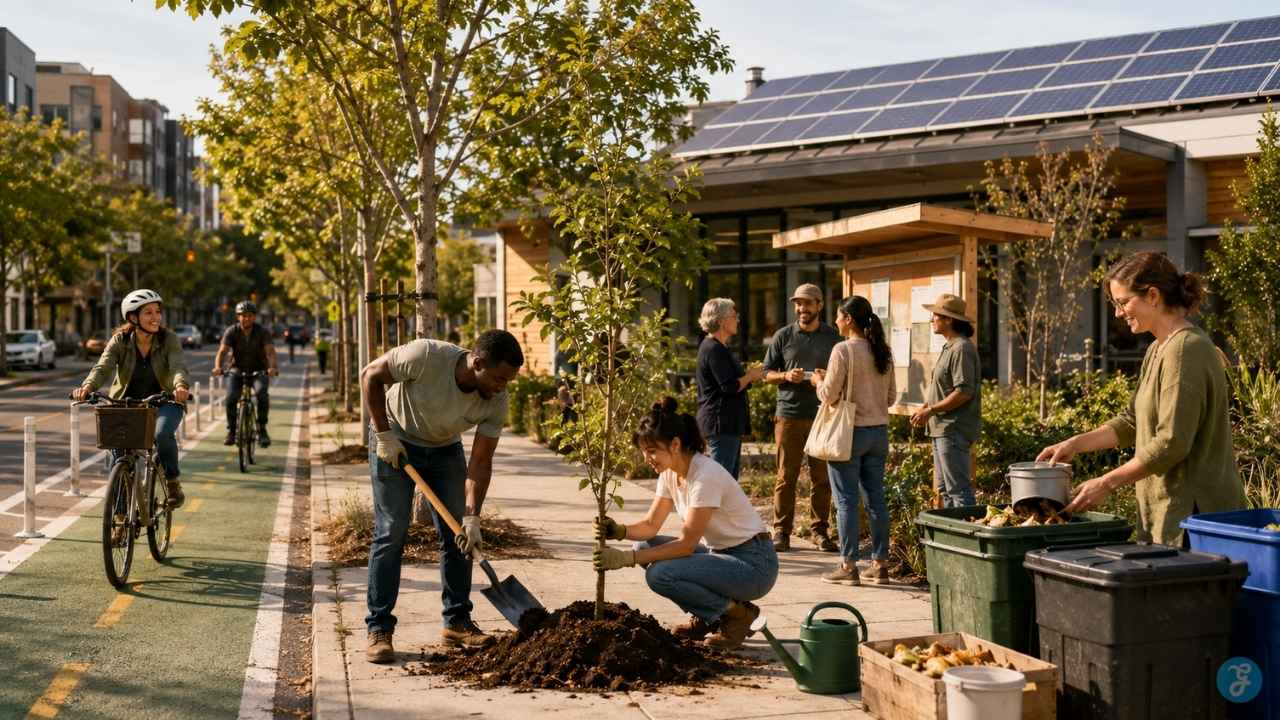
Most climate advice tells people what to do alone. Drive less. Buy less. Eat differently. Switch bulbs. Reduce waste. Plant something. Vote. Those actions can matter. But the most powerful local climate actions do something bigger: they change the systems around daily life so more people can make lower-carbon choices without fighting the same barriers every day. That is where local climate work becomes interesting.
A single household composting is useful. A neighborhood compost program changes the waste stream. One person biking is good. A safer street makes biking possible for hundreds of people. One family buying solar is meaningful. Community solar can help renters, apartment dwellers, and shaded-roof households access clean power too. One tree helps. A shade plan for the hottest blocks can reduce heat risk for an entire neighborhood.
This is why community climate action should not be treated as symbolic volunteerism. Local governments, schools, libraries, faith groups, neighborhood associations, utilities, small businesses, and residents all make decisions that shape buildings, transportation, food, waste, trees, public spending, and emergency resilience.
EPA’s local climate and energy strategy series groups local emissions-reduction work into areas such as energy efficiency, transportation, community planning and design, solid waste and materials management, and renewable energy. That is a useful reminder: local climate work is not one activity. It is a set of shared systems that can improve over time.
This guide focuses on 11 local climate actions that compound because they create habits, infrastructure, policies, and community capacity that keep paying off.
What Makes Local Climate Actions Compound?
A local climate action compounds when its impact does not stop with one person’s behavior. It may create a public policy, a better building, a new shared service, a safer route, a local rule, a reliable volunteer network, a community-owned resource, or a budget line that keeps working after the first campaign ends. That is why some actions have more leverage than they seem.
A public building energy upgrade saves energy year after year. A safer crosswalk can shift thousands of short trips. A local compost pickup route helps many households divert food waste. A tree canopy plan can cool streets for decades if trees are cared for properly. A repair café can stop dozens of items from being thrown away while teaching skills. A climate dashboard can make local leaders answer for progress.
The best local environmental work usually has three traits:
| Compounding Trait | Why It Matters |
| It changes a shared system | More people benefit without each person solving the problem alone. |
| It can be repeated | A habit, route, policy, or program grows stronger over time. |
| It creates local capacity | The community becomes better prepared for future climate decisions. |
| It is measurable | People can see whether the action is working. |
| It improves daily life | Climate action lasts longer when it also improves comfort, cost, safety, or health. |
That last point matters. Local climate action should not feel like punishment. The strongest projects often make neighborhoods cooler, safer, cleaner, cheaper to run, and easier to live in.
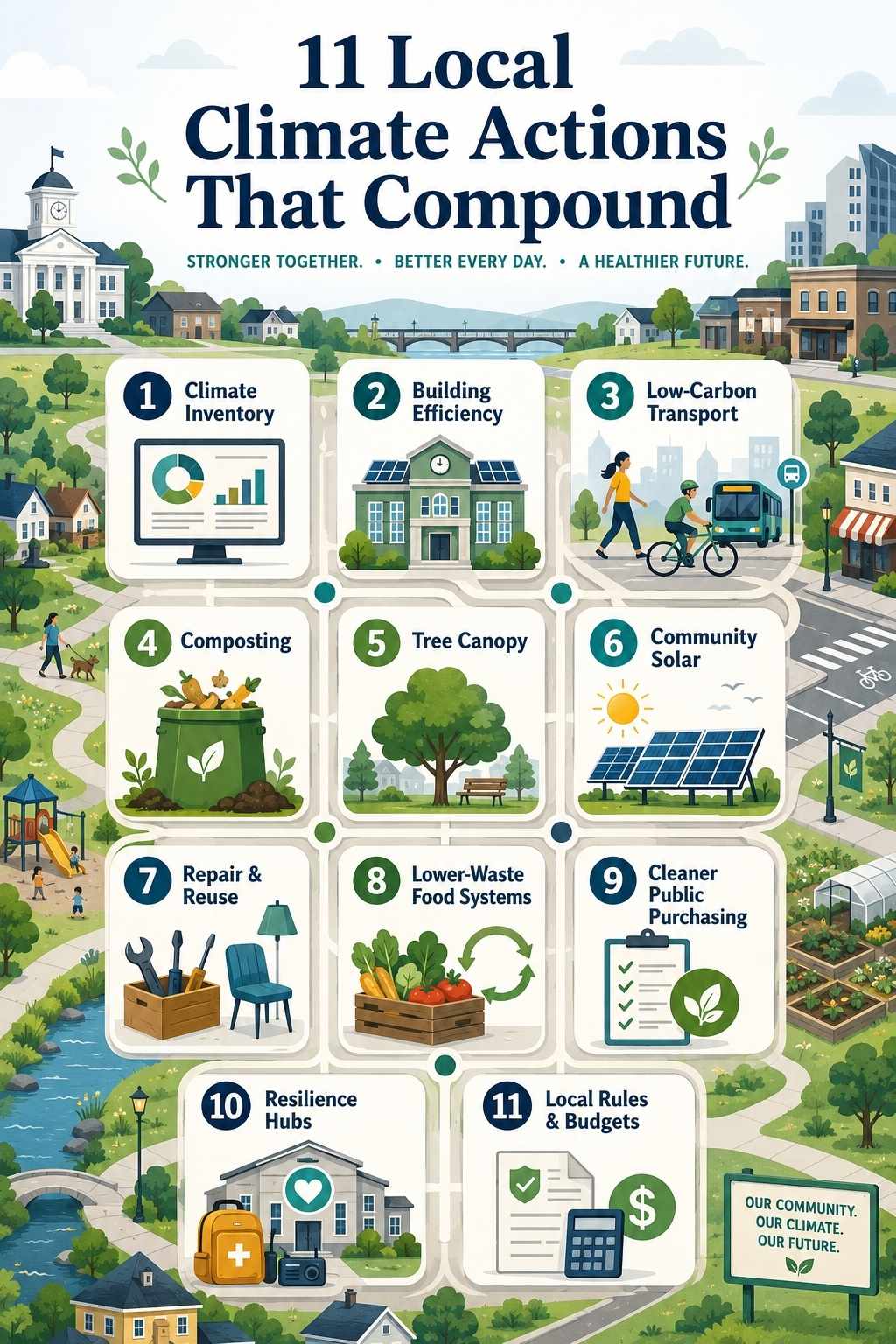
11 Local Climate Actions That Compound
These actions are not ranked as quick lifestyle tips. They are local levers. Some can be started by residents. Others require school boards, city councils, utilities, local businesses, neighborhood groups, or public agencies.
1. Demand a Local Climate Inventory and Public Progress Tracking
A community cannot manage what it refuses to measure. That is why one of the most important local climate actions is pushing for a greenhouse gas inventory, climate action plan, and public progress dashboard. It may sound less exciting than planting trees or launching a cleanup, but it creates the foundation for serious accountability.
A local climate inventory shows where emissions come from: buildings, transportation, waste, energy use, industry, municipal operations, or other sources. Once the baseline exists, the community can set targets, prioritize projects, and track whether policies are actually reducing emissions.
The GHG Protocol for Cities says city greenhouse gas inventories help cities measure emissions, build more effective reduction strategies, set measurable goals, and track progress more accurately.
For residents, this action can look like asking the city to publish annual emissions data, requesting a public climate dashboard, attending budget hearings, or asking candidates how they will track progress. For neighborhood groups, it can mean translating complicated reports into simple community updates.
This compounds because it changes the conversation from “we care about climate” to “we know where emissions come from, what we are doing, and whether it is working.”
Best for: Residents, advocacy groups, local journalists, students, civic associations, and climate committees.
Why it matters: Data turns climate promises into something residents can question, compare, and monitor.
What to watch: A dashboard is only useful if it is updated. Ask for regular reporting, clear metrics, and plain-language explanations.
2. Upgrade Energy Efficiency in Schools, Libraries, Rentals, and Public Buildings
Public and shared buildings are climate opportunities hiding in plain sight. Schools, libraries, recreation centers, city halls, public housing, rental buildings, community centers, and small commercial spaces use energy every day. When they waste energy, the cost shows up in public budgets, rent, utility bills, and emissions.
Energy-efficiency upgrades can include LED lighting, insulation, air sealing, efficient heating and cooling, heat pumps, smart controls, better windows, building benchmarking, and maintenance improvements. These changes are not flashy, but they compound because they keep saving energy for years.
EPA notes that local governments can increase building energy efficiency by 10%, 20%, and 30% through effective energy management practices such as assessing performance, setting goals, and regularly evaluating progress.
This is especially important for schools and libraries because the savings can support public services instead of being wasted on avoidable energy costs. In rental housing, efficiency also matters for equity. Tenants often pay utility bills but do not control insulation, appliances, windows, or heating systems.
Local environmental work can push for building audits, energy benchmarking ordinances, weatherization programs, landlord incentives, public building retrofits, and utility assistance that actually reaches households.
Best for: School boards, city councils, tenants’ groups, parents, facility managers, public housing advocates, and neighborhood associations.
Why it matters: Building upgrades reduce emissions while improving comfort and lowering operating costs.
What to watch: Make sure efficiency work does not ignore ventilation, indoor air quality, tenant protections, or affordability.
3. Make Low-Carbon Transportation Easier Locally
Transportation choices are local whether people admit it or not. A person may want to walk, bike, or take transit, but if the street has no sidewalk, the bus comes once an hour, the bike lane disappears at a dangerous intersection, or school drop-off is designed around cars, the “choice” is not very real.
That is why transportation is one of the most important areas for community climate action. C40 says transport accounts for nearly one-third of city emissions, and changing urban transport options can reduce greenhouse gas and air-pollutant emissions.
Local action can include safer sidewalks, protected bike lanes, traffic calming, bus priority lanes, shaded transit stops, school streets, bike parking, carpool programs, transit passes, safer crossings, and better first-mile and last-mile connections.
This is not about shaming every driver. Many people drive because the local system gives them no better option. The goal is to make lower-carbon travel more realistic for more trips.
A safer route to school can reduce hundreds of car drop-offs. A protected bike lane can make e-bike commuting possible. Better bus shelters can make transit usable during heat or rain. A complete streets policy can change how every future road project is designed. That is compounding action.
Best for: Parents, commuters, students, cyclists, disability advocates, transit riders, neighborhood groups, and local planners.
Why it matters: Transportation infrastructure shapes daily habits for years.
What to watch: Safety and accessibility must lead. A “bike-friendly” plan that ignores disabled residents, older adults, transit riders, and low-income workers will not be strong enough.
4. Expand Composting and Food-Waste Prevention
Food waste is not just a household guilt issue. It is a local methane issue. When food waste goes to landfill, it can generate methane as it breaks down. EPA’s analysis of landfilled food waste found that methane emissions from landfilled food waste are increasing and that diverting food waste from landfills is an effective way to reduce methane emissions from municipal solid waste landfills.
That makes composting and food-waste prevention important local climate actions. The key is to think beyond one backyard compost bin. Community composting can include curbside organics collection, drop-off sites, school compost programs, community gardens, food-scrap pickup services, compost education, restaurant food-waste audits, and local rules that keep edible food from being thrown away.
Food-waste prevention should come before composting. The best waste is the food that never becomes waste in the first place. Local groups can support meal planning workshops, food rescue partnerships, community fridges, pantry coordination, school cafeteria waste tracking, and better donation systems.
Compost also has a local benefit when it supports soil health in gardens, parks, tree plantings, and urban farms. That closes the loop more visibly than shipping waste away.
Best for: Neighborhood groups, schools, restaurants, farmers markets, apartment buildings, community gardens, and local waste departments.
Why it matters: Food-waste systems can reduce landfill methane while creating useful soil amendments.
What to watch: Compost programs need good operations. Contamination, pests, poor pickup logistics, and weak education can undermine the effort.
5. Plant and Protect Shade Where Heat Risk Is Highest
Tree planting is often treated like a feel-good climate activity. It can be more than that, but only when done carefully.
The strongest local case for trees is not that they magically offset fossil fuel emissions. It is that they reduce heat, create shade, improve comfort, support stormwater management, and make neighborhoods more livable.
EPA says trees and vegetation lower surface and air temperatures by providing shade and cooling through evapotranspiration. EPA also describes trees and other vegetation as a simple and effective way to reduce heat islands.
The local equity angle matters. Hotter neighborhoods often have more pavement, fewer trees, fewer parks, more traffic, and less access to cooling. A serious shade campaign should prioritize the blocks, bus stops, schoolyards, playgrounds, senior housing areas, and walking routes where heat risk is highest.
Planting is only the first step. Trees need watering, maintenance, protection from construction damage, appropriate species selection, and enough soil space to survive. A dead sapling does not cool a street.
Local action can include tree canopy mapping, shade audits, schoolyard greening, adopt-a-tree programs, native planting, park funding, heat-risk maps, and policies that protect mature trees during development.
Best for: Neighborhood groups, schools, tenants, public health advocates, parks departments, youth groups, and local environmental organizations.
Why it matters: Shade reduces heat exposure and makes walking, waiting, playing, and gathering safer during hot weather.
What to watch: Do not frame trees as a simple carbon offset. Focus on heat, shade, health, stormwater, biodiversity, and long-term care.
6. Join or Build Community Solar Access
Rooftop solar is not available to everyone. Renters may not control the roof. Apartment dwellers may have no rooftop access. Some homes are shaded. Some roofs are old. Some households cannot afford installation. Some people move too often to justify owning a system. Community solar helps solve part of that access problem.
DOE says community solar can allow households and businesses to access solar benefits, including lower electricity costs, even if they cannot host solar on their own roof. DOE also lists potential benefits such as resilience during blackouts or weather events, community wealth building, and local job creation.
Local climate action can push utilities, city governments, cooperatives, faith groups, schools, and community organizations to make community solar easier to access. It can also focus on consumer protection, fair subscription terms, low-income access, and projects that provide real local benefits rather than only marketing claims.
This action compounds because it expands clean-energy participation beyond homeowners with good roofs and disposable income.
Community solar can also connect with resilience hubs, schools, libraries, and public buildings when paired with storage or local planning. The details depend on state law, utility rules, and available programs.
Best for: Renters, apartment residents, homeowners with unsuitable roofs, energy co-ops, local governments, faith groups, and utility advocates.
Why it matters: Clean energy access should not depend only on roof ownership.
What to watch: Read subscription terms carefully. Watch for unclear savings claims, cancellation fees, and projects that do not clearly benefit local residents.
7. Create Repair, Reuse, Tool-Library, and Swap Networks
Not every local climate action needs to start at city hall. Repair and reuse networks can start with neighbors.
A tool library lets people borrow items they use only occasionally: drills, ladders, garden tools, sewing machines, pressure washers, camping gear, induction cooktops for testing, or weatherization tools. A repair café helps residents fix small appliances, clothing, bikes, lamps, toys, and electronics. A swap network keeps usable items moving instead of sending them to landfill.
This matters because consumption is not only personal. Many households buy things because sharing, repair, and reuse systems are weak or inconvenient.
A neighborhood tool library changes that. It reduces duplicate purchases, saves money, teaches skills, and builds trust. A repair event does the same. It turns “throw it away” into “let’s see if this can be fixed.”
EPA’s local strategy work includes solid waste and materials management as a local climate and energy strategy category, which supports treating reuse and waste prevention as part of local climate planning rather than a side hobby.
This is one of the most approachable neighborhood sustainability actions because people can see the value quickly. They save money, avoid clutter, meet neighbors, and keep materials in use longer.
Best for: Neighborhood associations, libraries, makerspaces, schools, apartment buildings, faith groups, and community centers.
Why it matters: Reuse networks reduce material demand while building community skills and resilience.
What to watch: Tool libraries need storage, maintenance, liability rules, checkout systems, and volunteers or staff.
8. Shift Schools and Community Meals Toward Lower-Waste Food Systems
Food systems are local in very practical ways. Schools, faith groups, community centers, shelters, workplaces, hospitals, and local events serve meals repeatedly. Those meals create purchasing patterns, waste patterns, packaging habits, and cultural norms.
Local climate action does not have to start with telling every person what to eat at home. It can start with institutions that already buy and serve food.
A school district can reduce cafeteria waste, add share tables where allowed, improve food donation systems, serve more plant-forward meals, compost scraps, reduce single-use packaging, and teach students where food goes after lunch. A community center can run low-waste events. A faith group can switch from disposable plates to reusables. A local festival can require vendors to follow composting or waste-reduction rules.
This compounds because institutions repeat meals every week. Small menu, purchasing, serving, and waste changes add up.
It also avoids moralizing. The goal is not to shame people’s diets. The goal is to reduce waste, normalize lower-impact options, and make better choices easier in shared spaces.
Best for: Schools, parent groups, faith communities, event organizers, food pantries, community kitchens, and local institutions.
Why it matters: Repeated food programs shape waste, purchasing, education, and community habits.
What to watch: Food changes should respect culture, nutrition, affordability, allergies, student acceptance, and staff capacity.
9. Push Cleaner Public Purchasing and Local Fleets
Local governments and public institutions buy a lot of things. Vehicles. Buses. Landscaping equipment. Building materials. Cleaning products. Appliances. Office supplies. Food. Concrete. Asphalt. Lighting. Heating systems. Contracts. That purchasing power can either lock in pollution or accelerate better options.
Cleaner public purchasing can include electric school buses, efficient city vehicles, low-emission landscaping equipment, energy-efficient appliances, lower-carbon building materials, recycled-content products, repairable equipment, renewable electricity, and stronger contractor standards.
This matters because procurement repeats. A city does not buy one product one time. It creates policies, preferred vendors, bid requirements, maintenance contracts, and fleet replacement schedules.
For example, replacing one gas mower is useful. Changing the city’s landscaping equipment standard is more powerful. Buying one efficient vehicle helps. Rewriting fleet policy affects years of purchases. Asking schools to consider electric buses can change children’s daily exposure to diesel exhaust while reducing emissions over time.
Local residents can influence this by showing up for budget meetings, asking procurement questions, supporting pilot programs, and requesting life-cycle cost analysis rather than only lowest upfront cost.
Best for: City councils, school boards, public works departments, procurement officers, parent groups, and taxpayer advocates.
Why it matters: Public purchasing can move markets and reduce repeated emissions from local operations.
What to watch: Cleaner purchasing should include maintenance plans, worker training, charging infrastructure, equity, and full life-cycle costs.
10. Build Neighborhood Resilience Hubs for Heat, Storms, Outages, and Flooding
Climate action is not only about reducing emissions. It is also about preparing for impacts already happening. Resilience hubs are trusted community-serving places that can support residents before, during, and after extreme weather. They may provide cooling, heating, electricity, phone charging, food storage, medical device charging, information, supplies, and trusted local coordination.
The Urban Sustainability Directors Network describes resilience hubs as community-centered resources that strengthen neighborhood capacity and support local leadership. RMI describes them as physical, community-serving facilities that can support vulnerable populations before, during, and after extreme weather or disasters.
A resilience hub could be a library, school, faith building, community center, nonprofit office, or housing complex. The most effective hubs are not just emergency shelters opened during crisis. They are trusted places that serve the community year-round.
This matters because heat waves, storms, floods, smoke events, and grid outages do not affect everyone equally. Older adults, renters, disabled residents, outdoor workers, low-income households, medically vulnerable people, and people without reliable transportation may face higher risk.
Local climate action can help identify hub locations, secure funding, install solar and battery backup where feasible, train volunteers, map vulnerable residents, and build communication systems before disaster hits.
Best for: Community centers, libraries, faith groups, local governments, mutual aid groups, housing organizations, and public health teams.
Why it matters: Resilience hubs can turn climate preparedness from a private household burden into shared neighborhood protection.
What to watch: A hub needs trust, staffing, maintenance, accessibility, communication plans, and long-term funding. A building with a sign is not enough.
11. Show Up Where Local Rules and Budgets Are Decided
Some of the most compounding local climate actions happen in boring rooms. Zoning meetings. Budget hearings. Utility commission meetings. School board sessions. Transit board votes. Planning workshops. Procurement reviews. Public comment periods. Housing hearings. Road redesign meetings.
These are where communities decide whether to build sidewalks, widen roads, protect trees, fund buses, allow housing near transit, repair schools, buy electric buses, approve parking minimums, expand composting, upgrade public buildings, or invest in resilience.
Many high-impact climate decisions are made long before the average resident hears about them.
Showing up does not mean giving a perfect speech. It can mean reading the agenda, sending a short comment, asking who benefits, requesting climate impact analysis, supporting a good plan, questioning a bad one, or helping neighbors understand what is being decided.
This action compounds because rules and budgets shape every project that follows. A zoning reform can affect housing and transportation for decades. A complete streets policy can influence future road repairs. A tree protection ordinance can preserve mature canopy. A school district capital plan can determine whether buildings waste energy for another generation.
Local climate work often looks less like a protest sign and more like consistent civic pressure.
Best for: Residents, parents, students, business owners, renters, neighborhood groups, and anyone who can track local decisions.
Why it matters: Infrastructure, zoning, budgets, and procurement decide whether climate action becomes real.
What to watch: Local processes can be slow. Build coalitions so the work does not depend on one exhausted person attending every meeting.

Quick Comparison: 11 Local Climate Actions
| Local Climate Action | Main Impact | Why It Compounds |
| Demand a local climate inventory | Accountability | Creates baseline data and progress tracking |
| Upgrade shared buildings | Energy reduction | Saves energy year after year |
| Improve walking, biking, and transit | Lower car dependence | Makes low-carbon travel easier for more people |
| Expand composting and food-waste prevention | Methane reduction | Changes the local waste stream |
| Build tree canopy and shade | Heat resilience | Protects neighborhoods over time |
| Support community solar | Clean energy access | Helps people who cannot install rooftop solar |
| Create repair and reuse networks | Waste reduction | Builds shared skills and lowers material demand |
| Shift community food systems | Lower waste and emissions | Changes purchasing and meal habits at scale |
| Push cleaner public purchasing | Institutional impact | Changes repeated local spending decisions |
| Build resilience hubs | Adaptation and safety | Prepares neighborhoods for heat, storms, and outages |
| Show up for local rules and budgets | Governance | Shapes infrastructure before it is built |
Best Local Climate Action by Community Need
| Community Need | Best Action to Start With |
| No climate accountability | Climate inventory and public dashboard |
| High public energy bills | School, library, and municipal building efficiency |
| Unsafe streets | Walking, biking, transit, and complete streets advocacy |
| Food waste problem | Composting and food-waste prevention |
| Extreme heat | Tree canopy, shade, cooling centers, and schoolyard greening |
| Renters without solar access | Community solar campaigns |
| High household costs | Repair, reuse, swap, and tool-sharing networks |
| Wasteful public spending | Cleaner procurement and fleet policies |
| Storm or outage risk | Resilience hubs |
| Weak local policy | Showing up for zoning, budgets, and utility decisions |
How to Start Local Environmental Work Without Burning Out
Start with one system, not every problem at once. If your neighborhood is dealing with heat, begin with shade, cooling, bus stops, and resilience hubs. If waste is the biggest concern, begin with composting, food rescue, and repair networks. If your town has climate promises but no visible progress, start with public tracking and budget accountability. Then find the decision-maker.
For trees, that may be the parks department, public works department, school district, or planning board. For composting, it may be the waste department, a private hauler, a school, or a community garden. For building efficiency, it may be the school board, city facilities team, housing authority, landlord association, or utility.
Finally, make it repeatable. A one-day event can help, but a monthly repair café, annual tree-care budget, recurring dashboard update, permanent compost route, or adopted procurement policy lasts longer. Local climate actions compound when they become part of how the community works.
Common Mistakes to Avoid
- Focusing only on symbolic actions. Cleanups, awareness days, and social posts can build momentum, but they need to connect to systems like waste prevention, transit, energy, procurement, or policy.
- Overclaiming tree planting. Trees are valuable for shade, cooling, stormwater, air quality, and livability. They should not be presented as a simple way to offset fossil fuel use.
- Ignoring renters and low-income households. Local climate plans that only help homeowners buy new technology will miss many people.
- Treating local government as the only actor. Schools, libraries, businesses, utilities, landlords, faith groups, and neighborhood associations all make climate-relevant decisions.
- Refusing to measure progress. Good intentions do not reduce emissions by themselves. Communities need baselines, targets, budgets, and updates.
- Trying to do everything with volunteers. Compounding action usually needs institutions, funding, policy, and paid capacity.
A Simple 30-Day Plan for Community Climate Action
- In the first week, choose one local system: buildings, transportation, waste, heat, energy, food, purchasing, resilience, or local policy.
- In the second week, gather basic evidence. Take photos, map problem spots, collect bills or public data, read the city climate plan, check school board agendas, or ask neighbors what they experience.
- In the third week, identify the decision-maker and make one specific request. Ask for a meeting, send public comments, contact a council member, speak to a school board, or partner with an existing community group.
- In the fourth week, turn the request into a repeatable action. That could be a pilot project, public dashboard request, repair event schedule, compost sign-up drive, tree-care plan, or budget proposal.
Start smaller than your ambition, but choose something that can grow.
Final Thoughts
Local climate actions matter most when they change the conditions around daily life. One person can make better choices. A neighborhood can make better choices easier. A city can make them normal. That is the power of compounding local action.
Demand a climate inventory. Upgrade shared buildings. Make low-carbon transportation safer. Divert food waste. Protect shade. Expand community solar. Build repair and reuse networks. Change institutional food habits. Push cleaner public purchasing. Create resilience hubs. Show up where local rules and budgets are decided.
None of these actions are instant fixes. But they do something individual lifestyle changes cannot always do: they reshape the systems people live inside.
That is where community climate action becomes more than good intention. It becomes local infrastructure, local accountability, local resilience, and neighborhood sustainability that keeps building over time.
Frequently Asked Questions About Local Climate Actions
1. What are local climate actions?
Local climate actions are community-level steps that reduce emissions, cut waste, improve resilience, or make sustainable choices easier where people live. Examples include building efficiency upgrades, safer walking and biking routes, composting programs, community solar, tree canopy projects, repair networks, and local climate accountability.
2. What local climate actions have the biggest impact?
The biggest local climate actions usually change shared systems. Building efficiency, transportation infrastructure, composting, public purchasing, clean energy access, climate inventories, and resilience planning often matter more than one-time events because they influence many people over time.
3. How can neighborhoods support community climate action?
Neighborhoods can support community climate action by organizing compost drop-offs, tree-care groups, repair cafés, tool libraries, walking and biking safety campaigns, community solar outreach, school sustainability projects, and public comments on local budgets or zoning decisions.
4. Is planting trees a good local climate action?
Planting and protecting trees can be a strong local climate action when it focuses on shade, heat reduction, stormwater, biodiversity, and long-term care. It should not be oversold as a simple carbon-offset solution. Tree survival, location, species choice, and maintenance matter.
5. How can renters join local environmental work?
Renters can join local environmental work through composting programs, community solar, tenant energy-efficiency campaigns, repair networks, transit advocacy, neighborhood tree projects, resilience hubs, and public comments on housing, zoning, and utility decisions. Climate action should not depend only on homeownership.
6. What is the easiest local climate action to start?
The easiest starting point is often a small, repeatable project: a repair swap, compost sign-up drive, school food-waste audit, tree-care day, local climate dashboard request, or safer-streets petition. The best first action is specific, visible, and connected to a larger local system.