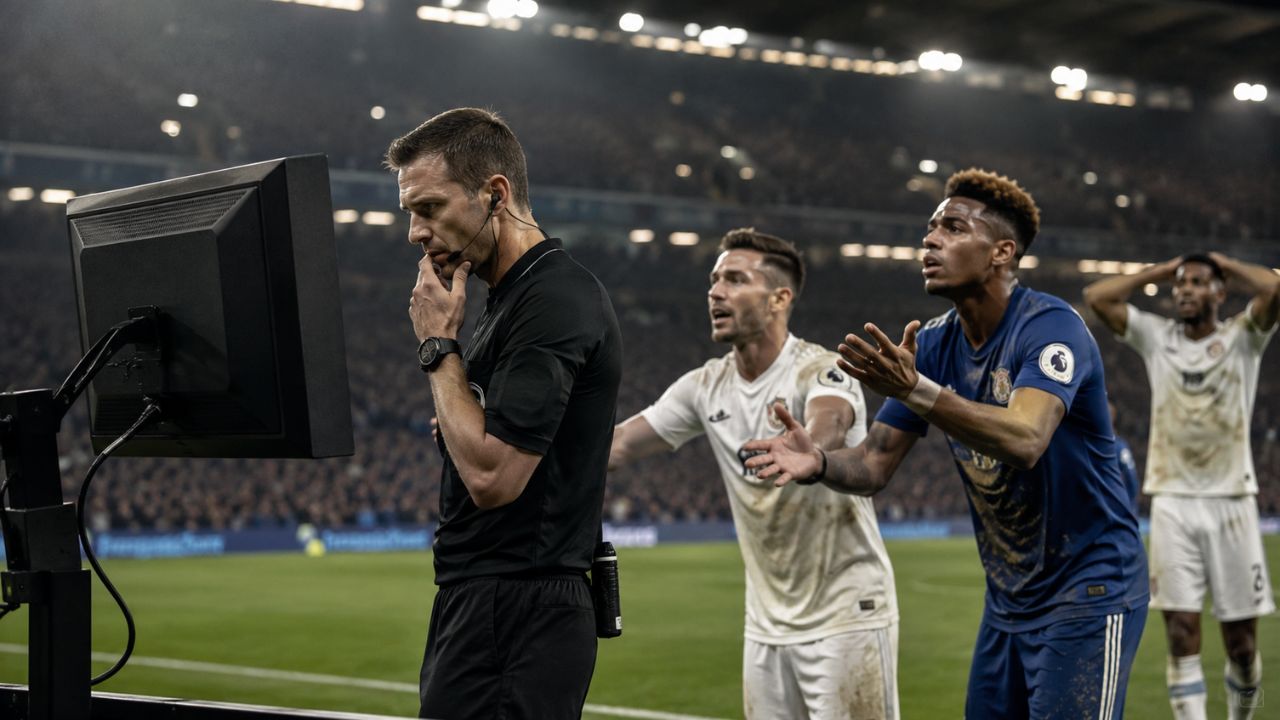
Something broke in my living room on the night of July 7, and it forced me to finally sit down and answer a question I’d been avoiding for years: is VAR ruining football? It was past 11 PM in Dhaka; Egypt was 1-0 up against Argentina, and Mostafa Zico had just scored a goal worthy of any World Cup highlight reel. Then came the pause. The referee jogged to the monitor, the room went quiet, and a minute later the goal was gone, wiped out for a foul most of us hadn’t even noticed. Egypt lost 3-2. By morning, the Egyptian FA had filed an official complaint.
I’ve watched football since the 90s, long before anyone imagined a video assistant referee. I’ve also spent my working life in technology, so I’m the last person to fear a camera and an algorithm. And yet, after a month of this World Cup, ten controversies’ worth of evidence, and too many ruined celebrations, I owed myself an honest answer, backed by data rather than 12 AM anger.
What VAR Promised When It Arrived
VAR (Video Assistant Referee) is a team of officials who review footage and can intervene in four situations: goals, penalty decisions, direct red cards, and mistaken identity. FIFA introduced it at the 2018 World Cup in Russia after years of trials, and the pitch was simple. Football had lived with too many famous injustices, and technology would catch the ones that mattered.
If you grew up watching football in the 90s and 2000s like I did, you understood the appeal instantly. We had all seen goals that never crossed the line given and goals that clearly did cross the line waved away. The referee’s word was final, television replays humiliated him within seconds, and nothing could be done. VAR promised to close that gap between what officials saw and what everyone at home could see.
The promise was never perfection. IFAB, the body that writes football’s laws, framed VAR’s job as correcting “clear and obvious errors” and “serious missed incidents.” Minimum interference, maximum benefit, as the protocol puts it. Eight years later, that phrase reads almost like satire. But it’s worth remembering the intent before judging the result.
The Benefits Nobody Wants to Admit
Here’s the part angry fans (me included, some nights) don’t like saying out loud: VAR works more often than it fails.
Goal-line disputes have essentially vanished from top-level football. Clear offside errors, the kind where a striker is a full meter ahead of the defense, are almost extinct. FIFA claimed that correct decision rates at the 2018 World Cup rose above 99 percent with VAR, up from roughly 95 percent without it. Even if you treat FIFA’s own numbers with suspicion, and I do, the direction is obviously right. Watch any pre-2018 season review and count the outright refereeing howlers. There were many more.
The engineer in me also wants to defend the machinery itself. Semi-automated offside tracking, the connected match ball, and goal-line sensors: this stack is genuinely impressive, accurate to margins no linesman’s eye could ever match. In the ten controversies below, you’ll notice a pattern. The technology almost never fails. The humans operating it, and the rules governing it, fail constantly.
That distinction is the whole article, really. Keep it in mind.
Ten VAR Controversies That Explain Everything Wrong
1. Argentina 3-2 Egypt, World Cup 2026: the night that started
Egypt led the defending champions 1-0 with 32 minutes left when everything unraveled. Zico’s 58th-minute goal was disallowed after VAR recommended a review for Marwan Attia’s foul on Lisandro Martínez in the buildup, a shirt tug and a step on the foot. Late on, Egypt’s penalty appeals for a challenge on Hamdy Fathy and Mohammad Salah were waved away, and Argentina completed the comeback in the 93rd minute.
What burned fans most was the inconsistency. As Ian Wright put it on ITV, if you pull play back for that foul, you have to pull it back for the one on Mohamed Salah before Argentina’s third. Alan Shearer said it plainly: either both are fouls, or neither is. The Egyptian FA’s formal complaint called out the fairness and consistency of decisions that directly shaped the result. I watched it live, and I still can’t tell you what the standard was that night.
2. Germany vs Paraguay, World Cup 2026: a “foul” that ended a superpower
Jonathan Tah headed Germany into the lead deep in extra time of their round-of-32 tie. Then referee Jalal Jayed went to the monitor and disallowed it, ruling that Waldemar Anton had pushed goalkeeper Orlando Gill before the corner came in. Paraguay won on penalties, and four-time champions Germany crashed out in one of the biggest World Cup upsets ever played.
[Video Credit goes to @PitchLine]
The twist: this fell under a brand-new IFAB clarification for 2026 that lets VAR punish fouls committed before the ball is even in play at set pieces. Julian Nagelsmann called the decision “a joke.” Pierluigi Collina, FIFA’s refereeing chief, insisted nobody could object to disallowing an unfair goal. Both men are describing the same three seconds of football. That’s the problem.
3. Iran vs Egypt, World Cup 2026: when a millimetre kills a dream
Shoja Khalilzadeh bundled home a 93rd-minute goal in Iran’s group finale, a goal that would have sent them to the knockout stage for the first time in their history. A long VAR review found him offside in the buildup by what replays suggested was barely a millimeter. Under the laws, the call is almost certainly correct, because offside has no tolerance band. But watching grown men collapse over a margin invisible to every human eye in the stadium, you have to ask what the sport actually gains. The measurement is right. The experience is wrong.
4. Vinícius Júnior vs Scotland, World Cup 2026: re-refereeing the buildup
Vinícius won the ball off Jack Hendry, finished coolly, and had the goal ruled out on review for a foul that most Brazilian observers described as minimal contact. Days later, a broadly similar challenge involving Alexis Mac Allister in Argentina vs Austria went unpunished and the resulting goal stood. Two near-identical situations, two opposite outcomes, within one tournament. Carlo Ancelotti’s fury on the touchline said what every fan was thinking.
5. Luis Díaz, Liverpool vs Tottenham, 2023: the day VAR admitted human error
The most instructive VAR failure ever, because we got to hear it. Díaz scored and was wrongly flagged offside, and VAR Darren England, believing the on-field decision was a goal, told referee Simon Hooper, “Check complete.” The lines had been drawn correctly. Díaz was onside. Within seconds the replay operator was pleading, “Delay the game,” but play had restarted and IFAB rules forbid going back.
[Video Credit goes to @stadiumastro]
The released audio captures England repeating “I can’t do anything” as the mistake becomes irreversible. PGMOL admitted “significant human error,” and the Premier League itself acknowledged systemic weaknesses in the process. Read that again: the technology got it right, and the protocol made the truth inadmissible.
6. Argentina vs Brazil, Copa América 2019: even Messi cried bias
If you think complaints about VAR favoring big teams come only from small nations, here’s the counterexample. After Argentina’s semi-final loss to hosts Brazil, in which two strong penalty appeals went unreviewed, Lionel Messi claimed the tournament was set up for Brazil. Days later he spoke openly of corruption at CONMEBOL and was handed a three-month international ban for it. The biggest player of his generation, at a continental tournament, felt exactly what Egypt’s fans felt last week. Whatever the truth, when both giants and underdogs believe the system bends, the system has a legitimacy crisis.
7. Manchester United vs PSG, 2019: the handball nobody understood
United needed a miracle at the Parc des Princes, and VAR delivered one. Deep in stoppage time, Diogo Dalot’s shot struck Presnel Kimpembe’s arm, the referee reviewed it on screen, and Marcus Rashford’s penalty sent United through. Neymar erupted on Instagram: four guys who know nothing about football watching a slow-motion replay, in his words, and UEFA banned him from European matches for the outburst. The incident defined the handball chaos era, when nobody, players included, could tell you what a handball actually was from one week to the next.
8. Tunisia 1-0 France, World Cup 2022: an equalizer erased after the final whistle threat
Antoine Griezmann volleyed home a 98th-minute equalizer, play restarted, and then the goal was disallowed for offside after a review that replays suggested was itself wrong since a Tunisian defender had played the ball. France lodged an official complaint, which FIFA rejected. A dead-rubber match in the standings, but a live demonstration that VAR reviews at the highest level can produce outcomes even the aggrieved federation’s lawyers can’t untangle.
9. Arsenal 1-1 Brentford, 2023: the official who forgot to draw the lines
[Video Credit goes to @thecentrumentertainment]
During Arsenal’s title race, Ivan Toney’s equalizer stood despite an offside in the buildup because VAR official Lee Mason simply never drew the offside lines. He left PGMOL within days. Along with the Díaz incident, this is the clearest proof of where VAR’s weakness lives. Cameras don’t forget. People do.
10. Portugal 2-0 Uruguay, World Cup 2022: the penalty against the guidance
In stoppage time, the ball brushed José María Giménez’s supporting arm as he slid, and after a VAR review Portugal got a penalty that sealed the game. FIFA’s own pre-tournament guidance had indicated supporting-arm contact shouldn’t be penalized. A big footballing nation benefited anyway. File it with the pattern we need to talk about next.
What Football Looked Like Without VAR
Before you conclude that VAR ruined football, be honest about what football was.
Maradona’s Hand of God in 1986 is the most celebrated foul in sporting history. A World Cup quarter-final decided by a handball the referee missed and a hundred cameras caught. VAR erases it in forty seconds.
Thierry Henry’s double handball against Ireland in the 2009 playoff sent France to a World Cup Ireland had earned a shootout for, at minimum. The injustice was so naked that FIFA later paid the Irish FA a settlement. One review fixes it.
Frank Lampard’s shot against Germany in 2010 crossed the line by half a meter. Everyone in the world saw it except the officials. That single moment forced FIFA into goal-line technology, the first crack in its resistance to cameras.
And South Korea’s 2002 semi-final run, with the disallowed goals of Italy and Spain, remains the tournament that fans across Asia and Europe still argue about a generation later. Most of those decisions don’t survive a VAR review.
This is my 90s-kid confession: the football of my childhood was romantic, and it was also routinely, outrageously unfair. We didn’t have fewer controversies before VAR. We had the same controversies with no possibility of correction. Anyone selling you the pre-VAR era as a golden age is selling nostalgia, and I say that as someone who owns plenty of it.
Does VAR Only Protect the Bigger Teams?
Now the uncomfortable question, the one I’ve been building toward since that July night.
This isn’t only a World Cup pattern, and it isn’t only my perception. In the 2025-26 Premier League season, the KMI panel’s own data showed that Arsenal and Chelsea benefited from the most officiating mistakes, with Arsenal winning the title while the panel judged they should have conceded three penalties and received three red cards that never came.
One analysis put the champions’ haul at four points gained directly from VAR errors, while newly promoted Leeds were the only club to get nothing at all in their favor. Correlation isn’t conspiracy, and big clubs also attack more, which skews raw counts. But when the errors keep landing on the same side of the table, season after season, tournament after tournament, telling fans it all evens out stops working.
Let me be precise about what I’m claiming, because this matters. I’m not alleging fixed matches. I’m observing that VAR intervenes on judgment calls; judgment is human, and humans feel pressure. A World Cup without Argentina, without Messi’s farewell, and without Brazil, France, Spain or England is a poorer television product, and this tournament’s sponsorship and broadcast money is the largest in FIFA’s history.
When referees know which outcome the world wants, “50/50 both ways” has a way of becoming “50/50 one way.” Even the perception is corrosive. As one beIN Sports piece put it during this tournament, fans don’t demand perfection; they just want to believe the players decide the match, not the whistle.
VAR was supposed to kill that suspicion. Instead, by intervening selectively, it has given the suspicion slow-motion replays.
Tennis Solved This Ten Years Ago, But Why Can’t Football?
Here’s where my day job makes me impatient. I work in technology, and I watch three sports seriously: football, cricket, and tennis. Only one of them has made peace with its machines.
Tennis introduced Hawk-Eye challenges back in 2006. The system is player-initiated, so the people with the most at stake control when it’s used. It’s transparent, with the animated ball-track shown instantly to the player, the crowd, and the broadcast. It’s fast, resolving in seconds. And it’s final, so nobody argues, because everyone saw the same evidence at the same moment. The tours trusted it so completely that electronic line calling has now replaced human line judges at almost every top event, including Wimbledon.
Cricket’s DRS sits in the middle. Teams get limited reviews, the ball-tracking and edge-detection graphics are broadcast to everyone, and the “umpire’s call” honestly admits the technology’s margin of error instead of pretending precision it doesn’t have. I have my complaints as a cricket watcher, but I always know what was reviewed and why.
Football took the opposite path on every count. Reviews are initiated by hidden officials, the deliberation happens in secret, the fan in the stadium learns almost nothing, and the standard for intervening shifts matches to match. Yes, football is fluid in a way tennis isn’t, and a challenge system is genuinely harder to design around continuous play. But the core failure isn’t technical. Football adopted the technology and refused the transparency. Tennis proves fans will embrace the machine when they can see what it sees.
Is VAR Ruining Football: My Verdict as a 90s Kid
So, is VAR ruining football? No. But the people running it are doing their best to.
The technology is the most defensible part of the whole system. Semi-automated offside doesn’t have moods. The connected ball doesn’t care about sponsorship money. Every genuinely indefensible moment in my list of ten, from “check complete” to undrawn lines to reviews that reach one team’s fouls and not the other’s, traces back to human judgment, opaque protocol, or FIFA and IFAB governance. We built a precision instrument and handed it to an institution that operates in the dark.
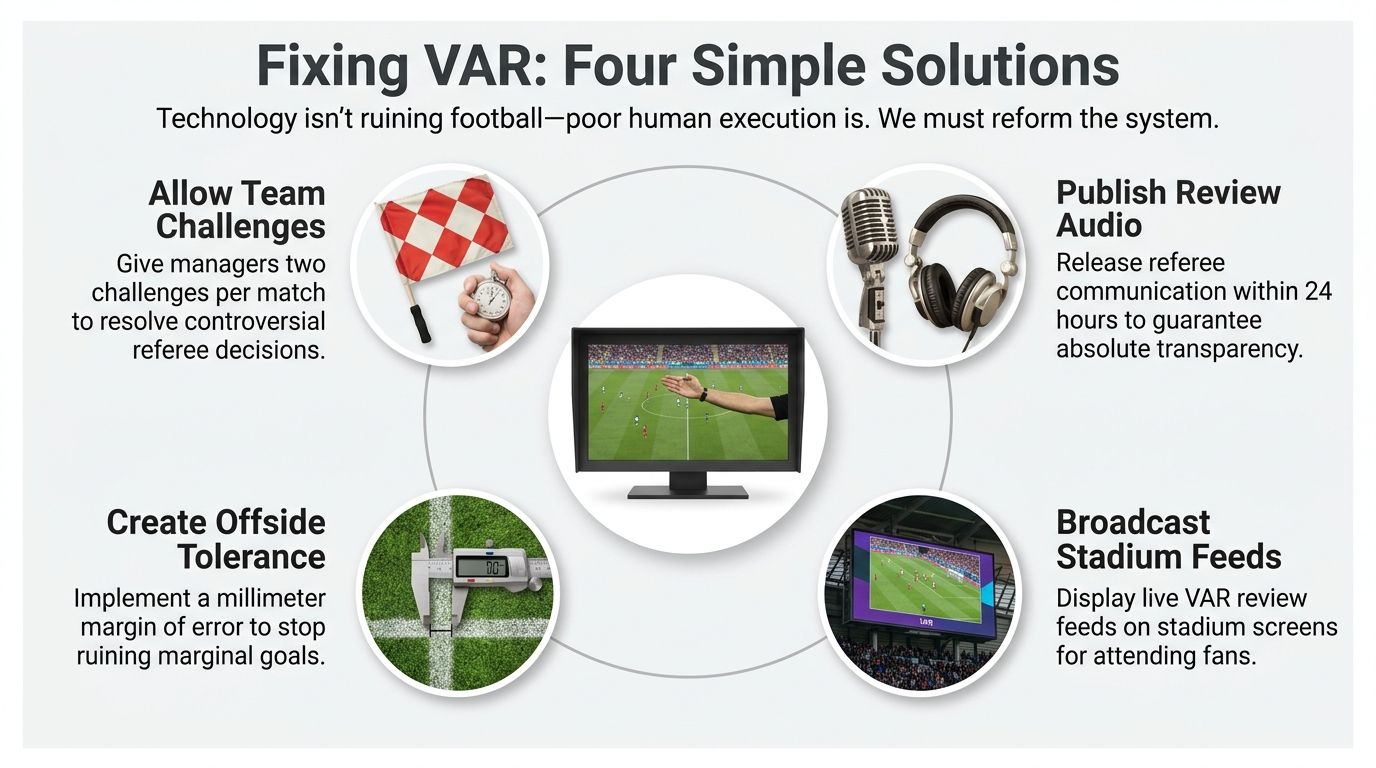
What I want by the 2030 World Cup is boringly achievable. Give each team two challenges per match and watch the “why did VAR intervene there?” debate mostly evaporate. The fans are already there before the lawmakers, with the FSA poll showing a challenge system is the only VAR reform with net public support. Publish the audio of every review within 24 hours, since the PGMOL already proved it’s possible after the Díaz fiasco. Put the review feed on the stadium screens the way cricket and tennis do. And write a tolerance band into offside so that a millimeter of a striker’s backside stops deciding nations’ fates.
Until then, I’ll keep doing what I did on July 7: staying up past 11:30 PM with my family, screaming at a goal, and then holding my breath through a review, hoping the humans in the booth are having a good night. That hope shouldn’t be part of the sport. If VAR has broken your heart too, tell me your incident in the comments. I have a feeling this list of ten is about to get longer.
FAQs on Is VAR Ruining Football
Why was Egypt’s goal disallowed against Argentina at the 2026 World Cup?
VAR recommended an on-field review for a foul by Egypt’s Marwan Attia on Lisandro Martínez in the buildup to Mostafa Zico’s 62nd-minute goal, judging that Attia held Martínez’s shirt while standing on his foot. The referee overturned the goal, Egypt lost 3-2, and the Egyptian FA filed an official complaint about the officiating.
What new VAR rules were introduced for the 2026 World Cup?
IFAB approved several expansions: VAR can now punish attacking fouls committed before the ball is in play at set pieces (the rule behind Germany’s disallowed goal against Paraguay), review incorrect second yellow cards, and correct mistaken identity. FIFA also empowered referees to show red cards for confrontational mouth-covering.
Why doesn’t football use a challenge system like tennis?
IFAB has so far resisted it, arguing football’s continuous play makes team-initiated reviews disruptive. Critics counter that cricket manages limited reviews in a flowing game and that a challenge system would fix VAR’s biggest flaw: fans never knowing why some incidents get reviewed and others don’t.
Has VAR actually improved refereeing accuracy?
Yes, by FIFA’s own figures, which claimed correct decision rates above 99 percent at the 2018 World Cup compared with roughly 95 percent without VAR. Goal-line errors and clear offside mistakes have nearly disappeared. The controversies now cluster around subjective judgment calls and inconsistent application, not factual accuracy.