Coming home from a trip always feels a little strange. One day, you are walking down unfamiliar streets, noticing colors, smells, food, weather, buildings, and little details you would normally ignore. A few days later, you are back to laundry, deadlines, bills, notifications, and the same old route to the same old places. That shift can feel harsh.
But over time, I have realized something important: the best part of travel is not always the destination. Sometimes it is the version of yourself that shows up while you are away.
You walk more. You look around more. You eat with more attention. You talk to people. You spend more time outside. You care less about small digital noise. You let curiosity lead the day instead of routine.
Then you come home and slowly drop all of it. That is the part worth questioning. Because some travel habits to keep are not vacation habits at all. They are better-life habits. They just become easier to notice when you are away from your normal routine. In this article, I’m going to share my personal points of view of travel habits to keep after returning home.
Why Travel Habits Matter After the Trip Ends
A good trip interrupts autopilot. At home, most of us move through the day with our heads full. We already know where we are going, what we need to do, and what can wait. We do not notice the street corner we pass every morning. We do not sit with our coffee. We do not look at the sky unless the weather is bad enough to annoy us.
Travel changes that. When you are somewhere new, your attention wakes up. Even ordinary things feel interesting because they are not part of your default pattern. A bakery window, a train station, a local market, a quiet lane, a park bench, a simple breakfast, a sunset from a rooftop, all of it feels more alive because you are actually paying attention.
That is why returning home should not only be about unpacking. It should also be about asking: What did this trip teach me about how I want to live when I am not traveling?
Not everything needs to come back with you. Nobody needs to live at home like they are permanently on holiday. But a few habits are worth keeping because they make regular life feel less rushed and more awake.
Walk Like You Are Still Exploring
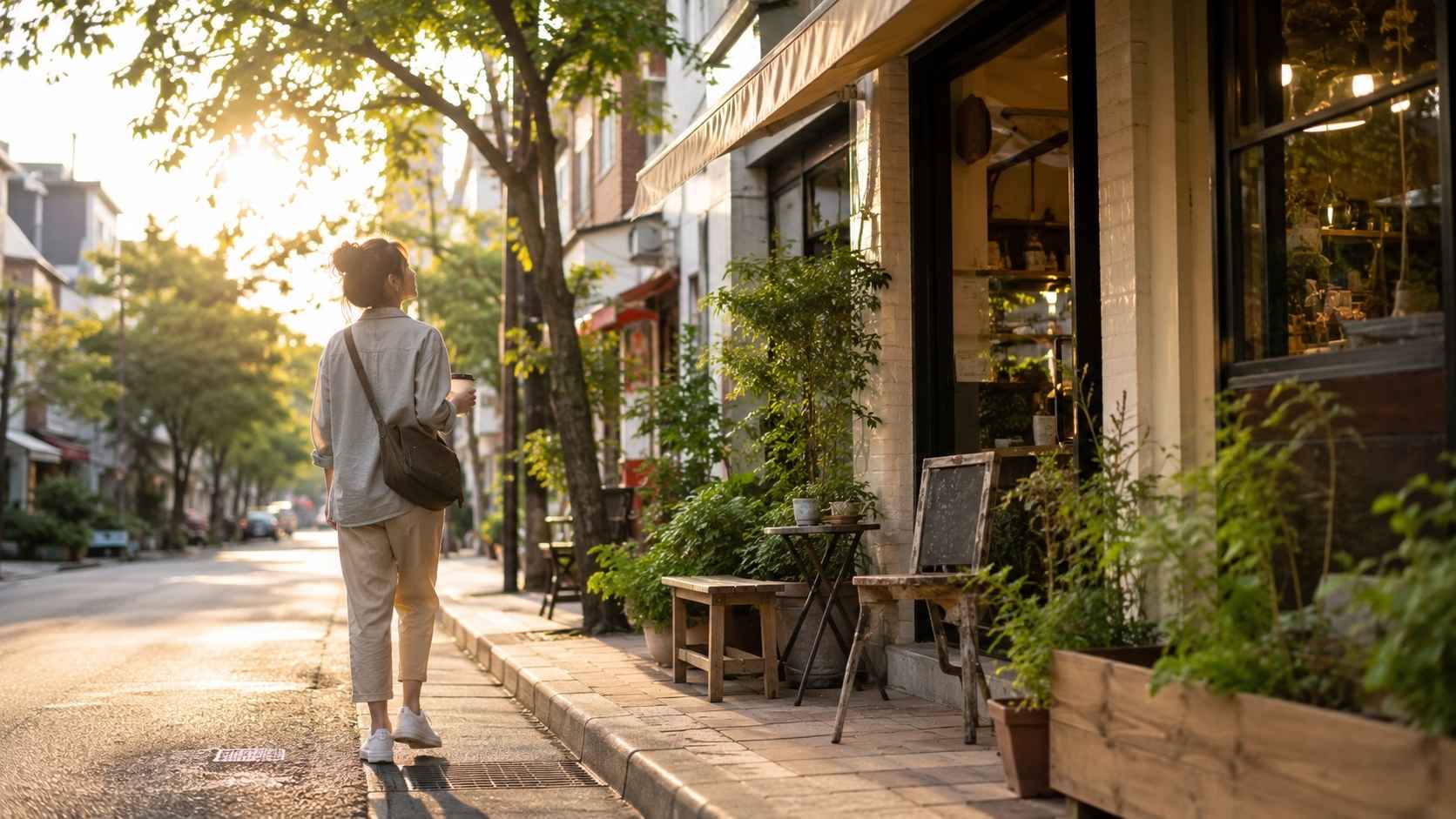
Walking is one of the first habits I notice when I travel. On a trip, walking rarely feels like a task. It becomes part of the experience. You walk to find breakfast. You walk through old streets. You walk around museums, parks, markets, waterfronts, temples, plazas, and neighborhoods you have never seen before.
At home, walking somehow becomes less romantic. It turns into exercise, inconvenience, or something you do only when parking is difficult.
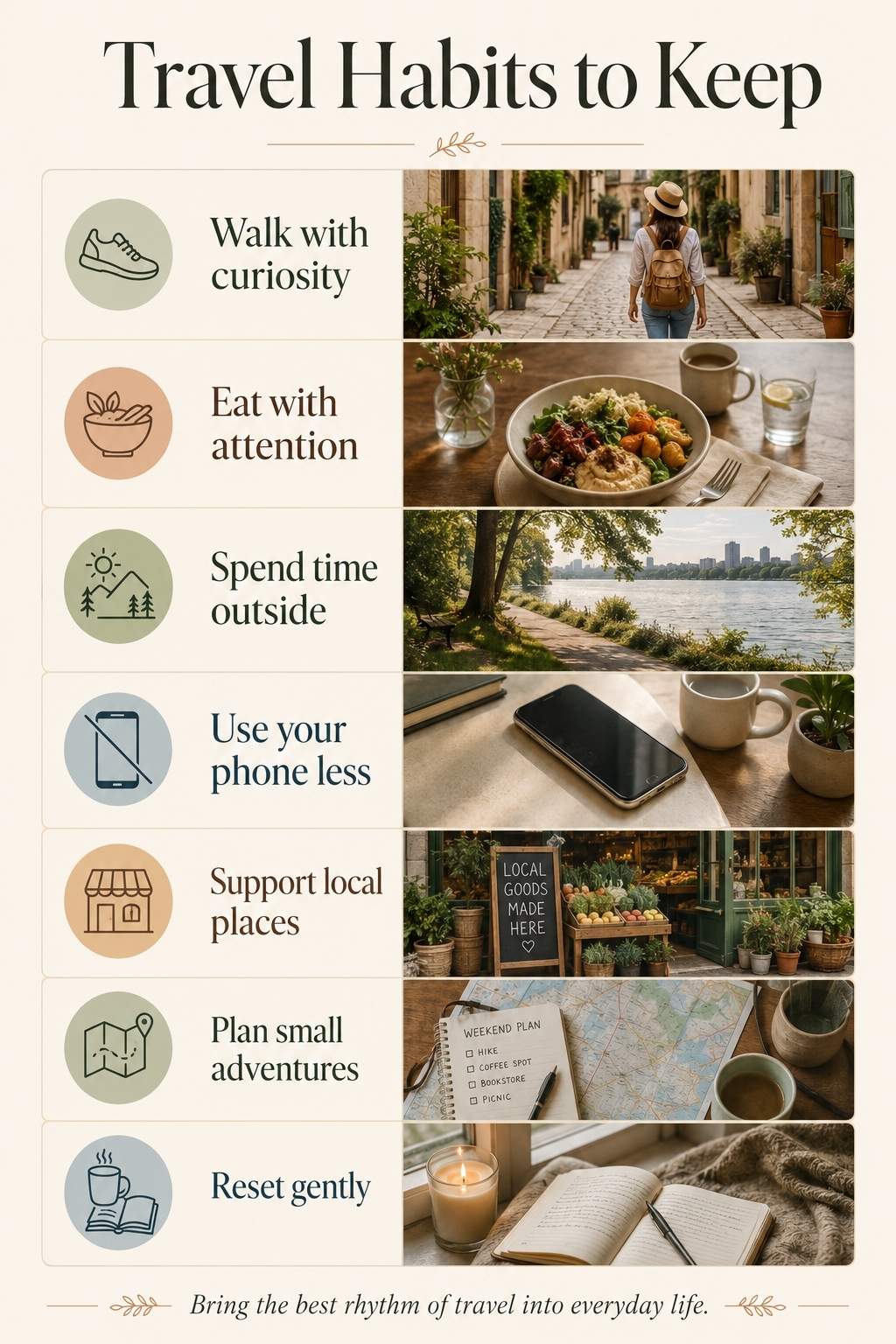
That is a shame. One of the easiest travel habits to keep is walking with curiosity. Take a different route to a familiar place. Walk after dinner. Explore a nearby neighborhood you usually drive through. Turn one weekly errand into a walk. Step outside without treating it like a fitness challenge.
The point is not to count every step. The point is to notice what you usually miss. When you walk like a traveler, even your own town starts offering small surprises again: a quiet side street, a new café, a tree in bloom, a mural you never noticed, a house with strange windows, a shop that has been there for years but somehow escaped your attention.
You do not need a new country for that. You need slower feet and open eyes.
Spend More Time Outside
Travel naturally pulls people outside. Even someone who spends most workdays indoors will happily sit near a beach, wander through a garden, eat at an outdoor table, walk through a park, or watch the evening light change over a city. Then they return home and go right back inside.
This is one of the travel habits I think most people should protect. Outdoor time has a way of changing the pace of the day. It gives your mind a little more space. It also reminds you that life is happening beyond screens, rooms, errands, and work.
You do not need a dramatic landscape. A morning walk counts. So does tea on a balcony, lunch outside, a short evening stroll, sitting in a local park, gardening, reading near a window, or choosing the longer route home because it has better trees.
The habit is simple: stop treating fresh air as something reserved for vacation. Home has weather too. Home has light too. Home has seasons too. Sometimes we just stop looking.
Keep the Traveler’s Curiosity at Home
Travel makes curiosity feel natural. You wonder what a dish is called. You look up the history of a building. You ask a local where to eat. You read signs. You notice how people commute, gather, shop, pray, celebrate, rest, and use public spaces.
At home, curiosity gets lazy. You pass the same restaurant for years and never go in. You ignore the small museum nearby. You do not know the story behind the old building on the corner. You keep saving your curiosity for somewhere “more interesting.”
But your own city, town, or neighborhood probably has more layers than you give it credit for.
A good habit is to become a local traveler once a month. Try one place you have ignored. Visit a nearby market. Walk through a neighborhood without rushing. Look up one local story. Attend a community event. Take a different road just to see where it goes.
This does not mean pretending every place is magical. It means refusing to let familiarity make you blind. Curiosity is not only for faraway places. It is a way of moving through life.

Eat Like the Meal Deserves Your Attention
Food is one of the strongest memories people bring back from travel. Sometimes it is a beautiful meal at a restaurant. Sometimes it is street food eaten while standing up. Sometimes it is fruit from a market, bread from a bakery, tea served slowly, coffee at a tiny table, or a dish you had never tried before.
The food matters, but attention matters too. When traveling, you usually notice meals more. You taste properly. You ask what something is. You remember where you ate it. You connect the food to the place.
At home, meals often become background noise. You eat while scrolling. You answer messages between bites. You rush breakfast. You eat lunch at your desk. You order something because you are too tired to think. For me one of the best travel habits to keep is eating with more attention.
That does not mean cooking elaborate meals every night. It can be much simpler. Recreate one dish from a trip. Buy seasonal produce. Eat one meal without your phone. Set the table even when dinner is simple. Try a new spice. Visit a local market. Make weekend breakfast feel slower.
Food is one of the easiest ways to bring travel home because it carries memory. A single flavor can remind you that meals are not just fuel. They are pauses. They are rituals. They are a way to feel present.
Support Local Businesses Like You Do When Traveling
When people travel, they often look for local places. They want the family-run restaurant, the neighborhood bakery, the independent bookstore, the craft market, the local guide, the tiny café that does not look like a chain. They want to feel connected to the place.
At home, convenience takes over again. We choose the quickest option, the biggest platform, the most familiar chain, the delivery app, the thing that requires the least thought.
There is nothing wrong with convenience sometimes. Real life is busy. But one travel habit worth keeping is paying attention to where your money goes.
Buy from the neighborhood bakery once in a while. Try the small restaurant instead of the default chain. Use a local repair shop. Visit the farmers market. Recommend a business you genuinely like. Treat your own community as a place worth supporting, not just a place where you happen to live.
Travel teaches us that local character matters. Coming home should remind us that our own local places need that same attention.
Use Your Phone Less During Real Moments
Phones are useful while traveling. They help with maps, bookings, translations, tickets, payments, photos, and staying safe. But the best travel moments often happen when the phone becomes secondary.
You take the photo, then lower the camera. You watch the sunset instead of recording the whole thing. You sit at dinner and talk. You walk without checking every notification. You let the moment be enough.
At home, the phone creeps back into every empty space. A short wait becomes scrolling. A meal becomes scrolling. A walk becomes headphones, messages, and half-attention. Even rest becomes another screen.
One habit I like keeping after a trip is a small phone boundary. Phone-free meals. A walk without headphones. The first few minutes of the morning without checking messages. Notifications turned off for things that do not need immediate attention. Taking fewer photos but actually remembering the moment.
The goal is not to become anti-phone. The goal is to stop letting the phone interrupt every real experience. Travel has a way of reminding us that not every beautiful thing needs proof. Sometimes attention is the proof.
Savor the Trip Instead of Letting It Disappear
A lot of people come home, post a few photos, and then let the trip vanish into the camera roll. That feels like a waste. If a trip mattered, give it a proper landing. Choose your favorite photos. Print one. Make a small album. Write down five moments you do not want to forget. Cook something you ate there. Save a playlist from the trip. Send photos to the people who traveled with you. Place one meaningful object somewhere you will actually see it.
This is not about living in the past. It is about understanding what the trip gave you.
Maybe you miss the quiet. Maybe you miss walking everywhere. Maybe you miss being outside. Maybe you miss eating slowly. Maybe you miss feeling less reachable. Maybe you miss who you were when the day had more space in it.
That information is useful. Because once you know what you miss, you can bring a small part of it into daily life.
Protect Your Sleep After You Return
People often return from travel and immediately punish themselves for leaving. They land late, wake up early, answer every message, overbook the first week, skip groceries, ignore laundry, and expect their body to catch up somehow.
That is not a return. That is a crash. One of the most practical travel habits to keep is respecting rest, especially during the first few days back.
Unpack early. Keep the first evening simple. Drink water. Get morning light if your schedule feels off. Avoid overcommitting immediately. Return to your normal bedtime as quickly as possible. Leave a buffer day between travel and work when you can.
That buffer day is not laziness. It is the difference between carrying the trip home gently and turning it into another source of exhaustion. A good trip should not end with you needing another trip to recover from it.
Keep a Small Adventure on the Calendar
Coming home feels flat when the next interesting thing is nowhere in sight. You go from new places and open days to a calendar full of errands, deadlines, and repeated routines. The answer is not always another big trip. It can be a small adventure.
A nearby town. A museum. A day hike. A new restaurant. A morning market. A picnic. A local festival. A sunrise walk. A cooking class. A weekend train ride. A different route through your own city.
Small adventures matter because they keep curiosity alive between bigger trips. They also take pressure off vacation. When one trip has to provide all your joy, rest, novelty, romance, and meaning, it becomes too heavy. Ordinary life needs smaller sparks too.
Before the post-trip energy disappears, put one local adventure on the calendar. Not a vague “someday.” A date.
Bring Home One Cultural Habit Respectfully
One of the best parts of travel is seeing that people live differently.
Maybe you notice long evening walks. Maybe you admire slower meals. Maybe you enjoy daily tea, local markets, family gatherings, afternoon rest, public festivals, quiet mornings, or the habit of greeting people more warmly.
It is natural to bring inspiration home. But it should be done respectfully. Do not turn another culture into a costume or a decorative personality trait. Learn what the habit means. Give credit when you talk about it. Avoid stripping traditions of context. Keep what genuinely improves your life without pretending it belongs to you in the same way.
A respectful version is usually simple. You make tea more slowly because a trip reminded you that rituals calm you. You learn the background of a dish before cooking it. You greet shopkeepers more warmly because you appreciated that elsewhere. You adopt a weekly family meal because you saw how food can hold people together.
The best cultural habits are not souvenirs. They are lessons you carry carefully.
Waste Less and Notice What You Use
Travel often makes waste more visible. You notice plastic bottles. You think about carrying a reusable bag. You become more aware of food waste when every meal feels intentional. You turn off lights in a hotel room. You respect public spaces because you know you are a guest.
That awareness belongs at home too. Use leftovers. Plan meals before shopping. Carry a reusable bottle. Repair something instead of replacing it immediately. Avoid buying things you do not need just because the purchase is easy. Leave parks, beaches, cafés, public transport, and shared spaces better than you found them.
This habit does not require perfection. It simply asks you to stay aware. A traveler often thinks, “What am I leaving behind in this place?” That is a good question at home too.
Stay Socially Open
Travel makes many people more open to small connections. You ask for directions. You talk to a host. You chat with a shopkeeper. You meet another traveler. You spend more focused time with the person you came with. Even introverts often have more small human exchanges while traveling than they do during a normal week at home.
Then routine returns, and everyone disappears into schedules. Another best travel habits to keep is simple social openness.
Say hello to neighbors. Invite someone for coffee. Eat with family without screens. Reconnect with a friend after you return. Join a local class. Attend a community event. Ask someone how they are and actually listen.
You do not need to become wildly extroverted. You just need to stop treating connection as something that only happens when life feels new.
Unpack Quickly and Reset Gently
This sounds basic, but it changes the whole return. An unpacked suitcase sitting in the corner keeps your brain half-away and half-behind. Laundry piles up. Receipts scatter. Toiletries stay in bags. Your home starts feeling like a waiting room.
Unpack within 24 hours if possible. I made this mistakes few times but when I started unpacking early, it gave me some clarity to do other things and more time to reset.
Wash what needs washing. Put things back. Store the suitcase. Sort souvenirs. Back up photos. Refill groceries. Prepare one simple meal. Give yourself a clean landing.
But do not confuse resetting with punishing yourself. You can unpack without answering every work message. You can do laundry without planning five social obligations. You can return to normal life without pretending the trip never happened.
A good reset says: “I am home, and I am going to make home feel livable again.” That is enough.
Before and After: Turning Travel Habits Into Home Habits
The easiest way to keep a travel habit is to shrink it until it fits real life.
| Travel Version | Home Version |
| Walking through a new city after breakfast | Taking a 15-minute morning walk before work |
| Eating slowly at a local restaurant | Having one phone-free dinner at home |
| Visiting a park, beach, or viewpoint | Spending two short breaks outside during the week |
| Asking locals for recommendations | Trying one new neighborhood spot each month |
| Taking photos of small details | Noticing one beautiful thing on an ordinary day |
| Buying from local vendors | Choosing a nearby small business before a default chain |
| Feeling less rushed | Leaving one unscheduled evening after returning home |
| Talking more with travel companions | Planning a no-screen meal with family or friends |
You do not need to recreate the destination. You only need to keep the behavior that made the destination feel meaningful.
A Quick Guide to Travel Habits Worth Keeping
| Travel Habit | How to Keep It at Home |
| Walking everywhere | Take one curiosity walk each week or turn one errand into a walk. |
| Eating with attention | Recreate one travel meal or eat one slower meal each day. |
| Spending time outside | Build short outdoor breaks into the week. |
| Supporting local places | Choose independent cafés, markets, shops, or restaurants more often. |
| Staying curious | Explore one unfamiliar place in your own city each month. |
| Using your phone less | Create phone-free meals, walks, or morning time. |
| Savoring memories | Print photos, journal moments, or cook something from the trip. |
| Resting properly | Protect sleep and avoid overbooking the first week back. |
| Reducing waste | Plan meals, use leftovers, carry reusables, and buy with intention. |
| Connecting with people | Keep the traveler’s openness through small conversations and invitations. |
Travel does not have to end as sharply as we think. The destination ends. The habits can continue.
What Coming Home Can Teach You
A good trip is not only a break from real life. It can be a preview of a better rhythm. Not a perfect life. Not a permanent vacation. Not a fantasy where nobody has bills, deadlines, school runs, chores, or stress. Just a better rhythm.
More walking. More noticing. Better sleep. Slower meals. Less phone noise. More outdoor time. More local curiosity. More respect for resources. More effort to connect.
The best travel habits to keep are not the ones that make home feel like a hotel. They are the ones that make home feel less automatic.
You do not need to escape your life to keep the best parts of travel. You can bring some of them back with you. Savour them and plan your next trip, that’s what I do and it feels refreshed.
Frequently Asked Questions About The Best Travel Habits to Keep After Returning Home
1. What are the best travel habits to keep after returning home?
The best travel habits to keep are the ones that make daily life feel more present and less rushed. Walking more, spending time outside, eating slower, using your phone less, supporting local places, protecting sleep, and staying curious about your own city are all worth keeping.
2. How do I avoid losing the vacation mindset after coming home?
Do not try to recreate the whole vacation. Instead, identify what made you feel better. Was it rest, movement, food, nature, connection, novelty, or less screen time? Then turn one or two of those into small weekly habits.
3. Why do I feel low after returning from a trip?
Coming home can feel flat because travel interrupts routine, while home often brings back the same responsibilities, pace, and digital noise. The feeling is common. A gentle reset, enough sleep, unpacking quickly, and planning one small local adventure can make the return easier.
4. How can I keep travel energy without spending more money?
Use curiosity instead of money. Walk through a different neighborhood, visit a free local event, cook a travel-inspired meal, go to a nearby park, take photos of ordinary details, or try a small local business you have never visited.
5. What should I do first after returning from a trip?
Unpack, wash what needs washing, put your suitcase away, refill basic groceries, back up your photos, and protect your sleep. A clean reset helps you return home without feeling overwhelmed.
6. Can travel habits really improve everyday life?
Yes, when they are realistic. You do not need to live like you are on vacation. But walking more, eating with attention, spending time outside, reducing phone noise, staying curious, and making room for connection can make everyday life feel more balanced.