

It’s an uncomfortable reality in digital media: a publication can pull in massive traffic and still have absolutely no clue who its readers are. Understanding Audience Persona Development for Publishers is crucial in today’s digital landscape.
Pageviews only tell you what someone clicked. Search queries show what they were hunting for, and social metrics just flag what sparked a reaction. Even your newsletter stats only reveal what prompted a return visit. None of this surface-level data actually explains who your reader is, what they need next, or why they trust you. It won’t tell you why one deeply reported feature earns lifelong loyalty while another triggers an instant bounce.
Utilizing Audience Persona Development for Publishers enables deeper insights into your readers’ preferences. That’s where Audience Persona Development for Publishers comes in.
By focusing on Audience Persona Development for Publishers, you can enhance reader engagement.
A persona shouldn’t be a decorative slide deck featuring a stock photo and a fake alliterative name. It needs to be a working editorial tool. When built correctly, audience persona development for publishers helps your team make sharper, faster decisions about topics, formats, headlines, newsletter strategy, internal linking, and content depth.
Effective Audience Persona Development for Publishers ensures content aligns with reader expectations.
A good reader persona doesn’t replace editorial judgment—it sharpens it.
With Audience Persona Development for Publishers, you can tailor your content strategy to meet reader needs.
What Audience Persona Development Means for Publishers
Grasping the importance of Audience Persona Development for Publishers can significantly improve your content quality.

Audience Persona Development translates raw research into clear, actionable profiles that actually guide your content decisions.
The concept of Audience Persona Development for Publishers is essential for effective editorial planning.
Think of a reader persona as a practical snapshot of a key audience segment. It maps out their goals, questions, habits, frustrations, and the exact reasons they either trust or ignore your publication. While software companies build personas around buyers, publishers must focus on readers first. That distinction changes everything about how you approach the work.
By analyzing data, Audience Persona Development for Publishers can reveal what your audience truly values.
Depending on your niche, your publication might serve:
- Casual search visitors looking for a quick answer.
- Loyal newsletter readers expecting weekly analysis.
- Professionals seeking tactical guidance.
- Founders researching high-stakes business decisions.
- Consumers comparing products before a purchase.
- Beginners who need plain-English explanations.
Understanding your audience through Audience Persona Development for Publishers drives meaningful engagement.
These groups simply do not behave the same way. A casual searcher wants a fast, clear answer without the fluff. A newsletter subscriber wants to see useful patterns, not just one-off tips. A founder wants practical decisions and risk assessments, while a beginner needs definitions before they can grasp your frameworks.
Utilizing Audience Persona Development for Publishers makes your content more targeted and effective. A well-crafted persona helps editors recognize these differences before assigning or approving a piece of content.
The role of Audience Persona Development for Publishers cannot be overstated in a competitive landscape.
Why Publishers Need Personas More Than They Think
Incorporating Audience Persona Development for Publishers into your strategy can elevate your content’s impact. Many publishers confidently claim they already know their audience. Sometimes they do. But more often than not, they only know the audience that is easiest to see.
Building your strategy on Audience Persona Development for Publishers is essential for sustained success.
Search traffic can easily overrepresent people with urgent, one-off questions. Social traffic highlights the loudest, most reactive voices. Newsletter replies skew toward your most loyal superfans, while sales teams might lean heavily on commercial assumptions. As a result, editors end up writing for the audience they want to serve, rather than the one actually using the site.
With Audience Persona Development for Publishers, you can identify and nurture your key audience segments.
Personas synthesize all these fragmented signals into one coherent picture, helping teams answer vital editorial questions:
Emphasizing Audience Persona Development for Publishers helps in crafting personalized content experiences.
- Who is this piece actually for?
- What does this reader already know?
- What would make this article useful enough to bookmark and share?
- Does this require a beginner’s explanation or an expert’s nuance?
- Should this be a guide, a checklist, an opinion piece, or a case study?
- Which channels will attract the right readers?
- What should the reader do immediately after reading?
The principles of Audience Persona Development for Publishers drive successful editorial strategies.
Without personas, teams often default to writing for a vague “general audience,” which inevitably leads to flat, uninspired content. A business founder reading up on content strategy doesn’t need the same article as a junior marketer learning the basic terms. If the persona is blurry, the article will be too.
Through Audience Persona Development for Publishers, you can effectively bridge the gap between content and audience.
A Reader Persona Is Not a Demographic Sketch
When done right, Audience Persona Development for Publishers enhances your overall content strategy.
The weakest personas start and end with basic demographics: “Marketing Manager Mary, 35, lives in London, reads blogs, and wants growth.”
For meaningful results, invest in Audience Persona Development for Publishers as a core component of your strategy.
That simply isn’t enough. While age, location, and job title might matter occasionally, behavior and intent are far more critical for editorial planning.
Ultimately, Audience Persona Development for Publishers is not just a task, but a vital part of your content journey.
A highly effective reader persona explains:
- The specific task the reader is trying to complete.
- The decision they are currently facing.
- What they already understand (and what they misunderstand).
- The type of evidence that earns their trust.
- The friction points that make them leave a page.
- The content formats they actually use.
- What you can help them do next.
As you incorporate Audience Persona Development for Publishers, your content will resonate more powerfully.
For publishers, the best personas read less like customer profiles and more like editorial briefs.
Adopting Audience Persona Development for Publishers is essential in today’s competitive media environment.
Weak persona:
Collectively, Audience Persona Development for Publishers shapes the future of your content strategy.
“Rafiq, 32, digital marketer, interested in SEO.”
By embracing Audience Persona Development for Publishers, you position your publication for success.
Useful reader persona:
In conclusion, Audience Persona Development for Publishers should be at the forefront of your editorial strategy.
“An in-house marketer responsible for organic growth who needs practical SEO workflows, not beginner definitions. They are usually comparing software options, building internal plans, or trying to justify decisions to leadership. They trust clear examples, process breakdowns, source-backed claims, and honest warnings about trade-offs.”
That second version actually gives a writer something to work with. It instantly dictates the required depth, tone, evidence, and internal linking strategy.
What Makes Publisher Personas Different From Brand Personas?
Publisher personas have to reflect content behavior. While a brand asks, “Who might buy this product?”, a publisher must ask, “Who needs this information, how do they find it, and why would they come back?”
Publishers need to study reading patterns just as closely as intent:
- Do they scan articles or read deeply?
- Are they arriving via search, social media, newsletters, or direct traffic?
- Do they prefer lists, deep-dive explainers, data stories, or templates?
- Do they return for the topic, the specific author, or the utility of the site?
- Do they trust expert voices, lived experiences, hard data, or editorial judgment?
If a persona doesn’t actively shape editorial decisions, it’s just a useless document taking up space on a drive.
Where Audience Research Should Start
You don’t necessarily need a massive, expensive research project to get started. Audience research should begin with the evidence your team already has scattered across your tech stack.
Valuable sources include:
- Google Search Console and Analytics data
- Newsletter open rates and click patterns
- On-site search queries
- Article comments and community discussions
- Customer support tickets and reader emails
- Paywall conversion paths
- Editorial and sales team observations
- Direct interviews with real readers
The danger lies in treating any single source as the absolute truth. Search Console shows what people typed before arriving, but it won’t tell you why they stayed. Social engagement shows emotion, but it often exaggerates controversy.
Great audience research cross-references these signals. If search queries, newsletter clicks, and reader emails all point to the same knowledge gap, that topic deserves your attention.
The Research Questions That Actually Help Editors
Persona projects can easily become too abstract. To keep things grounded, tie your research directly to editorial decisions.
Ask questions like:
- What specific “jobs” are readers trying to complete with our content?
- Which topics attract one-time visitors, and which build a loyal, returning audience?
- Where do readers consistently get confused?
- What do beginners need that experts find obvious (and vice versa)?
- Which audiences are we currently attracting but failing to serve well?
That last point is crucial. A site might draw massive traffic with broad SEO topics but completely fail to engage the high-value professionals it actually wants to monetize. Personas help expose those critical gaps.
How to Build a Reader Persona From Real Signals
Start by looking for patterns, not by inventing catchy names. Don’t start with “Founder Faisal”; start by grouping repeated reader needs.
For example, a site covering content strategy might notice that some readers want basic definitions, some need process templates, and others are looking for ways to explain strategy to their CEO. Those aren’t personas yet—they are behavior clusters.
Next, give those clusters context by determining the reader’s knowledge stage, preferred formats, trust signals, and frustrations. Then, compile it into a usable profile.
What to Include in a Practical Persona
|
Persona Field |
What to Capture |
Why It Matters |
|
Reader Type |
Who this audience represents |
Keeps the persona grounded in reality. |
|
Main Goal |
What they are trying to accomplish |
Dictates the purpose of the article. |
|
Knowledge Level |
Beginner, intermediate, advanced |
Shapes content depth and vocabulary. |
|
Common Questions |
What they repeatedly need answered |
Drives topic planning and clusters. |
|
Trust Signals |
What makes content credible to them |
Guides sourcing, data, and examples. |
|
Frustrations |
What makes them bounce or lose trust |
Prevents weak or annoying content choices. |
|
Preferred Formats |
Guides, checklists, explainers, templates |
Supports editorial and visual planning. |
|
Best Channels |
Search, newsletter, social, direct |
Helps tailor distribution strategies. |
|
Next Step |
What they should do or read next |
Supports internal linking and conversions. |
Keep these profiles brief. A persona that takes six pages to read will never be used in a fast-paced editorial meeting.
Example Reader Personas for a Publisher
Here is how a publisher might translate audience patterns into usable profiles.
1. The Practical Planner
This reader manages content or marketing work and desperately needs operational clarity. They don’t want motivational fluff.
- What they want: Step-by-step guides, workflow breakdowns, templates, and clear examples from similar industries.
- What they hate: Vague advice like “know your audience.” They need to know the how, not just the why.
2. The Founder Who Needs a Decision
This reader doesn’t have time to become an expert; they just need enough clarity to make a hire, approve a budget, or finalize a strategy.
- What they want: Plain language, business impacts, clear trade-offs, and bottom-line recommendations.
- What they hate: 5,000-word academic deep dives. They scan for judgment and immediate value.
3. The Specialist Looking for Depth
This reader already knows the basics and will leave immediately if an article spends three paragraphs defining common terms.
- What they want: Sharper thinking, edge cases, advanced frameworks, original analysis, and heavily sourced details.
4. The Beginner With a Real Task
This reader is new to the topic but highly motivated. They are trying to solve a specific problem today, like building their first content calendar.
- What they want: Simple explanations, logical sequencing, and definitions placed naturally in context. They don’t need jargon, but they do need structure.
Note: Three to six strong personas are infinitely more valuable than a dozen thin ones.
How Personas Shape Editorial Planning
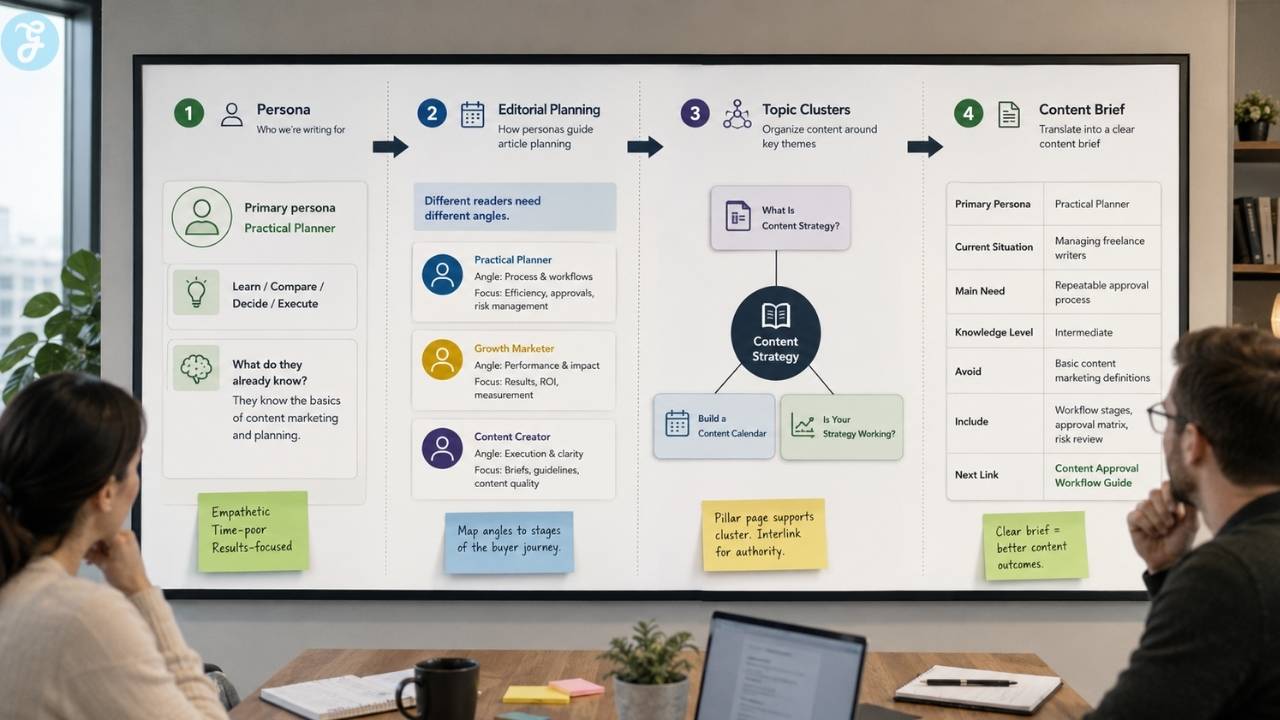
Personas should dictate your editorial calendar long before a writer is ever assigned a piece. For every planned article, ask:
- Which persona is this primarily serving?
- Is this reader trying to learn, compare, decide, or execute?
- What do they already know, and what can we skip explaining?
This eliminates generic assignments. Instead of telling a writer, “Write an article about audience research,” an editor can say:
“Write this for a content lead at a growing publisher who has traffic data but no clear reader profiles. Focus on turning existing audience signals into practical personas for planning.”
That is a vastly superior brief. It hands the writer a specific reader, a concrete problem, and a clear shape for the piece.
Personas and Topic Clusters
Topic clusters organize your subject matter, but personas clarify who those clusters serve.
If your core pillar is “Content Strategy,” the cluster pages should target different needs. A beginner gets “What Is a Content Strategy?”, while a manager gets “How to Build a Content Calendar,” and a founder gets “How to Know if Your Content Strategy is Actually Working.” Without personas, topic clusters are just robotic keyword maps. With them, they become natural reader journeys.
The Details That Actually Belong in a Brief
You don’t need to paste the entire persona profile into every content brief—just the elements that shape the article.
|
Brief Item The journey of Audience Persona Development for Publishers is ongoing and requires continuous refinement. |
Example for the Writer |
|
Primary Persona |
The Practical Planner |
|
Current Situation |
Managing content output across multiple freelance writers. |
|
Main Need |
Wants to build a repeatable, bottleneck-free approval process. |
|
Knowledge Level |
Intermediate |
|
Avoid Explaining |
The basic definition of content marketing. |
|
Must Include |
Workflow stages, approval matrices, and risk-based reviews. |
|
Next Link / CTA |
Link to the “Content Approval Workflow Guide.” |
What Bad Personas Look Like
Bad personas are easy to create because they look polished but offer zero editorial value. They usually feature fake names, stock photos, generic frustrations, and demographic details that have no bearing on content creation.
“Sarah is a 29-year-old professional who loves learning online. She is busy, uses social media, and wants trusted information.”
That describes almost anyone and helps absolutely no one. It won’t help you choose a headline, format, or distribution channel.
Common Mistakes in Audience Persona Development
- Inventing them in a meeting: Guessing who your audience is based on internal assumptions creates false confidence. Base them on real data.
- Relying solely on analytics: Analytics tell you what happened, not why. A page might rank well but serve the wrong audience.
- Making too many: A small team cannot write for twelve different personas. Start with the core groups that drive your business goals.
- Confusing topic interest with a persona: “People interested in AI” is a category, not a persona. A developer evaluating APIs needs drastically different content than a teacher using AI for lesson plans.
- Freezing them forever: Search behavior and platforms change. Review and update your personas periodically.
How to Validate a Persona
Treat your persona as a working hypothesis until it proves its worth. You’ll know it’s working when:
- Editors actually reference it in planning meetings.
- Writers find briefs easier to execute.
- Articles align more closely with search intent.
- Newsletter signups and on-site engagement improve.
- The team finds it easier to say “no” to off-brand topics.
If nothing changes after you roll out a persona, it’s probably too vague.
Integrating Personas into Content Governance
Personas shouldn’t just live in brief templates; they should be woven into your entire content governance system. They make it incredibly easy to decide which old pages to update, which to merge, and which topics fall completely outside your strategy.
They also streamline approval workflows. If reviewers clash over an edit, the editor can simply ask: Does this change actually help our target persona complete their task? This neutralizes internal politics and keeps the focus strictly on the reader.
A Simple 7-Step Development Process
- Define the Publishing Goal: Are you trying to improve newsletter retention, rank higher in search, or drive paid subscriptions? The goal dictates the research.
- Collect Existing Evidence: Gather search data, top-performing pages, newsletter metrics, and reader comments. Study your weak content, too—it often reveals audience mismatches.
- Talk to Real Readers: Send a survey or conduct short interviews. Ask what they were trying to solve when they found you, and what they felt was missing.
- Group by Needs: Look for behavioral patterns. Group readers by what they need from your content, not just their job titles.
- Create Short Profiles: Build practical, one-page profiles focusing on goals, frustrations, knowledge levels, and editorial guidance.
- Apply to Real Content: Test the personas against upcoming articles. If they don’t change the way you approach the brief, refine them.
- Review and Update: Revisit your personas every 6 to 12 months, or whenever there is a major shift in site strategy or audience behavior.
Final Thoughts
Audience Persona Development shifts a publisher’s mindset from “we need to publish more content” to “we know exactly who this is for and why it needs to exist.” This shift transforms editorial planning. It sharpens topic clusters, clarifies content briefs, and keeps editing focused on the reader. Most importantly, it helps publishers distinguish between empty, fleeting traffic and the highly engaged readers who actually matter to the bottom line.
Build your personas from reality, keep them concise, and embed them directly into your daily workflow. A strong strategy starts with knowing what you want to say, but a successful one relies on knowing exactly who needs to hear it.
Ultimately, the goal of Audience Persona Development for Publishers is to create impactful connections with your readers.
Frequently Asked Questions (FAQs) Audience Persona Development for Publishers
What is the difference between a reader persona and a buyer persona?
A buyer persona focuses on purchasing intent—who is going to buy a product, what their budget is, and how they make purchasing decisions. A reader persona focuses entirely on content consumption. It outlines what information someone needs, how they prefer to digest it (e.g., quick lists vs. deep dives), what earns their editorial trust, and what prompts them to return to a publication.
How many reader personas does a publisher actually need?
More isn’t always better. Most publishers only need three to six core personas to cover their primary audience segments. Smaller editorial teams might only need two or three. Creating too many personas leads to generic content and confuses the writers. You only need to add a new persona if that specific audience requires a drastically different editorial approach.
Can we build audience personas using just Google Analytics?
Analytics are a great starting point, but they shouldn’t be your only source of truth. Data dashboards tell you what happened (e.g., this article got 10,000 pageviews and a high bounce rate), but they rarely tell you why. To build accurate personas, you need to combine that quantitative data with qualitative insights—like reader surveys, newsletter replies, social media comments, and on-site search queries.
How often should a publisher update their reader personas?
Treat your personas as living documents, not static files. As a general rule, review them every 6 to 12 months. However, you should also update them whenever there is a major shift in your site’s editorial strategy, a significant change in search and platform traffic patterns, or if you are launching a new content pillar.
Should every single article target a specific persona?
Yes, most articles should have one primary persona in mind before the writer types a single word. Trying to satisfy every type of reader with one piece of content usually results in a bloated, unfocused article. While a piece might naturally serve a secondary persona through internal links or sidebars, the core narrative should be written for one specific audience.